




Kelsey Beavers, PhD
@kelseybeavers.bsky.social
Computational Biologist @TACCutexas🤘🏻Interested in developing resources to streamline coral ‘omics research and discovery🧬🖥️ Let’s collaborate! kbeavers@tacc.utexas.edu
Our findings suggest even visibly healthy tissue is responding to SCTLD by increasing symbiont (or pathogen) uptake via Rab5a.
If SCTLD involves a symbiont-borne pathogen, this would worsen infection rather than fight it!
Understanding this may be key to detecting and stopping SCTLD earlier.
If SCTLD involves a symbiont-borne pathogen, this would worsen infection rather than fight it!
Understanding this may be key to detecting and stopping SCTLD earlier.
July 24, 2025 at 4:02 PM
Our findings suggest even visibly healthy tissue is responding to SCTLD by increasing symbiont (or pathogen) uptake via Rab5a.
If SCTLD involves a symbiont-borne pathogen, this would worsen infection rather than fight it!
Understanding this may be key to detecting and stopping SCTLD earlier.
If SCTLD involves a symbiont-borne pathogen, this would worsen infection rather than fight it!
Understanding this may be key to detecting and stopping SCTLD earlier.
Many intracellular pathogens, including some bacteria and parasites, can hijack Rab5a to evade immune defenses and survive inside host cells.
So in HD tissue, Rab5a may reflect:
— symbiont uptake and retention
— early pathogen manipulation
— early host–symbiont dysregulation
So in HD tissue, Rab5a may reflect:
— symbiont uptake and retention
— early pathogen manipulation
— early host–symbiont dysregulation

July 24, 2025 at 4:02 PM
Many intracellular pathogens, including some bacteria and parasites, can hijack Rab5a to evade immune defenses and survive inside host cells.
So in HD tissue, Rab5a may reflect:
— symbiont uptake and retention
— early pathogen manipulation
— early host–symbiont dysregulation
So in HD tissue, Rab5a may reflect:
— symbiont uptake and retention
— early pathogen manipulation
— early host–symbiont dysregulation
In cnidarians, Rab proteins play a key role in symbiosis by mediating symbiosome stabilization within host cells.
In Aiptasia, Rab5a localizes to symbiosomes only when they contain viable, newly acquired symbionts (Fig from Chen et al. 2004: doi.org/10.1016/j.bb...)
But there's a twist...
In Aiptasia, Rab5a localizes to symbiosomes only when they contain viable, newly acquired symbionts (Fig from Chen et al. 2004: doi.org/10.1016/j.bb...)
But there's a twist...

July 24, 2025 at 4:02 PM
In cnidarians, Rab proteins play a key role in symbiosis by mediating symbiosome stabilization within host cells.
In Aiptasia, Rab5a localizes to symbiosomes only when they contain viable, newly acquired symbionts (Fig from Chen et al. 2004: doi.org/10.1016/j.bb...)
But there's a twist...
In Aiptasia, Rab5a localizes to symbiosomes only when they contain viable, newly acquired symbionts (Fig from Chen et al. 2004: doi.org/10.1016/j.bb...)
But there's a twist...
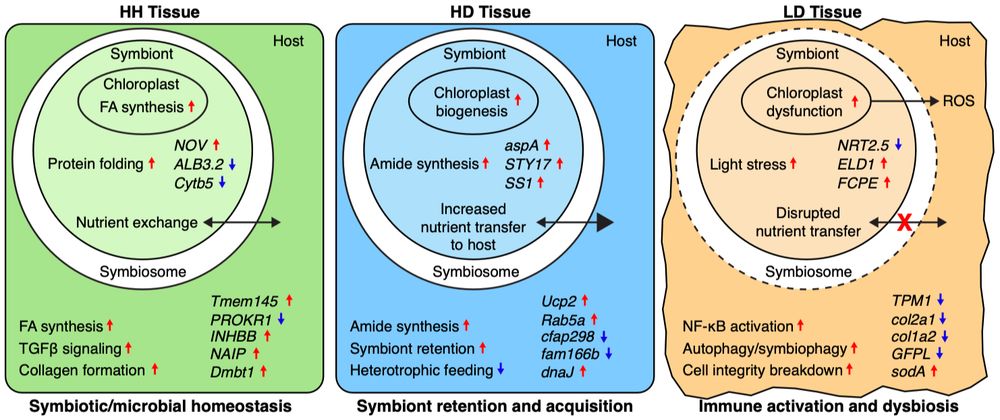
What was REALLY fascinating was what we found in HD tissue: it’s not just “in-between” HH and LD—it’s a biologically distinct state.
One gene stood out: Rab5a, which plays a key role in symbiont uptake and intracellular trafficking in cnidarians.
One gene stood out: Rab5a, which plays a key role in symbiont uptake and intracellular trafficking in cnidarians.

July 24, 2025 at 4:02 PM
What was REALLY fascinating was what we found in HD tissue: it’s not just “in-between” HH and LD—it’s a biologically distinct state.
One gene stood out: Rab5a, which plays a key role in symbiont uptake and intracellular trafficking in cnidarians.
One gene stood out: Rab5a, which plays a key role in symbiont uptake and intracellular trafficking in cnidarians.
In lesion tissue (LD), we found signatures of NF-κB immune activation, autophagy, oxidative stress and cytoskeletal/ECM breakdown in the coral host, alongside chloroplast dysfunction in the symbionts.
Together, these signal a complete collapse of holobiont homeostasis.
Together, these signal a complete collapse of holobiont homeostasis.


July 24, 2025 at 4:02 PM
In lesion tissue (LD), we found signatures of NF-κB immune activation, autophagy, oxidative stress and cytoskeletal/ECM breakdown in the coral host, alongside chloroplast dysfunction in the symbionts.
Together, these signal a complete collapse of holobiont homeostasis.
Together, these signal a complete collapse of holobiont homeostasis.
In healthy tissue, we found strong signatures of TGFβ signaling in the top-ranked genes (Tmem145, INHBB). This pathway is known to suppress inflammation and support symbiosis in cnidarians. We also observed high expression of Dmbt1, a gene associated with mucosal homeostasis and microbial balance.


July 24, 2025 at 4:02 PM
In healthy tissue, we found strong signatures of TGFβ signaling in the top-ranked genes (Tmem145, INHBB). This pathway is known to suppress inflammation and support symbiosis in cnidarians. We also observed high expression of Dmbt1, a gene associated with mucosal homeostasis and microbial balance.
This study was SO cool because for the first time we were able to describe how SCTLD progresses at the gene expression level as a coral goes from healthy to diseased.
Some of what we found made perfect sense, but some other findings totally surprised us! ‼️
Some of what we found made perfect sense, but some other findings totally surprised us! ‼️
July 24, 2025 at 4:02 PM
This study was SO cool because for the first time we were able to describe how SCTLD progresses at the gene expression level as a coral goes from healthy to diseased.
Some of what we found made perfect sense, but some other findings totally surprised us! ‼️
Some of what we found made perfect sense, but some other findings totally surprised us! ‼️
Instead of just asking which genes are differentially expressed, we asked:
👉 Which genes best distinguish coral health states?
This ML approach ranks genes by their predictive power, and we applied it to both the coral (M. cavernosa) and its main algal symbiont (C. goreaui)
👉 Which genes best distinguish coral health states?
This ML approach ranks genes by their predictive power, and we applied it to both the coral (M. cavernosa) and its main algal symbiont (C. goreaui)

July 24, 2025 at 4:02 PM
Instead of just asking which genes are differentially expressed, we asked:
👉 Which genes best distinguish coral health states?
This ML approach ranks genes by their predictive power, and we applied it to both the coral (M. cavernosa) and its main algal symbiont (C. goreaui)
👉 Which genes best distinguish coral health states?
This ML approach ranks genes by their predictive power, and we applied it to both the coral (M. cavernosa) and its main algal symbiont (C. goreaui)
We used an algorithm that combines supervised ML with differential expression stats to identify gene expression signatures characteristic of three tissue states in SCTLD:
— HH = healthy tissue on a healthy colony
— HD = “healthy” tissue on a diseased colony
— LD = active lesion tissue
— HH = healthy tissue on a healthy colony
— HD = “healthy” tissue on a diseased colony
— LD = active lesion tissue


July 24, 2025 at 4:02 PM
We used an algorithm that combines supervised ML with differential expression stats to identify gene expression signatures characteristic of three tissue states in SCTLD:
— HH = healthy tissue on a healthy colony
— HD = “healthy” tissue on a diseased colony
— LD = active lesion tissue
— HH = healthy tissue on a healthy colony
— HD = “healthy” tissue on a diseased colony
— LD = active lesion tissue
I'll start 🙂 I do #coral #transcriptomics, and a huge time constraint has been conducting literature searches for each and every gene on my (many) gene lists! While I recognize the value of lit reviews, this process feels very inefficient in terms of time-to-discovery
November 26, 2024 at 4:33 PM
I'll start 🙂 I do #coral #transcriptomics, and a huge time constraint has been conducting literature searches for each and every gene on my (many) gene lists! While I recognize the value of lit reviews, this process feels very inefficient in terms of time-to-discovery