


@jvelezjuarbe.bsky.social
Associate Curator at NHMLA. Vertebrate paleontologist with an interest in marine mammals and Caribbean vertebrates. Boricua🇵🇷 The Caribbean & Eastern Pacific are my playground! Views are my own.
These differences may be due to variations in seafloor productivity, and/or physiological differences between #desmostylians, #sirenians and #sloths.
To learn more make sure to check out our paper and its many figures: peerj.com/articles/198...
6/6
#FossilFriday
To learn more make sure to check out our paper and its many figures: peerj.com/articles/198...
6/6
#FossilFriday
Aquatic sloths (Thalassocnus) from the Miocene of Chile and the evolution of marine mammal herbivory in the Pacific Ocean
The evolution of marine mammals in South America includes unique and extinct lineages found nowhere else in the world, such as the walrus-convergent whale Odobenocetops and multiple aquatic sloth spec...
peerj.com
October 3, 2025 at 1:40 PM
These differences may be due to variations in seafloor productivity, and/or physiological differences between #desmostylians, #sirenians and #sloths.
To learn more make sure to check out our paper and its many figures: peerj.com/articles/198...
6/6
#FossilFriday
To learn more make sure to check out our paper and its many figures: peerj.com/articles/198...
6/6
#FossilFriday
Besides describing this amazing material we also compared ancient marine mammal herbivore communities across the Pacific Ocean. One of the things we noticed is that the South Pacific communities were chronostratigraphically younger, but also with smaller body sizes & less diverse.
5/6
#FossilFriday
5/6
#FossilFriday

October 3, 2025 at 1:40 PM
Besides describing this amazing material we also compared ancient marine mammal herbivore communities across the Pacific Ocean. One of the things we noticed is that the South Pacific communities were chronostratigraphically younger, but also with smaller body sizes & less diverse.
5/6
#FossilFriday
5/6
#FossilFriday
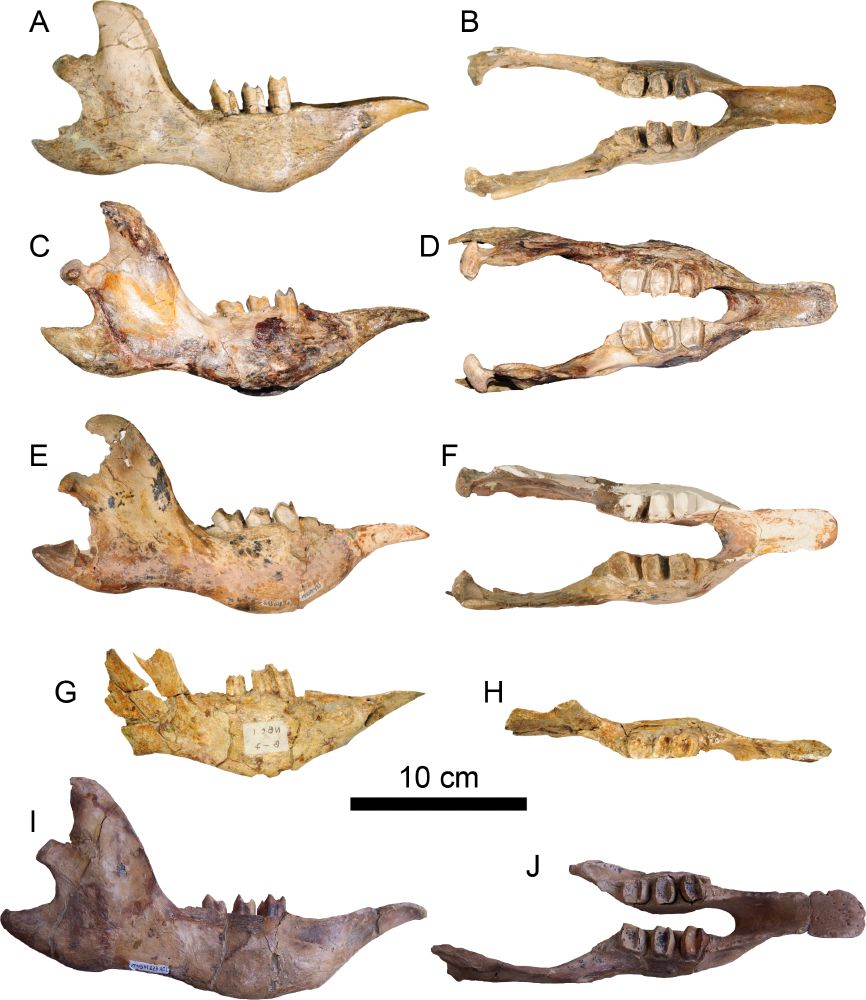
After a thorough morphological assessment we concluded that the morphology of the NBC specimens is closest to #Thalassocnus natans, otherwise known from the late #Miocene of #Peru. But we did noticed some differences that may hint at greater variation, or a different species!
4/6
#FossilFriday
4/6
#FossilFriday

October 3, 2025 at 1:40 PM
After a thorough morphological assessment we concluded that the morphology of the NBC specimens is closest to #Thalassocnus natans, otherwise known from the late #Miocene of #Peru. But we did noticed some differences that may hint at greater variation, or a different species!
4/6
#FossilFriday
4/6
#FossilFriday
The specimens we describe come from the Late #Miocene Bahia Inglesa Formation in the Atacama Region. The fossils, all from the Norte Bahía Caldera (NBC) locality, include associated cranial & postcranial elements of one individual, plus additional material representing others.
3/6
#FossilFriday
3/6
#FossilFriday


October 3, 2025 at 1:40 PM
The specimens we describe come from the Late #Miocene Bahia Inglesa Formation in the Atacama Region. The fossils, all from the Norte Bahía Caldera (NBC) locality, include associated cranial & postcranial elements of one individual, plus additional material representing others.
3/6
#FossilFriday
3/6
#FossilFriday
While fossils of #Thalassocnus are best known from the Pisco Formation in Peru, they've been previously found in Chile too. This includes a site we previously worked on, #CerroBallena! And although mainly known from marine deposits, there is at least one continental record!
2/6
#FossilFriday
2/6
#FossilFriday

October 3, 2025 at 1:40 PM
While fossils of #Thalassocnus are best known from the Pisco Formation in Peru, they've been previously found in Chile too. This includes a site we previously worked on, #CerroBallena! And although mainly known from marine deposits, there is at least one continental record!
2/6
#FossilFriday
2/6
#FossilFriday