




Juan P. Arroyave
@juanpah.bsky.social
🇨🇴/🇬🇧 PhD candidate Nottingham Trent Uni |
Interested in Moral Psychology, Threat and Uncertainty and Self control.
Interested in Moral Psychology, Threat and Uncertainty and Self control.
www.sciencedirect.com/science/arti... This insightful paper provides a sound evolutionary explanation of the threat management in humans.
Threat detection is pivotal for reproductive fitness. Here, the authors emphasize two independent, yet related systems: self-protection and disease avoidance.
Threat detection is pivotal for reproductive fitness. Here, the authors emphasize two independent, yet related systems: self-protection and disease avoidance.

Human threat management systems: Self-protection and disease avoidance
Humans likely evolved precautionary systems designed to minimize the threats to reproductive fitness posed by highly interdependent ultrasociality. A …
www.sciencedirect.com
December 2, 2025 at 4:52 PM
www.sciencedirect.com/science/arti... This insightful paper provides a sound evolutionary explanation of the threat management in humans.
Threat detection is pivotal for reproductive fitness. Here, the authors emphasize two independent, yet related systems: self-protection and disease avoidance.
Threat detection is pivotal for reproductive fitness. Here, the authors emphasize two independent, yet related systems: self-protection and disease avoidance.
Reposted by Juan P. Arroyave

🚨Two postdoc positions @tse-fr.eu @iast.fr 🚨
We are recruiting two postdocs as part of the ANR-funded project ENFORCE.
Join me, @giuliandr.bsky.social, & @zhgarfield.com, to study punitive systems across societies.
Full time, 2 years, no teaching.
Deadline: Jan 23
www.tse-fr.eu/groups/depar...
We are recruiting two postdocs as part of the ANR-funded project ENFORCE.
Join me, @giuliandr.bsky.social, & @zhgarfield.com, to study punitive systems across societies.
Full time, 2 years, no teaching.
Deadline: Jan 23
www.tse-fr.eu/groups/depar...

Department of Social and Behavioral Sciences
www.tse-fr.eu
December 1, 2025 at 12:37 PM
🚨Two postdoc positions @tse-fr.eu @iast.fr 🚨
We are recruiting two postdocs as part of the ANR-funded project ENFORCE.
Join me, @giuliandr.bsky.social, & @zhgarfield.com, to study punitive systems across societies.
Full time, 2 years, no teaching.
Deadline: Jan 23
www.tse-fr.eu/groups/depar...
We are recruiting two postdocs as part of the ANR-funded project ENFORCE.
Join me, @giuliandr.bsky.social, & @zhgarfield.com, to study punitive systems across societies.
Full time, 2 years, no teaching.
Deadline: Jan 23
www.tse-fr.eu/groups/depar...
Reposted by Juan P. Arroyave

This week's Cooperation Colloquium:
Alex Mesoudi @alexmesoudi.com
Experimental evidence that reputation-based partner choice facilitates information sharing in humans
Date: December 5
Time: 15:00 UTC+1 (Vienna) / 9 am ET (NYC)
Sign up: list.ku.dk/postorius/li...
Alex Mesoudi @alexmesoudi.com
Experimental evidence that reputation-based partner choice facilitates information sharing in humans
Date: December 5
Time: 15:00 UTC+1 (Vienna) / 9 am ET (NYC)
Sign up: list.ku.dk/postorius/li...

December 1, 2025 at 2:22 PM
This week's Cooperation Colloquium:
Alex Mesoudi @alexmesoudi.com
Experimental evidence that reputation-based partner choice facilitates information sharing in humans
Date: December 5
Time: 15:00 UTC+1 (Vienna) / 9 am ET (NYC)
Sign up: list.ku.dk/postorius/li...
Alex Mesoudi @alexmesoudi.com
Experimental evidence that reputation-based partner choice facilitates information sharing in humans
Date: December 5
Time: 15:00 UTC+1 (Vienna) / 9 am ET (NYC)
Sign up: list.ku.dk/postorius/li...
Do we judge a bad action the same way regardless of where or when it occurred? An interesting 2016 study conducted across 7 diverse societies pointed out moral parochialism...
rsj.scienceconnect.io/api/oauth/au...
rsj.scienceconnect.io/api/oauth/au...

Journals | Royal Society
Discover new research from across the sciences.
rsj.scienceconnect.io
October 30, 2025 at 11:22 AM
Do we judge a bad action the same way regardless of where or when it occurred? An interesting 2016 study conducted across 7 diverse societies pointed out moral parochialism...
rsj.scienceconnect.io/api/oauth/au...
rsj.scienceconnect.io/api/oauth/au...
Reposted by Juan P. Arroyave

Our new research finds that people are willing to cheat if it benefits their group — even when they gain nothing themselves.
"the risk of dishonesty in organizations is not limited to selfish acts...employees might bend rules to benefit their team or in-group members."
www.nhh.no/en/nhh-bulle...
"the risk of dishonesty in organizations is not limited to selfish acts...employees might bend rules to benefit their team or in-group members."
www.nhh.no/en/nhh-bulle...
We lie for those who are like us
Three experiments with more than 5,000 participants show that people are willing to cheat if it benefits their group — even when they gain nothing themselves.
www.nhh.no
September 1, 2025 at 5:32 PM
Our new research finds that people are willing to cheat if it benefits their group — even when they gain nothing themselves.
"the risk of dishonesty in organizations is not limited to selfish acts...employees might bend rules to benefit their team or in-group members."
www.nhh.no/en/nhh-bulle...
"the risk of dishonesty in organizations is not limited to selfish acts...employees might bend rules to benefit their team or in-group members."
www.nhh.no/en/nhh-bulle...
Could a deadly virus help explain the significant global trend toward conservative and right-wing leadership?
The parasite stress model may offer insight into this dynamic…
The parasite stress model may offer insight into this dynamic…
May 4, 2025 at 6:00 PM
Could a deadly virus help explain the significant global trend toward conservative and right-wing leadership?
The parasite stress model may offer insight into this dynamic…
The parasite stress model may offer insight into this dynamic…
Reposted by Juan P. Arroyave

Juan Pablo Arroyave's research focuses on how we make decisions regarding a transgression when we face a threat. His presentation is titled "Threat and mind-blind judgements".

April 24, 2025 at 12:37 PM
Juan Pablo Arroyave's research focuses on how we make decisions regarding a transgression when we face a threat. His presentation is titled "Threat and mind-blind judgements".
Reposted by Juan P. Arroyave

How it started / how it's going.....

March 18, 2025 at 2:44 AM
How it started / how it's going.....
Reposted by Juan P. Arroyave

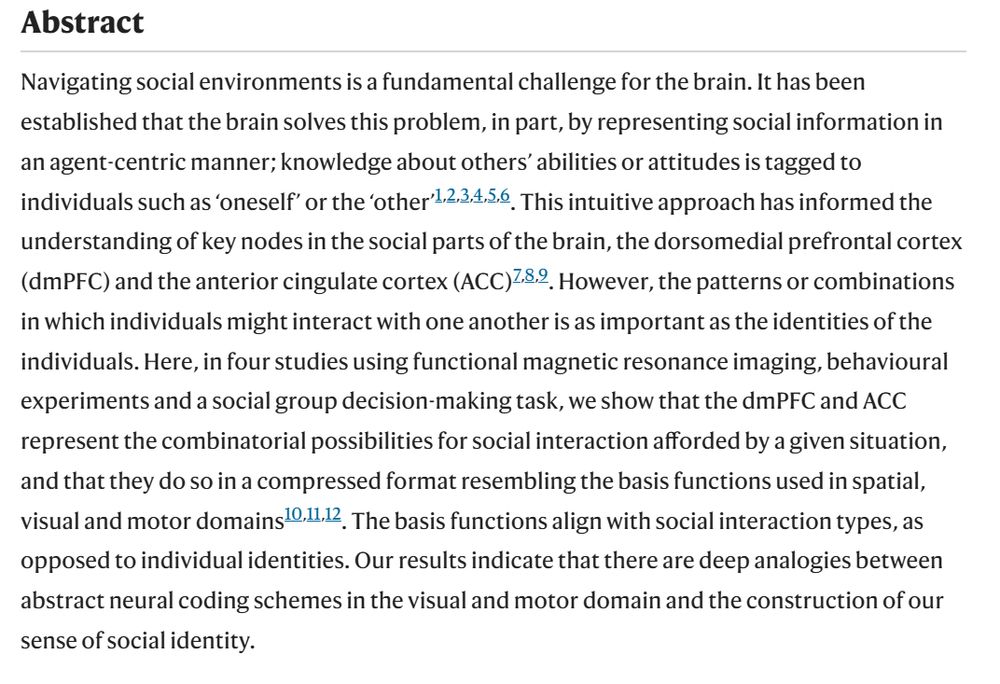
Our paper in Nature (@mkwittmann.bsky.social et al.): the brain does not only process the *identity* of a person but primarily our *relationship* to them. Even on a neural level, who someone is *in relation to others* is key. www.nature.com/articles/s41...
#PsychSciSky #socialpsyc #neuroskyence
#PsychSciSky #socialpsyc #neuroskyence
March 12, 2025 at 5:37 PM
Our paper in Nature (@mkwittmann.bsky.social et al.): the brain does not only process the *identity* of a person but primarily our *relationship* to them. Even on a neural level, who someone is *in relation to others* is key. www.nature.com/articles/s41...
#PsychSciSky #socialpsyc #neuroskyence
#PsychSciSky #socialpsyc #neuroskyence
Reposted by Juan P. Arroyave

Tuesday Evo Ath seminar "Understanding in-group bias, reducing publication bias: Investigating human parochialism through Registered Reports". Adam Kenny, London Interdisciplinary School @UCLanthropology DFL 3.30-5pm then🍷
www.ucl.ac.uk/anthropology...
www.ucl.ac.uk/anthropology...

Evolutionary Anthropology seminars
www.ucl.ac.uk
February 24, 2025 at 12:58 PM
Tuesday Evo Ath seminar "Understanding in-group bias, reducing publication bias: Investigating human parochialism through Registered Reports". Adam Kenny, London Interdisciplinary School @UCLanthropology DFL 3.30-5pm then🍷
www.ucl.ac.uk/anthropology...
www.ucl.ac.uk/anthropology...
Reposted by Juan P. Arroyave

Call for papers! Pablo Abitbol, Santiago Amaya and I will be co-editing a Special Issue on "Memory, Emotion and Forgiveness" in the Review of Philosophy and Psychology. If you are a philosopher and/or psychologist working at the intersection of memory, emotion and forgiveness [1/2]
November 19, 2024 at 8:52 PM
Call for papers! Pablo Abitbol, Santiago Amaya and I will be co-editing a Special Issue on "Memory, Emotion and Forgiveness" in the Review of Philosophy and Psychology. If you are a philosopher and/or psychologist working at the intersection of memory, emotion and forgiveness [1/2]
About the case of Trump calling immigrants as a “threat”: This a common strategy among some leaders as a tool to foster unity by creating a shared sense of danger. This often involves portraying outgroups as existential threats to the ingroup's welfare… journals.sagepub.com/doi/10.1177/...

Global Crisis Frame Matters for Unity: Resource Threat Hampers While Safety Threat Promotes Intergroup Cooperation - Xiaoyan Miao, Li Liu, Jianning Dang, Chao Li, Zhen Liu, Xinying Jiang, Lingling Hua...
Realistic global crises trap humanity in common threats requiring intergroup unity to combat them. How do common threats shape intergroup cooperation? Previous ...
journals.sagepub.com
February 14, 2025 at 10:44 AM
About the case of Trump calling immigrants as a “threat”: This a common strategy among some leaders as a tool to foster unity by creating a shared sense of danger. This often involves portraying outgroups as existential threats to the ingroup's welfare… journals.sagepub.com/doi/10.1177/...
Reposted by Juan P. Arroyave

Roy Baumeister called ego depletion "one of the most replicable findings in social psychology." As someone who spent 20 years studying it—and ultimately had to admit it wasn't real—I have to respectfully disagree. Here's my perspective of what went so wrong.

The Collapse of Ego Depletion
Science's Biggest Self-Control Failure
open.substack.com
January 29, 2025 at 2:49 PM
Roy Baumeister called ego depletion "one of the most replicable findings in social psychology." As someone who spent 20 years studying it—and ultimately had to admit it wasn't real—I have to respectfully disagree. Here's my perspective of what went so wrong.
One of the main problems about cultural relativism. People often put at the same level opinions and scientific evidence/rational conclusions. This is why a lot of university students strongly supports empty beliefs as astrology and homeopathy.
Postmodern views are linked to authoritarianism. www.stevestewartwilliams.com/p/manterrupt...

January 26, 2025 at 12:57 PM
One of the main problems about cultural relativism. People often put at the same level opinions and scientific evidence/rational conclusions. This is why a lot of university students strongly supports empty beliefs as astrology and homeopathy.
Reposted by Juan P. Arroyave

The V-Shaped Perception Gap: The stronger people’s political commitments, the less accurate their understanding of what the other side thinks. The politically disengaged have the most accurate picture of their fellow citizens’ views. www.stevestewartwilliams.com/p/manterrupt...

January 25, 2025 at 11:30 PM
The V-Shaped Perception Gap: The stronger people’s political commitments, the less accurate their understanding of what the other side thinks. The politically disengaged have the most accurate picture of their fellow citizens’ views. www.stevestewartwilliams.com/p/manterrupt...
"The human mind is in the service of evolutionary success, not truth. To think otherwise is to resurrect the pre-Darwinian error that humans are different from all other animals.”
-John Gray, 2002 Straw Dogs: Thoughts on Humans and Other Animals (p. 26).
-John Gray, 2002 Straw Dogs: Thoughts on Humans and Other Animals (p. 26).
January 24, 2025 at 5:38 PM
"The human mind is in the service of evolutionary success, not truth. To think otherwise is to resurrect the pre-Darwinian error that humans are different from all other animals.”
-John Gray, 2002 Straw Dogs: Thoughts on Humans and Other Animals (p. 26).
-John Gray, 2002 Straw Dogs: Thoughts on Humans and Other Animals (p. 26).
Reposted by Juan P. Arroyave

🎉Postdoc Alert! I am recruiting a postdoc to start Summer 2025 in the Mind & Morality Lab at Brown. If you're interested, please send a CV, cover letter, and names of at least two references to julia_marshall1@brown.edu by 2/28. If you have questions, don't hesitate to reach out!

January 24, 2025 at 2:08 PM
🎉Postdoc Alert! I am recruiting a postdoc to start Summer 2025 in the Mind & Morality Lab at Brown. If you're interested, please send a CV, cover letter, and names of at least two references to julia_marshall1@brown.edu by 2/28. If you have questions, don't hesitate to reach out!
Reposted by Juan P. Arroyave
Stated mate preferences vs. revealed mate preferences www.stevestewartwilliams.com/p/implicit-b...

January 24, 2025 at 9:00 AM
Stated mate preferences vs. revealed mate preferences www.stevestewartwilliams.com/p/implicit-b...
“Instead of questioning someone’s gullibility, it’s often more useful to ask what goal they’re pursuing by expressing such beliefs”.
January 16, 2025 at 7:23 PM
“Instead of questioning someone’s gullibility, it’s often more useful to ask what goal they’re pursuing by expressing such beliefs”.
Reposted by Juan P. Arroyave
Our latest research in the NYT!
"[Inzlicht's] other worry was that the corporations in control of chatbots had an “unprecedented power to influence people en masse.”
www.nytimes.com/2025/01/15/t...
"[Inzlicht's] other worry was that the corporations in control of chatbots had an “unprecedented power to influence people en masse.”
www.nytimes.com/2025/01/15/t...

She Is in Love With ChatGPT (Gift Article)
A 28-year-old woman with a busy social life spends hours on end talking to her A.I. boyfriend for advice and consolation. And yes, they do have sex.
www.nytimes.com
January 15, 2025 at 3:33 PM
Our latest research in the NYT!
"[Inzlicht's] other worry was that the corporations in control of chatbots had an “unprecedented power to influence people en masse.”
www.nytimes.com/2025/01/15/t...
"[Inzlicht's] other worry was that the corporations in control of chatbots had an “unprecedented power to influence people en masse.”
www.nytimes.com/2025/01/15/t...
Reposted by Juan P. Arroyave

Our new paper, on the evolution of institutions, is out in PNAS!
How can institutions promote cooperation when they themselves rely on cooperation? Check out JB's awesome thread!
Very proud of this paper with @jliep.bsky.social, N. Baumard, @jbaptistandre.bsky.social!
www.pnas.org/doi/abs/10.1...
How can institutions promote cooperation when they themselves rely on cooperation? Check out JB's awesome thread!
Very proud of this paper with @jliep.bsky.social, N. Baumard, @jbaptistandre.bsky.social!
www.pnas.org/doi/abs/10.1...

Do we cooperate because of institutions, or do institutions exist because we cooperate?
In this @pnas.org paper led by @jliep.bsky.social, with @lfitouchi.bsky.social & N. Baumard, we develop a mathematical model that answers this question.
👇
www.pnas.org/doi/10.1073/...
In this @pnas.org paper led by @jliep.bsky.social, with @lfitouchi.bsky.social & N. Baumard, we develop a mathematical model that answers this question.
👇
www.pnas.org/doi/10.1073/...

December 16, 2024 at 2:37 PM
Our new paper, on the evolution of institutions, is out in PNAS!
How can institutions promote cooperation when they themselves rely on cooperation? Check out JB's awesome thread!
Very proud of this paper with @jliep.bsky.social, N. Baumard, @jbaptistandre.bsky.social!
www.pnas.org/doi/abs/10.1...
How can institutions promote cooperation when they themselves rely on cooperation? Check out JB's awesome thread!
Very proud of this paper with @jliep.bsky.social, N. Baumard, @jbaptistandre.bsky.social!
www.pnas.org/doi/abs/10.1...
Such an interesting passage (Pizarro and Bloom, 2003) on how people intuitively understand their own moral judgment are affected by affective states. Something to be considered in further moral judgment experiments about punishment decisions.

January 15, 2025 at 12:06 PM
Such an interesting passage (Pizarro and Bloom, 2003) on how people intuitively understand their own moral judgment are affected by affective states. Something to be considered in further moral judgment experiments about punishment decisions.
Reposted by Juan P. Arroyave

7 January 1792: #OTD Mary Wollstonecraft's Vindication of the Rights of Women was published.
This text was hugely influential and is regarded as one of the earliest works of feminist philosophy.
This text was hugely influential and is regarded as one of the earliest works of feminist philosophy.

January 7, 2025 at 10:05 AM
7 January 1792: #OTD Mary Wollstonecraft's Vindication of the Rights of Women was published.
This text was hugely influential and is regarded as one of the earliest works of feminist philosophy.
This text was hugely influential and is regarded as one of the earliest works of feminist philosophy.