


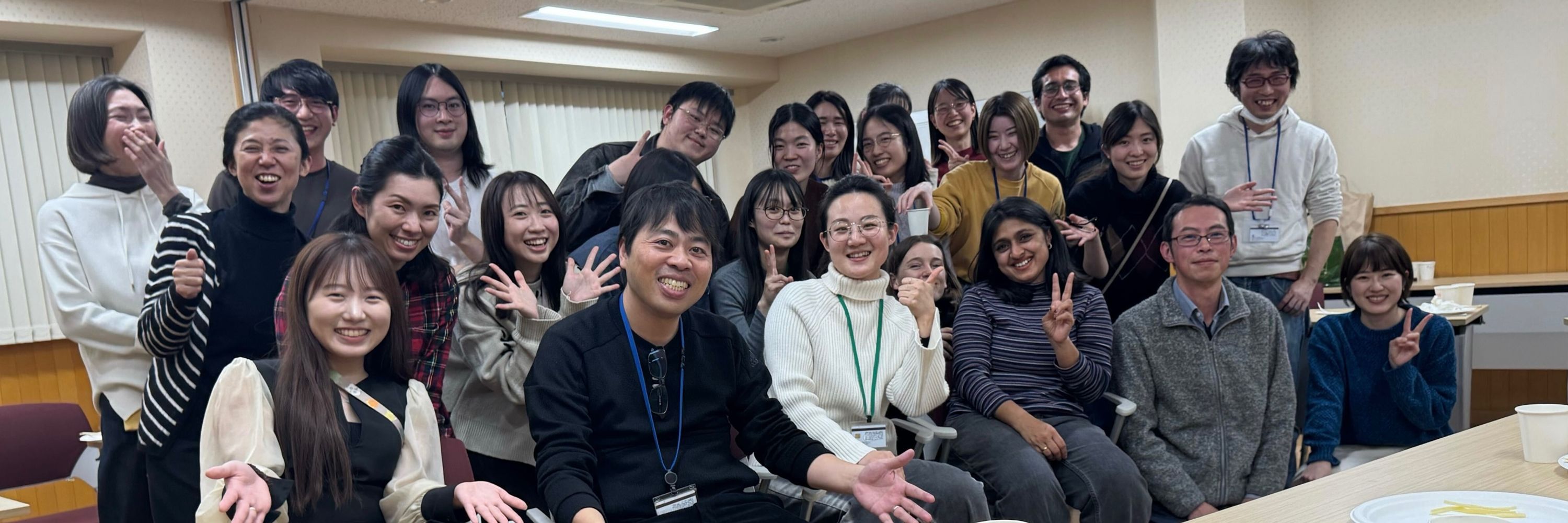
Suzuki Laboratory
@jsuzukilab.bsky.social
Understanding biology phenomena at a molecular level 🧫
Institute for Integrated Cell-Material Sciences (iCeMS), Kyoto University
Graduate School of Biostudies, Kyoto University
https://www.suzuki.icems.kyoto-u.ac.jp/en/
Institute for Integrated Cell-Material Sciences (iCeMS), Kyoto University
Graduate School of Biostudies, Kyoto University
https://www.suzuki.icems.kyoto-u.ac.jp/en/
If you are interested in reading more about Crunch (and seeing candid shots of Suzuki-sensei), here are a few news links! 📰
English:
www.japantimes.co.jp/news/2025/09...
Japanese:
www.nikkei.com/article/DGXZ...
Korean:
www.medipana.com/article/view...
Chinese:
geneonline.news/%E4%BA%AC%E9...
English:
www.japantimes.co.jp/news/2025/09...
Japanese:
www.nikkei.com/article/DGXZ...
Korean:
www.medipana.com/article/view...
Chinese:
geneonline.news/%E4%BA%AC%E9...

Kyoto University develops protein to help remove cancer cells
The protein binds to unwanted cells to make it easier for immune cells to pick out their target for removal.
www.japantimes.co.jp
September 9, 2025 at 7:52 AM
If you are interested in reading more about Crunch (and seeing candid shots of Suzuki-sensei), here are a few news links! 📰
English:
www.japantimes.co.jp/news/2025/09...
Japanese:
www.nikkei.com/article/DGXZ...
Korean:
www.medipana.com/article/view...
Chinese:
geneonline.news/%E4%BA%AC%E9...
English:
www.japantimes.co.jp/news/2025/09...
Japanese:
www.nikkei.com/article/DGXZ...
Korean:
www.medipana.com/article/view...
Chinese:
geneonline.news/%E4%BA%AC%E9...
Yamato-san‘s research on Crunch was just published in Nature Biomedical Engineering!!
What is Crunch? 🤔
Crunch is a tool we developed to remove non-dying cells by taking advantage of MerTK-mediated cell engulfment. 🍽️
doi.org/10.1038/s415...
What is Crunch? 🤔
Crunch is a tool we developed to remove non-dying cells by taking advantage of MerTK-mediated cell engulfment. 🍽️
doi.org/10.1038/s415...

Phagocytic clearance of targeted cells with a synthetic ligand - Nature Biomedical Engineering
A synthetic protein ligand enables the recognition of surface proteins on unwanted cells, targeting them for engulfment and elimination in vivo.
doi.org
September 9, 2025 at 7:47 AM
Yamato-san‘s research on Crunch was just published in Nature Biomedical Engineering!!
What is Crunch? 🤔
Crunch is a tool we developed to remove non-dying cells by taking advantage of MerTK-mediated cell engulfment. 🍽️
doi.org/10.1038/s415...
What is Crunch? 🤔
Crunch is a tool we developed to remove non-dying cells by taking advantage of MerTK-mediated cell engulfment. 🍽️
doi.org/10.1038/s415...

We also love scramblases!
Panpan-san elucidated the importance of calcium in the activation of Xkr4
doi.org/10.1038/s414...
Panpan-san elucidated the importance of calcium in the activation of Xkr4
doi.org/10.1038/s414...

Extracellular calcium functions as a molecular glue for transmembrane helices to activate the scramblase Xkr4 - Nature Communications
Dying cells display an “eat me” signal through phospholipid scrambling. Here, the authors show that activation of the plasma membrane-bound Xkr4 scramblase requires extracellular calcium as a “molecul...
doi.org
March 14, 2025 at 6:19 AM
We also love scramblases!
Panpan-san elucidated the importance of calcium in the activation of Xkr4
doi.org/10.1038/s414...
Panpan-san elucidated the importance of calcium in the activation of Xkr4
doi.org/10.1038/s414...
If you would like to find out more about testicular in vivo revival screening, the method is detailed in this Star Protocol paper: doi.org/10.1016/j.xp... 🦠💉🐀
Redirecting
doi.org
March 14, 2025 at 6:16 AM
If you would like to find out more about testicular in vivo revival screening, the method is detailed in this Star Protocol paper: doi.org/10.1016/j.xp... 🦠💉🐀
Not only can revival screening be used in vitro, it can also be used in vivo! 🐀
Using in vivo revival screening, Noguchi-san identified Rd3 as a significant factor in spermatogenesis
doi.org/10.1016/j.xg...
Using in vivo revival screening, Noguchi-san identified Rd3 as a significant factor in spermatogenesis
doi.org/10.1016/j.xg...
Redirecting
doi.org
March 14, 2025 at 6:13 AM
Not only can revival screening be used in vitro, it can also be used in vivo! 🐀
Using in vivo revival screening, Noguchi-san identified Rd3 as a significant factor in spermatogenesis
doi.org/10.1016/j.xg...
Using in vivo revival screening, Noguchi-san identified Rd3 as a significant factor in spermatogenesis
doi.org/10.1016/j.xg...
What is revival screening? In this Molecular Cell paper, Dr. Maruoka illustrates how he was able to use this method to screen for sgRNAs enriched in dying cells 😵
Interested? Read more here: doi.org/10.1016/j.mo...
Interested? Read more here: doi.org/10.1016/j.mo...
Redirecting
doi.org
March 14, 2025 at 6:08 AM
What is revival screening? In this Molecular Cell paper, Dr. Maruoka illustrates how he was able to use this method to screen for sgRNAs enriched in dying cells 😵
Interested? Read more here: doi.org/10.1016/j.mo...
Interested? Read more here: doi.org/10.1016/j.mo...
Suzuki Lab has moved to Bluesky!
Want to find out more about our lab? We’ve summarized current screening systems, including revival screening, a key technique developed in our lab, here: doi.org/10.1146/annu... 🔑
Want to find out more about our lab? We’ve summarized current screening systems, including revival screening, a key technique developed in our lab, here: doi.org/10.1146/annu... 🔑
Genome-Wide Screening Approaches for Biochemical Reactions Independent of Cell Growth | Annual Reviews
Genome-wide screening is a potent approach for comprehensively understanding the molecular mechanisms of biological phenomena. However, despite its widespread use in the past decades across various bi...
doi.org
March 14, 2025 at 6:01 AM
Suzuki Lab has moved to Bluesky!
Want to find out more about our lab? We’ve summarized current screening systems, including revival screening, a key technique developed in our lab, here: doi.org/10.1146/annu... 🔑
Want to find out more about our lab? We’ve summarized current screening systems, including revival screening, a key technique developed in our lab, here: doi.org/10.1146/annu... 🔑