



Jon Greif
@jon-m-g.bsky.social
Retired Cancer Surgeon, Enjoys Astrophotography, Golf, 3D Printing.
WebSite: https://www.skyandtelescope.org/author/jgreif/
WebSite: https://www.skyandtelescope.org/author/jgreif/
The sun has been active with no fewer than 96 visible sun spots in various regions. A large flare triggered an R2 radio blackout across the sunlit side of the Earth at 02:50 UTC (6:50 pm last evening, PST). A large flare can be seen in this image, shot from our backyard this noon. #astrophotography

December 4, 2025 at 11:17 PM
The sun has been active with no fewer than 96 visible sun spots in various regions. A large flare triggered an R2 radio blackout across the sunlit side of the Earth at 02:50 UTC (6:50 pm last evening, PST). A large flare can be seen in this image, shot from our backyard this noon. #astrophotography
Tonight's Super Harvest Moon just clearing the mountains East of Alpine -- the first of 4 consecutive Super Moons. #astrophotography

October 7, 2025 at 3:04 AM
Tonight's Super Harvest Moon just clearing the mountains East of Alpine -- the first of 4 consecutive Super Moons. #astrophotography
The Shark Nebula is a star-forming nebula, 15 light years across, approximately 650 light years away in the northern constellation Cepheus (the King). It was discovered in 1962 by Beverly Turner Lynds and listed in her Catalogue of Dark Nebulae as LDN 1235. #astrophotography

September 22, 2025 at 11:15 PM
The Shark Nebula is a star-forming nebula, 15 light years across, approximately 650 light years away in the northern constellation Cepheus (the King). It was discovered in 1962 by Beverly Turner Lynds and listed in her Catalogue of Dark Nebulae as LDN 1235. #astrophotography
This is the Crescent Nebula (NGC6888) imaged in a background of swirling hydrogen and oxygen gases (the hydrogen gas is red, the oxygen is blue). The Crescent Nebula (also known as NGC 6888) is an emission nebula in the constellation Cygnus, about 5000 light-years away from Earth. #astrophotography

August 24, 2025 at 6:57 PM
This is the Crescent Nebula (NGC6888) imaged in a background of swirling hydrogen and oxygen gases (the hydrogen gas is red, the oxygen is blue). The Crescent Nebula (also known as NGC 6888) is an emission nebula in the constellation Cygnus, about 5000 light-years away from Earth. #astrophotography
The Helix Nebula is a planetary nebula located 655 light-years away in the Southern Hemisphere constellation Aquarius. These images represent 2 hours of exposure time through narrow band filters using a remotely accessed telescope at the Siding Springs Observatory in NSW Australia. #astrophotography


August 22, 2025 at 4:51 AM
The Helix Nebula is a planetary nebula located 655 light-years away in the Southern Hemisphere constellation Aquarius. These images represent 2 hours of exposure time through narrow band filters using a remotely accessed telescope at the Siding Springs Observatory in NSW Australia. #astrophotography
The North America Nebula (NGC 7000) in the constellation Cygnus, imaged from our backyard observatory in Alpine, CA, USA, and processed in Foraxx Palatte. NGC 7000 was discovered in 1786 by William Herschel observing from Slough, England. #astrophotography

August 2, 2025 at 3:34 PM
The North America Nebula (NGC 7000) in the constellation Cygnus, imaged from our backyard observatory in Alpine, CA, USA, and processed in Foraxx Palatte. NGC 7000 was discovered in 1786 by William Herschel observing from Slough, England. #astrophotography
Surrounding the star Sadr in the constellation Cygnus the Swan is a giant Hydrogen II nebular region designated IC 1318 (AKA the Butterfly Nebula). This image is IC1318a, and was taken with a ZWO SeeStar 50 while camped near the top of Palomar Mountain, Warner Springs, CA. #astrophotography

July 5, 2025 at 11:12 PM
Surrounding the star Sadr in the constellation Cygnus the Swan is a giant Hydrogen II nebular region designated IC 1318 (AKA the Butterfly Nebula). This image is IC1318a, and was taken with a ZWO SeeStar 50 while camped near the top of Palomar Mountain, Warner Springs, CA. #astrophotography
Abell 39 is a faint planetary nebula (a type of emission nebula consisting of an expanding, glowing shell of ionized gas ejected from a red giant star late in life). The image represents 23 hours exposure time over two weeks, through our Backyard Observatory's 8 inch reflector. #astrophotography

July 2, 2025 at 7:04 PM
Abell 39 is a faint planetary nebula (a type of emission nebula consisting of an expanding, glowing shell of ionized gas ejected from a red giant star late in life). The image represents 23 hours exposure time over two weeks, through our Backyard Observatory's 8 inch reflector. #astrophotography
This is dwarf galaxy IC2574, AKA Coddington's Nebula, after Edwin Coddington, who first saw it in 1898. 12 million light-years away, IC 2574 is part of the M81 galaxy group in the constellation Ursa Major. This image was shot over 10 nights from our backyard in Alpine California. #astrophotography

June 21, 2025 at 4:49 AM
This is dwarf galaxy IC2574, AKA Coddington's Nebula, after Edwin Coddington, who first saw it in 1898. 12 million light-years away, IC 2574 is part of the M81 galaxy group in the constellation Ursa Major. This image was shot over 10 nights from our backyard in Alpine California. #astrophotography
The night sky, last night, from our campsite in San Joaquin State Park, Idyllwild, CA. Can you find the Big Dipper (hint: it's hanging by its handle)? #astrophotography

June 3, 2025 at 10:37 PM
The night sky, last night, from our campsite in San Joaquin State Park, Idyllwild, CA. Can you find the Big Dipper (hint: it's hanging by its handle)? #astrophotography
The sun from our backyard this afternoon. The Solar News for today (from EarthSky.org): Activity remains high thanks to region AR4098 which kicked things off yesterday with an X1.1 flare, and followed up with a powerful M8.9 flare and several narrow coronal mass ejections. #astrophotography

EarthSky | Updates on your cosmos and world
EarthSky.org
May 27, 2025 at 12:11 AM
The sun from our backyard this afternoon. The Solar News for today (from EarthSky.org): Activity remains high thanks to region AR4098 which kicked things off yesterday with an X1.1 flare, and followed up with a powerful M8.9 flare and several narrow coronal mass ejections. #astrophotography
Messier 88 is a spiral galaxy about 55 million light-years from Earth in the constellation Coma Berenices. It was discovered by Charles Messier in 1781. M88 is one of many galaxies that belong to the Virgo Cluster of galaxies.The image is from our backyard observatory in Alpine CA. #astrophotography

May 23, 2025 at 11:36 PM
Messier 88 is a spiral galaxy about 55 million light-years from Earth in the constellation Coma Berenices. It was discovered by Charles Messier in 1781. M88 is one of many galaxies that belong to the Virgo Cluster of galaxies.The image is from our backyard observatory in Alpine CA. #astrophotography
This is the Owl Nebula (aka M97), a planetary nebula in the constellation Ursa Major. This image was shot a few nights ago from our backyard observatory in nearly full moonlight, using Ha, Oiii and Sii narrow band filters and processed in Foraxx Palette. #astrophotography

May 13, 2025 at 9:49 PM
This is the Owl Nebula (aka M97), a planetary nebula in the constellation Ursa Major. This image was shot a few nights ago from our backyard observatory in nearly full moonlight, using Ha, Oiii and Sii narrow band filters and processed in Foraxx Palette. #astrophotography
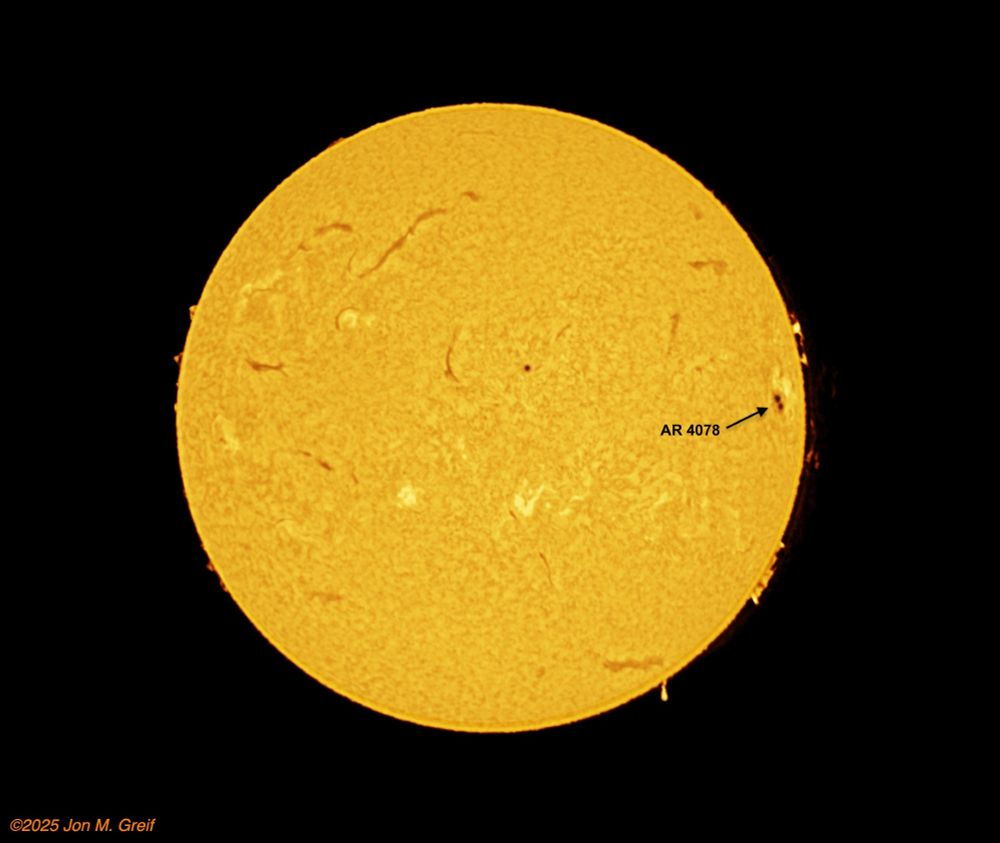
Here's a look at the afternoon sun today, from our backyard with a 50 mm/F7 dedicated H-alpha solar telescope. Flare activity jumped to moderate over the past 24 hours. An M flare from sunspot area AR4078 at 10:02 UTC (2 AM PST) produced an R1 (minor) radio blackout over Egypt. #astrophotography
April 30, 2025 at 12:53 AM
Here's a look at the afternoon sun today, from our backyard with a 50 mm/F7 dedicated H-alpha solar telescope. Flare activity jumped to moderate over the past 24 hours. An M flare from sunspot area AR4078 at 10:02 UTC (2 AM PST) produced an R1 (minor) radio blackout over Egypt. #astrophotography
Two nights of exposure with the small SeeStar S50 telescope at the Texas Star Party in Ft. Davis, TX, resulted in this image of the Pinwheel Galaxy (M101), a face-on, counterclockwise spiral galaxy located 21 million light-years from Earth in the constellation Ursa Major. #astrophotography

April 25, 2025 at 7:25 PM
Two nights of exposure with the small SeeStar S50 telescope at the Texas Star Party in Ft. Davis, TX, resulted in this image of the Pinwheel Galaxy (M101), a face-on, counterclockwise spiral galaxy located 21 million light-years from Earth in the constellation Ursa Major. #astrophotography
We're at the Texas Star Party in the Big Bend area of Texas, near the MacDonald Observatory in Fort Davis, under pristine (Bortle 1) night skies. This is the Whirlpool Galaxy, M51, and its interacting companion, NGC 5195, imaged over two nights with a SeeStar S50 telescope. #astrophotography

April 23, 2025 at 9:05 PM
We're at the Texas Star Party in the Big Bend area of Texas, near the MacDonald Observatory in Fort Davis, under pristine (Bortle 1) night skies. This is the Whirlpool Galaxy, M51, and its interacting companion, NGC 5195, imaged over two nights with a SeeStar S50 telescope. #astrophotography
This morning's earthquake a little after 10 AM PDT, as captured by our backyard surveillance cam in Alpine, CA, USA. #earthquake
April 15, 2025 at 1:07 AM
This morning's earthquake a little after 10 AM PDT, as captured by our backyard surveillance cam in Alpine, CA, USA. #earthquake
Tonight's full "Pink" Moon from our backyard and through the clouds. It's the smallest, faintest, most distant full moon of 2025. It’s a micromoon, the opposite of a supermoon, a full moon at its farthest from Earth, and it's the 2nd of 3 full micromoons in a row. #astrophotography

April 13, 2025 at 5:23 AM
Tonight's full "Pink" Moon from our backyard and through the clouds. It's the smallest, faintest, most distant full moon of 2025. It’s a micromoon, the opposite of a supermoon, a full moon at its farthest from Earth, and it's the 2nd of 3 full micromoons in a row. #astrophotography
NGC 2392, AKA the Clown Face Nebula is a bipolar double-shell planetary nebula. NGC 2392 was discovered by William Herschel in 1787. It lies 6500 light-years away in the constellation Gemini. This image was taken through narrow band filters and processed in Hubble Palette (SHO). #astrophotography

April 9, 2025 at 8:35 PM
NGC 2392, AKA the Clown Face Nebula is a bipolar double-shell planetary nebula. NGC 2392 was discovered by William Herschel in 1787. It lies 6500 light-years away in the constellation Gemini. This image was taken through narrow band filters and processed in Hubble Palette (SHO). #astrophotography
M94 (also known as the Cat's Eye Galaxy) is a spiral galaxy in the constellation Canes Venatici. It was discovered by Pierre Méchain in 1781, and catalogued by Charles Messier two days later. Image is from our backyard observatory, 9 hours through a 200 mm Newtonian telescope. #astrophotography

April 8, 2025 at 11:22 PM
M94 (also known as the Cat's Eye Galaxy) is a spiral galaxy in the constellation Canes Venatici. It was discovered by Pierre Méchain in 1781, and catalogued by Charles Messier two days later. Image is from our backyard observatory, 9 hours through a 200 mm Newtonian telescope. #astrophotography
M81, upper left, and M82, lower right, are nearby galaxies in Ursa Major. M81 is a grand design spiral galaxy and M82 is a starburst galaxy.This image represents 4 hours of exposure time night before last through the 8 inch reflecting telescope in our backyard observatory. #astrophotography

March 23, 2025 at 8:22 PM
M81, upper left, and M82, lower right, are nearby galaxies in Ursa Major. M81 is a grand design spiral galaxy and M82 is a starburst galaxy.This image represents 4 hours of exposure time night before last through the 8 inch reflecting telescope in our backyard observatory. #astrophotography
Abell 33 (Also called the Diamond Ring Nebula) is a faint spherical planetary nebula located 2700 light years away in the constellation Hydra. It lies just behind the star HD 83535 giving it the "diamond ring." The nebula gets its coloration from the Oxygen-lll emissions. #astrophotography

March 21, 2025 at 11:35 PM
Abell 33 (Also called the Diamond Ring Nebula) is a faint spherical planetary nebula located 2700 light years away in the constellation Hydra. It lies just behind the star HD 83535 giving it the "diamond ring." The nebula gets its coloration from the Oxygen-lll emissions. #astrophotography
SH2-240, the Spaghetti Nebula, is a supernova remnant between Auriga and Taurus. Discovered in 1952 at the Crimean Observatory, in what is now Ukraine, by Grigory Shajn using a camera with a Hydrogen alpha filter. Image is with Ha, Oiii & Sii filters through an 8" Newtonian scope. #astrophotography

March 12, 2025 at 8:48 PM
SH2-240, the Spaghetti Nebula, is a supernova remnant between Auriga and Taurus. Discovered in 1952 at the Crimean Observatory, in what is now Ukraine, by Grigory Shajn using a camera with a Hydrogen alpha filter. Image is with Ha, Oiii & Sii filters through an 8" Newtonian scope. #astrophotography
The Orion Nebula (M42) is a diffuse nebula in the Milky Way situated south of Orion's Belt, in the sword of Orion. At 1,344 light-years away it is the closest region of massive star formation to Earth. This image represents 12 hours exposure time using our 8" reflecting telescope. #astrophotography

March 5, 2025 at 11:34 PM
The Orion Nebula (M42) is a diffuse nebula in the Milky Way situated south of Orion's Belt, in the sword of Orion. At 1,344 light-years away it is the closest region of massive star formation to Earth. This image represents 12 hours exposure time using our 8" reflecting telescope. #astrophotography
IC 2118/NGC 1909 (also known as the Witch Head Nebula due to its shape -- hint: she's looking to the right) is an extremely faint reflection nebula 900 LY from Earth, believed to be an ancient supernova gas cloud illuminated by the supergiant star Rigel in the constellation Orion. #astrophotography

March 1, 2025 at 11:03 PM
IC 2118/NGC 1909 (also known as the Witch Head Nebula due to its shape -- hint: she's looking to the right) is an extremely faint reflection nebula 900 LY from Earth, believed to be an ancient supernova gas cloud illuminated by the supergiant star Rigel in the constellation Orion. #astrophotography