



A brief history of the discovery of the immunoglobulins and the origin of the modern immunoglobulin nomenclature
onlinelibrary.wiley.com/doi/epdf/10....
onlinelibrary.wiley.com/doi/epdf/10....
onlinelibrary.wiley.com
October 29, 2025 at 10:09 AM
A brief history of the discovery of the immunoglobulins and the origin of the modern immunoglobulin nomenclature
onlinelibrary.wiley.com/doi/epdf/10....
onlinelibrary.wiley.com/doi/epdf/10....
After 14 days in ICU eGFR or eCrCl will over estimate true GFR more than TWO-fold yet they are still often quoted as guides to drug dosing!
October 26, 2025 at 6:43 PM
After 14 days in ICU eGFR or eCrCl will over estimate true GFR more than TWO-fold yet they are still often quoted as guides to drug dosing!
As intravenous fluids are rapidly lost to the interstitial space any affect on cardiac output and GFR will be very transient…
September 7, 2025 at 9:38 PM
As intravenous fluids are rapidly lost to the interstitial space any affect on cardiac output and GFR will be very transient…
However creatinine concentration decrease reduces its excretion for any fixed GFR causing loss of steady state and rapid accumulation of creatinine in the expanded volume until concentration is normalized and steady state is regained. This can be easily modeled and takes a few hours at most.
September 7, 2025 at 9:36 PM
However creatinine concentration decrease reduces its excretion for any fixed GFR causing loss of steady state and rapid accumulation of creatinine in the expanded volume until concentration is normalized and steady state is regained. This can be easily modeled and takes a few hours at most.
Also our good friend the Canadian Intensivist!!
April 19, 2025 at 5:46 PM
Also our good friend the Canadian Intensivist!!
I’m no expert in this area but this is a good start I think: www.kireports.org/article/S246...

Hyponatremia in the Dialysis Population
Sodium derangements are among the most frequently encountered electrolyte disorders
in patients with end-stage renal disease. As dialysis patients are predisposed to
hyponatremia via multiple pathways...
www.kireports.org
April 9, 2025 at 6:16 AM
I’m no expert in this area but this is a good start I think: www.kireports.org/article/S246...
What about hyponatraemia in chronic dialysis patients? - common and impactful - mostly but not exclusively due to fluid overload??
April 7, 2025 at 5:38 PM
What about hyponatraemia in chronic dialysis patients? - common and impactful - mostly but not exclusively due to fluid overload??
Incredibly valuable approach. I’m interested in ordinal longitudinal outcomes based on an organ failure score - ie where there might be more than one way to achieve the same level. Can this approach be applied to this type of ordinal outcome variable?
March 20, 2025 at 8:14 AM
Incredibly valuable approach. I’m interested in ordinal longitudinal outcomes based on an organ failure score - ie where there might be more than one way to achieve the same level. Can this approach be applied to this type of ordinal outcome variable?
My approach was by no means perfect but see journals.lww.com/anesthesia-a...

Acute Kidney Injury and Risk of Death After Elective... : Anesthesia & Analgesia
ndergoing elective in-patient surgery. AKI was defined using Kidney Disease Improving Global Outcomes criteria. Patients missing preoperative creatinine data were excluded. We used multivariable logis...
journals.lww.com
March 20, 2025 at 5:03 AM
My approach was by no means perfect but see journals.lww.com/anesthesia-a...
So what you need to model is an interaction term between age and eGFR with eGFR fitted to a spline (ie rcs). If you use creatinine then you would do the same but an interaction with sex would also be needed!
March 20, 2025 at 5:01 AM
So what you need to model is an interaction term between age and eGFR with eGFR fitted to a spline (ie rcs). If you use creatinine then you would do the same but an interaction with sex would also be needed!
That is an eGFR of 100 at age 20y equates lowest risk but at 75y this would equate to sarcopenia and the nadir of risk might be eGFR 70.
March 20, 2025 at 4:56 AM
That is an eGFR of 100 at age 20y equates lowest risk but at 75y this would equate to sarcopenia and the nadir of risk might be eGFR 70.
A good question John and one I’ve looked at previously. eGFR (and creatinine) has a u-shaped relationship with risk of death - the minima of this risk profile varies with age.
March 20, 2025 at 4:54 AM
A good question John and one I’ve looked at previously. eGFR (and creatinine) has a u-shaped relationship with risk of death - the minima of this risk profile varies with age.
In another thought differentiating urinoma as a cause of a post-transplant collection in the context of severe DGF (ATN) can’t be reliably made based on fluid biochemistry as composition of urine CAN be similar to plasma
February 2, 2025 at 11:04 AM
In another thought differentiating urinoma as a cause of a post-transplant collection in the context of severe DGF (ATN) can’t be reliably made based on fluid biochemistry as composition of urine CAN be similar to plasma
In these circumstances GFR 5 can still give >200ml/h urine. I’ve always felt the TGF response in AKI may be adaptive to prevent massive diuresis in context of tubular injury…
February 2, 2025 at 11:02 AM
In these circumstances GFR 5 can still give >200ml/h urine. I’ve always felt the TGF response in AKI may be adaptive to prevent massive diuresis in context of tubular injury…
Fun fact- the clock time in the UK the at start of posix time was at 01:00 1/1/1970 due to a short lived experiment with British Standard Time (GMT+1 year round) that was in place in 1970. This genuinely caused an off by one hour issue in some of my code once that was difficult to debug!
January 14, 2025 at 3:38 PM
Fun fact- the clock time in the UK the at start of posix time was at 01:00 1/1/1970 due to a short lived experiment with British Standard Time (GMT+1 year round) that was in place in 1970. This genuinely caused an off by one hour issue in some of my code once that was difficult to debug!
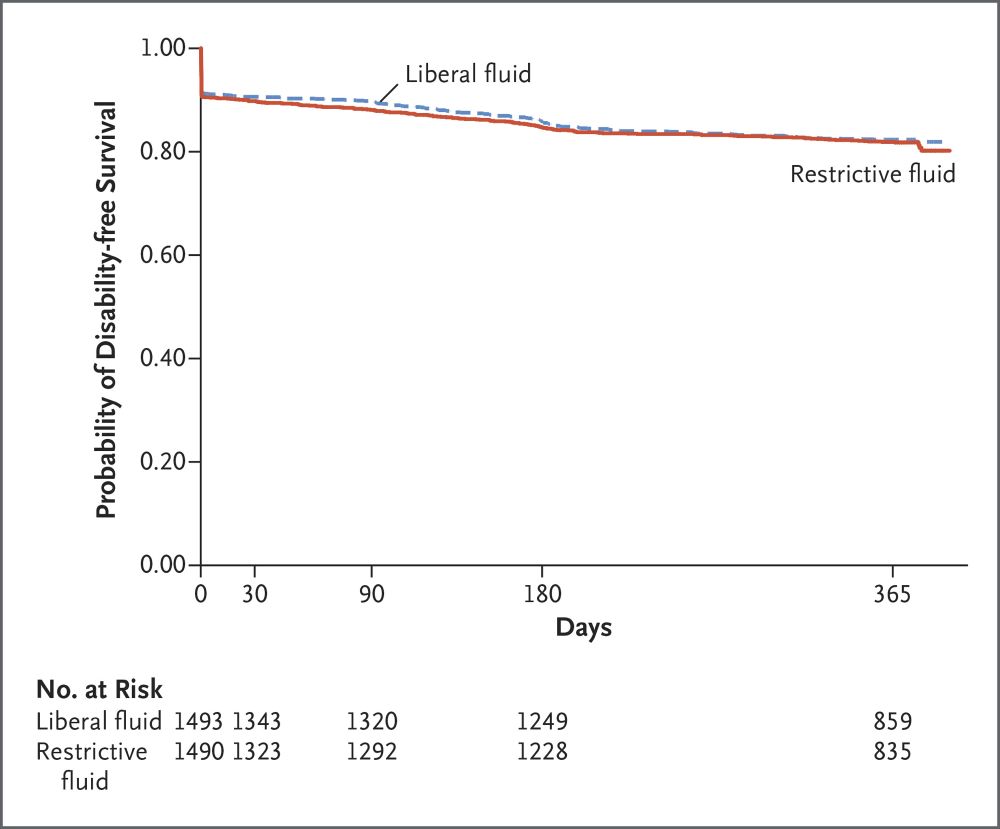
Effectively practice has changed ahead of evidence. Also note highly restrictive strategies might also be harmful in some contexts ie surgery see RELIEF. www.nejm.org/doi/full/10....
Restrictive versus Liberal Fluid Therapy for Major Abdominal Surgery | NEJM
Guidelines to promote the early recovery of patients undergoing major surgery recommend a restrictive intravenous-fluid strategy for abdominal surgery. However, the supporting evidence is limited, ...
www.nejm.org
January 14, 2025 at 2:35 PM
Effectively practice has changed ahead of evidence. Also note highly restrictive strategies might also be harmful in some contexts ie surgery see RELIEF. www.nejm.org/doi/full/10....
CLOVERS as above and CLASSIC www.nejm.org/doi/full/10....
Both studies are ‘neutral’ but essentially define the bottom of the j-shape risk distribution - Note the fluid administration in the ‘liberal’ arms is a lot less liberal than fluid use seen in the past ie PROCESS study 2014.
Both studies are ‘neutral’ but essentially define the bottom of the j-shape risk distribution - Note the fluid administration in the ‘liberal’ arms is a lot less liberal than fluid use seen in the past ie PROCESS study 2014.

Restriction of Intravenous Fluid in ICU Patients with Septic Shock | NEJM
Intravenous fluids are recommended for the treatment of patients who are in septic
shock, but higher fluid volumes have been associated with harm in patients who are
in the intensive care unit (ICU...
www.nejm.org
January 14, 2025 at 2:34 PM
CLOVERS as above and CLASSIC www.nejm.org/doi/full/10....
Both studies are ‘neutral’ but essentially define the bottom of the j-shape risk distribution - Note the fluid administration in the ‘liberal’ arms is a lot less liberal than fluid use seen in the past ie PROCESS study 2014.
Both studies are ‘neutral’ but essentially define the bottom of the j-shape risk distribution - Note the fluid administration in the ‘liberal’ arms is a lot less liberal than fluid use seen in the past ie PROCESS study 2014.