




The Journal of Muscle Research and Cell Motility
@jmrcm-springer.bsky.social
Official site for the Journal of Muscle Research and Cell Motility.
JMRCM publishes original research on the excitation and contraction of muscle and the processes underlying contractility and motility of cells. https://link.springer.com/journal/10974
JMRCM publishes original research on the excitation and contraction of muscle and the processes underlying contractility and motility of cells. https://link.springer.com/journal/10974
Michelle Peckham et al. demonstrate the role of MEGF10 in myoblast fusion, and how it affects satellite cell behaviour in muscle fibres responding to mechanical overload.
doi.org/10.1007/s109...
8/8
doi.org/10.1007/s109...
8/8

The role of MEGF10 in myoblast fusion and hypertrophic response to overload of skeletal muscle - Journal of Muscle Research and Cell Motility
Biallelic mutations in multiple EGF domain protein 10 (MEGF10) gene cause EMARDD (early myopathy, areflexia, respiratory distress and dysphagia) in humans, a severe recessive myopathy, associated with reduced numbers of PAX7 positive satellite cells. To better understand the role of MEGF10 in satellite cells, we overexpressed human MEGF10 in mouse H-2kb-tsA58 myoblasts and found that it inhibited fusion. Addition of purified extracellular domains of human MEGF10, with (ECD) or without (EGF) the N-terminal EMI domain to H-2kb-tsA58 myoblasts, showed that the ECD was more effective at reducing myoblast adhesion and fusion by day 7 of differentiation, yet promoted adhesion of myoblasts to non-adhesive surfaces, highlighting the importance of the EMI domain in these behaviours. We additionally tested the role of Megf10 in vivo using transgenic mice with reduced (Megf10+/−) or no (Megf10−/−) Megf10. We found that the extensor digitorum longus muscle had fewer anti-Pax7 stained cell nuclei and was less able to undergo hypertrophy in response to muscle overload concomitant with a lower level of satellite cell activation. Taken together, our data suggest that MEGF10 may promote satellite cell adhesion and survival and prevent premature fusion helping to explain its role in EMARDD.
doi.org
October 7, 2025 at 11:30 AM
Michelle Peckham et al. demonstrate the role of MEGF10 in myoblast fusion, and how it affects satellite cell behaviour in muscle fibres responding to mechanical overload.
doi.org/10.1007/s109...
8/8
doi.org/10.1007/s109...
8/8
Frederic Relaix et al. consider the specific role of Pax3 in adult muscle stem cells, which is only found in a subset of muscle stem cell.
doi.org/10.1007/s109...
7/8
doi.org/10.1007/s109...
7/8

Regulation and function of Pax3 in muscle stem cell heterogeneity and stress response - Journal of Muscle Research and Cell Motility
Journal of Muscle Research and Cell Motility -
doi.org
October 7, 2025 at 11:30 AM
Frederic Relaix et al. consider the specific role of Pax3 in adult muscle stem cells, which is only found in a subset of muscle stem cell.
doi.org/10.1007/s109...
7/8
doi.org/10.1007/s109...
7/8
Terry Partridge considers why it is that in muscular dystrophy, a small number of skeletal muscle fibres begin to re-express dystrophin from nominally null mutations of the gene.
doi.org/10.1007/s109...
6/8
doi.org/10.1007/s109...
6/8
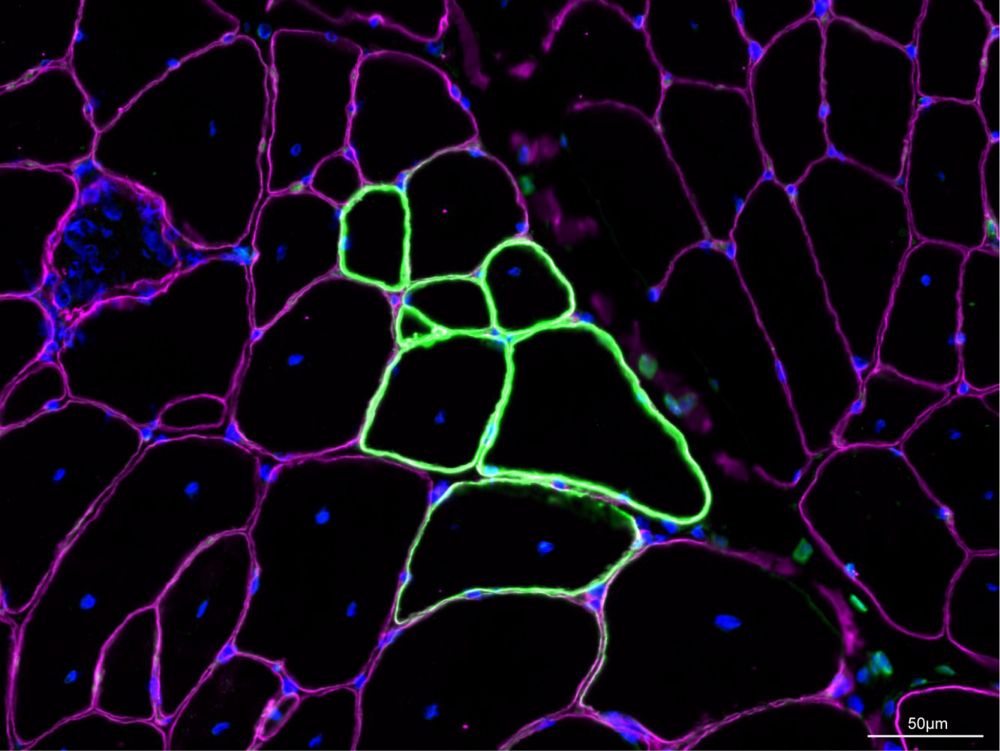
Skeletal muscle: a biologists’ adventure playground - Journal of Muscle Research and Cell Motility
A brief discussion about skeletal muscle, aberrant expression of dystrophin from null mutations of the gene, potential explanations as to why this occurs, and how understanding this could be useful for potential therapies in the future.
doi.org
October 7, 2025 at 11:30 AM
Terry Partridge considers why it is that in muscular dystrophy, a small number of skeletal muscle fibres begin to re-express dystrophin from nominally null mutations of the gene.
doi.org/10.1007/s109...
6/8
doi.org/10.1007/s109...
6/8
Steve Harridge et al. contributed a comprehensive review that considers the particular benefits and challenges of using human primary stem cells in culture.
doi.org/10.1007/s109...
5/8
doi.org/10.1007/s109...
5/8

Insights into human muscle biology from human primary skeletal muscle cell culture - Journal of Muscle Research and Cell Motility
This review arises from the symposium held in honour of Prof Jenny Morgan at UCL in 2024 and the authors would like to acknowledge the outstanding contribution that Prof Morgan has made to the field of translational muscle cell biology. Prof Morgan published a review article in 2010 entitled: Are human and mice satellite cells really the same? In which the authors highlighted differences between species which are still pertinent to skeletal muscle cell culture studies today. To our knowledge there are no comprehensive reviews which outline the considerable work that has been undertaken using human primary skeletal muscle origin cells as the main model system. This review highlights the multitude of muscle biology that has been investigated using human primary cells, as well as discussing the advantages and disadvantages over other cell models. We also discuss future directions for primary cell culture models utilising the latest technologies in cell type specificity and culture systems.
doi.org
October 7, 2025 at 11:30 AM
Steve Harridge et al. contributed a comprehensive review that considers the particular benefits and challenges of using human primary stem cells in culture.
doi.org/10.1007/s109...
5/8
doi.org/10.1007/s109...
5/8
Included in the collection:
Tom Roberts and his group contributed a review on the progress and prospects in antisense oligonucleotide-mediated exon skipping therapies for Duchenne muscular dystrophy
doi.org/10.1007/s109...
4/8
Tom Roberts and his group contributed a review on the progress and prospects in antisense oligonucleotide-mediated exon skipping therapies for Duchenne muscular dystrophy
doi.org/10.1007/s109...
4/8
October 7, 2025 at 11:30 AM
Included in the collection:
Tom Roberts and his group contributed a review on the progress and prospects in antisense oligonucleotide-mediated exon skipping therapies for Duchenne muscular dystrophy
doi.org/10.1007/s109...
4/8
Tom Roberts and his group contributed a review on the progress and prospects in antisense oligonucleotide-mediated exon skipping therapies for Duchenne muscular dystrophy
doi.org/10.1007/s109...
4/8
She identified progenitor cell types that contribute to skeletal muscle regeneration and manipulating these cell populations to enhance muscle repair in skeletal muscle regenerative medicine and muscular dystrophy treatment.
3/8
3/8
October 7, 2025 at 11:30 AM
She identified progenitor cell types that contribute to skeletal muscle regeneration and manipulating these cell populations to enhance muscle repair in skeletal muscle regenerative medicine and muscular dystrophy treatment.
3/8
3/8
Her research has focused on the biology of skeletal muscle and its capacity to regenerate, using in vitro models of stem cell activation, proliferation and differentiation and in vivo transplantation models.
2/8
2/8
October 7, 2025 at 11:30 AM
Her research has focused on the biology of skeletal muscle and its capacity to regenerate, using in vitro models of stem cell activation, proliferation and differentiation and in vivo transplantation models.
2/8
2/8
This article forms part of of our European Muscle Conference series. Find more articles in our collection:
link.springer.com/collections/...
link.springer.com/collections/...
European Muscle Conference
The European Society for Muscle Research (ESMR) was founded in 1971, and the first EMC meeting was organized in 1972 in Liege (Belgium). Since then, annual ...
link.springer.com
August 18, 2025 at 8:41 AM
This article forms part of of our European Muscle Conference series. Find more articles in our collection:
link.springer.com/collections/...
link.springer.com/collections/...
This article forms part of our special collection on smooth muscle cell function in health & disease.
link.springer.com/collections/...
link.springer.com/collections/...
Smooth Muscle Cell Function in Health and Disease
Smooth muscle cells perform vital functions in a range of organs including lungs, intestines, and blood vessels. The current research focus on the ...
link.springer.com
August 5, 2025 at 7:23 AM
This article forms part of our special collection on smooth muscle cell function in health & disease.
link.springer.com/collections/...
link.springer.com/collections/...
Special Collection Editors:
Ken Campbell, Thomas Kampourakis & Cheavar Blair
University of Kentucky, USA
Ken Campbell, Thomas Kampourakis & Cheavar Blair
University of Kentucky, USA
July 21, 2025 at 6:25 PM
Special Collection Editors:
Ken Campbell, Thomas Kampourakis & Cheavar Blair
University of Kentucky, USA
Ken Campbell, Thomas Kampourakis & Cheavar Blair
University of Kentucky, USA
(3/3)
The editors encourage submissions that address molecular & cellular level contractility in skeletal/cardiac #muscle. Papers that address basic #mechanisms will be valued as highly as those targeting #translational opportunities.
We strive to obtain reviews that are timely & fair from experts.
The editors encourage submissions that address molecular & cellular level contractility in skeletal/cardiac #muscle. Papers that address basic #mechanisms will be valued as highly as those targeting #translational opportunities.
We strive to obtain reviews that are timely & fair from experts.
July 21, 2025 at 6:25 PM
(3/3)
The editors encourage submissions that address molecular & cellular level contractility in skeletal/cardiac #muscle. Papers that address basic #mechanisms will be valued as highly as those targeting #translational opportunities.
We strive to obtain reviews that are timely & fair from experts.
The editors encourage submissions that address molecular & cellular level contractility in skeletal/cardiac #muscle. Papers that address basic #mechanisms will be valued as highly as those targeting #translational opportunities.
We strive to obtain reviews that are timely & fair from experts.
(2/3)
Key events in this evolution include the identification of #sarcomeric variants as an important cause of #hypertrophic #cardiomyopathy and the continuing development of therapeutic #myotropes.
Key events in this evolution include the identification of #sarcomeric variants as an important cause of #hypertrophic #cardiomyopathy and the continuing development of therapeutic #myotropes.
July 21, 2025 at 6:25 PM
(2/3)
Key events in this evolution include the identification of #sarcomeric variants as an important cause of #hypertrophic #cardiomyopathy and the continuing development of therapeutic #myotropes.
Key events in this evolution include the identification of #sarcomeric variants as an important cause of #hypertrophic #cardiomyopathy and the continuing development of therapeutic #myotropes.