



@jillyanny.bsky.social
Reposted

8. It is difficult to overstate what a catastrophe this will be for the US research and education systems, particular in biomedical fields.
It is deliberate and wanton devastation entirely out of scale with any concern about DEI activities on campuses.
The goal is destroy US universities.
It is deliberate and wanton devastation entirely out of scale with any concern about DEI activities on campuses.
The goal is destroy US universities.
February 8, 2025 at 12:46 AM
8. It is difficult to overstate what a catastrophe this will be for the US research and education systems, particular in biomedical fields.
It is deliberate and wanton devastation entirely out of scale with any concern about DEI activities on campuses.
The goal is destroy US universities.
It is deliberate and wanton devastation entirely out of scale with any concern about DEI activities on campuses.
The goal is destroy US universities.
Reposted
7. This order did not come out of nowhere. It was a core component of Lindsey Burke's Dept. of Education chapter in the Project 2025 report.
(Private foundations typically pay 10-15% overhead rates, and the logic of this comparison is made explicit in today's Supplemental Guidance from NIH.)
(Private foundations typically pay 10-15% overhead rates, and the logic of this comparison is made explicit in today's Supplemental Guidance from NIH.)

February 8, 2025 at 12:41 AM
7. This order did not come out of nowhere. It was a core component of Lindsey Burke's Dept. of Education chapter in the Project 2025 report.
(Private foundations typically pay 10-15% overhead rates, and the logic of this comparison is made explicit in today's Supplemental Guidance from NIH.)
(Private foundations typically pay 10-15% overhead rates, and the logic of this comparison is made explicit in today's Supplemental Guidance from NIH.)
Reposted
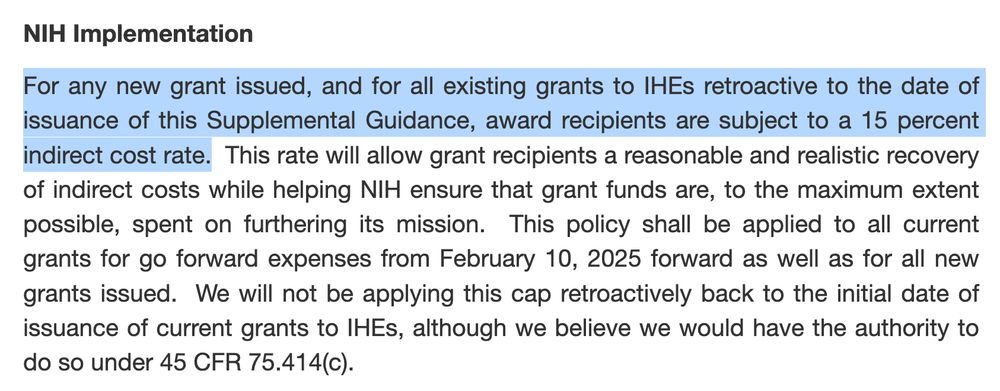
6. The policy does not just affect funding going forward. All existing NIH grants will have their indirect rates cut to 15% as of today, the date of issuance.
For a large university, this creates a sudden and catastrophic shortfall of hundreds of millions of dollars against already budgeted funds.
For a large university, this creates a sudden and catastrophic shortfall of hundreds of millions of dollars against already budgeted funds.
February 8, 2025 at 12:33 AM
6. The policy does not just affect funding going forward. All existing NIH grants will have their indirect rates cut to 15% as of today, the date of issuance.
For a large university, this creates a sudden and catastrophic shortfall of hundreds of millions of dollars against already budgeted funds.
For a large university, this creates a sudden and catastrophic shortfall of hundreds of millions of dollars against already budgeted funds.
Reposted
5. Other schools may have even higher overhead rates. Harvard's is around 69%.
This new order slashes that percentage to a maximum of 15%. This means cutting one of the most important sources of university funding nationwide by 75% or more.
Universities cannot function with this scale of cut.
This new order slashes that percentage to a maximum of 15%. This means cutting one of the most important sources of university funding nationwide by 75% or more.
Universities cannot function with this scale of cut.
February 8, 2025 at 12:28 AM
5. Other schools may have even higher overhead rates. Harvard's is around 69%.
This new order slashes that percentage to a maximum of 15%. This means cutting one of the most important sources of university funding nationwide by 75% or more.
Universities cannot function with this scale of cut.
This new order slashes that percentage to a maximum of 15%. This means cutting one of the most important sources of university funding nationwide by 75% or more.
Universities cannot function with this scale of cut.
Reposted
4. These F&A costs, colloquially known as "overhead", are typically north of 50%. At the UW, for example, the overhead rate is 55%. That means that if I get federal grant for $1,000,000 of direct research funding, the university receives an additional $550,000 to cover operating expenses and such.
February 8, 2025 at 12:24 AM
4. These F&A costs, colloquially known as "overhead", are typically north of 50%. At the UW, for example, the overhead rate is 55%. That means that if I get federal grant for $1,000,000 of direct research funding, the university receives an additional $550,000 to cover operating expenses and such.
Reposted
3. To this end, they support the institutions where grantees work by paying facilities and administration (F&A) costs to research institutions such as universities. These costs above and beyond the direct amount of the grant are essential to fund university infrastructure and personnel.
February 8, 2025 at 12:22 AM
3. To this end, they support the institutions where grantees work by paying facilities and administration (F&A) costs to research institutions such as universities. These costs above and beyond the direct amount of the grant are essential to fund university infrastructure and personnel.
Reposted
2. While NSF and NIH indeed have a mission to fund specific research innovations via grantmaking, they do a lot more than that.
Their principal role is support a scientific ecosystem in the United States, that includes everything from education and training to infrastructure and communication.
Their principal role is support a scientific ecosystem in the United States, that includes everything from education and training to infrastructure and communication.
February 8, 2025 at 12:18 AM
2. While NSF and NIH indeed have a mission to fund specific research innovations via grantmaking, they do a lot more than that.
Their principal role is support a scientific ecosystem in the United States, that includes everything from education and training to infrastructure and communication.
Their principal role is support a scientific ecosystem in the United States, that includes everything from education and training to infrastructure and communication.