



Jeremy Tran
@jeremyctran.bsky.social
Biomedical Engineering PhD Student at Boston University
Reposted by Jeremy Tran
I'm excited to share our latest work on developing a method to engineer drug-activatable nanobodies using a viral protease against a variety of targets. Thank you to my PI Dr. John Ngo, labmates @alex-marzilli.bsky.social, @jeremyctran.bsky.social and Chris Kuffner for their help during the project.
Quan Le engineered intracellular nanobodies that can be stabilized and activated by NS3 protease inhibitors. By inserting NS3 at key sites, he created drug-sensitive nanobodies targeting GFP, mCherry, ALFA tag, and the β2-adrenergic receptor. Check it out here:

Protease-Containing Nanobodies for Detecting and Manipulating Intracellular Antigens Using Antiviral Drugs
Tools to induce the formation of protein–protein interactions (PPIs) via small molecules are essential for investigating and engineering biological systems. Here we introduce a protease-based strategy...
pubs.acs.org
May 12, 2025 at 6:06 PM
I'm excited to share our latest work on developing a method to engineer drug-activatable nanobodies using a viral protease against a variety of targets. Thank you to my PI Dr. John Ngo, labmates @alex-marzilli.bsky.social, @jeremyctran.bsky.social and Chris Kuffner for their help during the project.
Reposted by Jeremy Tran

We leveraged fluorescein-based ‘adapter’ compounds to regulate SynNotch activity & gene expression via:
(1) a bio-orthogonal chemical ligation (Tz/TCO),
(2) a photolytic (o-nitrobenzyl) uncaging reaction, and
(3) in response to the folding state of natively-derived collagen proteins. Check it out!
(1) a bio-orthogonal chemical ligation (Tz/TCO),
(2) a photolytic (o-nitrobenzyl) uncaging reaction, and
(3) in response to the folding state of natively-derived collagen proteins. Check it out!
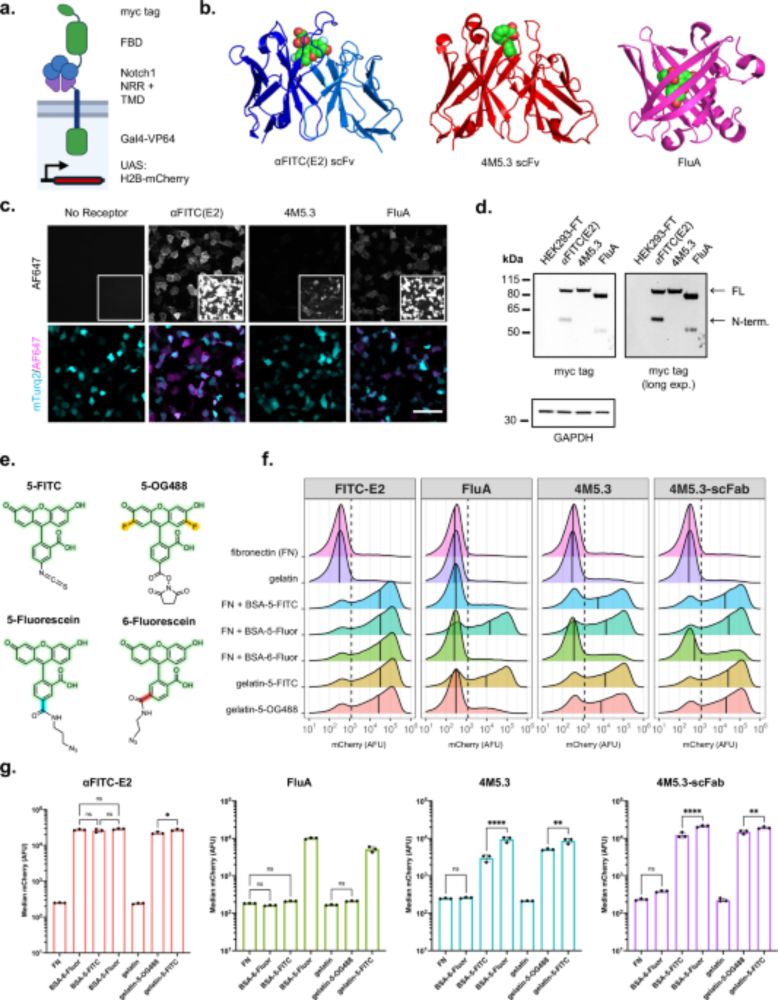
Fluorescein-based SynNotch adaptors for regulating gene expression responses to diverse extracellular and matrix-based cues - Nature Communications
Synthetic Notch (SynNotch) receptors can be used to endow cells with custom sense-and-respond capabilities. Here, the authors introduce a fluorescein-binding SynNotch as a versatile tool for controlli...
www.nature.com
January 22, 2025 at 9:11 PM
We leveraged fluorescein-based ‘adapter’ compounds to regulate SynNotch activity & gene expression via:
(1) a bio-orthogonal chemical ligation (Tz/TCO),
(2) a photolytic (o-nitrobenzyl) uncaging reaction, and
(3) in response to the folding state of natively-derived collagen proteins. Check it out!
(1) a bio-orthogonal chemical ligation (Tz/TCO),
(2) a photolytic (o-nitrobenzyl) uncaging reaction, and
(3) in response to the folding state of natively-derived collagen proteins. Check it out!