


Jason
@jasoner.net
Cubs fan. Trying to make a sabermetrics blog, blog.jasoner.net
Ok, so if I substitute that sqrt expression for v, then substitute vx - vwindx, vy - vwindy, etc, that should work?
September 14, 2025 at 4:28 AM
Ok, so if I substitute that sqrt expression for v, then substitute vx - vwindx, vy - vwindy, etc, that should work?
Also is omega spin rate (rpm) or angular velocity (radians per second)? I sort of assume the latter, but I figure it could be either
September 14, 2025 at 3:03 AM
Also is omega spin rate (rpm) or angular velocity (radians per second)? I sort of assume the latter, but I figure it could be either
Pitchers get more strikeouts, prevent more runs, etc as a direct result of their catcher's framing skills (or a wide zone. either way, exploit in the rules) why do they get credit (through allowing fewer runs) in WAR but catchers can't? Either way, you're giving someone credit for exploiting rules
August 21, 2025 at 12:12 AM
Pitchers get more strikeouts, prevent more runs, etc as a direct result of their catcher's framing skills (or a wide zone. either way, exploit in the rules) why do they get credit (through allowing fewer runs) in WAR but catchers can't? Either way, you're giving someone credit for exploiting rules
What's that hanging off your lanyard?
July 22, 2025 at 5:06 AM
What's that hanging off your lanyard?
I understand that the difference would likely be minimal, but I'm just curious as to why you chose when creating FIP to have it be constant. Is it a matter of simplicity?
June 26, 2025 at 3:27 AM
I understand that the difference would likely be minimal, but I'm just curious as to why you chose when creating FIP to have it be constant. Is it a matter of simplicity?
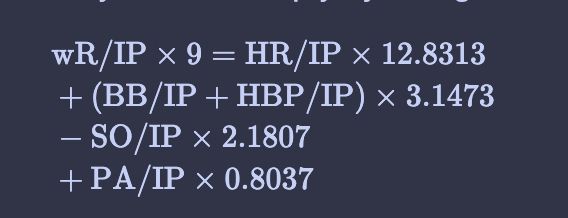
That term doesn't necessarily have to be constant though. I don't see why the PA term has to be the league average PA/IP instead of the pitcher's individual PA/IP. Wouldn't that fix the bias from better pitchers having fewer PAs?


June 26, 2025 at 1:08 AM
That term doesn't necessarily have to be constant though. I don't see why the PA term has to be the league average PA/IP instead of the pitcher's individual PA/IP. Wouldn't that fix the bias from better pitchers having fewer PAs?
Sorry I'm struggling to connect the dots here. Are you saying that because teams all get the same number of outs, that's why the number of plate appearances doesn't affect R - wRAA for teams?
May 31, 2025 at 4:34 PM
Sorry I'm struggling to connect the dots here. Are you saying that because teams all get the same number of outs, that's why the number of plate appearances doesn't affect R - wRAA for teams?
And I'm now seeing more stuff that implies this is wrong (the gradient between wRC specifically and runs = 1). Really not sure what's going on. wRC's formula (rearranged) is wRC - wRAA = k*PA, but R - wRAA ≠ k*PA, so why does the wRC formula work?
May 31, 2025 at 12:51 PM
And I'm now seeing more stuff that implies this is wrong (the gradient between wRC specifically and runs = 1). Really not sure what's going on. wRC's formula (rearranged) is wRC - wRAA = k*PA, but R - wRAA ≠ k*PA, so why does the wRC formula work?
tldr it appears that the number of PAs a team has does not have any effect on what the "average" level is in wRAA. No idea why this is. That means that wRC gives too much credit to teams that have more PAs and penalizes teams with fewer PAs too much, because somehow wRAA has already normalized this.
May 31, 2025 at 6:00 AM
tldr it appears that the number of PAs a team has does not have any effect on what the "average" level is in wRAA. No idea why this is. That means that wRC gives too much credit to teams that have more PAs and penalizes teams with fewer PAs too much, because somehow wRAA has already normalized this.
So if this observation is correct (and I have no clue why it would—it seems VERY wrong) it would appear that the correct formula for wRC would be something like wRAA + lgR/G * TG. Trying this out, we can see the relationship is significantly closer to expected (maybe it should be lgR/out * outs?)

May 31, 2025 at 6:00 AM
So if this observation is correct (and I have no clue why it would—it seems VERY wrong) it would appear that the correct formula for wRC would be something like wRAA + lgR/G * TG. Trying this out, we can see the relationship is significantly closer to expected (maybe it should be lgR/out * outs?)
...it appears that they are expected to score the same number of runs assuming they've both played a whole season, because there is no relationship between the number of runs that is average (R - wRAA) and PA (excluding the 2020 season).

May 31, 2025 at 6:00 AM
...it appears that they are expected to score the same number of runs assuming they've both played a whole season, because there is no relationship between the number of runs that is average (R - wRAA) and PA (excluding the 2020 season).
...as the same regardless of the number of PAs they have. Then, wRC is calculating by adding R/PA * PA, which then inflates the runs produced of teams with more PAs.
To illustrate it with an example. If one team has 100 wRAA in 100 PAs and another team has 100 wRAA in 50 PAs...
To illustrate it with an example. If one team has 100 wRAA in 100 PAs and another team has 100 wRAA in 50 PAs...
May 31, 2025 at 6:00 AM
...as the same regardless of the number of PAs they have. Then, wRC is calculating by adding R/PA * PA, which then inflates the runs produced of teams with more PAs.
To illustrate it with an example. If one team has 100 wRAA in 100 PAs and another team has 100 wRAA in 50 PAs...
To illustrate it with an example. If one team has 100 wRAA in 100 PAs and another team has 100 wRAA in 50 PAs...
of weighted runs is also higher in a higher number of PAs) but when comparing wRAA and runs, the expected relationship occurs.
I think this might be why the issue with wRC occurs. wRAA somehow (still not clear on why this is the case, but it appears to be) sets the average value for every team...
I think this might be why the issue with wRC occurs. wRAA somehow (still not clear on why this is the case, but it appears to be) sets the average value for every team...
May 31, 2025 at 6:00 AM
of weighted runs is also higher in a higher number of PAs) but when comparing wRAA and runs, the expected relationship occurs.
I think this might be why the issue with wRC occurs. wRAA somehow (still not clear on why this is the case, but it appears to be) sets the average value for every team...
I think this might be why the issue with wRC occurs. wRAA somehow (still not clear on why this is the case, but it appears to be) sets the average value for every team...
Ok I think I figured out the issue with wRAA vs RAA. The issue is that teams who score more runs have a higher "average" by my formula due to having more PAs, which suppresses their RAA slightly. I'm not quite sure why the same thing doesn't happen to wRAA (surely the average number...

May 31, 2025 at 6:00 AM
Ok I think I figured out the issue with wRAA vs RAA. The issue is that teams who score more runs have a higher "average" by my formula due to having more PAs, which suppresses their RAA slightly. I'm not quite sure why the same thing doesn't happen to wRAA (surely the average number...
Obviously an approximation but 27 outs per game should be close enough, still getting the same result. Outs/G is slightly lower than 27, but not by a ton.
Also: wRAA and RAA aren't per PA, so if the issue was using the wrong denominator, the wRAA vs RAA regression wouldn't have the same issue
Also: wRAA and RAA aren't per PA, so if the issue was using the wrong denominator, the wRAA vs RAA regression wouldn't have the same issue

May 30, 2025 at 4:38 PM
Obviously an approximation but 27 outs per game should be close enough, still getting the same result. Outs/G is slightly lower than 27, but not by a ton.
Also: wRAA and RAA aren't per PA, so if the issue was using the wrong denominator, the wRAA vs RAA regression wouldn't have the same issue
Also: wRAA and RAA aren't per PA, so if the issue was using the wrong denominator, the wRAA vs RAA regression wouldn't have the same issue
Where can I find runs per out? The number of outs will be roughly 27*G, but not quite because of extra innings (and in 2020, the 7 inning double headers).
May 30, 2025 at 4:15 PM
Where can I find runs per out? The number of outs will be roughly 27*G, but not quite because of extra innings (and in 2020, the 7 inning double headers).
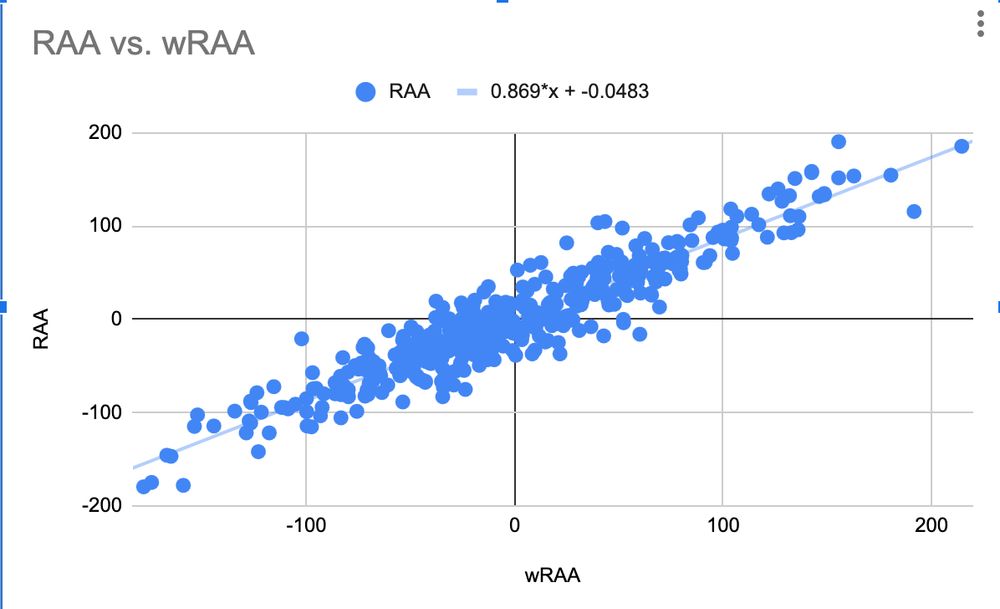
I also see a very similar result when comparing wRAA and RAA (runs above average, comparing the number of runs a team scored to lgR/PA * the team's number of PAs) where wRAA assumes the team will have a higher magnitude of RAA than they actually do (farther from the mean of 0)
May 30, 2025 at 3:19 PM
I also see a very similar result when comparing wRAA and RAA (runs above average, comparing the number of runs a team scored to lgR/PA * the team's number of PAs) where wRAA assumes the team will have a higher magnitude of RAA than they actually do (farther from the mean of 0)
CC @tangotiger.com to see if he can explain why this is or if I've gone wrong somewhere (I could be incorrect that one point of wRC+ is supposed to be one percentage point above average in run scoring). I recommend skipping to the end because the rest is not strictly necessary for what I've found
May 30, 2025 at 3:00 PM
CC @tangotiger.com to see if he can explain why this is or if I've gone wrong somewhere (I could be incorrect that one point of wRC+ is supposed to be one percentage point above average in run scoring). I recommend skipping to the end because the rest is not strictly necessary for what I've found
Doesn't seem like a change in bat speed in the first month vs last season correlates with a change in xwOBA for the rest of the season. This somewhat makes sense to me, because a bat speed reduction is likely intentional, as indicated by these changes in bat speed generally sticking around


May 4, 2025 at 2:04 AM
Doesn't seem like a change in bat speed in the first month vs last season correlates with a change in xwOBA for the rest of the season. This somewhat makes sense to me, because a bat speed reduction is likely intentional, as indicated by these changes in bat speed generally sticking around