


jason-z-kim.bsky.social
@jason-z-kim.bsky.social
Finally, we can predict individual performance on a battery of cognitive tasks using our optimized INT models better than the original model, demonstrating that our model not only captures functional and biological determinants of INTs, but also their behavioral consequence.

December 2, 2025 at 11:39 PM
Finally, we can predict individual performance on a battery of cognitive tasks using our optimized INT models better than the original model, demonstrating that our model not only captures functional and biological determinants of INTs, but also their behavioral consequence.
Third, we find that our optimized model INTs track empirically measured INTs from functional data, as well as the expression of gene markers for inhibitor interneurons. We replicate these results in mice, demonstrating convergence across species.

December 2, 2025 at 11:39 PM
Third, we find that our optimized model INTs track empirically measured INTs from functional data, as well as the expression of gene markers for inhibitor interneurons. We replicate these results in mice, demonstrating convergence across species.
Second, we find that our model with optimized INTs has dynamic modes that are much more modular structure that organize according to the INTs, allowing the optimized model to achieve a wide variety of state transitions by controlling way fewer regions.

December 2, 2025 at 11:39 PM
Second, we find that our model with optimized INTs has dynamic modes that are much more modular structure that organize according to the INTs, allowing the optimized model to achieve a wide variety of state transitions by controlling way fewer regions.
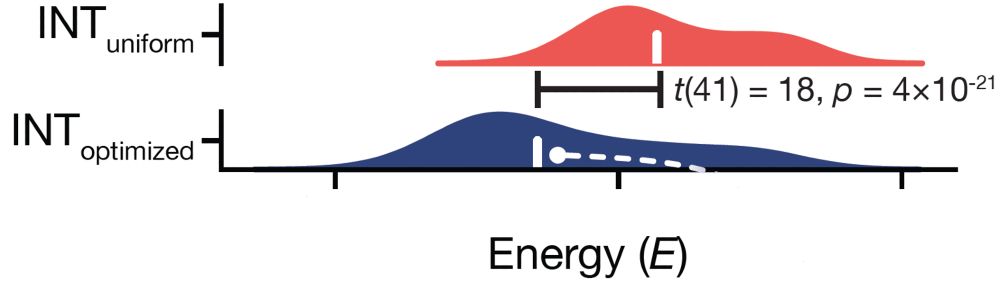
First, we find that our model with optimized INTs have stronger structure-function coupling, which requires less external perturbation (a.k.a. energy) to achieve empirically measured changes in activity.
December 2, 2025 at 11:39 PM
First, we find that our model with optimized INTs have stronger structure-function coupling, which requires less external perturbation (a.k.a. energy) to achieve empirically measured changes in activity.
Here we extend NCT to allow the parameters most important for internal dynamics to be learned using automatic differentiation, enabling us to discover these computationally important INTs from data. We discover that our inferred INTs improve the model and reflect known biology.

December 2, 2025 at 11:39 PM
Here we extend NCT to allow the parameters most important for internal dynamics to be learned using automatic differentiation, enabling us to discover these computationally important INTs from data. We discover that our inferred INTs improve the model and reflect known biology.
To model how these factors interact, network control theory (NCT) is a powerful quantitative framework that combines structure, function, and inputs. However, many of the parameters must be specified a priori, making it difficult to discover the best model from data.

December 2, 2025 at 11:39 PM
To model how these factors interact, network control theory (NCT) is a powerful quantitative framework that combines structure, function, and inputs. However, many of the parameters must be specified a priori, making it difficult to discover the best model from data.
The brain is a complex network of many regions that process information differently over time with their own intrinsic neural timescale (INT). These INTs depend on many factors including coupling to other regions, their own internal dynamics, and the specific computation.

December 2, 2025 at 11:39 PM
The brain is a complex network of many regions that process information differently over time with their own intrinsic neural timescale (INT). These INTs depend on many factors including coupling to other regions, their own internal dynamics, and the specific computation.
The brain computes by processing information over time through interactions between connectivity and dynamics that are hard to model. Here we infer these interactions from data and find they better predict cognitive performance! www.nature.com/articles/s41... w/ @lindenmp.bsky.social
December 2, 2025 at 11:39 PM
The brain computes by processing information over time through interactions between connectivity and dynamics that are hard to model. Here we infer these interactions from data and find they better predict cognitive performance! www.nature.com/articles/s41... w/ @lindenmp.bsky.social