



Jaclyn Wong
@jaclynswong.sciences.social.ap.brid.gy
Research Analyst at Langer Research Associates doing multi-method social science and public opinion research. Former associate professor of #sociology at […]
[bridged from https://sciences.social/@JaclynSWong on the fediverse by https://fed.brid.gy/ ]
[bridged from https://sciences.social/@JaclynSWong on the fediverse by https://fed.brid.gy/ ]
How are US adults feeling about immigration? Survey design and analysis by us!
https://abcnews.go.com/Politics/americans-bring-back-abrego-garcia-views-mixed-deportation/story?id=121123625&mc_cid=a48aedba06&mc_eid=UNIQID
https://abcnews.go.com/Politics/americans-bring-back-abrego-garcia-views-mixed-deportation/story?id=121123625&mc_cid=a48aedba06&mc_eid=UNIQID

More Americans say US should bring back Abrego Garcia, views mixed on other deportation issues: POLL
Americans hold mixed views on President Donald Trump's immigration policies, according to a ABC News/Washington Post/Ipsos poll.
abcnews.go.com
April 25, 2025 at 2:07 PM
How are US adults feeling about immigration? Survey design and analysis by us!
https://abcnews.go.com/Politics/americans-bring-back-abrego-garcia-views-mixed-deportation/story?id=121123625&mc_cid=a48aedba06&mc_eid=UNIQID
https://abcnews.go.com/Politics/americans-bring-back-abrego-garcia-views-mixed-deportation/story?id=121123625&mc_cid=a48aedba06&mc_eid=UNIQID
I worked on this!
https://www.chronicle.com/special-projects/the-different-voices-of-student-success/raising-student-voices/college-and-other-pathways
https://www.chronicle.com/special-projects/the-different-voices-of-student-success/raising-student-voices/college-and-other-pathways
April 17, 2025 at 3:53 PM
I haven't had any strangers touch my belly (THANK GOODNESS), but every time a random person asks about the baby's gender and I tell them we don't know and will be surprised, they insist I'll have a boy. Is this a thing??
April 15, 2025 at 1:08 AM
I haven't had any strangers touch my belly (THANK GOODNESS), but every time a random person asks about the baby's gender and I tell them we don't know and will be surprised, they insist I'll have a boy. Is this a thing??
Still can't believe this happened so close to where I live
https://oaklandside.org/2025/04/11/michael-burawoys-friends-remember-a-brilliant-scholar-and-committed-supporter-of-protest/
https://oaklandside.org/2025/04/11/michael-burawoys-friends-remember-a-brilliant-scholar-and-committed-supporter-of-protest/

At its core, Michael Burawoy believed the science of sociology was, even when encased in the stodgy halls of academia, a study of possible solutions to improve the world. As such, it was natural for theories from the profession to be used to advocate for social change.
Not all of his colleagues believed sociologists should be personally on the picket lines or protesting.
But Burawoy was different because that’s exactly what he was doing toward the end of his life.
In February, the legendary Berkeley sociologist was killed while walking on a Grand Avenue crosswalk near Lake Merritt. In the aftermath, sociologists worldwide mourned the loss of a giant of the field and a man who, they said, lit up every room he walked into with his charisma.
Burawoy made it his life’s work to engage with the world. Eventually, that led to a sociological theory called Public Sociology, which validated his increasingly vocal support of protest movements.
A public memorial is planned for Burawoy on Sunday at 1 p.m. Ahead of that, we decided to interview people who knew him.
They told us that while he only became directly involved in political movements in the last part of his career, his theories directly spoke to the major questions confronting these movements from the beginning.
Described as a “Marxist for Realists” for personally testing his social theories in industrial factories and other working-class sites, Burawoy believed capitalists exploited workers, that this was immoral, and that there were logical ways to prevent it.
“For him, his political commitments and academic work were all part of the same project,” CUNY professor Ruth Milkman told The Oaklandside in an interview. “Public Sociology came in, and it meant doing sociology in dialogue with progressive movements.”
## Sociological theory as a base for activism, including fighting sexual harassment
For about four decades, Burawoy’s support for activists was essentially “behind the scenes,” according to CUNY professor Ruth Milkman, one of his oldest friends and a renowned scholar of labor unions and gender.
Milkman remembers Burawoy’s support for a campaign she led against sexual harassment.
In the late 1970s, the young Cal student helped create a group called Women Organized Against Sexual Harassment at UC Berkeley. It was formed in response to allegations of sexual harassment by a male colleague of Burawoy’s in the Sociology Department.
Milkman and others alleged that this professor constantly tried to make “academic encounters into sexual ones” and that at times, he tried to kiss women in the mouth without permission. The professor wrote a negative letter of recommendation to a student who rejected his advances, and worse.
After getting a feminist lawyer from San Francisco to craft a Title IX complaint, the group worked to get the national legal standards of sexual harassment in universities to change. They eventually forced the professor to resign, according to an article on the issue years later by gender sociologists Linda Blum and Ethel Mickey. Blum was a Berkeley grad student at the time.
Other professors, including Burawoy, were an important part of holding the professor accountable and creating a safe environment for female students. Burawoy helped block the professor’s tenure until the legal case was resolved.
**Never miss a story.** **Sign up for The Oaklandside’s free daily newsletter.**
Email
Δ
“Michael wasn’t a central figure in the campaign, but he was definitely supportive — and horrified by the stories we told him,” Milkman said.
The New York professor also remembers Burawoy attending anti-apartheid protests. She said he used his background working and studying in Zambia, including writing his seminal book about labor and race, _The Colour of Class_ _,_ to help them create a proper reading list for their study group.
## Burawoy becomes increasingly active and speaks out against the war in Gaza
Even though his academic work advocated for engaging with public issues and communities and was used to support activism, Burawoy didn’t become an out-and-out activist until about 10 years ago. That’s according to Professor Milkman.
Milkman was the first graduate student whose dissertation Burawoy agreed to chair, which she completed in 1981. Over the years, she told The Oaklandside, he always supported the more “activist types” in their profession like her.
Around 2010, when he became the head of the Berkeley Faculty Association, he led it as a “progressive advocacy group” within the university.
“He became a very public activist — pressuring the administration, speaking out on campus issues, and so on,” she told us.
He butted heads with Cal’s administration about budget cuts and the increased use of lecturers as opposed to offering qualified academics tenure-track jobs.
Burawoy’s support of campus unions also became more visible. He showed up on the picket line with undergraduate and graduate student workers and gave rousing speeches. That’s where some of the rousing pictures of him that circulated following his death were taken.
“He was there on every single picket line for the entire decade I was at UC Berkeley, always agreeing to speak if we thought it would be helpful,” Zachary Levenson said about Burawoy after the news of his death.
According to Levenson, an urban sociologist who studied under Burawoy, his mentor was involved during the Occupy Movement that rose up in 2011 during the Great Recession. Burawoy once finished a lecture on the steps of one of the main buildings on campus to support students who had taken over the building protesting the rise of their tuition.
“Back when I was a student, he didn’t really do that kind of thing, although I recall him joining some of us at an anti-apartheid protest. That campaign was active at the time, and I was involved in it. He showed up once or twice,” Milkman said.
More recently, Burawoy, other academics, and his former students helped create the advocacy group _Sociologists for Palestine_. Milkman was one of the many who supported that work.
Working with Palestinian sociologist Areej Sabbagh-Khoury, Burawoy, and others, including the married couple of former presidents of the American Sociological Association, Mary Romero and Eric Margolis, worked for weeks to convince the membership to vote to pass a statement from the organization in support of Palestine.
Romero told The Oaklandside that the group’s statement was sent to 3,000 members, which led to deep and thoughtful discussions with many of them.
In his writings of the conflict, Burawoy said he considered the occupation of the Palestinian territories as a type of settler colonialism that mirrored other global conflicts where indigenous communities were displaced, such as in the United States, Australia, Algeria, South Africa, and Northern Ireland. When the governing body of the ASA first rejected supporting such a resolution because it would remove their members’ objectivity, Burawoy countered by saying it was the moral imperative of sociologists to speak up about injustice.
“The abstract defense of academic freedom may appear innocent and well-meaning, but when placed alongside the Resolution, it becomes not only vacuous and callous but also decisively anti-sociological. It refuses to examine whose academic freedom is being violated,” he wrote.
When Los Angeles police broke up a pro-Palestinian protest camp at UCLA last year, Burawoy joined other faculty members and students at a large protest in solidarity.
Milkman said Burawoy’s support for Palestine came “from the heart” and his family’s experience as jews in Europe during World War II. Burawoy’s family moved to Great Britain from Nazi Germany on the eve of war.
Burawoy’s version of public sociology, including the need for protests as a positive social action, continue to be part of the work of his recent students.
For example, Yueran Zhang, who received his Ph.D. from Berkeley last year, recently authored a research article exploring how workers in the industrial city of Wuhan, China, cleverly used the government’s facade of democracy to “air grievances, make subversive demands, assert agency, and even resist managerial despotism.”
## Advocating for change as part of the sociological tradition
The idea that academic sociology and politics shouldn’t mix comes from people who mistakenly believe their society doesn’t need further political growth or where there’s more apparent stability, according to the noted Peruvian sociologist Nicolás Lynch.
Reached at his home in Lima this week, Lynch, who spent weeks in deep conversations with Burawoy over lunch at the University of Wisconsin in 2008 as visiting scholars, said many sociologists in Latin America pursue the discipline to make political change.
“The countries here are not as defined. They fight for their rights, building,” he said in his native Spanish. “The conditions are more difficult, with people with a healthy well-being only being 20-30% of the population. The rest live day-by-day, so you want to figure out how to improve that.”
The now-71-year-old was one of those who used sociology directly in government.
He first became involved in politics in middle school and continued through his academic career, leading the university’s union against its administration. After working for years in academia, including writing a treatise on social movements that push for the transition from military dictatorships to democracy, he joined a democratic coalition to remove the dictator Alberto Fujimori from power.
“I think my desire to do grassroots politics led me to sociology,” he said.
Lynch, who also studied at New York’s New School for Social Research, where Burawoy recently gave a colloquium on whether racism drove capitalism or vice versa, said Burawoy’s sociological perspective influenced so many, especially students, because he was an incredibly simple but powerful communicator.
That was most apparent when Burawoy visited Lynch’s University in Lima and explained sociological intervention in public life in a seminar his 12-year-old son attended. The young Lynch told his dad he’d never understood what he did or why it was important until Burawoy explained it.
Lynch said it was clear to him that Burawoy also understood the sociable quality about himself, and that must’ve been why he became an advocate for public sociology, which could change how people saw the world. By being in the world, talking to people, and affecting their ideas, they were also putting his ideas to the test in the fastest but most human way possible.
“The idea of conducting ethnography from sociology, which he often mentioned — ethnography in social sciences traditionally belonged to anthropologists, rarely sociologists,” Lynch said. “But he said we must talk with people, listen, and be surprised.”
Lynch noted that Burawoy’s late-career move to more direct political advocacy, while not as involving as actually getting into representative politics, was still part of a broader natural inclination for sociologists when viewed from a historical viewpoint.
Recent major sociologists like Pierre Bourdieu, for example, stood together with protesters in the 1990s while developing socially conscious ideologies of “symbolic violence” and “cultural capital.” Those a bit longer ago, like Jane Addams and Antonio Gramsci, placed themselves in the center of political storms. Gramsci’s Prison Notebooks directly engaged with Italy’s fascist regime, specifically calling for a different, humane political system.
Burawoy also understood his role in that tradition, although he largely sought to raise others who engaged in public sociology to possibly greater heights.
In his most recent essay about W.E.B. Dubois, Burawoy sought to place the noted sociologist on the same level as Marx and Weber — who are considered founding theorists of the discipline. Burawoy traced Dubois’ career, searching for the most meaningful possible influence of his ideas. Dubois moved from academia, which wouldn’t correctly recognize his brilliance, to journalism and politics, where he helped create organizations such as the NAACP.
“[Dubois is] probably the greatest public sociologist to have walked this earth. He brought sociology to his advocacy of civil rights, Pan-Africanism, socialism and peace activism,” Burawoy wrote.
## A public sociology that regular people can feel inspired by
A community college transfer student named Alex Coffin got into UC Berkeley in the mid-2010s and immediately felt intimated.
Coffin knew she was smart but worried she was behind her cohort because she was older. Then, she started taking Burawoy’s courses. She said Burawoy immediately made her feel as valuable as anyone else by listening and thoughtfully answering her questions. He even took on criticisms.
“I was struck by his openness and humility,” Coffin said. “For example, I mentioned a few times that I thought he was calling on a lot more men than women, and he [internalized that].” He later got closer to gender parity, she said. “He dedicated a book to his students, ‘from whom he learns so much.’ If you didn’t know him, you didn’t understand how true that was.”
Coffin said that she, like many others, experienced the magic of a Burawoy lecture in the big halls but that her experience in the more intimate setting of a seminar gave her an up-close look at his adaptation of modern public sociology in action. The event highlighting this was a seminar in the middle of the 2016 election.
Before the 2016 election, Coffin said the seminar’s curriculum centered on Burawoy’s critiques of power against the university, especially how it was becoming less of a public institution and more like a business. Coffin remembers being in the seminar on election day and seeing Burawoy’s face the moment news went around that Trump was likely to win.
“He became quiet, as you could tell he was thinking about it,” she said.
Within moments, he pivoted, energetically connecting what was happening to the idea that institutions hold systems of power in unequal ways, how people can learn to adapt and defeat governments with fascistic tendencies, and how to “eat the elephant one bite at a time,” taking each piece of “the big scary thing” to process it to figure out its origins and how you can figure out your role in that.
Coffin said that as a person with a disability, the latter idea helped her feel like she could try to find something to do in the protest movements without being physically overwhelmed.
About 25 years earlier, Jesse Palmer felt his experience with Burawoy helped him better understand his politics.
An undergrad at Cal in the 1980s, he said he came into college as a liberal with a general idea about the importance of class in this country but left with a better understanding of power: that there were people with power and those without. A class lens was the best way to understand the problems of society that needed to be changed to fix them.
“The way he talked about Marxism allowed you to get out single-issue politics, to remove it from the gulags and nationalism,” he said. “An idea that people making things should control them. That wealth comes from the workers and [not someone like] Musk creates things. Capitalists own the means of production but don’t create wealth.”
It also helped, Palmer said, that Burawoy did all while reveling in the joy of teaching.
Palmer took what he learned from Burawoy to heart and focused his career on helping others through his legal work. He’s spent most of it working for nonprofit organizations, “trying to be the civil society outside the state or the capitalist class.”
Professor Sheba George, one of Burawoy’s colleagues at Berkeley, told The Oaklandside it’s not surprising how much of an impact his work and connections with students had decades after the fact. That’s because “he brought love into the equation,” and his sociology was a “personal” action with an exciting goal to improve the world.
“Jumping on tables and sacrificing the limited supply of his hair to make a point to get our attention was contagious. Michael was inviting you to share and understand something transformative and meaningful,” she said.
Coffin has sought over the past few months to try to make sense of the collision that killed her favorite teacher.
After thinking about it and going through her list of critiques, she noted traffic violence is “arguably more pervasive and dangerous” than other types of so-called public threats like petty crime, encampments, or drug dealing precisely because it’s something that powerful people participate in an feel like they benefit from.
“We demand the city clear sidewalks of encampments, but whole neighborhood blocks of sidewalks are blocked off to disabled access because people with cars and homes want to park in their small driveways,” Coffin said. “Class-based violence doesn’t always look the way we expect, and Burawoy has become a casualty of it.”
## **… We have a small favor to ask.**
We rely on readers like you to keep local journalism thriving in Oakland. That’s why we’re asking you to make a donation to help us do the work.
**Your support will enable us to foster real change** — and champion a free and independent press — at a time when it is needed most. So, what do you say?
Yes. I want to support The Oaklandside!
"*" indicates required fields
Send a private note to the editors.*
See an error that needs correcting? Have a tip, question or suggestion? Drop us a line.
Email*
Name
Phone
__This field is hidden when viewing the form
Embed URL
Δ
oaklandside.org
April 12, 2025 at 5:22 AM
Still can't believe this happened so close to where I live
https://oaklandside.org/2025/04/11/michael-burawoys-friends-remember-a-brilliant-scholar-and-committed-supporter-of-protest/
https://oaklandside.org/2025/04/11/michael-burawoys-friends-remember-a-brilliant-scholar-and-committed-supporter-of-protest/
My sister and her spouse biked with their 2yo to Amtrak and are about to board the train to visit us this weekend. They are living my best bike/transit life
April 11, 2025 at 3:40 PM
My sister and her spouse biked with their 2yo to Amtrak and are about to board the train to visit us this weekend. They are living my best bike/transit life
Reposted by Jaclyn Wong
Whoa - really interesting paper
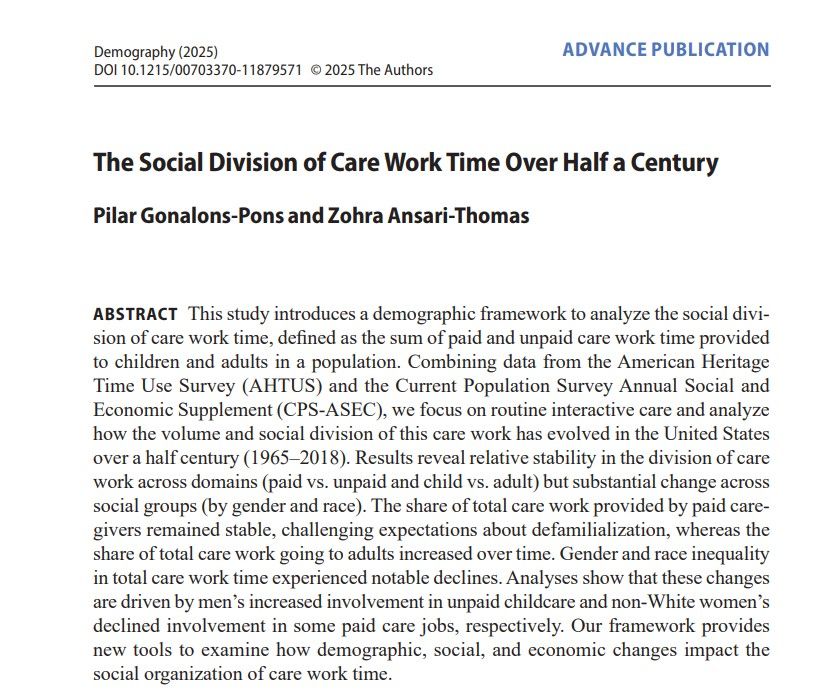
“Social Division of Care Work Time Over Half a Century”: @pgonalon.bsky.social & @z-ansari-thomas.bsky.social offer population-level estimates for volume & division of care work time across paid/unpaid & child/adult domains. @upenn.edu @fandmcollege.bsky.social read.dukeupress.edu/demography/a...
April 4, 2025 at 9:39 PM
Whoa - really interesting paper
Reposted by Jaclyn Wong
Academics - where are academic jobs posted for non-UK non-North American countries? If you were looking for jobs in, say, the Nordic countries, or Australia, where do you look? Asking for all the PhDs who are on the market this year. (Pls no April fools jokes, their nerves are frayed as it is)
April 1, 2025 at 9:15 PM
Academics - where are academic jobs posted for non-UK non-North American countries? If you were looking for jobs in, say, the Nordic countries, or Australia, where do you look? Asking for all the PhDs who are on the market this year. (Pls no April fools jokes, their nerves are frayed as it is)
Question for #qualitativeresearch and #sociology people: what platforms have you used to collect data for diary studies? Looking for recs!
March 11, 2025 at 6:07 PM
Question for #qualitativeresearch and #sociology people: what platforms have you used to collect data for diary studies? Looking for recs!
I'm sitting in a nursing rocker and knitting a baby hat. I feel like a very nest-y pregnant person right now
March 8, 2025 at 1:38 AM
I'm sitting in a nursing rocker and knitting a baby hat. I feel like a very nest-y pregnant person right now
Reposted by Jaclyn Wong
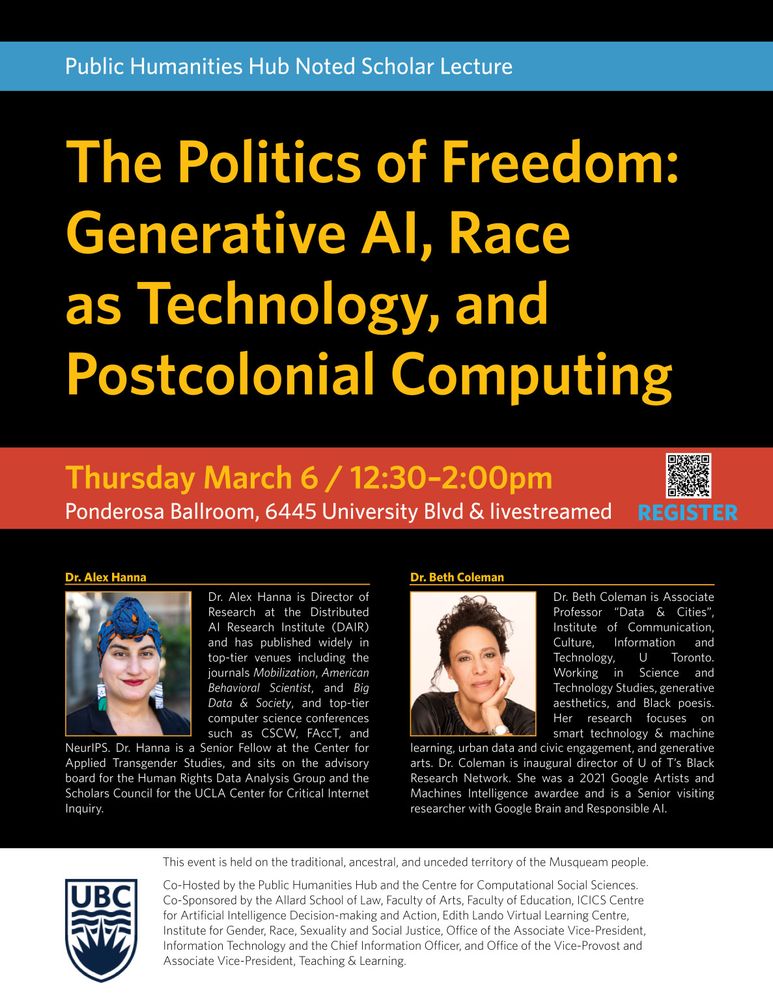
I have the privilege of moderating this event tomorrow. I've been doing my background reading and y'all, this is going to be a 🔥 event. Reading these two scholars in conversation with one another has put both of their work in a new light (for me). This is going to be a fascinating conversation 👀

Tomorrow! The Public Humanities Noted Scholar Lecture Series hosts @alexhanna.bsky.social and Prof. Beth Coleman to discuss Generative AI, race, and postcolonial computing. In person and on Zoom.
Co-sponsored by us and the Public Humanities Hub.
publichumanities.ubc.ca/events/event...
Co-sponsored by us and the Public Humanities Hub.
publichumanities.ubc.ca/events/event...
March 5, 2025 at 10:46 PM
I have the privilege of moderating this event tomorrow. I've been doing my background reading and y'all, this is going to be a 🔥 event. Reading these two scholars in conversation with one another has put both of their work in a new light (for me). This is going to be a fascinating conversation 👀
I'm coding survey responses to why people feel confident/not confident that we can develop technologies to help fight climate change and I'm just so struck by the number of answers with strong "anything is possible!" vibes
February 27, 2025 at 10:15 PM
I'm coding survey responses to why people feel confident/not confident that we can develop technologies to help fight climate change and I'm just so struck by the number of answers with strong "anything is possible!" vibes
Reposted by Jaclyn Wong

Let’s meet up! I’m hosting a photo walk through some of my favorite graffiti and mural filled alleys in SF’s Mission District and any Fediverse folks are invited. We’ll meet up at 24th and Valencia at 2pm on March 1st and hit up some of my favorite […]
[Original post on pixelfed.social]
[Original post on pixelfed.social]

February 25, 2025 at 2:14 AM
Let’s meet up! I’m hosting a photo walk through some of my favorite graffiti and mural filled alleys in SF’s Mission District and any Fediverse folks are invited. We’ll meet up at 24th and Valencia at 2pm on March 1st and hit up some of my favorite […]
[Original post on pixelfed.social]
[Original post on pixelfed.social]
Reposted by Jaclyn Wong

via @amstatnews.bsky.social Federal Statistics User Feedback Form: We seek your feedback as part of an ongoing @AmStatNews @GeorgeMasonU project to independently examine the health of the federal statistical system...
The feedback we seek includes examples of how you use federal statistics and […]
The feedback we seek includes examples of how you use federal statistics and […]
Original post on sciences.social
sciences.social
February 20, 2025 at 7:23 PM
via @amstatnews.bsky.social Federal Statistics User Feedback Form: We seek your feedback as part of an ongoing @AmStatNews @GeorgeMasonU project to independently examine the health of the federal statistical system...
The feedback we seek includes examples of how you use federal statistics and […]
The feedback we seek includes examples of how you use federal statistics and […]
Reposted by Jaclyn Wong

UNB's St. John campus is hiring a TT position in Sociology with an emphasis on quantitative methods. Although there are rules about prioritizing Canadian candidates, I would encourage US folks to apply.
universityaffairs.ca/search-job/?...
universityaffairs.ca/search-job/?...

February 7, 2025 at 3:45 PM
UNB's St. John campus is hiring a TT position in Sociology with an emphasis on quantitative methods. Although there are rules about prioritizing Canadian candidates, I would encourage US folks to apply.
universityaffairs.ca/search-job/?...
universityaffairs.ca/search-job/?...
Reposted by Jaclyn Wong
via @amstatnews.bsky.social ASA Survey on Census Data Use Cases: Knowing how Census data is used is critical for everything from determining how disclosure avoidance is applied to ensuring the data continues to flow. Here's how you can help. You can respond to ASA's survey about data uses. The […]
Original post on sciences.social
sciences.social
February 7, 2025 at 12:10 AM
via @amstatnews.bsky.social ASA Survey on Census Data Use Cases: Knowing how Census data is used is critical for everything from determining how disclosure avoidance is applied to ensuring the data continues to flow. Here's how you can help. You can respond to ASA's survey about data uses. The […]
Woohoo, paper with @danielcarlson and @pettsric accepted in JMF!! I'm finally a real family sociologist!
January 29, 2025 at 6:27 PM
Woohoo, paper with @danielcarlson and @pettsric accepted in JMF!! I'm finally a real family sociologist!
I'm giving a book talk at the UCSD #sociology colloquium on Thursday 1/30. Come hang out! https://sociology.ucsd.edu/announcements/events/index.html#Colloquium-Schedule
January 27, 2025 at 8:42 PM
I'm giving a book talk at the UCSD #sociology colloquium on Thursday 1/30. Come hang out! https://sociology.ucsd.edu/announcements/events/index.html#Colloquium-Schedule
I'm feeling both seen and...weirdly foreign? I'm particular, the final section on how to host a dumpling party reminded me of the fun but very slightly awkward dumpling party we hosted last year in SC where most of our guests didn't understand they were coming over to work and we didn't know we […]
Original post on sciences.social
sciences.social
January 27, 2025 at 4:09 PM
I'm feeling both seen and...weirdly foreign? I'm particular, the final section on how to host a dumpling party reminded me of the fun but very slightly awkward dumpling party we hosted last year in SC where most of our guests didn't understand they were coming over to work and we didn't know we […]
Stuff sucks. Chinese New Year ice cream helps

January 23, 2025 at 5:10 AM
Stuff sucks. Chinese New Year ice cream helps
When I described my old job as actually being eight jobs, I wasn't exaggerating! 😅☠️
https://mastodon.social/@Rhodium103/113831677591894306
https://mastodon.social/@Rhodium103/113831677591894306
Chris Armstrong (@Rhodium103@mastodon.social)
Every academic should be able to write code, write a book, engage in critical theory, design an experiment, talk for 5 minutes, talk for an hour, do education research, chair a committee, take orders from a committee, know physics, know history, know linguistics, appreciate literature, talk students down from doing stupid stuff, run a budget, use Word, use LaTeX, use a shared drive, build a website, coordinate a 25-man-deep phalanx, run a book seminar, run a lab. Specialisation is for insects.
mastodon.social
January 16, 2025 at 2:49 PM
When I described my old job as actually being eight jobs, I wasn't exaggerating! 😅☠️
https://mastodon.social/@Rhodium103/113831677591894306
https://mastodon.social/@Rhodium103/113831677591894306

I'm not a professor anymore, so how should I approach providing peer reviews? I'm still working on a few papers that I hope to eventually publish so I think I'm obligated do it. But I should probably only review papers that are 100% in my area of expertise. Still, reviewing papers is not a job […]
Original post on sciences.social
sciences.social
January 6, 2025 at 3:59 PM
I'm not a professor anymore, so how should I approach providing peer reviews? I'm still working on a few papers that I hope to eventually publish so I think I'm obligated do it. But I should probably only review papers that are 100% in my area of expertise. Still, reviewing papers is not a job […]
I love that I have a view of the Bay and the SF skyline from my co-working space. It's good for staring off into the distance while I think about data collection instrument design
January 2, 2025 at 11:33 PM
I love that I have a view of the Bay and the SF skyline from my co-working space. It's good for staring off into the distance while I think about data collection instrument design