Near Media
banner
index.nearmedia.co.ap.brid.gy
Near Media
@index.nearmedia.co.ap.brid.gy
Near Media is the go-to advisor for executives at multi-location brands and vertical agencies seeking to optimize their search strategy and tactics.

🌉 bridged from https://www.nearmedia.co/ on the fediverse by https://fed.brid.gy/
Hacking Engagement, Review Deletions, Maps' Economic Power, Real Estate Ads
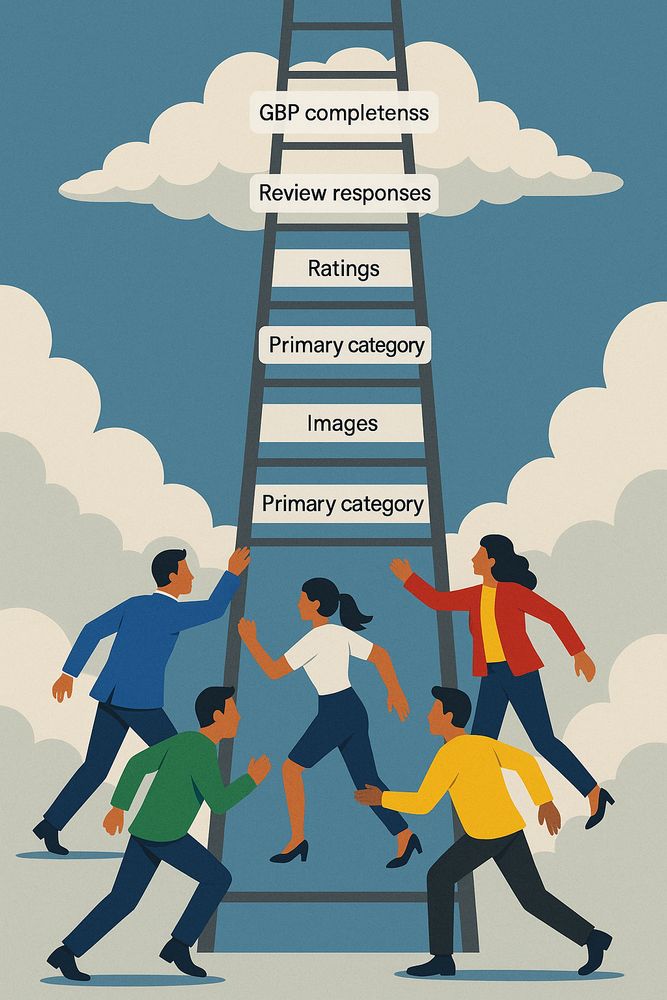
### Hacking Local Engagement Since the release of the Google antitrust "default search" trial exhibits and the subsequent search API leak, we've known that Google historically has used engagement signals for ranking (e.g., CTR, bounce rate). That also apparently applies to local. And many local ranking signals may in fact be proxies for engagement – perhaps the ultimate relevance signal. Not long ago, Andrew Shotland did some engagement hacking to see how it would impact local rankings: "I got 20 teenagers to search for a PI attorney in Pleasanton, click on their GBP, then use GMaps to drive to their office every day for a week. Within a week they were #1 for PI attorney queries in Pleasanton." More recently, Darren Shaw reported on a similar test that Holly Starks did with Google Maps and driving directions: "She put 100 phones in her car and set up driving directions to a business on Google Maps, drove there, and the result was crazy: That business’s rankings went from the 20s right to number 1!" These two tests suggest that Google is watching driving directions as well as local business visitation and factoring those signals into ranking. Shotland's advice was to ask employees to initiate driving directions before they drive to work – or get teenagers to do it. Image source: ChatGPT **Our take:** * This is probably not a hack that will become a widespread problem. * But it appears to conclusively illustrate that engagement – here directions and foot traffic – do impact local rankings (as proxies for popularity). * What are the other engagement signals that Google might be using in local? ### This post is for subscribers only Become a member to get access to all content Subscribe now
www.nearmedia.co
December 19, 2025 at 4:23 PM
Got Moats?, Google AI Training Probe, Agencies Are 'OK,' SMBs Are Social
### Where's the Moat? The way many SEOs and investors are now talking, you'd think that Google had locked up the "AI race." That perception has only emerged since Gemini 3's recent rollout. But there are several indications Google has gained ground on OpenAI. One data point is that OpenAI downloads have recently slowed. (OpenAI has also become nervous about Google's gains.) There's also Sensor Tower data showing that last month Gemini grew its monthly active users 30%, compared with ChatGPT's 5%. On the other hand, The Information reported that ChatGPT has nearly 900 million users, up from 800 million in October. Much of Gemini's recent adoption is tied to the viral popularity of its Nano Banana image creation tool, part of Gemini 2.5. Another consideration is that Google has a full AI tech stack, with its own chips, so it doesn't need to rely on Nvidia to the same extent that rivals do. And, as we've said before, Google can fund AI development out of the "irrationally high" rents it collects from advertisers. This leads to the perception that Google's financial position vis-à-vis AI is _much stronger_ than its rivals, which is probably true. Feeling some pressure, ChatGPT just hired Slack CEO Denise Dresser as CRO to accelerate monetization. And while ChatGPT still "owns" the AI brand and remains the market share leader – including among younger users – the adage that "the competition is just a click away" seems more applicable to AI than search. **Global AI Market Share** Chart: StatCounter **Our take:** * Google's ability to leverage its massive distribution (i.e., search, Chrome, Workspace) are huge advantages, together with its ad-revenues * If Google delivers a "good enough" AI experience, it will claw back some usage from ChatGPT, especially in local where it has better data. * Google is speeding up AI feature rollouts and pushing more people into AI Mode. But the need to drive ad clicks will block radical SERP change, for now. ### This post is for subscribers only Become a member to get access to all content Subscribe now
www.nearmedia.co
December 11, 2025 at 9:16 AM
AI Mode Subtext, Link Quality, Google Ad Labeling, Gemini Success
### AIOs & AI Mode: The Subtext Robby Stein, VP of Product at Google, was recently interviewed by Lenny Rachitsky on his podcast. Among other places, Stein has worked at Google, Meta and Yahoo. This is his second go at Google, following a consumer product leadership role at Instagram, where he oversaw Stories and Reel (both clones of rival products). Stein is now responsible for multiple search features including AI Overviews and AI Mode. It's a lengthy interview and Stein says lots of things. Among them, he remarks that AI hasn't impacted core Google usage. What he probably means is Google still has lots of traffic, but search usage _is_ changing. Stein says that AI is "expansionary," – something Liz Reid has repeatedly said – and growing the search query pie overall. There's an implication that that top-of-funnel questions are going to AI features and "core search" is increasingly about navigation, brand queries and last clicks. Here are some inferences from the conversation: AI Overviews (AIOs) were rushed out to respond to ChatGPT and AI Mode is the better version of what Google is seeking to build. The two features will thus eventually be consolidated. Stein touts Google's entity graphs (products and local structured data) as major differentiators vs rivals. Finally, he sees Gemini, the direct ChatGPT competitor, and AI Mode as distinct. Gemini is for creativity/productivity, he says, whereas AI Mode is for information and more search-like. But this distinction feels a bit forced. **Google's Robby Stein's Full Interview** ### This post is for subscribers only Become a member to get access to all content Subscribe now
www.nearmedia.co
October 17, 2025 at 7:06 PM
Local AI Citations, TikTok Explorers, Worthless Reviews, Global Opt-Out
### Unpacking Local AI Citations A new analysis, from Yext looks at how location, context and search intent affect which citations appear in AI results. The study critiques brand-level visibility analyses (see Profound) as being superficial and insufficient for local marketers. The study digested nearly 7 million citations from 1.6 million AI answers on OpenAI, Gemini and Perplexity. Yext also examined multiple query types (branded/unbranded, objective/subjective) across four industries (Finance, Food Service, Healthcare, and Retail). It then grouped citations into four categories: websites, listings (directories), review sites and social platforms, and other (news, forums, gov't, etc.). At the highest level, as one might expect, Yext found that citations differ by AI platform, industry and query type. For example, "Gemini shows a strong preference for first-party websites" (52.2%), while "OpenAI relies heavily on listings" (48.7%). Yext also points out that OpenAI draws heavily on Google Business Profiles as well. Each citation category was also rated according to the degree of control the brand or business may have. Websites, for instance, are "fully controllable," while directories are merely "controllable" and review/social sites can be "influenced" but not controlled. **Local Citations Differ by Model** Source: Yext ### This post is for subscribers only Become a member to get access to all content Subscribe now
www.nearmedia.co
October 13, 2025 at 5:26 AM
ChatGPT Local Apps, Brands Beat AIOs, Deceiving SMBs, AI for the Holidays
### Local Apps in ChatGPT One of ChatGPT's major strategic challenges is local search. OpenAI is making big investments in shopping with its new Checkout capability and Agentic Commerce Protocol, but so far not in local. Local is equally if not more strategic than shopping, but not as easily monetized. Local ChatGPT results are acceptable in many cases, but lag behind Google in terms of features and quality. Indeed, when local searchers can't find what they're looking for on ChatGPT, they turn to Google. We've been talking on the podcast for some time about this problem and how ChatGPT really needs to address it to be competitive with Google. At its developer day yesterday in San Francisco, the company made several announcements. One of them was an SDK for apps, which included a number of launch partners. This SDK effectively brings third-party app experiences into ChatGPT. Zillow is one of the launch partners, which allows users to search for real-estate listings on ChatGPT and then invoke Zillow. After that it provides a fairly robust version of the Zillow site/app experience within ChatGPT. The launch and soon-to-launch partners, in addition to Zillow, include AllTrails, Booking, Canva, Coursera, DoorDash, Expedia, Figma, Instacart, Khan Academy, OpenTable, Peloton, Spotify, Target, TheFork, Thumbtack, Tripadvisor and Uber. **Zillow in ChatGPT** Source: Zillow-ChatGPT ### This post is for subscribers only Become a member to get access to all content Subscribe now

www.nearmedia.co
October 7, 2025 at 10:55 PM
Local Agents, Alexa's Do-Over, Google Dark Ad Patterns, Reviewpocalypse
### AI Mode, Agents & Local It's still not clear whether and how AI Overviews, AI Mode, Web Guide (i.e., AI Organized pages) and Gemini and Gemini in Chrome will co-exist. Many people believe AI Mode is the future of Google's SERP. I'm not entirely convinced, but Google is aggressively promoting AI Mode, rolling it out globally and integrating it into Chrome. More recently the company has started releasing AI Mode's "agentic" capabilities for people opted-in to Google Search Labs. Google is starting with restaurant reservations but will shortly introduce local services appointments and event tickets. I had some challenges triggering the restaurant functionality but was able to get it to show up with the prompt "Find me a dinner reservation ..." The screen below was the result: restaurants with reservation buttons provided through Resy and OpenTable integrations. Other scheduling/commerce partners include Tock, Ticketmaster, StubHub, SeatGeek and Booksy. Most of these are coming out of Reserve with Google while others are likely separate integrations (see also, Google Actions). The current agentic functionality is comparatively primitive vs. its promise. But capabilities will accelerate and become more sophisticated over time. AI Mode is not widely used today but if it gains usage there are obvious local scheduling and commerce implications for marketers. **AI Mode 'Agentic' Reservations** ### This post is for subscribers only Become a member to get access to all content Subscribe now

www.nearmedia.co
September 29, 2025 at 6:03 PM
Local Users Want More, Google vs. Web, Local Ranking Variables, TikTok Survives
### Local Searchers Want More from AI The early 2022 - 2024 narrative that Google would be displaced by AI has given way among many SEOs to its polar opposite: ChatGPT hasn't had any impact on Google. That's equally untrue. What we see is a pattern of complementary or sequential usage, where people are using AI _and_ Google. AI is changing buyer journeys, but those changes typically vary by vertical and use case. Shopping and product comparison research is a prominent one, which is why Google is stepping up AI shopping efforts. Research we recently presented with Last Mile Retail (form required) at BrightonSEO looked at AI and Google usage for local search, extending to local product finding. What we see is that many people are using AI for local search but ChatGPT (primarily) is not providing the information depth and detail people want. In the survey (n=1,045 US adults), 66% of respondents said that a majority of their overall search activity has local intent. And 87% said they'd conducted local searches using AI, with 57% having done it multiple times. Yet 68% expressed mixed satisfaction with AI local results. The chart below shows what people believe is missing from local AI results. When they don't get what they want from AI, they (re)turn to Google. Source: Last Mile Retail-Near Media ### This post is for subscribers only Become a member to get access to all content Subscribe now

www.nearmedia.co
September 24, 2025 at 7:11 PM
Google-AI Overlap, Changing User Behavior, AI Mode, SiriGPT
### The Google-ChatGPT Overlap The chart below is getting a lot of attention on LinkedIn and Twitter. The data is from Similar Web. What it shows is the overlap between Google and ChatGPT users. In August, according to Similar Web, 95% of ChatGPT users went to Google, while just over 14% of Google users visited ChatGPT. The argument: everyone's using Google, only a fraction are using ChatGPT – and even ChatGPT users are visiting Google. In addition, ChatGPT referral traffic has recently declined. And here's another piece of data: there's potentially no conversion difference between Google and ChatGPT traffic. One conclusion might be: just focus on Google; you're not going to get enough leads from ChatGPT and Google's never going away. However, according to multiple surveys between 35% to nearly 60% of adults have used AI applications, mostly ChatGPT. (Frequency is a different discussion.) That represents somewhere between 90 and 160 million people in real terms. Many of those people are doing things on ChatGPT that they would otherwise have done on Google in the past. So what's "really going on" and why should you care? **ChatGPT-Google User Overlap** Note: the image looks suspiciously like the Death Star in Star Wars ### This post is for subscribers only Become a member to get access to all content Subscribe now
www.nearmedia.co
September 9, 2025 at 8:48 PM
Court Chickens Out, Bigger Pie, Bottom Ad, EU Blinks
### Google Gets Off Easy A Jeff Bezos inspired editorial in the Washington Post opines, "A judge did not need to curb Google’s power. AI is already doing that." While there's a smidgen of truth there, it's not nearly as much as the author thinks. As Rand Fishkin will tell you, ChatGPT isn't eroding Google's search volume (and more importantly ad revenue). Yesterday Judge Amit P. Mehta finally issued his 200+ page ruling in the remedies phase of the default search antitrust trial. Among other things, the government had asked for divestiture of Chrome. The court rejected that remedy as too severe, despite finding that "the Chrome default undoubtedly contributes to Google’s dominance in general search." As predicted, it barred Google from paying for exclusionary distribution agreements (e.g., the Apple-Google iOS search deal). But it didn't bar Google from paying for distribution. The most "serious" part of the opinion was the required sharing of "portions" of the search index and, more significantly, user-interaction data. Specifically, Google doesn't have to share its index, just a "one-time snapshot" of its search data. The court won't allow rivals to build search indexes off Google's data. But it required the disclosure of user data such as clicks, hovers, bounce-backs, query logs, and training datasets (GLUE, RankEmbed, GenAI-related). This second requirement could be very useful to SEOs and Google rivals. In response, Google predictably said, "We have concerns about how these requirements will impact our users and their privacy." While appearing measured, the court effectively chickened out. Critics have decried the ruling as ineffectual. **Snapshot of Judge Mehta's Remedies Decision** Source: Judge Amit P. Mehta's Ruling ### This post is for subscribers only Become a member to get access to all content Subscribe now
www.nearmedia.co
September 3, 2025 at 5:04 PM
Bing Places, AIO Love, No Google Killer, Where's the Decision?
### Optimizing for ChatGPT via Bing There's an ongoing debate about whether and how much ChatGPT is pulling from Google results vs. how reliant it is on Bing. Bing Places is probably in the mix for local but it's unclear how much ChatGPT uses it. It doesn't seem to explicitly cite Bing – ever. After conducting several local searches this morning, I asked it, "do you rely on Bing places for any of this local information?" ChatGPT's answer was, "When I give you local business information (restaurants, painters, dentists, etc.), I do not pull from Bing Places." We probably can't take that at face value but it's interesting. It also said it doesn't rely on Apple Maps or "proprietary databases" such as InfoGroup (old brand, now Data Axle). Let's assume that Bing Places is a data source for ChatGPT. Miriam Ellis and Whitespark looked at "17 local business categories across 9 major US cities" to determine the primary review sources that Bing Places relies upon, which _may_ in turn be helpful for ChatGPT visibility. Facebook, Yelp and Tripadvisor were the most frequently cited. There were other vertical directories cited in specific categories such as healthcare and home services. And Yelp is also often cited in Google's AI mode in many local categories. Regardless of how reliant ChatGPT is on Bing Places in fact, the larger message of the study, review diversification, is increasingly important. Source: Whitespark ### This post is for subscribers only Become a member to get access to all content Subscribe now
www.nearmedia.co
August 28, 2025 at 9:21 PM
LSAs Dominate, AI Failures, Common Local SEO Mistakes
### LSAs Are Eating the Pack Local Services Ads (LSAs) are in more than 70 local business categories. Originally introduced in 2015 in a few home services industries, they were intended to offer a simplified, fixed-price-per-lead ad product that delivered more obvious, concrete value to small businesses than AdWords, which were more opaque and drove significant churn. In 2020, bidding was introduced and they came to resemble Google Ads in many respects. In crucial ways, however, they don't look like traditional Google ads at all. As everyone reading this knows, LSAs look like Pack listings, only more so. They've got prominent, eye catching images; they feature reviews and offer other details that make them fairly compelling to users. Landing pages look like GBPs as well. They're always relevant to the query and are probably the best example of Google's familiar earnings-call mantra: "Ads are useful content." They're also almost always in the top slot in the SERP. What we see in our user-testing research is that when LSAs are present, as they often are these days, they grab attention and clicks often at the expense of the Local Pack and certainly of organic results. Many times organic results are way down the page. In the result below, you need to scroll to "page 4" before you see an organic listing. Even self-identified "ad skeptics" respond to LSAs. **Ads crowd out organic content** Source: Google ### Upgrade to continue reading Become a paid member to get access to all premium content Upgrade
www.nearmedia.co
August 19, 2025 at 11:10 PM
Trust Gap, Search Expansion, Local Signals, Apple's AI Comeback
### Google's Secret Weapon vs. AI: Trust If asked whether AI results are trustworthy, a majority of users will say "yes." The percentages vary depending on how the question is framed. But if they're prompted to consider issues like hallucination, accuracy, bias, plagiarism, privacy, and so on, they'll express concerns and trust goes down. I've had plenty of personal experience with ChatGPT hallucinating lately and it's becoming a major issue. A recent Yext survey of 2,200 people in the US and Europe found that "48% of AI users] cross-check answers across platforms, highlighting the need for consistent brand information everywhere." It's not entirely clear what "platforms" means here, but probably a range of other sites. In other words, they're using a secondary site to validate the AI result. This type of behavior is not new. It has existed in travel. (e.g., checking multiple sites for pricing) and local (checking reviews on other sites [as an anti-fraud strategy). But, if true, it represents a significant problem for AI. It could mean that trust in AI is eroding. And having to conduct a redundant lookup as a matter of routine reduces the efficiency of using ChatGPT. The whole game is trust. And even though Google has thoroughly "enshittified" its user experience, people still do trust Google. **In the abstract people trust AI results** Source: Dialog consumer survey 11/24, n=1K US adults who used both search and AI ### Upgrade to continue reading Become a paid member to get access to all premium content Upgrade
www.nearmedia.co
August 15, 2025 at 3:32 PM