



Eric Schniter
@humannature.bsky.social
Naturalist with a particular interest in humans:
Evolutionary anthropologist,
evolutionary psychologist,
behavioral economist,
studying life history theory, cooperation, and communication.
https://sites.google.com/site/ericschniter/
Evolutionary anthropologist,
evolutionary psychologist,
behavioral economist,
studying life history theory, cooperation, and communication.
https://sites.google.com/site/ericschniter/
I feel something like broken-hearted pain when observing the constant destruction of natural stuff that pretty much no one values. Natural spaces are turning into shitholes before our eyes - many of which are blind to the reality.

November 5, 2025 at 7:25 PM
I feel something like broken-hearted pain when observing the constant destruction of natural stuff that pretty much no one values. Natural spaces are turning into shitholes before our eyes - many of which are blind to the reality.
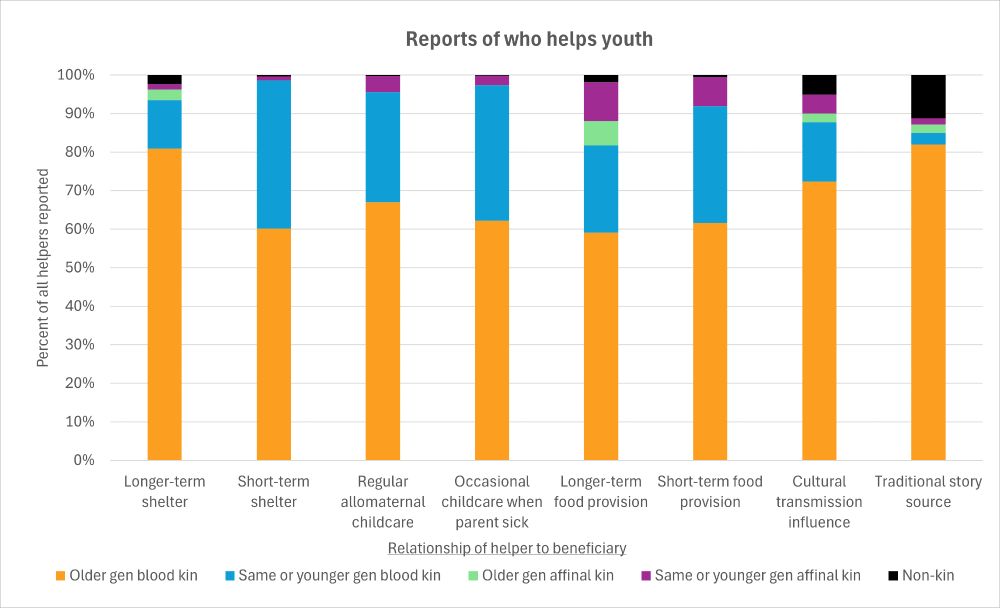
New paper out with insights into kinship, alloparenting, and cooperative breeding! 🧪
Older, closely related kin more often provide costly aid to young Tsimane, while unrelated alloparents provide older youth lower-cost - possible investment in future reciprocal relationships.
Older, closely related kin more often provide costly aid to young Tsimane, while unrelated alloparents provide older youth lower-cost - possible investment in future reciprocal relationships.
December 17, 2024 at 6:10 PM
New paper out with insights into kinship, alloparenting, and cooperative breeding! 🧪
Older, closely related kin more often provide costly aid to young Tsimane, while unrelated alloparents provide older youth lower-cost - possible investment in future reciprocal relationships.
Older, closely related kin more often provide costly aid to young Tsimane, while unrelated alloparents provide older youth lower-cost - possible investment in future reciprocal relationships.
Fallen ginko leaves at Chapman University.

December 3, 2024 at 10:44 PM
Fallen ginko leaves at Chapman University.
Video from the paper:
November 21, 2024 at 6:12 PM
Video from the paper:
The authors of this paper conclude that, based on evidence they document, Ethiopian wolves "could contribute to pollination". Cool stuff!
esajournals.onlinelibrary.wiley.com/doi/10.1002/...
esajournals.onlinelibrary.wiley.com/doi/10.1002/...

November 21, 2024 at 6:12 PM
The authors of this paper conclude that, based on evidence they document, Ethiopian wolves "could contribute to pollination". Cool stuff!
esajournals.onlinelibrary.wiley.com/doi/10.1002/...
esajournals.onlinelibrary.wiley.com/doi/10.1002/...
Unexpected gift from a student in my 8:30 am section. It's always interesting to see one's self from another's perspective. 😆

October 8, 2024 at 5:13 PM
Unexpected gift from a student in my 8:30 am section. It's always interesting to see one's self from another's perspective. 😆
How does behavioral history help?
We suggest that people rely on a conditional cooperation heuristic for predicting cooperative propensity, and that this is likely an evolved feature of cognition, fundamental to mind reading and behavior prediction.
[6/6]
We suggest that people rely on a conditional cooperation heuristic for predicting cooperative propensity, and that this is likely an evolved feature of cognition, fundamental to mind reading and behavior prediction.
[6/6]

January 8, 2024 at 4:24 PM
How does behavioral history help?
We suggest that people rely on a conditional cooperation heuristic for predicting cooperative propensity, and that this is likely an evolved feature of cognition, fundamental to mind reading and behavior prediction.
[6/6]
We suggest that people rely on a conditional cooperation heuristic for predicting cooperative propensity, and that this is likely an evolved feature of cognition, fundamental to mind reading and behavior prediction.
[6/6]
When players’ appearance was available to raters, they were not better able to predict players’ behavior.
So, what explains our results?
Rater’s ability to successfully predict is best explained by accurate gender stereotypes and behavioral history, when available.
[5/6]
So, what explains our results?
Rater’s ability to successfully predict is best explained by accurate gender stereotypes and behavioral history, when available.
[5/6]

January 8, 2024 at 4:23 PM
When players’ appearance was available to raters, they were not better able to predict players’ behavior.
So, what explains our results?
Rater’s ability to successfully predict is best explained by accurate gender stereotypes and behavioral history, when available.
[5/6]
So, what explains our results?
Rater’s ability to successfully predict is best explained by accurate gender stereotypes and behavioral history, when available.
[5/6]
We first elicited raters’ beliefs about the proportion of cooperative male and female players in the game.
Raters generally agree that females are more cooperative than males, consistent with cross-culturally common stereotypes and the PD behavior we observed.
[4/6]
Raters generally agree that females are more cooperative than males, consistent with cross-culturally common stereotypes and the PD behavior we observed.
[4/6]

January 8, 2024 at 4:22 PM
We first elicited raters’ beliefs about the proportion of cooperative male and female players in the game.
Raters generally agree that females are more cooperative than males, consistent with cross-culturally common stereotypes and the PD behavior we observed.
[4/6]
Raters generally agree that females are more cooperative than males, consistent with cross-culturally common stereotypes and the PD behavior we observed.
[4/6]
To figure out how people are able make better-than-chance predictions we used a prediction experiment to incrementally manipulate the sparse cues available for first and second impressions: gender, static and dynamic appearance, and behavioral history information.
[3/6]
[3/6]

January 8, 2024 at 4:21 PM
To figure out how people are able make better-than-chance predictions we used a prediction experiment to incrementally manipulate the sparse cues available for first and second impressions: gender, static and dynamic appearance, and behavioral history information.
[3/6]
[3/6]
We asked people to predict strangers' choices in rounds 1 & 2 of a repeated prisoner's dilemma with unknown endgame. As seen below, scores >0 show that people can do this at better-than-chance accuracy!
[2/6]
[2/6]

January 8, 2024 at 4:20 PM
We asked people to predict strangers' choices in rounds 1 & 2 of a repeated prisoner's dilemma with unknown endgame. As seen below, scores >0 show that people can do this at better-than-chance accuracy!
[2/6]
[2/6]
Parents contribute the most to traditional skill transmission, followed by older-generation relatives who transmit difficult-to-learn traditional skills not requiring great strength; e.g., music and storytelling.
[4/7]
[4/7]

December 11, 2023 at 5:39 PM
Parents contribute the most to traditional skill transmission, followed by older-generation relatives who transmit difficult-to-learn traditional skills not requiring great strength; e.g., music and storytelling.
[4/7]
[4/7]
Overall, Tsimane cultural information flows downward across three generations within extended families. Knowledge and skills are mainly influenced by older same-sex kin.
[3/7]
[3/7]

December 11, 2023 at 5:38 PM
Overall, Tsimane cultural information flows downward across three generations within extended families. Knowledge and skills are mainly influenced by older same-sex kin.
[3/7]
[3/7]
Our open access paper, “Cultural transmission vectors of essential knowledge and skills among Tsimane forager-farmers” is now out in Evolution and Human Behavior 🧪https://doi.org/10.1016/j.evolhumbehav.2022.08.002
[1/7]
[1/7]


December 11, 2023 at 5:34 PM
Our open access paper, “Cultural transmission vectors of essential knowledge and skills among Tsimane forager-farmers” is now out in Evolution and Human Behavior 🧪https://doi.org/10.1016/j.evolhumbehav.2022.08.002
[1/7]
[1/7]
screenshot from When Hobbits Were Real

October 26, 2023 at 1:27 AM
screenshot from When Hobbits Were Real
A good way to get to know one another in this new place; here's me based on my abstracts in PubMed using shiny.rcg.sfu.ca/u/rdmorin/pu...
Try it and post what you get!
Try it and post what you get!

September 28, 2023 at 9:36 PM
A good way to get to know one another in this new place; here's me based on my abstracts in PubMed using shiny.rcg.sfu.ca/u/rdmorin/pu...
Try it and post what you get!
Try it and post what you get!