




HISTORYinPOSTCARDS
@historyinpostcards.com
Explore history through our curated expositions of vintage postcards at https://historyinpostcards.com, now featuring:
the life of the astronomer Karel Hujer (1902-1988)
vignettes from prewar Japan
the life of the astronomer Karel Hujer (1902-1988)
vignettes from prewar Japan
This week, we update our interactive map featuring postcards from prewar Japan with a touch of color and some new functionality. The result should be a more natural browsing experience.
You can read more about the reasoning and try it for yourself at historyinpostcards.com/news/20251101/
You can read more about the reasoning and try it for yourself at historyinpostcards.com/news/20251101/


November 1, 2025 at 7:20 PM
This week, we update our interactive map featuring postcards from prewar Japan with a touch of color and some new functionality. The result should be a more natural browsing experience.
You can read more about the reasoning and try it for yourself at historyinpostcards.com/news/20251101/
You can read more about the reasoning and try it for yourself at historyinpostcards.com/news/20251101/
Social philately can add extraordinary value to a common stamp or card. As a kid, I devoured the pages of Verne's Around The World In 80 Days. Now my eyes shine the same holding a postcard sent by Gaston Stiegler in 1901, shortly after he finished the very feat in 63 days.


July 23, 2025 at 7:46 PM
Social philately can add extraordinary value to a common stamp or card. As a kid, I devoured the pages of Verne's Around The World In 80 Days. Now my eyes shine the same holding a postcard sent by Gaston Stiegler in 1901, shortly after he finished the very feat in 63 days.
In the meantime, here is something for digital preservation maniacs: a magnified close-up of a postcard divider, showcasing how the newly implemented transformations (on the right) allow for preserving sharper details at the same file size after rescaling from the raw scan.


July 15, 2025 at 4:54 PM
In the meantime, here is something for digital preservation maniacs: a magnified close-up of a postcard divider, showcasing how the newly implemented transformations (on the right) allow for preserving sharper details at the same file size after rescaling from the raw scan.
Having enjoyed the heights of Mount Myōgi, let's venture deep underground. The sprawling Akiyoshi Cave offers otherworldly rock formations too, some of which could be scaled in the past. Alas, no feet are slipping on the aptly named Monkey Slide anymore.
historyinpostcards.com/japan/176/
historyinpostcards.com/japan/176/

July 12, 2025 at 2:06 PM
Having enjoyed the heights of Mount Myōgi, let's venture deep underground. The sprawling Akiyoshi Cave offers otherworldly rock formations too, some of which could be scaled in the past. Alas, no feet are slipping on the aptly named Monkey Slide anymore.
historyinpostcards.com/japan/176/
historyinpostcards.com/japan/176/
'Climbing on top of honden' is a phrase you are most likely to find in a police report about a mischievous youtuber. However, you are actually more than welcome to scale the depicted Rumbling Rock, where the deity of Nakanotake Shrine resides.
historyinpostcards.com/japan/202/
historyinpostcards.com/japan/202/

July 10, 2025 at 5:04 PM
'Climbing on top of honden' is a phrase you are most likely to find in a police report about a mischievous youtuber. However, you are actually more than welcome to scale the depicted Rumbling Rock, where the deity of Nakanotake Shrine resides.
historyinpostcards.com/japan/202/
historyinpostcards.com/japan/202/
Mount Myōgi puts on a different coat each season, all beautiful. The playfully colored black-and-white photograph on this postcard takes us back to an autumn some hundred years ago. Climbing up to take a photo of this view did require a degree of bravado.
historyinpostcards.com/japan/122/
historyinpostcards.com/japan/122/

July 9, 2025 at 3:08 PM
Mount Myōgi puts on a different coat each season, all beautiful. The playfully colored black-and-white photograph on this postcard takes us back to an autumn some hundred years ago. Climbing up to take a photo of this view did require a degree of bravado.
historyinpostcards.com/japan/122/
historyinpostcards.com/japan/122/
Climbing up Mount Myōgi, hikers used to stop by the Lone Cedar Tree, where a small rest stop offered refreshments and the depicted view of the sharp Hittō Rock. The rest stop, Kondōsha, also published this postcard, as well as many others of the mountain.
historyinpostcards.com/japan/203/
historyinpostcards.com/japan/203/

July 8, 2025 at 5:51 PM
Climbing up Mount Myōgi, hikers used to stop by the Lone Cedar Tree, where a small rest stop offered refreshments and the depicted view of the sharp Hittō Rock. The rest stop, Kondōsha, also published this postcard, as well as many others of the mountain.
historyinpostcards.com/japan/203/
historyinpostcards.com/japan/203/
This week, we brave Mount Myōgi, a rather difficult hike offering views of otherworldly rock formations. The most popular course takes us through four magnificent stone gates that were carved, as the postcard poetically expresses, by the divine axe.
historyinpostcards.com/japan/201/
historyinpostcards.com/japan/201/

July 7, 2025 at 9:11 PM
This week, we brave Mount Myōgi, a rather difficult hike offering views of otherworldly rock formations. The most popular course takes us through four magnificent stone gates that were carved, as the postcard poetically expresses, by the divine axe.
historyinpostcards.com/japan/201/
historyinpostcards.com/japan/201/
Views of Amanohashidate from afar are the most photogenic, but strolling across the sandy shoal is an experience in itself. Local efforts make it possible to count and name individual pines, following the shoal's evolution through its photographic record.
historyinpostcards.com/japan/168/
historyinpostcards.com/japan/168/

July 4, 2025 at 3:46 PM
Views of Amanohashidate from afar are the most photogenic, but strolling across the sandy shoal is an experience in itself. Local efforts make it possible to count and name individual pines, following the shoal's evolution through its photographic record.
historyinpostcards.com/japan/168/
historyinpostcards.com/japan/168/
The best way to view Amanohashidate is said to be through your own legs. While it might sound like your uncle's odd joke, the folklore-based method of peering into the otherworld shifts the perspective in a way that led to the 2016 Ig Nobel Prize.
historyinpostcards.com/japan/167/
historyinpostcards.com/japan/167/

July 3, 2025 at 7:23 PM
The best way to view Amanohashidate is said to be through your own legs. While it might sound like your uncle's odd joke, the folklore-based method of peering into the otherworld shifts the perspective in a way that led to the 2016 Ig Nobel Prize.
historyinpostcards.com/japan/167/
historyinpostcards.com/japan/167/
Both Emperor Taishō and Emperor Shōwa visited Amanohashidate to take in the wondrous view. The small wooden pavilion used for their respective visits in 1907 and 1916 is long gone. In fact, today's visitors are greeted by much more luxurious facilities.
historyinpostcards.com/japan/165/
historyinpostcards.com/japan/165/

July 3, 2025 at 9:29 AM
Both Emperor Taishō and Emperor Shōwa visited Amanohashidate to take in the wondrous view. The small wooden pavilion used for their respective visits in 1907 and 1916 is long gone. In fact, today's visitors are greeted by much more luxurious facilities.
historyinpostcards.com/japan/165/
historyinpostcards.com/japan/165/
Amanohashidate is best viewed from high up, and what better way to climb to a lookout than in a wooden basket hanging on wires! Alas, today one has to make do with a box pulled by a wire (i.e., a cable car) that has been running up the slope since 1924.
historyinpostcards.com/japan/166/
historyinpostcards.com/japan/166/

July 1, 2025 at 5:10 PM
Amanohashidate is best viewed from high up, and what better way to climb to a lookout than in a wooden basket hanging on wires! Alas, today one has to make do with a box pulled by a wire (i.e., a cable car) that has been running up the slope since 1924.
historyinpostcards.com/japan/166/
historyinpostcards.com/japan/166/
Let's explore Amanohashidate this week, a sandy, pine-covered shoal extending over 3 kilometers. The curious geographic feature formed due to a collision of two currents trapping sand in a narrow strip. Various legends were spun about the wondrous sight.
historyinpostcards.com/japan/163/
historyinpostcards.com/japan/163/

June 30, 2025 at 7:25 PM
Let's explore Amanohashidate this week, a sandy, pine-covered shoal extending over 3 kilometers. The curious geographic feature formed due to a collision of two currents trapping sand in a narrow strip. Various legends were spun about the wondrous sight.
historyinpostcards.com/japan/163/
historyinpostcards.com/japan/163/
With the boom of picture postcards, anyone could obtain a photo of a faraway place. Even the enemy, thought the military censors at the turn of the century. The altered horizons on postcards of the Kanmon Straits hide the batteries of Shimonoseki Fortress.
historyinpostcards.com/japan/64/
historyinpostcards.com/japan/64/

June 27, 2025 at 4:47 PM
With the boom of picture postcards, anyone could obtain a photo of a faraway place. Even the enemy, thought the military censors at the turn of the century. The altered horizons on postcards of the Kanmon Straits hide the batteries of Shimonoseki Fortress.
historyinpostcards.com/japan/64/
historyinpostcards.com/japan/64/
The good old days, when knowing the town and a single-digit number would be enough to make a phone call, are over. The Funatsu Hotel is also long gone. But with ten digits, you can still reserve a room with a view of Mount Fuji at Lake Kawaguchi.
historyinpostcards.com/japan/6/
historyinpostcards.com/japan/6/

June 26, 2025 at 8:01 PM
The good old days, when knowing the town and a single-digit number would be enough to make a phone call, are over. The Funatsu Hotel is also long gone. But with ten digits, you can still reserve a room with a view of Mount Fuji at Lake Kawaguchi.
historyinpostcards.com/japan/6/
historyinpostcards.com/japan/6/
Once, the black ironsand of the Beach of Seven Ri was used to make swords. Many were returned to the sand in fierce battles at Inamura Cape, which guards the approach to Kamakura. The sea has since reclaimed the beach, even from these joyous swimmers.
historyinpostcards.com/japan/91/
historyinpostcards.com/japan/91/

June 25, 2025 at 4:04 PM
Once, the black ironsand of the Beach of Seven Ri was used to make swords. Many were returned to the sand in fierce battles at Inamura Cape, which guards the approach to Kamakura. The sea has since reclaimed the beach, even from these joyous swimmers.
historyinpostcards.com/japan/91/
historyinpostcards.com/japan/91/
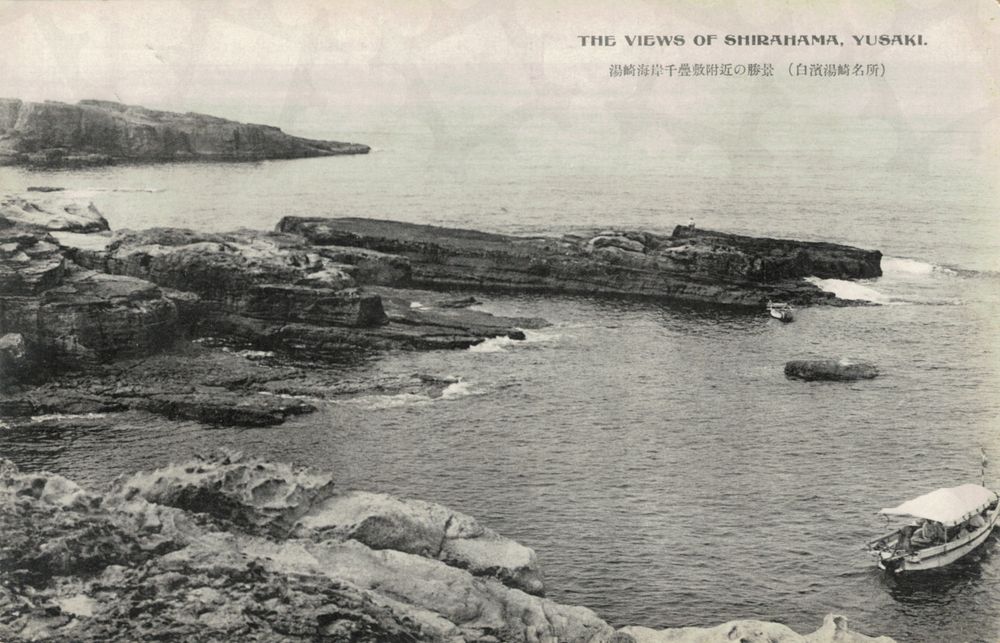
Senjōjiki has been sculpted by the sea for centuries and, at the time this photo was taken, copiously engraved by human hands. Since then, the two—sea and human hands—have collaborated to leave mostly the sea's work on display there. For the better, I say.
historyinpostcards.com/japan/140/
historyinpostcards.com/japan/140/
June 24, 2025 at 7:04 PM
Senjōjiki has been sculpted by the sea for centuries and, at the time this photo was taken, copiously engraved by human hands. Since then, the two—sea and human hands—have collaborated to leave mostly the sea's work on display there. For the better, I say.
historyinpostcards.com/japan/140/
historyinpostcards.com/japan/140/
Today, a kid would rightly be scolded for trying to reach Tatami Rock off the coast of Cape Misaki at high tide, but it is easy to imagine the smile of a little rascal who just became the king of his own island. Much more adventurous than watching Netflix!
historyinpostcards.com/japan/29/
historyinpostcards.com/japan/29/

June 23, 2025 at 4:56 PM
Today, a kid would rightly be scolded for trying to reach Tatami Rock off the coast of Cape Misaki at high tide, but it is easy to imagine the smile of a little rascal who just became the king of his own island. Much more adventurous than watching Netflix!
historyinpostcards.com/japan/29/
historyinpostcards.com/japan/29/
One of the things I like about Japanese decorative stamps is how faithfully they often represent their subjects. A case in point is this stamp of Gōra Park in Hakone. Sadly, the distinct, lovely street lamps are gone now, but the park retains its beauty.
historyinpostcards.com/japan/174/
historyinpostcards.com/japan/174/

June 20, 2025 at 6:48 PM
One of the things I like about Japanese decorative stamps is how faithfully they often represent their subjects. A case in point is this stamp of Gōra Park in Hakone. Sadly, the distinct, lovely street lamps are gone now, but the park retains its beauty.
historyinpostcards.com/japan/174/
historyinpostcards.com/japan/174/
Sometimes it is the kanji themselves that decorate the stamp, utilizing both older characters and ancient script. While this requires a degree of knowledge to appreciate, you can try comparing the upper line to a modern transcription: 拝参社神島之江
historyinpostcards.com/japan/206/
historyinpostcards.com/japan/206/

June 19, 2025 at 6:11 PM
Sometimes it is the kanji themselves that decorate the stamp, utilizing both older characters and ancient script. While this requires a degree of knowledge to appreciate, you can try comparing the upper line to a modern transcription: 拝参社神島之江
historyinpostcards.com/japan/206/
historyinpostcards.com/japan/206/
This lovely, evocative stamp proudly announces Kimii Temple as the second stop on the Saigoku Kannon Pilgrimage. The temple's grounds are a beautiful marriage of nature and Buddhist architecture that is worth visiting even without spiritual motivation.
historyinpostcards.com/japan/9/
historyinpostcards.com/japan/9/

June 18, 2025 at 5:28 PM
This lovely, evocative stamp proudly announces Kimii Temple as the second stop on the Saigoku Kannon Pilgrimage. The temple's grounds are a beautiful marriage of nature and Buddhist architecture that is worth visiting even without spiritual motivation.
historyinpostcards.com/japan/9/
historyinpostcards.com/japan/9/
Another hotel you can no longer visit is the Gōra Hotel in Hakone. Its distinct modern visage made it immediately recognizable when it opened in 1938, welcoming visitors of the then-recently established Fuji-Hakone National Park. It was closed in 1998.
historyinpostcards.com/japan/174/
historyinpostcards.com/japan/174/

June 17, 2025 at 3:57 PM
Another hotel you can no longer visit is the Gōra Hotel in Hakone. Its distinct modern visage made it immediately recognizable when it opened in 1938, welcoming visitors of the then-recently established Fuji-Hakone National Park. It was closed in 1998.
historyinpostcards.com/japan/174/
historyinpostcards.com/japan/174/
With a decidedly lighter theme, we continue with further elaborate decorative Japanese stamps. This one captures the lovely autumn scenery surrounding the 19th-century Kaedegawarō Hotel in Shiobara Onsen. Alas, its latest iteration was closed in 2017.
historyinpostcards.com/japan/128/
historyinpostcards.com/japan/128/

June 16, 2025 at 4:30 PM
With a decidedly lighter theme, we continue with further elaborate decorative Japanese stamps. This one captures the lovely autumn scenery surrounding the 19th-century Kaedegawarō Hotel in Shiobara Onsen. Alas, its latest iteration was closed in 2017.
historyinpostcards.com/japan/128/
historyinpostcards.com/japan/128/
"Air raid! Water.. Mask.. Lights..," exclaims the stamp, whose design also appeared on posters and fliers. In what is the cruelest of ironies, it is stamped on a postcard of Kototoi Bridge, where thousands of souls perished during the Bombing of Tokyo.
historyinpostcards.com/japan/74/
historyinpostcards.com/japan/74/

June 13, 2025 at 4:15 PM
"Air raid! Water.. Mask.. Lights..," exclaims the stamp, whose design also appeared on posters and fliers. In what is the cruelest of ironies, it is stamped on a postcard of Kototoi Bridge, where thousands of souls perished during the Bombing of Tokyo.
historyinpostcards.com/japan/74/
historyinpostcards.com/japan/74/
There might be little glory in digging a trench or building a bridge, but that is actually how battles are won. The moment a country starts training sappers en masse instead of select elite special forces, you know it is matching into a real war.
historyinpostcards.com/japan/73/
historyinpostcards.com/japan/73/

June 12, 2025 at 4:56 PM
There might be little glory in digging a trench or building a bridge, but that is actually how battles are won. The moment a country starts training sappers en masse instead of select elite special forces, you know it is matching into a real war.
historyinpostcards.com/japan/73/
historyinpostcards.com/japan/73/