



Hemlata Agarwala
@hemlataagarwala.bsky.social
Group Leader @ Technical University of Munich (TUM), Germany; Passionate coordination chemist with keen enthusiasm for Biology
Reposted by Hemlata Agarwala

Every machine in a Hospital that diagnoses your body without cutting you open is based on a principle of Physics, discovered by a Physicist who had no interest in Medicine.
If you think the world doesn’t need Basic Science, or that somehow Science has failed you, think again.
#sciencematters
If you think the world doesn’t need Basic Science, or that somehow Science has failed you, think again.
#sciencematters

November 25, 2025 at 1:40 AM
Every machine in a Hospital that diagnoses your body without cutting you open is based on a principle of Physics, discovered by a Physicist who had no interest in Medicine.
If you think the world doesn’t need Basic Science, or that somehow Science has failed you, think again.
#sciencematters
If you think the world doesn’t need Basic Science, or that somehow Science has failed you, think again.
#sciencematters
Reposted by Hemlata Agarwala

Can ChatGPT and Other AI Bots Serve as Peer Reviewers? | ACS Energy Letters pubs.acs.org/doi/10.1021/...

Can ChatGPT and Other AI Bots Serve as Peer Reviewers?
OR SEARCH CITATIONS
pubs.acs.org
March 7, 2025 at 12:20 PM
Can ChatGPT and Other AI Bots Serve as Peer Reviewers? | ACS Energy Letters pubs.acs.org/doi/10.1021/...
Elated to share that I have been selected by the European Innovation Council (EIC) to participate in the Women in Leadeship Programme (WLP) - 7th Cohort. Looking forward to be trained by some of the best expert innovators and entrepreneurs of Europe! #EUeic
@ec.europa.eu
@ec.europa.eu
February 22, 2025 at 8:48 PM
Elated to share that I have been selected by the European Innovation Council (EIC) to participate in the Women in Leadeship Programme (WLP) - 7th Cohort. Looking forward to be trained by some of the best expert innovators and entrepreneurs of Europe! #EUeic
@ec.europa.eu
@ec.europa.eu
Zoning in! Want to decipher complexity in electrochemical systems? Check out this new automated approach to construct Zone Diagrams in #Electrochemistry through a geometrical approach. A truly credible work done by @benajohnson.bsky.social 👇
Introducing a new, automated approach for constructing Zone Diagrams in #Electrochemistry. Check out how it is possible to decipher complexity in electrochemical systems through the lens of geometry, out now in JACS! #ChemSky pubs.acs.org/doi/10.1021/...

A Geometric Interpretation of Kinetic Zone Diagrams in Electrochemistry
Electrochemical systems with increasing complexity are gaining importance in catalytic energy conversion applications. Due to the interplay between transport phenomena and chemical kinetics, predicting optimization is a challenge, with numerous parameters controlling the overall performance. Zone diagrams provide a way to identify specific kinetic regimes and track how variations in the governing parameters translate the system between either adverse or optimal kinetic states. However, the current procedures for constructing zone diagrams are restricted to simplified systems with a minimal number of governing parameters. We present a computationally based method that maps the entire parameter space of multidimensional electrochemical systems and automatically identifies kinetic regimes. Once the current output over a discrete set of parameters is interpreted as a geometric surface, its geometry encodes all of the information needed to construct a zone diagram. Zone boundaries and limiting zones are defined by curved and flat regions, respectively. This geometric framework enables a systematic exploration of the parameter space, which is not readily accessible by analytical or direct numerical methods. This will become increasingly valuable for the rational design of electrochemical systems with intrinsically high complexity.
pubs.acs.org
February 22, 2025 at 11:45 AM
Zoning in! Want to decipher complexity in electrochemical systems? Check out this new automated approach to construct Zone Diagrams in #Electrochemistry through a geometrical approach. A truly credible work done by @benajohnson.bsky.social 👇
Happy to have contributed to this ground-breaking work in the field of redox conductive MOFs. Check it out! Just out in @chemsci.rsc.org #Chemistry #MOF #MarcusTheory 👇
What's rate-limiting in (redox) conductive MOFs: electron or ion diffusion? Turns out, neither. Instead, we find that slow ion diffusion generates an electric field that accelerates charge transport. Excited to share our recent paper out now in ChemSci! #ChemSky
pubs.rsc.org/en/Content/A...
pubs.rsc.org/en/Content/A...
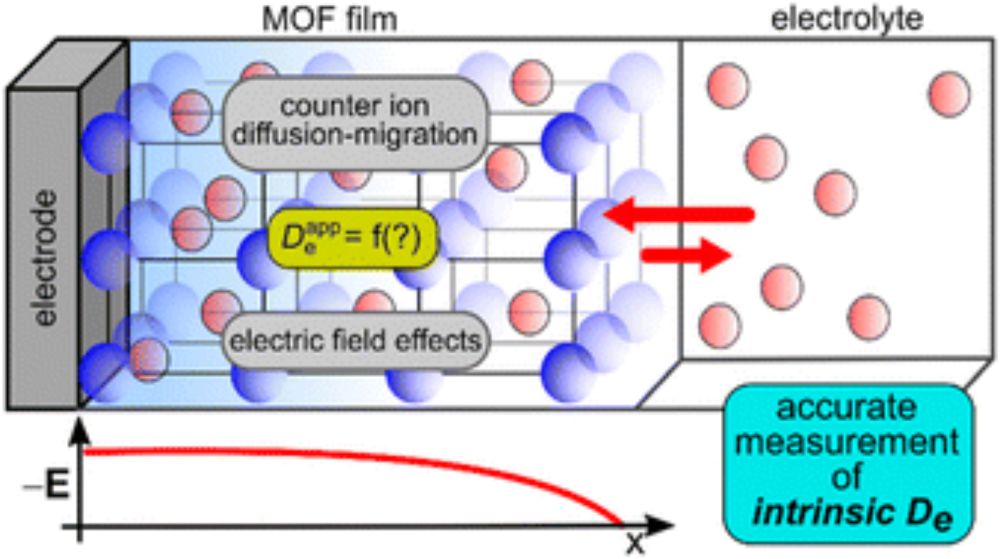
Beyond diffusion: ion and electron migration contribute to charge transport in redox-conducting metal–organic frameworks
Electrical conductivity through redox conducting MOFs (RCMOFs) proceeds by electron hopping between linkers of differing oxidation states. While this process is treated as a purely diffusional process...
pubs.rsc.org
February 22, 2025 at 11:39 AM
Happy to have contributed to this ground-breaking work in the field of redox conductive MOFs. Check it out! Just out in @chemsci.rsc.org #Chemistry #MOF #MarcusTheory 👇
Reposted by Hemlata Agarwala

What's rate-limiting in (redox) conductive MOFs: electron or ion diffusion? Turns out, neither. Instead, we find that slow ion diffusion generates an electric field that accelerates charge transport. Excited to share our recent paper out now in ChemSci! #ChemSky
pubs.rsc.org/en/Content/A...
pubs.rsc.org/en/Content/A...
Beyond diffusion: ion and electron migration contribute to charge transport in redox-conducting metal–organic frameworks
Electrical conductivity through redox conducting MOFs (RCMOFs) proceeds by electron hopping between linkers of differing oxidation states. While this process is treated as a purely diffusional process...
pubs.rsc.org
February 21, 2025 at 10:55 PM
What's rate-limiting in (redox) conductive MOFs: electron or ion diffusion? Turns out, neither. Instead, we find that slow ion diffusion generates an electric field that accelerates charge transport. Excited to share our recent paper out now in ChemSci! #ChemSky
pubs.rsc.org/en/Content/A...
pubs.rsc.org/en/Content/A...