Hanlu He
@hanluhe.bsky.social
PhD student @ SINeLab (Technical University of Denmark). Exploring interpersonal temporal dynamics of social interaction - in the lab and out in the wild.
More broadly, this work establishes IPS as a scalable marker of real-world social engagement and provides a framework for testing theories of shared attention, reciprocal interaction, and sensory–cognitive co-regulation in everyday environments.
December 7, 2025 at 8:57 AM
More broadly, this work establishes IPS as a scalable marker of real-world social engagement and provides a framework for testing theories of shared attention, reciprocal interaction, and sensory–cognitive co-regulation in everyday environments.
Together, these findings demonstrate that IPS emerges spontaneously in naturalistic social settings and is jointly constrained by physical proximity, social affiliation, social context, and the acoustic environment.
December 7, 2025 at 8:57 AM
Together, these findings demonstrate that IPS emerges spontaneously in naturalistic social settings and is jointly constrained by physical proximity, social affiliation, social context, and the acoustic environment.
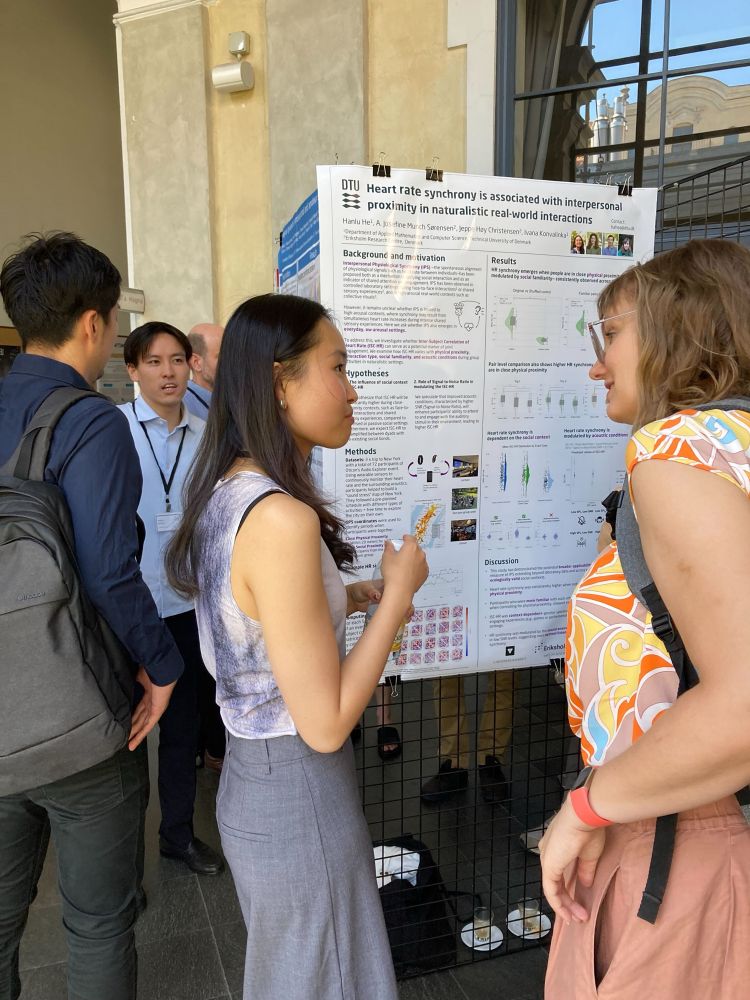
Acoustic conditions also modulated IPS: low-to-moderate sound pressure levels (SPL) and moderate-to-high signal-to-noise ratios (SNR) enhanced synchrony, while high SPL reduced it to levels characteristic of non-interactive contexts.

December 7, 2025 at 8:57 AM
Acoustic conditions also modulated IPS: low-to-moderate sound pressure levels (SPL) and moderate-to-high signal-to-noise ratios (SNR) enhanced synchrony, while high SPL reduced it to levels characteristic of non-interactive contexts.
Context matters. Synchrony emerged during close-proximity interactions and when people were exposed to common stimuli, but not during dispersed, non-interactive settings.

December 7, 2025 at 8:57 AM
Context matters. Synchrony emerged during close-proximity interactions and when people were exposed to common stimuli, but not during dispersed, non-interactive settings.
Synchrony was stronger for pairs who already knew each other — even after controlling for being in the same place.

December 7, 2025 at 8:57 AM
Synchrony was stronger for pairs who already knew each other — even after controlling for being in the same place.
People’s heart rates synchronized reliably when they were physically close, indicating that shared spatial and contextual exposure was sufficient to produce IPS.

December 7, 2025 at 8:57 AM
People’s heart rates synchronized reliably when they were physically close, indicating that shared spatial and contextual exposure was sufficient to produce IPS.
To address this, we collected continuous heart rate, GPS, and acoustic recordings from 72 participants across three independent multi-day trips to New York City, totaling >1000 hours of multimodal data.

December 7, 2025 at 8:57 AM
To address this, we collected continuous heart rate, GPS, and acoustic recordings from 72 participants across three independent multi-day trips to New York City, totaling >1000 hours of multimodal data.
Although IPS has been documented in laboratory and high-arousal settings, its emergence in everyday social interactions remains elusive.
December 7, 2025 at 8:57 AM
Although IPS has been documented in laboratory and high-arousal settings, its emergence in everyday social interactions remains elusive.
Our study presents the first large-scale evidence that interpersonal physiological synchrony (IPS) emerges in everyday social interactions and is systematically modulated by physical proximity, social familiarity, social context, and acoustic conditions.
December 7, 2025 at 8:57 AM
Our study presents the first large-scale evidence that interpersonal physiological synchrony (IPS) emerges in everyday social interactions and is systematically modulated by physical proximity, social familiarity, social context, and acoustic conditions.
Reposted by Hanlu He