


Gregory Gorobets 🌻
@gregorygorobets.bsky.social
chem phd @uchicago | wuttig lab 🐸 | ndseg fellow | ucla '23 | he/him
leveraging self-assembly on electrified interfaces for catalysis ⚡
leveraging self-assembly on electrified interfaces for catalysis ⚡
Reposted by Gregory Gorobets 🌻
🚨FEE WAIVERS!🚨
Sign up for our info sessions on Nov. 4 and Nov. 11th - anyone who registers and attends will get an application fee waiver!
chemistry.uchicago.edu/graduate-pro...
Sign up for our info sessions on Nov. 4 and Nov. 11th - anyone who registers and attends will get an application fee waiver!
chemistry.uchicago.edu/graduate-pro...

September 18, 2025 at 2:10 PM
🚨FEE WAIVERS!🚨
Sign up for our info sessions on Nov. 4 and Nov. 11th - anyone who registers and attends will get an application fee waiver!
chemistry.uchicago.edu/graduate-pro...
Sign up for our info sessions on Nov. 4 and Nov. 11th - anyone who registers and attends will get an application fee waiver!
chemistry.uchicago.edu/graduate-pro...
Reposted by Gregory Gorobets 🌻
Join us for upcoming info sessions to learn more about our PhD program in Chemistry at the University of Chicago! Details below.
We are super excited about our vibrant research community, and you could be a part of it! Applications are also now open!
chemistry.uchicago.edu/graduate-pro...
We are super excited about our vibrant research community, and you could be a part of it! Applications are also now open!
chemistry.uchicago.edu/graduate-pro...
September 25, 2025 at 3:07 AM
Join us for upcoming info sessions to learn more about our PhD program in Chemistry at the University of Chicago! Details below.
We are super excited about our vibrant research community, and you could be a part of it! Applications are also now open!
chemistry.uchicago.edu/graduate-pro...
We are super excited about our vibrant research community, and you could be a part of it! Applications are also now open!
chemistry.uchicago.edu/graduate-pro...
Reposted by Gregory Gorobets 🌻
My lab’s next paper is out in JACS!
Our electrode-orthogonal self-assembled layers can "self-heal" after degradation -- the key is a dynamic linkage we can molecularly tune! Hats off to Nico!
pubs.acs.org/doi/full/10....
Our electrode-orthogonal self-assembled layers can "self-heal" after degradation -- the key is a dynamic linkage we can molecularly tune! Hats off to Nico!
pubs.acs.org/doi/full/10....

July 19, 2025 at 1:57 PM
My lab’s next paper is out in JACS!
Our electrode-orthogonal self-assembled layers can "self-heal" after degradation -- the key is a dynamic linkage we can molecularly tune! Hats off to Nico!
pubs.acs.org/doi/full/10....
Our electrode-orthogonal self-assembled layers can "self-heal" after degradation -- the key is a dynamic linkage we can molecularly tune! Hats off to Nico!
pubs.acs.org/doi/full/10....
Reposted by Gregory Gorobets 🌻

Following quickly on her defense, Maia's most recent paper on electrochemical alkyne hydroalkylation was just published in ACS Catalysis! We think this is nice complement to Wittig chemistry, with better compatibility for several functional groups.
pubs.acs.org/doi/full/10....
pubs.acs.org/doi/full/10....
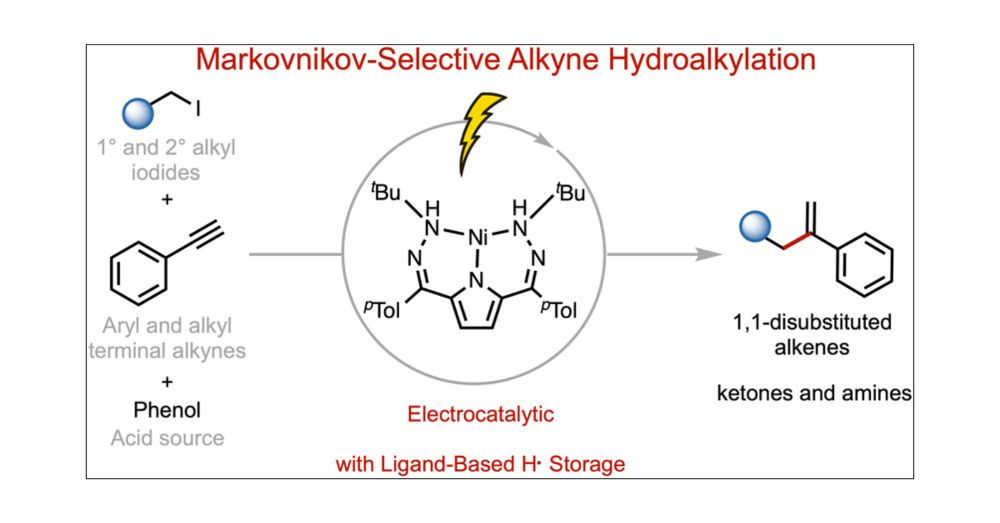
Markovnikov-Selective Electrocatalytic Hydroalkylation Enabled by Metal–Ligand Cooperative Storage of H-Atom Equivalents
The synthesis of 1,1-disubstituted olefins is an important transformation that classically uses strategies like Wittig chemistry or cross-coupling reactions. Here, we introduce an electrochemical method for the selective hydroalkylation of terminal alkynes to generate a variety of 1,1-disubstituted olefins. This approach utilizes a dihydrazonopyrrole Ni complex capable of storing a H2 equivalent (2H+ + 2e–) on the ligand backbone. This mild reaction uses electricity and a weak acid and thus tolerates amine and ketone functional groups which are sensitive to classic Wittig conditions. Mechanistic studies reveal the essential role of the ligand steric environment in dictating product regioselectivity. Calculations support an outer sphere alkyl radical addition instead of a Ni-centered reductive elimination mechanism which is commonly invoked for transition-metal hydroalkylation catalysts. Beyond its unique functional group compatibility, the scope of this reaction includes primary and secondary alkyl iodide electrophiles along with unactivated alkyne substrates. These findings underscore how metal–ligand cooperativity, particularly with ligand-based storage of protons and electrons, supports catalytic platforms which can be tuned for varied electrosynthetic applications beyond hydrogenation.
pubs.acs.org
June 6, 2025 at 6:43 PM
Following quickly on her defense, Maia's most recent paper on electrochemical alkyne hydroalkylation was just published in ACS Catalysis! We think this is nice complement to Wittig chemistry, with better compatibility for several functional groups.
pubs.acs.org/doi/full/10....
pubs.acs.org/doi/full/10....
Reposted by Gregory Gorobets 🌻
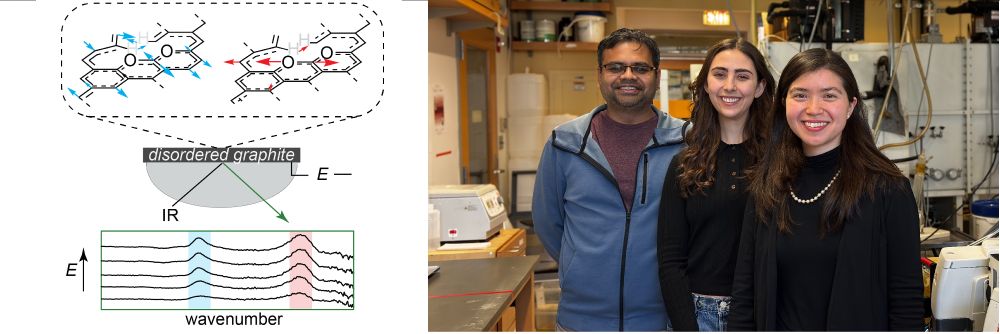
My lab's next paper is out in Angewandte Chemie!
Disorder activates graphitic carbon for echem rxns—but can we distinguish it in situ? Varying disorder shows different electric-field IR responses!
w/ Ry, Ben & calculations from Arpan in Galli Group
onlinelibrary.wiley.com/doi/10.1002/...
Disorder activates graphitic carbon for echem rxns—but can we distinguish it in situ? Varying disorder shows different electric-field IR responses!
w/ Ry, Ben & calculations from Arpan in Galli Group
onlinelibrary.wiley.com/doi/10.1002/...
January 17, 2025 at 9:55 PM
My lab's next paper is out in Angewandte Chemie!
Disorder activates graphitic carbon for echem rxns—but can we distinguish it in situ? Varying disorder shows different electric-field IR responses!
w/ Ry, Ben & calculations from Arpan in Galli Group
onlinelibrary.wiley.com/doi/10.1002/...
Disorder activates graphitic carbon for echem rxns—but can we distinguish it in situ? Varying disorder shows different electric-field IR responses!
w/ Ry, Ben & calculations from Arpan in Galli Group
onlinelibrary.wiley.com/doi/10.1002/...
Reposted by Gregory Gorobets 🌻
Happy to share the group's last paper of 2024, just accepted in Dalton Transactions. Congrats to Lauren and Nate! Check out how we link ligand pi-accepting and sigma-donating properties to the physical and photophysical properties of TTFtt diradicaloids.
pubs.rsc.org/en/content/a...
pubs.rsc.org/en/content/a...
Deconvoluting Capping Ligand Influence on Photophysical Properties in Tetrathiafulvalene-Based Diradicaloids
Tetrathiafulvalene-2,3,6,7-tetrathiolate (TTFtt) complexes are synthetically tunable and emit brightly in the near-infrared II region (NIR II, 1000-1700 nm). Their emission/absorption energies respond...
pubs.rsc.org
December 13, 2024 at 2:20 PM
Happy to share the group's last paper of 2024, just accepted in Dalton Transactions. Congrats to Lauren and Nate! Check out how we link ligand pi-accepting and sigma-donating properties to the physical and photophysical properties of TTFtt diradicaloids.
pubs.rsc.org/en/content/a...
pubs.rsc.org/en/content/a...
Reposted by Gregory Gorobets 🌻
You still have a chance to sign up for the UChicago Chemistry PhD info session, held on Nov 21st: apply-psd.uchicago.edu/register/?id...
Prospective students, especially those interested in the application process and/or fee waivers are encouraged to attend!
Prospective students, especially those interested in the application process and/or fee waivers are encouraged to attend!
UChicago Chemistry PhD Program Info Session
apply-psd.uchicago.edu
November 18, 2024 at 3:50 PM
You still have a chance to sign up for the UChicago Chemistry PhD info session, held on Nov 21st: apply-psd.uchicago.edu/register/?id...
Prospective students, especially those interested in the application process and/or fee waivers are encouraged to attend!
Prospective students, especially those interested in the application process and/or fee waivers are encouraged to attend!