



Gergely Hajdu
@gregecon.bsky.social
Behavioral economist at Vienna University of Economics and Business
https://sites.google.com/view/gergelyhajdu/
https://sites.google.com/view/gergelyhajdu/
In case the pervious link wouldn’t work: papers.ssrn.com/sol3/papers....
Lengthy waiting corrupts, especially when unexpected
<div>
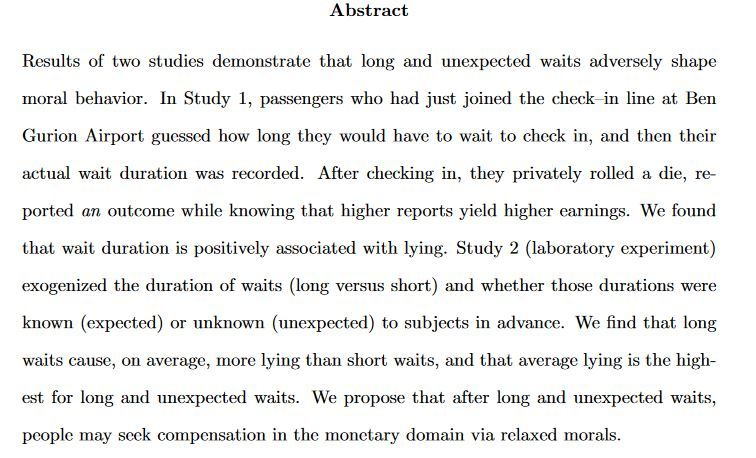
Results of two studies demonstrate that long and unexpected waits adversely shape <span>moral behavior. In Study 1, passengers who had just joined t
papers.ssrn.com
January 28, 2025 at 6:11 PM
In case the pervious link wouldn’t work: papers.ssrn.com/sol3/papers....
6/6
💡 For more details, check out our full paper papers.ssrn.com/sol3/papers....
💡 For more details, check out our full paper papers.ssrn.com/sol3/papers....
January 28, 2025 at 5:44 PM
6/6
💡 For more details, check out our full paper papers.ssrn.com/sol3/papers....
💡 For more details, check out our full paper papers.ssrn.com/sol3/papers....
5/6
📌 Examples:
A long, unexpected wait at a bank 🏦 might lead a frustrated customer to misreport income on a loan application.
Delayed exams 📝 could push students to justify cutting corners to recover lost time.
Everyday frustrations might have deeper ethical consequences than we realize.
📌 Examples:
A long, unexpected wait at a bank 🏦 might lead a frustrated customer to misreport income on a loan application.
Delayed exams 📝 could push students to justify cutting corners to recover lost time.
Everyday frustrations might have deeper ethical consequences than we realize.
January 28, 2025 at 5:44 PM
5/6
📌 Examples:
A long, unexpected wait at a bank 🏦 might lead a frustrated customer to misreport income on a loan application.
Delayed exams 📝 could push students to justify cutting corners to recover lost time.
Everyday frustrations might have deeper ethical consequences than we realize.
📌 Examples:
A long, unexpected wait at a bank 🏦 might lead a frustrated customer to misreport income on a loan application.
Delayed exams 📝 could push students to justify cutting corners to recover lost time.
Everyday frustrations might have deeper ethical consequences than we realize.
4/6
🤯 Why does this happen?
We propose a mechanism called “cross-domain compensation”: When people feel they’ve lost time—especially through unexpected delays—they develop a sense of being “owed”. This can lead to relaxing moral constraints to "make up" for that loss.
🤯 Why does this happen?
We propose a mechanism called “cross-domain compensation”: When people feel they’ve lost time—especially through unexpected delays—they develop a sense of being “owed”. This can lead to relaxing moral constraints to "make up" for that loss.
January 28, 2025 at 5:44 PM
4/6
🤯 Why does this happen?
We propose a mechanism called “cross-domain compensation”: When people feel they’ve lost time—especially through unexpected delays—they develop a sense of being “owed”. This can lead to relaxing moral constraints to "make up" for that loss.
🤯 Why does this happen?
We propose a mechanism called “cross-domain compensation”: When people feel they’ve lost time—especially through unexpected delays—they develop a sense of being “owed”. This can lead to relaxing moral constraints to "make up" for that loss.
3/6
🧪 Study 2: Lab Experiment
Participants were randomly assigned to short or long waits, with the duration either disclosed or not. Afterward, they completed a die-roll task where higher reports meant higher payoffs.
Result: A long, unexpected wait triggered the highest levels of dishonesty.
🧪 Study 2: Lab Experiment
Participants were randomly assigned to short or long waits, with the duration either disclosed or not. Afterward, they completed a die-roll task where higher reports meant higher payoffs.
Result: A long, unexpected wait triggered the highest levels of dishonesty.
January 28, 2025 at 5:44 PM
3/6
🧪 Study 2: Lab Experiment
Participants were randomly assigned to short or long waits, with the duration either disclosed or not. Afterward, they completed a die-roll task where higher reports meant higher payoffs.
Result: A long, unexpected wait triggered the highest levels of dishonesty.
🧪 Study 2: Lab Experiment
Participants were randomly assigned to short or long waits, with the duration either disclosed or not. Afterward, they completed a die-roll task where higher reports meant higher payoffs.
Result: A long, unexpected wait triggered the highest levels of dishonesty.
2/6
✈️ Study 1: Airport Field Experiment
Passengers waited in a check-in queue and were then asked to report a die roll in private, knowing that higher reports would yield higher payoffs. 📈
Finding: The longer passengers waited, the more they inflated their die-roll outcomes for personal gain.
✈️ Study 1: Airport Field Experiment
Passengers waited in a check-in queue and were then asked to report a die roll in private, knowing that higher reports would yield higher payoffs. 📈
Finding: The longer passengers waited, the more they inflated their die-roll outcomes for personal gain.
January 28, 2025 at 5:44 PM
2/6
✈️ Study 1: Airport Field Experiment
Passengers waited in a check-in queue and were then asked to report a die roll in private, knowing that higher reports would yield higher payoffs. 📈
Finding: The longer passengers waited, the more they inflated their die-roll outcomes for personal gain.
✈️ Study 1: Airport Field Experiment
Passengers waited in a check-in queue and were then asked to report a die roll in private, knowing that higher reports would yield higher payoffs. 📈
Finding: The longer passengers waited, the more they inflated their die-roll outcomes for personal gain.