




Granville Matheson
@granvillejmath.bsky.social
Enthusiast, dad, researcher. Working at Karolinska Institutet with PET quantification and analysis. Interested in (Bayesian) stats, molecular imaging, pharmacokinetics, #rstats, brains and brain imaging. Scottish South African in Sweden.
If you have any questions or would like some help with implementing the model, don't hesitate to shoot me a mail! We also have a clinical paper coming soon with this data to show that this model can identify new clinically-relevant associations which were not previously identifiable!
December 9, 2024 at 10:52 AM
If you have any questions or would like some help with implementing the model, don't hesitate to shoot me a mail! We also have a clinical paper coming soon with this data to show that this model can identify new clinically-relevant associations which were not previously identifiable!
This model is currently implemented in #rstats, @mcmc_stan and #brms, but it should be quite straightforward to translate to other languages. I've included the code and sample data, as well as a fully documented notebook to demonstrate how to use it github.com/mathesong/Si...

GitHub - mathesong/SiMBA_Ref_Materials: Demonstration of how to apply SiMBA for reference tissue models SRTM and FRTM
Demonstration of how to apply SiMBA for reference tissue models SRTM and FRTM - mathesong/SiMBA_Ref_Materials
github.com
December 9, 2024 at 10:52 AM
This model is currently implemented in #rstats, @mcmc_stan and #brms, but it should be quite straightforward to translate to other languages. I've included the code and sample data, as well as a fully documented notebook to demonstrate how to use it github.com/mathesong/Si...
It is known that there is regional variation in the rate of decreases in serotonin 1B receptor BP. So we checked the variations from the mean age effect, and even here, our outcomes were highly replicable.

December 9, 2024 at 10:52 AM
It is known that there is regional variation in the rate of decreases in serotonin 1B receptor BP. So we checked the variations from the mean age effect, and even here, our outcomes were highly replicable.
Despite all these differences, our model yielded highly similar estimates of the association between model parameters and age across datasets. We also found that we could also successfully combine and harmonise datasets in the same model using covariates to improve performance further.

December 9, 2024 at 10:52 AM
Despite all these differences, our model yielded highly similar estimates of the association between model parameters and age across datasets. We also found that we could also successfully combine and harmonise datasets in the same model using covariates to improve performance further.
Applied to real datasets, we decided to test how replicable our mode's inferences were in data from three different PET centres, with different PET systems, acquisition protocols, preprocessing, subject demographics. So we looked at the effects of age on regional serotonin 1B receptor availability.
December 9, 2024 at 10:52 AM
Applied to real datasets, we decided to test how replicable our mode's inferences were in data from three different PET centres, with different PET systems, acquisition protocols, preprocessing, subject demographics. So we looked at the effects of age on regional serotonin 1B receptor availability.
We also show large improvements to inferences made. Here, estimating simulated treatment effects relative to a placebo intervention. A: large increases in power, and B: our model's estimates of treatment effects are closer to the true value across simulated datasets

December 9, 2024 at 10:52 AM
We also show large improvements to inferences made. Here, estimating simulated treatment effects relative to a placebo intervention. A: large increases in power, and B: our model's estimates of treatment effects are closer to the true value across simulated datasets
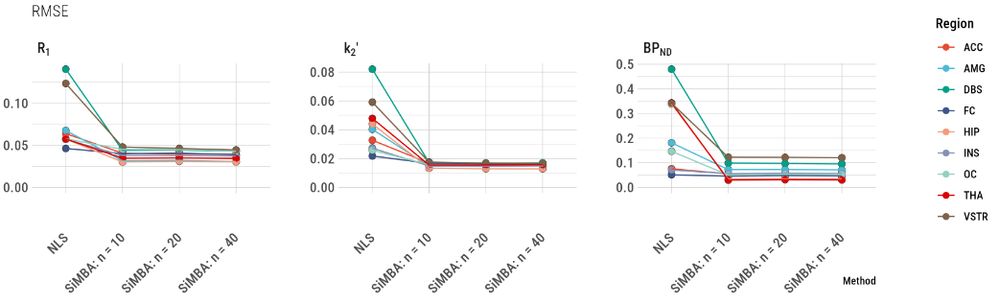
We show dramatic improvements in quantification using SRTM, reducing the RMSE by over 50% on average (and up to 90% for one region) for BPND, but also for the other estimated parameters too.
December 9, 2024 at 10:52 AM
We show dramatic improvements in quantification using SRTM, reducing the RMSE by over 50% on average (and up to 90% for one region) for BPND, but also for the other estimated parameters too.
This builds on our previous work where we introduced this approach, called SiMBA, for gold-standard invasive PET quantification i.e. with arterial blood collection. But most quantitative PET uses reference regions instead: now SiMBA can be applied for this too!
www.sciencedirect.com/science/arti...
www.sciencedirect.com/science/arti...
December 9, 2024 at 10:52 AM
This builds on our previous work where we introduced this approach, called SiMBA, for gold-standard invasive PET quantification i.e. with arterial blood collection. But most quantitative PET uses reference regions instead: now SiMBA can be applied for this too!
www.sciencedirect.com/science/arti...
www.sciencedirect.com/science/arti...
Riiight - nice idea! All that lagging and leading is going to get pretty brutal though! 😄
Mixing up a bit of base and a bit of tidyverse whenever they feel right just suits the way my brain works - but all the really "paradigm"-consistent solutions always just look so satisfying!
Mixing up a bit of base and a bit of tidyverse whenever they feel right just suits the way my brain works - but all the really "paradigm"-consistent solutions always just look so satisfying!
December 4, 2024 at 10:01 AM
Riiight - nice idea! All that lagging and leading is going to get pretty brutal though! 😄
Mixing up a bit of base and a bit of tidyverse whenever they feel right just suits the way my brain works - but all the really "paradigm"-consistent solutions always just look so satisfying!
Mixing up a bit of base and a bit of tidyverse whenever they feel right just suits the way my brain works - but all the really "paradigm"-consistent solutions always just look so satisfying!
After seeing some of you folks rocking the cheeky eval(parse()) today, I'm feeling extra inspired to follow along and learn some new tricks... I'll try to keep up for as long as I can!
December 3, 2024 at 10:00 PM
After seeing some of you folks rocking the cheeky eval(parse()) today, I'm feeling extra inspired to follow along and learn some new tricks... I'll try to keep up for as long as I can!
And thanks so much to @riinu.bsky.social for teaching me about carbon.now.sh for generating the geautiful code figures!

Carbon
Carbon is the easiest way to create and share beautiful images of your source code.
carbon.now.sh
December 3, 2024 at 6:58 AM
And thanks so much to @riinu.bsky.social for teaching me about carbon.now.sh for generating the geautiful code figures!
Awesome - thanks!! I've seen these so often and always wondered...
December 2, 2024 at 3:28 PM
Awesome - thanks!! I've seen these so often and always wondered...
I love your clean code screenshots! Are you just taking screenshots of your editor, or is there some package or add-on you're using for generating these?
December 2, 2024 at 3:24 PM
I love your clean code screenshots! Are you just taking screenshots of your editor, or is there some package or add-on you're using for generating these?