



@gladstonebrookes.bsky.social
luv soy, luv seed oils, hate animal abuse. simple as
Typo in one of the summary tables, I think.
360 out of 1000 is 36%, not 3.6%, so the absolute risk difference should be 3% (not 0.3%), which is clinically significant under their criteria (so not "little to no difference" as is currently written).
360 out of 1000 is 36%, not 3.6%, so the absolute risk difference should be 3% (not 0.3%), which is clinically significant under their criteria (so not "little to no difference" as is currently written).

November 4, 2025 at 11:22 AM
Typo in one of the summary tables, I think.
360 out of 1000 is 36%, not 3.6%, so the absolute risk difference should be 3% (not 0.3%), which is clinically significant under their criteria (so not "little to no difference" as is currently written).
360 out of 1000 is 36%, not 3.6%, so the absolute risk difference should be 3% (not 0.3%), which is clinically significant under their criteria (so not "little to no difference" as is currently written).

October 18, 2025 at 9:37 AM
This guy's takes on nutrition include the belief that seed oils cause school shootings by weakening your connection to God, and that heroin overdose is because of seed oils.


September 21, 2025 at 1:30 PM
This guy's takes on nutrition include the belief that seed oils cause school shootings by weakening your connection to God, and that heroin overdose is because of seed oils.
Hey @gidmk.bsky.social, following this post, I dug into the study further, and it turns out there are a *lot* more issues with it.
Only one of the estimates used is actually what they claim it is (odds ratio for the association between highest vs lowest intake of cruciferous veg and colon cancer)..
Only one of the estimates used is actually what they claim it is (odds ratio for the association between highest vs lowest intake of cruciferous veg and colon cancer)..


September 21, 2025 at 8:59 AM
Hey @gidmk.bsky.social, following this post, I dug into the study further, and it turns out there are a *lot* more issues with it.
Only one of the estimates used is actually what they claim it is (odds ratio for the association between highest vs lowest intake of cruciferous veg and colon cancer)..
Only one of the estimates used is actually what they claim it is (odds ratio for the association between highest vs lowest intake of cruciferous veg and colon cancer)..
My new favourite graph.

September 20, 2025 at 7:04 PM
My new favourite graph.

This seems like a really weird way to do their statistical analysis, and they don't actually provide proper justification for it.
Transforming your variables into this trichotomy would only reduce statistical power, which is especially problematic given the small sample size to start off with...
Transforming your variables into this trichotomy would only reduce statistical power, which is especially problematic given the small sample size to start off with...

August 2, 2025 at 5:55 PM
This seems like a really weird way to do their statistical analysis, and they don't actually provide proper justification for it.
Transforming your variables into this trichotomy would only reduce statistical power, which is especially problematic given the small sample size to start off with...
Transforming your variables into this trichotomy would only reduce statistical power, which is especially problematic given the small sample size to start off with...
What's with the long rambles in the discussion about CBT, the PACE trial, NICE guidelines, and Paul Garner?
Seems rather out of place.
Bonus points for erroneously describing the Cochrane review as "recently updated."
Seems rather out of place.
Bonus points for erroneously describing the Cochrane review as "recently updated."
![The review of CBT shows (on four studies about 371 participants) a clinical response in the short term of 40% for CBT compared to 26% for usual care, so an advantage of just over 20% [63]. However, the interpretation of the efficacy studies of CBT is not univocal [4], and the associations of patients with CFS/ME express strong doubts about its use [76]. CBT may have even less effect if there is comorbidity with depression [77]. If this were confirmed, it would represent a serious problem because comorbidity with depression is very common, especially in the most severe forms [77]. In contrast, as HVB-BF could influence the biorhythm system [78,79,80], this aspect could be of particular interest in respect to stress, anxiety, and mood syndromes [81]; thus, in the frequent case of co-morbidity between these disorders and chronic fatigue syndromes. Compared to CBT, the HVB-BF intervention does not claim to be therapeutic, at least in the sense that it does not aim to cure but simply to provide a tool to help the person in managing the disorder. Furthermore, it entails a more autonomous and immediate role for the user, both in applying the technique during training sessions and in independently implementing it in real-life stressful situations. For this reason, it might be that it is better accepted, and this can explain the very low dropout rate achieved. Another systematic review, recently updated, conducted specifically on exercise therapy showed a possible (moderate) effect but without evident advantages compared to CBT or antidepressants [82].](https://cdn.bsky.app/img/feed_thumbnail/plain/did:plc:p5gvf4uc5wmsm24tyr6gvj2h/bafkreidwrh7scbi7wjdtyjysfudzgoefeo7flz4nkpjkmxjpm3huogcazi@jpeg)
![The use of exercise has itself been the subject of fierce controversy. Since the publication of the previous NICE guidelines (2007) [4] and the PACE Trial (2011), the ME Association has been vehement in its argument that the use of graded, regulated and inflexible exercise therapy as a management approach for people with ME/CFS is wrong, ineffective, and can cause harm. The ME Association has called for NICE to withdraw its recommendation for the use of exercise, pointing out that research evidence has found methodological weaknesses in clinical trials proving the effectiveness of exercise and that surveys of the opinions of people who have used this therapy have shown that this treatment method can be perceived as ineffective and harmful [76]. NICE then completely revised the ME/CFS guideline and, after a full assessment of the evidence [83], withdrew its support for the use of exercise in CFS/ME. The new NICE guidelines warn against the use of exercise in Long COVID [4]. The case of Paul Garner, a professor in Liverpool, is emblematic of these controversies [84]. Garner was affected by severe CFS and Long COVID. After participating in an intensive physical exercise program, he relapsed dramatically with severe fatigue syndrome [84]. After the use of techniques to reduce symptoms and related stress, Garner slowly recovered. His journey led him to the belief that “post-exertional” malaise after an exercise plays a role in people with CFS/ME, as an automatic learnt brain response [84].](https://cdn.bsky.app/img/feed_thumbnail/plain/did:plc:p5gvf4uc5wmsm24tyr6gvj2h/bafkreidzwjke67jnw2e3yejewvfme6eecf55rz7jngdyu2ehqwtge6ucfi@jpeg)
![The ME patient associations, which were always against a “psychologizing” interpretation of the syndrome, turned against Garner. The purpose of a typical physical exercise training was thus considered a “psychologizing” interpretation [84]. It may be somewhat ambiguous because today physical exercise is known to produce bio-physiological consequences [85,86]. But this is understandable because in a recent survey of over 2000 people suffering from ME/CFS, most reported worsening of symptoms after physical exercise [87]. Garner himself reiterated that, while there is still a tendency to “psychologize” a problem for which there are no clear solutions, one must also recognize that excessive medicalization of the issue, reinforced by media coverage, fosters the belief in irreversible biological damage and, consequently, amplifies the impact [88]. This impasse could be addressed by adopting approaches that enable healthcare professionals to offer supportive interventions which, while not claiming to be curative, may enhance patients’ ability to manage their condition. If confirmed to yield these preliminary improvements, biofeedback could play a meaningful role in this regard. Firstly, because the role of the person suffering from the disorder can have a much more autonomous and independent role than in CBT, where, by definition, the role of the therapist is pivotal, and secondly, because the intervention could present fewer side effects than physical exercise, could be more accessible and, ultimately, would marry very well with other therapies aimed at the “physiopathogenetic” treatment of the disorder.](https://cdn.bsky.app/img/feed_thumbnail/plain/did:plc:p5gvf4uc5wmsm24tyr6gvj2h/bafkreiflzknnd24bej53lhxyrxsdsnbs26fu64ccmykfdve2uezrdssxmm@jpeg)
August 2, 2025 at 5:54 PM
What's with the long rambles in the discussion about CBT, the PACE trial, NICE guidelines, and Paul Garner?
Seems rather out of place.
Bonus points for erroneously describing the Cochrane review as "recently updated."
Seems rather out of place.
Bonus points for erroneously describing the Cochrane review as "recently updated."
What the heck is this gibberish?!

August 2, 2025 at 9:28 AM
What the heck is this gibberish?!
LMAO at CD (for Crohn’s Disease) being rewritten as Compact Disc.

July 29, 2025 at 8:13 AM
LMAO at CD (for Crohn’s Disease) being rewritten as Compact Disc.
What is your definition of "people who exercise", please?
The only paper linked as "further reading" is this (pmc.ncbi.nlm.nih.gov/articles/PMC...) which certainly does not have a clear dochotomisation of 'yes exercise' vs. 'no exercise', and in fact, they suggest the effects for...
The only paper linked as "further reading" is this (pmc.ncbi.nlm.nih.gov/articles/PMC...) which certainly does not have a clear dochotomisation of 'yes exercise' vs. 'no exercise', and in fact, they suggest the effects for...

July 13, 2025 at 9:25 PM
What is your definition of "people who exercise", please?
The only paper linked as "further reading" is this (pmc.ncbi.nlm.nih.gov/articles/PMC...) which certainly does not have a clear dochotomisation of 'yes exercise' vs. 'no exercise', and in fact, they suggest the effects for...
The only paper linked as "further reading" is this (pmc.ncbi.nlm.nih.gov/articles/PMC...) which certainly does not have a clear dochotomisation of 'yes exercise' vs. 'no exercise', and in fact, they suggest the effects for...
And this isn't the only one


July 9, 2025 at 8:45 AM
And this isn't the only one
Beautiful, isn't it?

July 9, 2025 at 8:42 AM
Beautiful, isn't it?
I saw this paper recently that claims age to be a mediator and even says, apparently without a hint of irony, "the mechanism remains unclear."
You don't say.
pubmed.ncbi.nlm.nih.gov/30130291/
You don't say.
pubmed.ncbi.nlm.nih.gov/30130291/

July 9, 2025 at 8:16 AM
I saw this paper recently that claims age to be a mediator and even says, apparently without a hint of irony, "the mechanism remains unclear."
You don't say.
pubmed.ncbi.nlm.nih.gov/30130291/
You don't say.
pubmed.ncbi.nlm.nih.gov/30130291/
"Our study is observational in nature, and so cannot establish causality."

July 7, 2025 at 9:51 PM
"Our study is observational in nature, and so cannot establish causality."
One interesting example I found recently is at least 17 different papers in Frontiers that randomly feature the same phrase (or very similar) wording and the same four references in the same order, all in the last several months.
x.com/GladstoneB81...
x.com/GladstoneB81...

June 18, 2025 at 8:39 PM
One interesting example I found recently is at least 17 different papers in Frontiers that randomly feature the same phrase (or very similar) wording and the same four references in the same order, all in the last several months.
x.com/GladstoneB81...
x.com/GladstoneB81...
Well, this seems like a perfectly reasonable DAG...
May 25, 2025 at 1:20 PM
Well, this seems like a perfectly reasonable DAG...
Christ, this is bleak.
Also, in what fucking universe is Gary Brecka an "expert"?
Also, in what fucking universe is Gary Brecka an "expert"?

May 14, 2025 at 10:00 PM
Christ, this is bleak.
Also, in what fucking universe is Gary Brecka an "expert"?
Also, in what fucking universe is Gary Brecka an "expert"?
Aetiology of type 2 diabetes: an experimental medicine odyssey
"This review describes a prolonged research endeavour to test the twin cycle hypothesis that type 2 diabetes is caused by fat-induced dysfunction of the liver and pancreas"
link.springer.com/article/10.1...
"This review describes a prolonged research endeavour to test the twin cycle hypothesis that type 2 diabetes is caused by fat-induced dysfunction of the liver and pancreas"
link.springer.com/article/10.1...

May 7, 2025 at 3:29 PM
Aetiology of type 2 diabetes: an experimental medicine odyssey
"This review describes a prolonged research endeavour to test the twin cycle hypothesis that type 2 diabetes is caused by fat-induced dysfunction of the liver and pancreas"
link.springer.com/article/10.1...
"This review describes a prolonged research endeavour to test the twin cycle hypothesis that type 2 diabetes is caused by fat-induced dysfunction of the liver and pancreas"
link.springer.com/article/10.1...
Very nice paper!
So would this result suggest that analyses modelling the replacement of e.g. 5%E from carbs with 5%E from fat are suspect, especially without adjustment for total energy?
So would this result suggest that analyses modelling the replacement of e.g. 5%E from carbs with 5%E from fat are suspect, especially without adjustment for total energy?

May 1, 2025 at 8:24 PM
Very nice paper!
So would this result suggest that analyses modelling the replacement of e.g. 5%E from carbs with 5%E from fat are suspect, especially without adjustment for total energy?
So would this result suggest that analyses modelling the replacement of e.g. 5%E from carbs with 5%E from fat are suspect, especially without adjustment for total energy?
What in tarnation
"Figure 7 presents the average dietary creatine intake, cancer prevalence, odds ratio (OR), and p-value across different groups as percentages."
AS PERCENTAGES?!
www.frontiersin.org/journals/nut...
"Figure 7 presents the average dietary creatine intake, cancer prevalence, odds ratio (OR), and p-value across different groups as percentages."
AS PERCENTAGES?!
www.frontiersin.org/journals/nut...

February 6, 2025 at 6:37 PM
What in tarnation
"Figure 7 presents the average dietary creatine intake, cancer prevalence, odds ratio (OR), and p-value across different groups as percentages."
AS PERCENTAGES?!
www.frontiersin.org/journals/nut...
"Figure 7 presents the average dietary creatine intake, cancer prevalence, odds ratio (OR), and p-value across different groups as percentages."
AS PERCENTAGES?!
www.frontiersin.org/journals/nut...
I flirtered with statistical significance once.

January 14, 2025 at 3:42 PM
I flirtered with statistical significance once.
Seeing pseudoscientists comparing themselves to Semmelweis or Galileo or whomever always reminds me of this quote by Carl Sagan:

January 7, 2025 at 9:14 PM
Seeing pseudoscientists comparing themselves to Semmelweis or Galileo or whomever always reminds me of this quote by Carl Sagan:
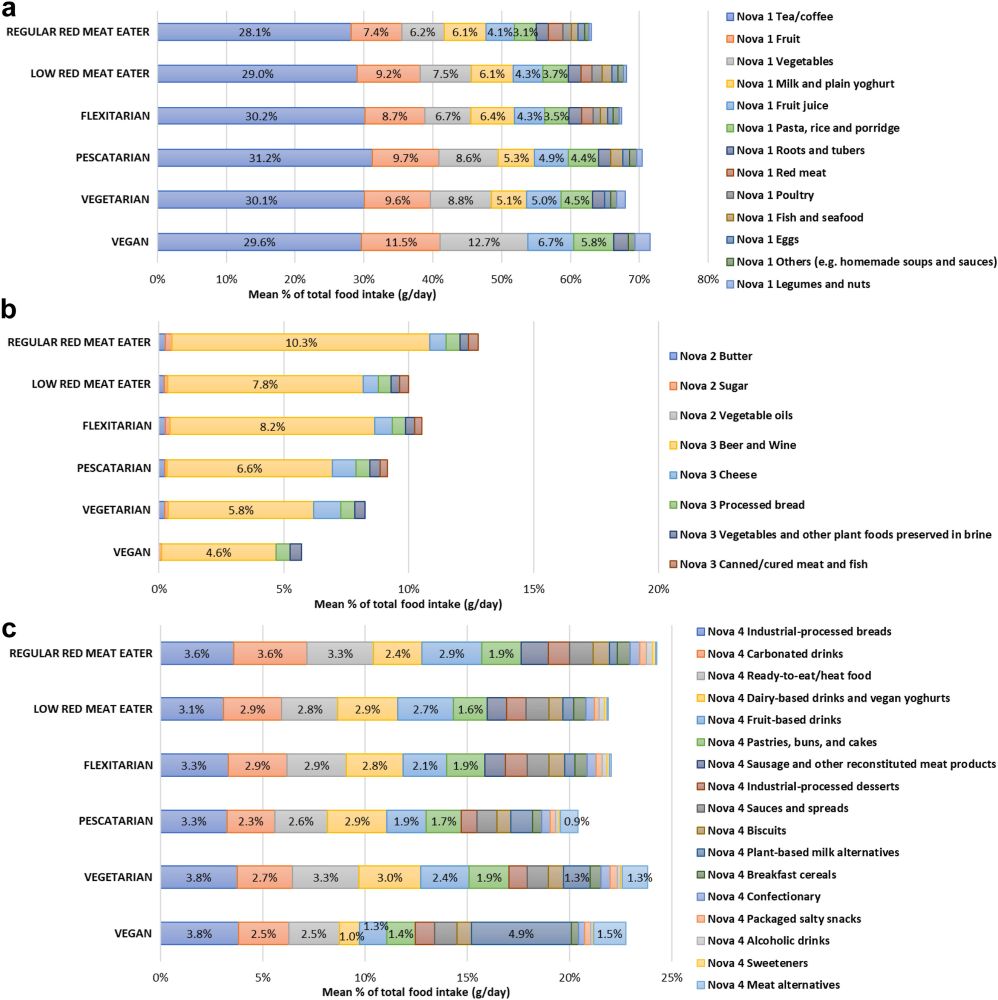
The difference in combined plant milk and meat substitute consumption between vegetarians and the reference group was around 2.2% of total food, and 2.7% of energy. In vegans, the difference was larger.
I.e. easily enough to account for the difference in total UPF intake
I.e. easily enough to account for the difference in total UPF intake
December 5, 2024 at 5:41 PM
The difference in combined plant milk and meat substitute consumption between vegetarians and the reference group was around 2.2% of total food, and 2.7% of energy. In vegans, the difference was larger.
I.e. easily enough to account for the difference in total UPF intake
I.e. easily enough to account for the difference in total UPF intake
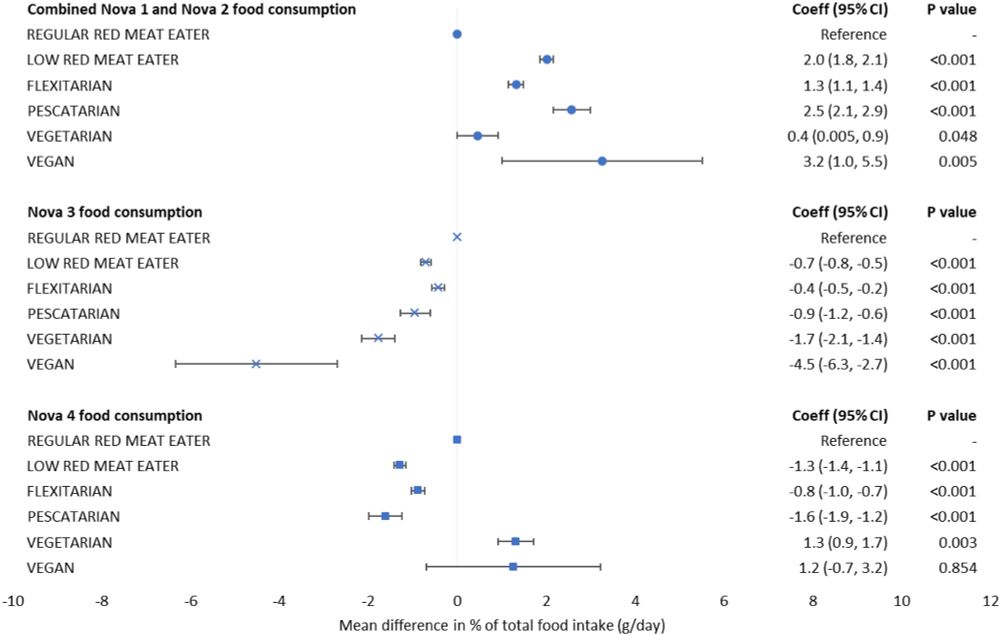
After adjustment for covariates, vegetarians consumed 1.3 percentage points more UPF as proportion of daily food intake, and 2.3 pp as percentage of energy intake, compared to regular red meat eaters (consuming more than once a week).

December 5, 2024 at 5:41 PM
After adjustment for covariates, vegetarians consumed 1.3 percentage points more UPF as proportion of daily food intake, and 2.3 pp as percentage of energy intake, compared to regular red meat eaters (consuming more than once a week).