




Giacomo Gattoni
@giacomogattoni.bsky.social
Postdoctoral researcher in the Tosches lab at Columbia Uni | PhD in the Benito-Gutiérrez lab at Cambridge Uni | #Embryo2022 | Interested in and enchanted by brain evolution 🧠
Buon 25 Aprile!
On this day we celebrate the efforts and victory of the Italian resistance movement, and the liberation of Italy from fascism and from Nazi occupation! 🎉
On this day we celebrate the efforts and victory of the Italian resistance movement, and the liberation of Italy from fascism and from Nazi occupation! 🎉

April 25, 2025 at 7:44 PM
Buon 25 Aprile!
On this day we celebrate the efforts and victory of the Italian resistance movement, and the liberation of Italy from fascism and from Nazi occupation! 🎉
On this day we celebrate the efforts and victory of the Italian resistance movement, and the liberation of Italy from fascism and from Nazi occupation! 🎉
This work clarifies the complex evolutionary history of FoxQ2 genes, identifying two ancient paralogs (FoxQ2a+b and FoxQ2c) expressed in distinct embryonic domains, and a more recent duplication of FoxQ2a and FoxQ2b. We also find a richer repertoire of vertebrate Fox genes than previously thought.

April 24, 2025 at 3:11 PM
This work clarifies the complex evolutionary history of FoxQ2 genes, identifying two ancient paralogs (FoxQ2a+b and FoxQ2c) expressed in distinct embryonic domains, and a more recent duplication of FoxQ2a and FoxQ2b. We also find a richer repertoire of vertebrate Fox genes than previously thought.
Finally, we compared FoxQ2 upstream region across 5 amphioxus species to detect conserved regulatory regions and predict transcription factor binding with developmental-timing and cell-type specificity, suggesting a similar FoxQ2a regulation in deuterostomes in line with functional conservation. 🧬

April 24, 2025 at 3:11 PM
Finally, we compared FoxQ2 upstream region across 5 amphioxus species to detect conserved regulatory regions and predict transcription factor binding with developmental-timing and cell-type specificity, suggesting a similar FoxQ2a regulation in deuterostomes in line with functional conservation. 🧬
We then studied the expression of these paralogs in a variety of chordates: FoxQ2a is found in the amphioxus anterior ectoderm and in retina photoreceptors of zebrafish and chick. 👁️ The real surprise was the mysterious FoxQ2c, which we found expressed in the endoderm of amphioxus, lamprey and skate!

April 24, 2025 at 3:11 PM
We then studied the expression of these paralogs in a variety of chordates: FoxQ2a is found in the amphioxus anterior ectoderm and in retina photoreceptors of zebrafish and chick. 👁️ The real surprise was the mysterious FoxQ2c, which we found expressed in the endoderm of amphioxus, lamprey and skate!
These revealed the presence of three ancient FoxQ2 genes! FoxQ2a and FoxQ2b were described previously, and we found a third branch called FoxQ2c. FoxQ2a+b and FoxQ2c types separated already near the root of the animal tree, while FoxQ2b duplicated from FoxQ2a in the cnidarian-bilaterian ancestor.

April 24, 2025 at 3:11 PM
These revealed the presence of three ancient FoxQ2 genes! FoxQ2a and FoxQ2b were described previously, and we found a third branch called FoxQ2c. FoxQ2a+b and FoxQ2c types separated already near the root of the animal tree, while FoxQ2b duplicated from FoxQ2a in the cnidarian-bilaterian ancestor.
To answer these questions and explain the counterintuitive conserved expression of divergent genes, here we have performed #phylogenetic and #synteny analyses of FoxQ2 #genes from 21 animal phyla. 🧬

April 24, 2025 at 3:11 PM
To answer these questions and explain the counterintuitive conserved expression of divergent genes, here we have performed #phylogenetic and #synteny analyses of FoxQ2 #genes from 21 animal phyla. 🧬
FoxQ2 genes were first discovered by studying #amphioxus, but they have since been found in at least 14 animal phyla. Different studies have shown their conserved anterior expression in the embryos of many animals, from jellyfish to flies, worms and sea urchins. 🪸🪱🪰⭐🐟

April 24, 2025 at 3:11 PM
FoxQ2 genes were first discovered by studying #amphioxus, but they have since been found in at least 14 animal phyla. Different studies have shown their conserved anterior expression in the embryos of many animals, from jellyfish to flies, worms and sea urchins. 🪸🪱🪰⭐🐟
This work clarifies the complex evolutionary history of FoxQ2 genes, identifying two ancient paralogs (FoxQ2a+b and FoxQ2c) expressed in distinct embryonic domains, and a more recent duplication of FoxQ2a and FoxQ2b. We also find a richer repertoire of vertebrate Fox genes than previously thought 🧬
April 24, 2025 at 1:07 PM
This work clarifies the complex evolutionary history of FoxQ2 genes, identifying two ancient paralogs (FoxQ2a+b and FoxQ2c) expressed in distinct embryonic domains, and a more recent duplication of FoxQ2a and FoxQ2b. We also find a richer repertoire of vertebrate Fox genes than previously thought 🧬
Finally, we compared FoxQ2 upstream region across 5 amphioxus species to detect conserved regulatory regions and predict transcription factor binding with developmental-timing and cell-type specificity, suggesting a similar FoxQ2a regulation in deuterostomes in line with functional conservation.
April 24, 2025 at 1:07 PM
Finally, we compared FoxQ2 upstream region across 5 amphioxus species to detect conserved regulatory regions and predict transcription factor binding with developmental-timing and cell-type specificity, suggesting a similar FoxQ2a regulation in deuterostomes in line with functional conservation.
We then studied the expression of these paralogs in a variety of #chordates: FoxQ2a is found in the amphioxus anterior ectoderm and in retina photoreceptors of zebrafish and chick 👁️ The real surprise was the mysterious FoxQ2c, which we found expressed in the endoderm of amphioxus, lamprey and skate!
April 24, 2025 at 1:07 PM
We then studied the expression of these paralogs in a variety of #chordates: FoxQ2a is found in the amphioxus anterior ectoderm and in retina photoreceptors of zebrafish and chick 👁️ The real surprise was the mysterious FoxQ2c, which we found expressed in the endoderm of amphioxus, lamprey and skate!
These revealed the presence of three ancient FoxQ2 genes! FoxQ2a and FoxQ2b were described previously, and we found a third branch called FoxQ2c. FoxQ2a+b and FoxQ2c types separated already near the root of the animal tree, while FoxQ2b duplicated from FoxQ2a in the cnidarian-bilaterian ancestor.
April 24, 2025 at 1:07 PM
These revealed the presence of three ancient FoxQ2 genes! FoxQ2a and FoxQ2b were described previously, and we found a third branch called FoxQ2c. FoxQ2a+b and FoxQ2c types separated already near the root of the animal tree, while FoxQ2b duplicated from FoxQ2a in the cnidarian-bilaterian ancestor.
To answer these questions and explain the counterintuitive conserved expression of divergent genes, here we have performed #phylogenetic and #synteny analyses of FoxQ2 genes from 21 animal phyla. 🧬
April 24, 2025 at 1:07 PM
To answer these questions and explain the counterintuitive conserved expression of divergent genes, here we have performed #phylogenetic and #synteny analyses of FoxQ2 genes from 21 animal phyla. 🧬
FoxQ2 genes were first discovered by studying #amphioxus, but since then they have been found in at least 14 animal phyla. Different studies have shown their conserved anterior expression in the embryos of many animals, from jellyfish to flies, worms and sea urchins.
April 24, 2025 at 1:07 PM
FoxQ2 genes were first discovered by studying #amphioxus, but since then they have been found in at least 14 animal phyla. Different studies have shown their conserved anterior expression in the embryos of many animals, from jellyfish to flies, worms and sea urchins.
Our work shows the conservation of an anterior co-expression module across deuterostomes. With the evolution of dorsal neurulation in the chordate ancestor, the anterior neural plate came under the influence of this gene module, leading to the development of the sensory-neurosecretory forebrain.

January 27, 2025 at 5:22 PM
Our work shows the conservation of an anterior co-expression module across deuterostomes. With the evolution of dorsal neurulation in the chordate ancestor, the anterior neural plate came under the influence of this gene module, leading to the development of the sensory-neurosecretory forebrain.
But what cell types arise from the ANE that is controlled by this gene module? We described a neurosecretory, hypothalamic-like region that forms the anterior brain of amphioxus larvae together with the frontal eye, and that is specifically lost following Wnt overactivation.

January 27, 2025 at 5:22 PM
But what cell types arise from the ANE that is controlled by this gene module? We described a neurosecretory, hypothalamic-like region that forms the anterior brain of amphioxus larvae together with the frontal eye, and that is specifically lost following Wnt overactivation.
As late Wnt overactivation does not lead to loss of neural cells, we examined what happens to the brain when aGRN genes are removed. We find that the ancient co-expression module is necessary to confer anterior identity to the neural plate, as the brain is posteriorized when the module is repressed.

January 27, 2025 at 5:22 PM
As late Wnt overactivation does not lead to loss of neural cells, we examined what happens to the brain when aGRN genes are removed. We find that the ancient co-expression module is necessary to confer anterior identity to the neural plate, as the brain is posteriorized when the module is repressed.
These results suggest that the same co-expression module patterns the ANE across deuterostomes! 🤩 We further found that in amphioxus, all aGRN genes were downregulated in the ectoderm following Wnt overactivation, indicating a conserved role of Wnt signalling in ANE specification.

January 27, 2025 at 5:22 PM
These results suggest that the same co-expression module patterns the ANE across deuterostomes! 🤩 We further found that in amphioxus, all aGRN genes were downregulated in the ectoderm following Wnt overactivation, indicating a conserved role of Wnt signalling in ANE specification.
Investigation of aGRN genes in amphioxus revealed that early phase genes are co-expressed on the animal side and restrict anteriorly, while late phase genes appear in the anterior brain during neurulation, with a similar dynamic to apical organ development in echinoderms.

January 27, 2025 at 5:22 PM
Investigation of aGRN genes in amphioxus revealed that early phase genes are co-expressed on the animal side and restrict anteriorly, while late phase genes appear in the anterior brain during neurulation, with a similar dynamic to apical organ development in echinoderms.
By comparing published #scRNAseq datasets, we found a biphasic activation of aGRN genes in sea urchin and amphioxus but not in zebrafish, where FoxQ2 is missing and other markers are expressed only later in the hypothalamus. This supports the conservation of ANE specification across deuterostomes.

January 27, 2025 at 5:22 PM
By comparing published #scRNAseq datasets, we found a biphasic activation of aGRN genes in sea urchin and amphioxus but not in zebrafish, where FoxQ2 is missing and other markers are expressed only later in the hypothalamus. This supports the conservation of ANE specification across deuterostomes.
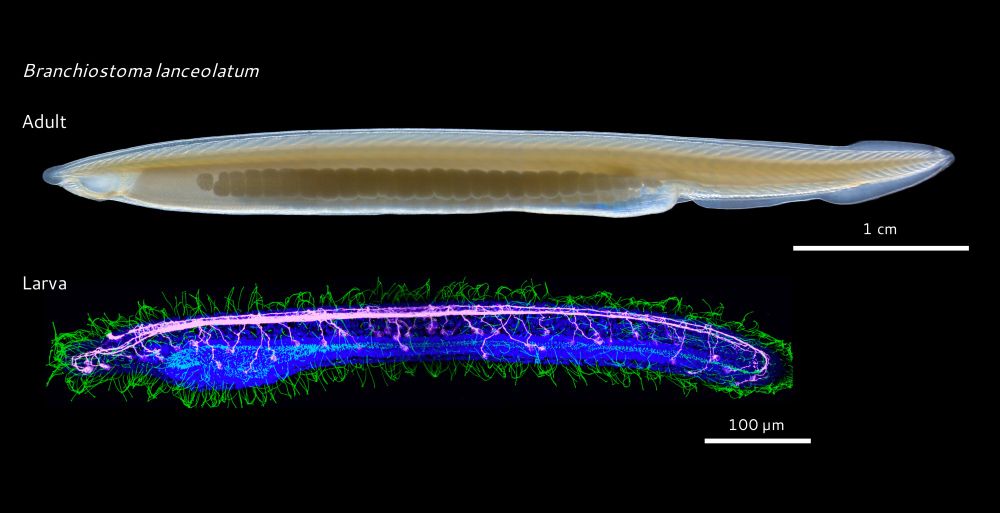
To address all these questions, we turned to our favorite model, the basally-branching chordate #amphioxus. Amphioxus has a (simple) tubular brain like vertebrates, but it also expresses Six3/6 and FoxQ2 early in development, similar to echinoderms and hemichordates.
January 27, 2025 at 5:22 PM
To address all these questions, we turned to our favorite model, the basally-branching chordate #amphioxus. Amphioxus has a (simple) tubular brain like vertebrates, but it also expresses Six3/6 and FoxQ2 early in development, similar to echinoderms and hemichordates.
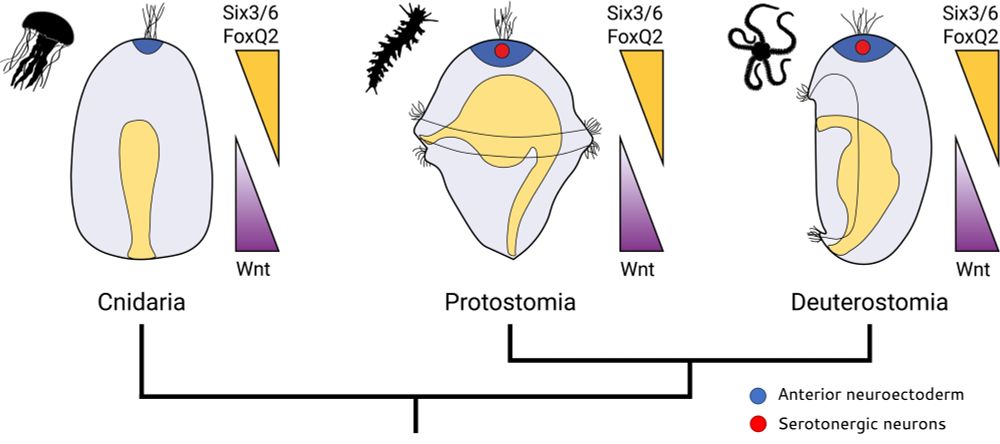
Interestingly, the genes controlling development of the anterior neuroectoderm (ANE) are highly conserved in distantly related animals, suggesting the presence of an ancient regulatory system (aGRN) that begins with early interactions between Wnt signalling and anterior Six3/6 and FoxQ2 genes.
January 27, 2025 at 5:22 PM
Interestingly, the genes controlling development of the anterior neuroectoderm (ANE) are highly conserved in distantly related animals, suggesting the presence of an ancient regulatory system (aGRN) that begins with early interactions between Wnt signalling and anterior Six3/6 and FoxQ2 genes.
This question has long puzzled scientists, especially since chordates' closest relatives (echinoderms and hemichordates) lack a brain! ⭐ However, their larvae have an anterior concentration of neurons - the apical organ - which has sparked interest due to its conservation across invertebrates.

January 27, 2025 at 5:22 PM
This question has long puzzled scientists, especially since chordates' closest relatives (echinoderms and hemichordates) lack a brain! ⭐ However, their larvae have an anterior concentration of neurons - the apical organ - which has sparked interest due to its conservation across invertebrates.
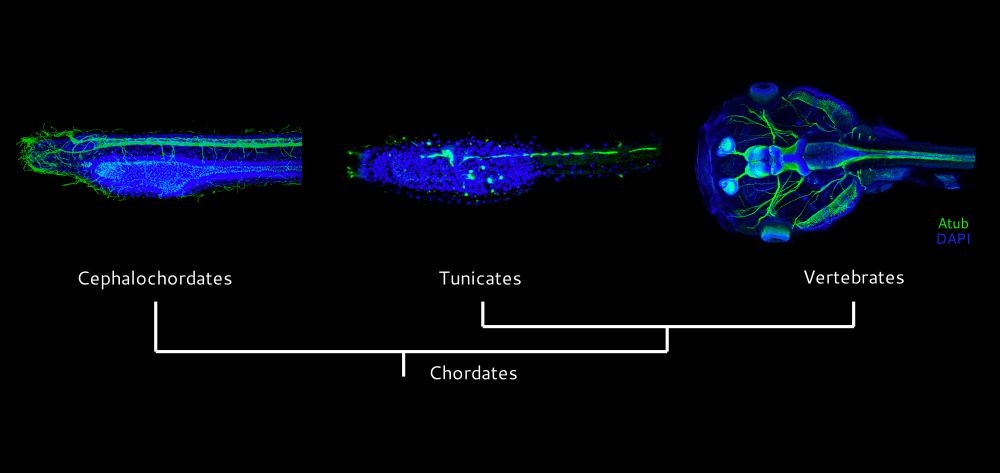
All chordates, including vertebrates, have a dorsal neural tube with an anterior brain, suggesting this structure dates back at least to their common ancestor ~550 million years ago. But when and how did the chordate brain evolve?
January 27, 2025 at 5:22 PM
All chordates, including vertebrates, have a dorsal neural tube with an anterior brain, suggesting this structure dates back at least to their common ancestor ~550 million years ago. But when and how did the chordate brain evolve?