


gardonkulous☑️
@gardonkulous.bsky.social
Orion is back in the sky, so it's time for a new #astrophotography image of the Great Orion Nebula. This stellar nursery is relatively close to Earth, "only" about 1350 light years away. It's so large and bright that you can actually see it with the naked eye away from cities. #astronomy #astro

December 16, 2025 at 3:27 AM
Orion is back in the sky, so it's time for a new #astrophotography image of the Great Orion Nebula. This stellar nursery is relatively close to Earth, "only" about 1350 light years away. It's so large and bright that you can actually see it with the naked eye away from cities. #astronomy #astro
My first proper #astrophotography mosaic of M31 - the Andromeda Galaxy, our largest galactic neighbor. At 2.5 million light years distant, its apparent size is still 6 times wider than the full Moon. Andromeda is much larger than our Milky Way with some estimates suggesting up to 1 trillion stars.

November 30, 2025 at 8:21 PM
My first proper #astrophotography mosaic of M31 - the Andromeda Galaxy, our largest galactic neighbor. At 2.5 million light years distant, its apparent size is still 6 times wider than the full Moon. Andromeda is much larger than our Milky Way with some estimates suggesting up to 1 trillion stars.
New #astrophotography target! This is my first time imaging the Heart Nebula. The two lobes are formed by a young open star cluster (IC 1805) in the center. The hot stellar wind blows the ionized hydrogen outward, forming the heart shape. #astronomy #astro

November 24, 2025 at 4:04 AM
New #astrophotography target! This is my first time imaging the Heart Nebula. The two lobes are formed by a young open star cluster (IC 1805) in the center. The hot stellar wind blows the ionized hydrogen outward, forming the heart shape. #astronomy #astro
New #astrophotography image of NGC 6823, the Cloud Sculpting Cluster. This is an open cluster of newly formed stars inside a huge cloud of gas and dust. The close grouping of stars creates very strong stellar winds that erode the dust into long finger-like columns. #astronomy #astro

November 10, 2025 at 1:40 AM
New #astrophotography image of NGC 6823, the Cloud Sculpting Cluster. This is an open cluster of newly formed stars inside a huge cloud of gas and dust. The close grouping of stars creates very strong stellar winds that erode the dust into long finger-like columns. #astronomy #astro
My latest #astrophotography image of Sharpless 101, the Tulip Nebula. It lies about 8,000 light years from earth in the constellation Cygnus. If you look in the lower right of this photo, the two bright stars mark the location of Cygnus X-1, the first black hole ever discovered. #astronomy #astro

November 3, 2025 at 2:53 AM
My latest #astrophotography image of Sharpless 101, the Tulip Nebula. It lies about 8,000 light years from earth in the constellation Cygnus. If you look in the lower right of this photo, the two bright stars mark the location of Cygnus X-1, the first black hole ever discovered. #astronomy #astro
My new #astrophotography image of the Crescent Nebula. Although it may look similar to a supernova remnant, this nebula's source is a Wolf-Rayet star, a type of star with incredibly strong stellar winds that continually belch gas and dust away at high speeds. #astronomy #astro

October 17, 2025 at 3:32 AM
My new #astrophotography image of the Crescent Nebula. Although it may look similar to a supernova remnant, this nebula's source is a Wolf-Rayet star, a type of star with incredibly strong stellar winds that continually belch gas and dust away at high speeds. #astronomy #astro
My latest #astrophotography image of the M33, the Triangulum Galaxy. At 2.73 million light-years distant, this is our second nearest neighboring galaxy and the 3rd largest in the Local Group that includes the Milky Way and Andromeda.

October 12, 2025 at 4:02 PM
My latest #astrophotography image of the M33, the Triangulum Galaxy. At 2.73 million light-years distant, this is our second nearest neighboring galaxy and the 3rd largest in the Local Group that includes the Milky Way and Andromeda.
My new #astrophotography image of the Dumbell Nebula. This type is a "planetary nebula" due to its shape, but it has nothing to do with planets. It is actually a supernova remnant, the shell of gas and dust emitted by the violent explosion at the end of a star's life. #astro #astronomy

October 11, 2025 at 2:46 AM
My new #astrophotography image of the Dumbell Nebula. This type is a "planetary nebula" due to its shape, but it has nothing to do with planets. It is actually a supernova remnant, the shell of gas and dust emitted by the violent explosion at the end of a star's life. #astro #astronomy
Getting really excited for the return of the Winter sky. In anticipation, I went and re-stacked and re-processed all of my old Horsehead nebula photos into one. This represents about 5.5 hrs of imaging time. Amazed I can get a view like this from my backyard. #astrophotography #astronomy #astro

October 4, 2025 at 9:56 PM
Getting really excited for the return of the Winter sky. In anticipation, I went and re-stacked and re-processed all of my old Horsehead nebula photos into one. This represents about 5.5 hrs of imaging time. Amazed I can get a view like this from my backyard. #astrophotography #astronomy #astro
My latest #astrophotography image of M16 - the Eagle Nebula, along with one I took about 10 months ago. Exactly the same equipment, the new version just has more integration time and I've upped my post processing skill a whole lot. #astronomy


September 28, 2025 at 4:02 AM
My latest #astrophotography image of M16 - the Eagle Nebula, along with one I took about 10 months ago. Exactly the same equipment, the new version just has more integration time and I've upped my post processing skill a whole lot. #astronomy


This is what I get:

March 15, 2025 at 1:37 PM
This is what I get:
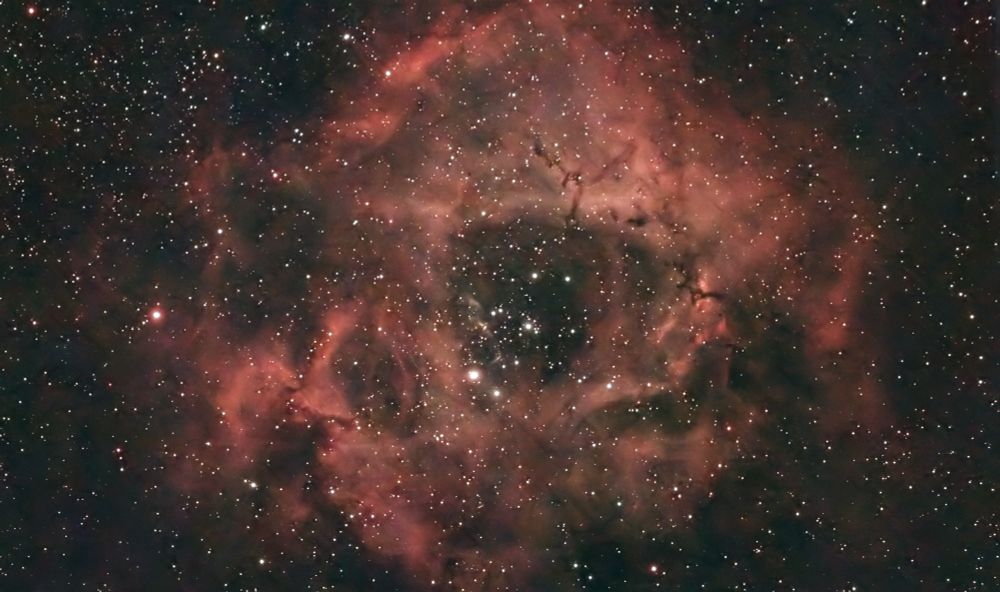
It's been a while since I posted any #astrophotography, but the Rosette Nebula is finally up in my part of the sky and I had to image it. This dense star-forming region is roughly 5,200 light years from Earth and resembles a human skull. #astronomy
March 6, 2025 at 4:30 AM
It's been a while since I posted any #astrophotography, but the Rosette Nebula is finally up in my part of the sky and I had to image it. This dense star-forming region is roughly 5,200 light years from Earth and resembles a human skull. #astronomy
The Wizard Nebula is never late, nor is it early. It arrives precisely when it means to! (after 4 hours of imaging and another 2 hours of processing). #astrophotography #astronomy

January 3, 2025 at 3:14 AM
The Wizard Nebula is never late, nor is it early. It arrives precisely when it means to! (after 4 hours of imaging and another 2 hours of processing). #astrophotography #astronomy
I'm on a bit of a galaxy kick this week. This is M74, the Phantom Galaxy. It's 32 million light years away and is another galaxy with many similarities to our own Milky Way including size, structure and number of stars. 3 supernovae have been observed in it since 2002. #astrophotography #astronomy

December 7, 2024 at 6:55 AM
I'm on a bit of a galaxy kick this week. This is M74, the Phantom Galaxy. It's 32 million light years away and is another galaxy with many similarities to our own Milky Way including size, structure and number of stars. 3 supernovae have been observed in it since 2002. #astrophotography #astronomy
Something different today- Galaxy groups! Deer Lick in the upper left, Stephan's Quintet in the lower right. The closest galaxy in this image is 40 million light years away, the furthest over 350 million. I'll be observing these more, there's so much more detail to see. #astrophotgraphy #astronomy

December 6, 2024 at 2:17 AM
Something different today- Galaxy groups! Deer Lick in the upper left, Stephan's Quintet in the lower right. The closest galaxy in this image is 40 million light years away, the furthest over 350 million. I'll be observing these more, there's so much more detail to see. #astrophotgraphy #astronomy
This might be my favorite #astrophotography image yet. M33, the Triangulum. This is my first try at drizzling, a technique developed for Hubble that uses fancy math to tease extra detail from *in between* pixels. I think it worked. Look at the structure in the dust lanes! #astronomy

December 5, 2024 at 2:53 AM
This might be my favorite #astrophotography image yet. M33, the Triangulum. This is my first try at drizzling, a technique developed for Hubble that uses fancy math to tease extra detail from *in between* pixels. I think it worked. Look at the structure in the dust lanes! #astronomy
More progress in my #astrophotography journey. This time is M16, the Eagle Nebula. In the middle you can see the Pillars of Creation made famous by the Hubble Space Telescope. These are processed using the exact same series of exposures, 18 days apart. I think I'm learning! #astronomy


November 29, 2024 at 2:22 AM
More progress in my #astrophotography journey. This time is M16, the Eagle Nebula. In the middle you can see the Pillars of Creation made famous by the Hubble Space Telescope. These are processed using the exact same series of exposures, 18 days apart. I think I'm learning! #astronomy
Woke up to 5 new followers today! That's a lot for someone who doesn't network 😄. As a reward, here's some more #astrophotography. My latest processing of the NGC 281 , the Pac-Man nebula. This star-forming region is located 10,000 light years away. #astronomy

November 27, 2024 at 2:15 PM
Woke up to 5 new followers today! That's a lot for someone who doesn't network 😄. As a reward, here's some more #astrophotography. My latest processing of the NGC 281 , the Pac-Man nebula. This star-forming region is located 10,000 light years away. #astronomy
I picked a new #astrophotography target tonight, the Elephant's Trunk nebula. I only managed to get about 3 hours of exposure time so I definitely want to revisit it soon, there's so much more detail I want to try to bring out. #astronomy

November 23, 2024 at 5:21 AM
I picked a new #astrophotography target tonight, the Elephant's Trunk nebula. I only managed to get about 3 hours of exposure time so I definitely want to revisit it soon, there's so much more detail I want to try to bring out. #astronomy
I think my #astrophotography skills are leveling up. Here's my first attempt at the Ghost of Cassiopeia from a few weeks ago, and tonight's verision. #astronomy


November 19, 2024 at 4:59 AM
I think my #astrophotography skills are leveling up. Here's my first attempt at the Ghost of Cassiopeia from a few weeks ago, and tonight's verision. #astronomy
This is my first attempt at a mosaic image. I combined 4 long-exposure panels to create this wide view of the Pelican Nebula in the constellation Cygnus. #astrophotography #astronomy

November 16, 2024 at 5:08 AM
This is my first attempt at a mosaic image. I combined 4 long-exposure panels to create this wide view of the Pelican Nebula in the constellation Cygnus. #astrophotography #astronomy
I've got another #astrophotography photo for y'all! This is SH2-112, the Nautilus Nebula. It's a cloud of interstellar dust in the constellation Cygnus. It's really unique because the cloud itself is much larger than what you see here, but this is the only section that is illuminated. #astronomy

November 14, 2024 at 2:30 AM
I've got another #astrophotography photo for y'all! This is SH2-112, the Nautilus Nebula. It's a cloud of interstellar dust in the constellation Cygnus. It's really unique because the cloud itself is much larger than what you see here, but this is the only section that is illuminated. #astronomy
It's cloudy tonight so I'm processing some old astro photos. Here's Comet C/2023 A3 from late September. This comet can still be seen in the skies now, but it is getting progressively fainter as it travels back out to the far reaches of the Solar System. #astronomy #astrophotography

November 13, 2024 at 2:27 AM
It's cloudy tonight so I'm processing some old astro photos. Here's Comet C/2023 A3 from late September. This comet can still be seen in the skies now, but it is getting progressively fainter as it travels back out to the far reaches of the Solar System. #astronomy #astrophotography