



German Lagunas-Robles
@g-lagunasrobles.bsky.social
postdoc @ IU Bloomington (Bracewell Lab)
genome evolution, ants, and beetles 🧬🐜🪲
genome evolution, ants, and beetles 🧬🐜🪲
Led by Jessica Purcell. The team included @giuliascarparo.bsky.social , Madison Sankovitz, Mari West, Zul Alam, and Alan Brelsford.
July 24, 2025 at 2:10 PM
Led by Jessica Purcell. The team included @giuliascarparo.bsky.social , Madison Sankovitz, Mari West, Zul Alam, and Alan Brelsford.
There were ~10% of colonies showing mismatches between supergene genotype and phenotype, but we only observed this at one site. This raised the possibility that environment may override supergene control of colony queen number.
July 24, 2025 at 1:39 PM
There were ~10% of colonies showing mismatches between supergene genotype and phenotype, but we only observed this at one site. This raised the possibility that environment may override supergene control of colony queen number.
Colonies with single queens were more common in the north, but the queen number polymorphism was present throughout the gradient. The supergene haplotype frequency reflected this as the frequency also varied with latitude.
July 24, 2025 at 1:39 PM
Colonies with single queens were more common in the north, but the queen number polymorphism was present throughout the gradient. The supergene haplotype frequency reflected this as the frequency also varied with latitude.
We sampled Formica podzolica colonies across a latitudinal gradient between Alaska and New Mexico. Surprisingly, Formica podzolica has SIX(!) common supergene variants that are differentiated by three distinct cassettes.
July 24, 2025 at 1:39 PM
We sampled Formica podzolica colonies across a latitudinal gradient between Alaska and New Mexico. Surprisingly, Formica podzolica has SIX(!) common supergene variants that are differentiated by three distinct cassettes.
Reposted by German Lagunas-Robles

The #EditorsChoice for this month from EIC @maxreuter.bsky.social is
"Unexpected absence of a multiple-queen supergene haplotype from supercolonial populations of Formica ants" by
@g-lagunasrobles.bsky.social et al
academic.oup.com/jeb/article/...
"Unexpected absence of a multiple-queen supergene haplotype from supercolonial populations of Formica ants" by
@g-lagunasrobles.bsky.social et al
academic.oup.com/jeb/article/...
Unexpected absence of a multiple-queen supergene haplotype from supercolonial populations of Formica ants
Abstract. Ants exhibit many complex social organization strategies. One particularly elaborate strategy is supercoloniality, in which a colony consists of
academic.oup.com
April 23, 2025 at 7:59 AM
The #EditorsChoice for this month from EIC @maxreuter.bsky.social is
"Unexpected absence of a multiple-queen supergene haplotype from supercolonial populations of Formica ants" by
@g-lagunasrobles.bsky.social et al
academic.oup.com/jeb/article/...
"Unexpected absence of a multiple-queen supergene haplotype from supercolonial populations of Formica ants" by
@g-lagunasrobles.bsky.social et al
academic.oup.com/jeb/article/...
Thanks to Zul Alam and Alan Brelsford for their work on this! (4/n)
April 9, 2025 at 2:02 PM
Thanks to Zul Alam and Alan Brelsford for their work on this! (4/n)
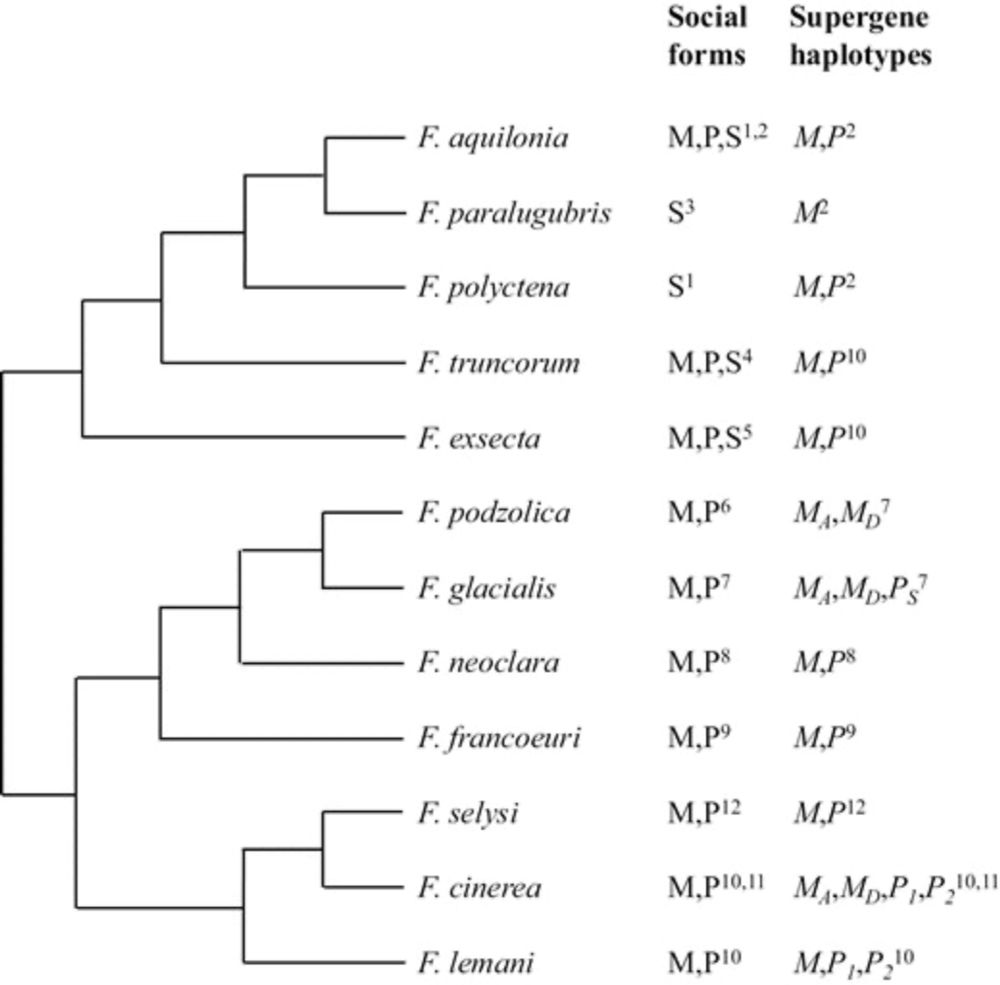
Taken together, these results suggest that supercoloniality isn't as simple as having the multi-queen supergene haplotype. (3/n)
April 9, 2025 at 2:02 PM
Taken together, these results suggest that supercoloniality isn't as simple as having the multi-queen supergene haplotype. (3/n)
We find that the multi-queen haplotype is missing from a supercolonial population. Additionally, we find a similar pattern with the multi-queen haplotype being absent in one supercolonial species, but present in another. (2/n)
April 9, 2025 at 2:01 PM
We find that the multi-queen haplotype is missing from a supercolonial population. Additionally, we find a similar pattern with the multi-queen haplotype being absent in one supercolonial species, but present in another. (2/n)
Thanks to Zul Alam and Alan Brelsford for their work on this! (4/n)
April 9, 2025 at 1:54 PM
Thanks to Zul Alam and Alan Brelsford for their work on this! (4/n)
Taken together, these results suggest that supercoloniality isn't as simple as having the multi-queen supergene haplotype. (3/n)
April 9, 2025 at 1:51 PM
Taken together, these results suggest that supercoloniality isn't as simple as having the multi-queen supergene haplotype. (3/n)
We find that the multi-queen haplotype is missing from a supercolonial population. Additionally, we find a similar pattern with the multi-queen haplotype being absent in one supercolonial species, but present in another. (2/n)
April 9, 2025 at 1:51 PM
We find that the multi-queen haplotype is missing from a supercolonial population. Additionally, we find a similar pattern with the multi-queen haplotype being absent in one supercolonial species, but present in another. (2/n)