




Francisco M Soler-Martínez
@fransolmar.bsky.social
Postdoctoral fellow at Aarhus University | Social Psychology of Economic Inequality |
It made me reflect: maybe we need to rethink how we communicate science. We often rely on slides packed with text and graphs, but perhaps we should aim for more intentional, clear, and direct ideas. Science deserves compelling communication!

July 18, 2025 at 4:22 PM
It made me reflect: maybe we need to rethink how we communicate science. We often rely on slides packed with text and graphs, but perhaps we should aim for more intentional, clear, and direct ideas. Science deserves compelling communication!
A fun twist: during my presentation, the power went out! No slides, no visuals—just me and the audience. And honestly… it was one of the best experiences I've had presenting research. More engaging, more human. Like a good seminar, not a slideshow.

July 18, 2025 at 4:22 PM
A fun twist: during my presentation, the power went out! No slides, no visuals—just me and the audience. And honestly… it was one of the best experiences I've had presenting research. More engaging, more human. Like a good seminar, not a slideshow.
The symposium wrapped up with a thoughtful integrative discussion by Rosa Rodríguez-Bailón, highlighting how these findings contribute to the broader psychology of inequality—and what are the open questions and future directions!

July 18, 2025 at 4:22 PM
The symposium wrapped up with a thoughtful integrative discussion by Rosa Rodríguez-Bailón, highlighting how these findings contribute to the broader psychology of inequality—and what are the open questions and future directions!
@celbaek.bsky.social brought results from a large-scale megastudy in the U.S., testing 20 interventions to boost support for redistribution. They identified what works (and what doesn't) in shifting perceptions and attitudes toward inequality and its reduction!

July 18, 2025 at 4:22 PM
@celbaek.bsky.social brought results from a large-scale megastudy in the U.S., testing 20 interventions to boost support for redistribution. They identified what works (and what doesn't) in shifting perceptions and attitudes toward inequality and its reduction!
@phdlope.bsky.social presented work from Spain and the UK showing that when people perceive high economic inequality, they are less likely to believe in meritocracy—and that leads to more support for redistribution. Perception → Beliefs about meritocracy → Policy preferences.

July 18, 2025 at 4:22 PM
@phdlope.bsky.social presented work from Spain and the UK showing that when people perceive high economic inequality, they are less likely to believe in meritocracy—and that leads to more support for redistribution. Perception → Beliefs about meritocracy → Policy preferences.
Franco Bastias analyzed data from France, Sweden, and the UK to show how emotional reactions to inequality mediate the relationship between system-justifying ideologies and support for redistribution. Emotions matter, even in ideological contexts.

July 18, 2025 at 4:22 PM
Franco Bastias analyzed data from France, Sweden, and the UK to show how emotional reactions to inequality mediate the relationship between system-justifying ideologies and support for redistribution. Emotions matter, even in ideological contexts.
Silvia Filippi shared experimental and cross-sectional findings from Italy, showing how misconceptions about progressive taxation—and the negative emotions these evoke—can reduce support for tax-based redistribution. Understanding emotion & cognition here is key!

July 18, 2025 at 4:22 PM
Silvia Filippi shared experimental and cross-sectional findings from Italy, showing how misconceptions about progressive taxation—and the negative emotions these evoke—can reduce support for tax-based redistribution. Understanding emotion & cognition here is key!
I had the honor of chairing a symposium titled "Unpacking support for redistribution: Psychological mechanisms and interventions." We had a highly engaged audience, and an incredible lineup of researchers—huge thanks to everyone who joined and made it such a dynamic session! Here's a quick recap 🧵👇

July 18, 2025 at 4:22 PM
I had the honor of chairing a symposium titled "Unpacking support for redistribution: Psychological mechanisms and interventions." We had a highly engaged audience, and an incredible lineup of researchers—huge thanks to everyone who joined and made it such a dynamic session! Here's a quick recap 🧵👇
So, what can we do?
👀First, just notice it. It’s not just about money. It’s about how we live.
🗣️Then, tell the secret. Support policies that reduce inequality. Think about how and who we buy from. Ask questions. Organize.
Thanks for reading this far! Feel free to share to help spread the secret💥
👀First, just notice it. It’s not just about money. It’s about how we live.
🗣️Then, tell the secret. Support policies that reduce inequality. Think about how and who we buy from. Ask questions. Organize.
Thanks for reading this far! Feel free to share to help spread the secret💥

May 25, 2025 at 8:29 PM
So, what can we do?
👀First, just notice it. It’s not just about money. It’s about how we live.
🗣️Then, tell the secret. Support policies that reduce inequality. Think about how and who we buy from. Ask questions. Organize.
Thanks for reading this far! Feel free to share to help spread the secret💥
👀First, just notice it. It’s not just about money. It’s about how we live.
🗣️Then, tell the secret. Support policies that reduce inequality. Think about how and who we buy from. Ask questions. Organize.
Thanks for reading this far! Feel free to share to help spread the secret💥
♻️ You're worried about recycling a yogurt pot correctly, and feel bad for taking a long shower.
Meanwhile, some are taking joyrides to space — each flight emitting more CO₂ than many people will in their entire lives.
Inequality is also unsustainable.
Meanwhile, some are taking joyrides to space — each flight emitting more CO₂ than many people will in their entire lives.
Inequality is also unsustainable.

May 25, 2025 at 8:29 PM
♻️ You're worried about recycling a yogurt pot correctly, and feel bad for taking a long shower.
Meanwhile, some are taking joyrides to space — each flight emitting more CO₂ than many people will in their entire lives.
Inequality is also unsustainable.
Meanwhile, some are taking joyrides to space — each flight emitting more CO₂ than many people will in their entire lives.
Inequality is also unsustainable.
🕒 You barely see your family and friends because your job has unstable hours and low pay.
Meanwhile, others have free time, hobbies, long vacations — and quality time with loved ones.
We don't own our time, inequality decides who gets it.
Meanwhile, others have free time, hobbies, long vacations — and quality time with loved ones.
We don't own our time, inequality decides who gets it.

May 25, 2025 at 8:29 PM
🕒 You barely see your family and friends because your job has unstable hours and low pay.
Meanwhile, others have free time, hobbies, long vacations — and quality time with loved ones.
We don't own our time, inequality decides who gets it.
Meanwhile, others have free time, hobbies, long vacations — and quality time with loved ones.
We don't own our time, inequality decides who gets it.
🏠 You’re debating whether you can afford your rent this month.
Your landlord is deciding whether to Airbnb or just leave the place empty.
Spoiler: they own 50 more.
Your landlord is deciding whether to Airbnb or just leave the place empty.
Spoiler: they own 50 more.

May 25, 2025 at 8:29 PM
🏠 You’re debating whether you can afford your rent this month.
Your landlord is deciding whether to Airbnb or just leave the place empty.
Spoiler: they own 50 more.
Your landlord is deciding whether to Airbnb or just leave the place empty.
Spoiler: they own 50 more.
🎓 You dream of a master’s degree but can't afford the tuition — even at a public university.
Someone else? Pays with ease, graduates, lands the job through a friend of a friend.
Merit, right?
Someone else? Pays with ease, graduates, lands the job through a friend of a friend.
Merit, right?

May 25, 2025 at 8:29 PM
🎓 You dream of a master’s degree but can't afford the tuition — even at a public university.
Someone else? Pays with ease, graduates, lands the job through a friend of a friend.
Merit, right?
Someone else? Pays with ease, graduates, lands the job through a friend of a friend.
Merit, right?
That billionaire wealth is so far away, it’s hard to even see it.
But here’s the secret:
Inequality isn’t just about the numbers. It’s right here, woven into everyday life.
Let me show you 👇
But here’s the secret:
Inequality isn’t just about the numbers. It’s right here, woven into everyday life.
Let me show you 👇

May 25, 2025 at 8:29 PM
That billionaire wealth is so far away, it’s hard to even see it.
But here’s the secret:
Inequality isn’t just about the numbers. It’s right here, woven into everyday life.
Let me show you 👇
But here’s the secret:
Inequality isn’t just about the numbers. It’s right here, woven into everyday life.
Let me show you 👇
Let’s talk in distances we all understand.
If what an average person in Spain earns in a year is just 1 mm, how far does the richest person’s wealth go?
🏃♀️ Grab your running shoes — we could run a 10K and still not get there.
What you make in a year: 1 mm
Wealth of the richest people: KILOMETERS
If what an average person in Spain earns in a year is just 1 mm, how far does the richest person’s wealth go?
🏃♀️ Grab your running shoes — we could run a 10K and still not get there.
What you make in a year: 1 mm
Wealth of the richest people: KILOMETERS

May 25, 2025 at 8:29 PM
Let’s talk in distances we all understand.
If what an average person in Spain earns in a year is just 1 mm, how far does the richest person’s wealth go?
🏃♀️ Grab your running shoes — we could run a 10K and still not get there.
What you make in a year: 1 mm
Wealth of the richest people: KILOMETERS
If what an average person in Spain earns in a year is just 1 mm, how far does the richest person’s wealth go?
🏃♀️ Grab your running shoes — we could run a 10K and still not get there.
What you make in a year: 1 mm
Wealth of the richest people: KILOMETERS
We represented inequality in the pub:
10 people at a table. The waiter brings 10 pints of beer — 1 per person?
Nope.
🍺 1 person (the richest 10%) grabs 8 pints (around 80% of the wealth)
🍺 Half the table (the poorest 50%) shares the last splash of 1 pint (only 2% of the wealth)
Cheers?
10 people at a table. The waiter brings 10 pints of beer — 1 per person?
Nope.
🍺 1 person (the richest 10%) grabs 8 pints (around 80% of the wealth)
🍺 Half the table (the poorest 50%) shares the last splash of 1 pint (only 2% of the wealth)
Cheers?

May 25, 2025 at 8:29 PM
We represented inequality in the pub:
10 people at a table. The waiter brings 10 pints of beer — 1 per person?
Nope.
🍺 1 person (the richest 10%) grabs 8 pints (around 80% of the wealth)
🍺 Half the table (the poorest 50%) shares the last splash of 1 pint (only 2% of the wealth)
Cheers?
10 people at a table. The waiter brings 10 pints of beer — 1 per person?
Nope.
🍺 1 person (the richest 10%) grabs 8 pints (around 80% of the wealth)
🍺 Half the table (the poorest 50%) shares the last splash of 1 pint (only 2% of the wealth)
Cheers?
We don’t walk around knowing stats about inequality. And when we do see the numbers...
They don’t mean much. They feel distant. It's hard to care about what you can’t picture.
Let's try to picture it👇
They don’t mean much. They feel distant. It's hard to care about what you can’t picture.
Let's try to picture it👇

May 25, 2025 at 8:29 PM
We don’t walk around knowing stats about inequality. And when we do see the numbers...
They don’t mean much. They feel distant. It's hard to care about what you can’t picture.
Let's try to picture it👇
They don’t mean much. They feel distant. It's hard to care about what you can’t picture.
Let's try to picture it👇
👀 People who read a fictitious newspaper article highlighting the second narrative (high overlap between income and health/education disparities) were less accepting of economic inequality and more supportive of redistributive measures.

April 13, 2025 at 9:34 AM
👀 People who read a fictitious newspaper article highlighting the second narrative (high overlap between income and health/education disparities) were less accepting of economic inequality and more supportive of redistributive measures.
Here we were interested in people's perceptions of the overlap between income inequality and health/education disparities. We used 7 pairs of circles with different degrees of overlap to ask about this perception.

April 13, 2025 at 9:34 AM
Here we were interested in people's perceptions of the overlap between income inequality and health/education disparities. We used 7 pairs of circles with different degrees of overlap to ask about this perception.
📢 NEW PUBLICATION! 📢
3rd paper of the thesis, in SPPS (2025). 4 studies testing whether 'connecting' income inequality to health and education disparities could increase people’s motivation to reduce it doi.org/10.1177/1948...
3rd paper of the thesis, in SPPS (2025). 4 studies testing whether 'connecting' income inequality to health and education disparities could increase people’s motivation to reduce it doi.org/10.1177/1948...

April 13, 2025 at 9:34 AM
📢 NEW PUBLICATION! 📢
3rd paper of the thesis, in SPPS (2025). 4 studies testing whether 'connecting' income inequality to health and education disparities could increase people’s motivation to reduce it doi.org/10.1177/1948...
3rd paper of the thesis, in SPPS (2025). 4 studies testing whether 'connecting' income inequality to health and education disparities could increase people’s motivation to reduce it doi.org/10.1177/1948...
What is more: scenarios about economic disparities in health and education, compared to income inequality alone, elicited stronger rejection of inequality and greater support for redistributive policies and collective action!💥

March 24, 2025 at 3:12 PM
What is more: scenarios about economic disparities in health and education, compared to income inequality alone, elicited stronger rejection of inequality and greater support for redistributive policies and collective action!💥
✅ Findings:
Across studies, perceived economic inequality in all domains (health, education, and income) led to greater intolerance toward inequality, which in turn increased support for redistribution and collective action.
Across studies, perceived economic inequality in all domains (health, education, and income) led to greater intolerance toward inequality, which in turn increased support for redistribution and collective action.

March 24, 2025 at 3:12 PM
✅ Findings:
Across studies, perceived economic inequality in all domains (health, education, and income) led to greater intolerance toward inequality, which in turn increased support for redistribution and collective action.
Across studies, perceived economic inequality in all domains (health, education, and income) led to greater intolerance toward inequality, which in turn increased support for redistribution and collective action.
📢 NEW PUBLICATION! 📢
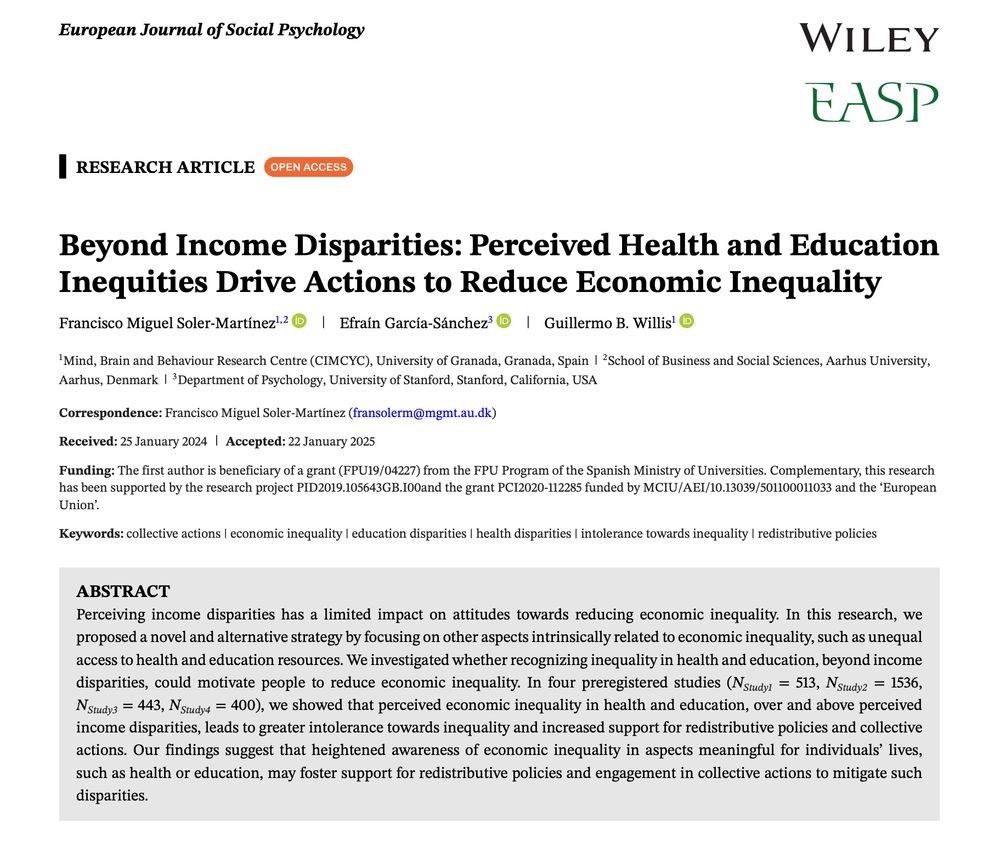
2nd paper of the thesis, in EJSP (2025). We ran 4 studies to test whether perceptions of economic-based disparities in health and education—beyond income—could enhance support for redistribution and collective action to reduce economic inequality doi.org/10.1002/ejsp...
2nd paper of the thesis, in EJSP (2025). We ran 4 studies to test whether perceptions of economic-based disparities in health and education—beyond income—could enhance support for redistribution and collective action to reduce economic inequality doi.org/10.1002/ejsp...
March 24, 2025 at 3:12 PM
📢 NEW PUBLICATION! 📢
2nd paper of the thesis, in EJSP (2025). We ran 4 studies to test whether perceptions of economic-based disparities in health and education—beyond income—could enhance support for redistribution and collective action to reduce economic inequality doi.org/10.1002/ejsp...
2nd paper of the thesis, in EJSP (2025). We ran 4 studies to test whether perceptions of economic-based disparities in health and education—beyond income—could enhance support for redistribution and collective action to reduce economic inequality doi.org/10.1002/ejsp...
Key findings:
📊 While only 20% of people mentioned income disparities as one of the worst expressions of inequality in their countries, this percentage rose to 45% and 42% for healthcare and educational opportunities.
📊 While only 20% of people mentioned income disparities as one of the worst expressions of inequality in their countries, this percentage rose to 45% and 42% for healthcare and educational opportunities.

March 24, 2025 at 2:42 PM
Key findings:
📊 While only 20% of people mentioned income disparities as one of the worst expressions of inequality in their countries, this percentage rose to 45% and 42% for healthcare and educational opportunities.
📊 While only 20% of people mentioned income disparities as one of the worst expressions of inequality in their countries, this percentage rose to 45% and 42% for healthcare and educational opportunities.
📢 PUBLICATION 📢
1st paper of the thesis, in RLP (2023). We analysed secondary data from the Latinobarómetro (n = 20,204, 18 countries) to explore concerns about inequality in health, education, and income, and how they relate to collective action intentions doi.org/10.14349/rlp...
1st paper of the thesis, in RLP (2023). We analysed secondary data from the Latinobarómetro (n = 20,204, 18 countries) to explore concerns about inequality in health, education, and income, and how they relate to collective action intentions doi.org/10.14349/rlp...

March 24, 2025 at 2:42 PM
📢 PUBLICATION 📢
1st paper of the thesis, in RLP (2023). We analysed secondary data from the Latinobarómetro (n = 20,204, 18 countries) to explore concerns about inequality in health, education, and income, and how they relate to collective action intentions doi.org/10.14349/rlp...
1st paper of the thesis, in RLP (2023). We analysed secondary data from the Latinobarómetro (n = 20,204, 18 countries) to explore concerns about inequality in health, education, and income, and how they relate to collective action intentions doi.org/10.14349/rlp...