




Timothy C. Tucker | Restoring Democracy
@exposed1.substack.com
Investigative Journalist & Publisher, Restoring Democracy's Promise. Applying engineering-level systems analysis to expose the hidden architecture of power. Delivering irrefutable, primary-source-backed accountability. https://restoring-democracy.org
Reposted by Timothy C. Tucker | Restoring Democracy
The pattern is the point:
• Crypto ATMs → “fraud prevention”
• ALPR cameras → “local crime”
• Fusion centers → “sharing”
Different excuses. Same architecture: collect → retain → route → federate. 2/4🧵⬇️
• Crypto ATMs → “fraud prevention”
• ALPR cameras → “local crime”
• Fusion centers → “sharing”
Different excuses. Same architecture: collect → retain → route → federate. 2/4🧵⬇️

January 8, 2026 at 11:23 PM
The pattern is the point:
• Crypto ATMs → “fraud prevention”
• ALPR cameras → “local crime”
• Fusion centers → “sharing”
Different excuses. Same architecture: collect → retain → route → federate. 2/4🧵⬇️
• Crypto ATMs → “fraud prevention”
• ALPR cameras → “local crime”
• Fusion centers → “sharing”
Different excuses. Same architecture: collect → retain → route → federate. 2/4🧵⬇️
Addition:
Following further document review, several states previously marked hybrid or unconfirmed are now verified as operating inside SAVE usage. The scope is broader—and more normalized—than initially visible.
Updated map below current known status as of 1/9/2025.
Following further document review, several states previously marked hybrid or unconfirmed are now verified as operating inside SAVE usage. The scope is broader—and more normalized—than initially visible.
Updated map below current known status as of 1/9/2025.

January 9, 2026 at 10:44 PM
Addition:
Following further document review, several states previously marked hybrid or unconfirmed are now verified as operating inside SAVE usage. The scope is broader—and more normalized—than initially visible.
Updated map below current known status as of 1/9/2025.
Following further document review, several states previously marked hybrid or unconfirmed are now verified as operating inside SAVE usage. The scope is broader—and more normalized—than initially visible.
Updated map below current known status as of 1/9/2025.
Reposted by Timothy C. Tucker | Restoring Democracy
This isn’t about cameras. It’s about governance by database.
When movement + financial + identity records merge, you don’t need warrants—you need access.
Full Part IV linked below. 4/4 🧵
exposed1.substack.com/p/dojs-confi...
When movement + financial + identity records merge, you don’t need warrants—you need access.
Full Part IV linked below. 4/4 🧵
exposed1.substack.com/p/dojs-confi...

January 9, 2026 at 5:46 AM
This isn’t about cameras. It’s about governance by database.
When movement + financial + identity records merge, you don’t need warrants—you need access.
Full Part IV linked below. 4/4 🧵
exposed1.substack.com/p/dojs-confi...
When movement + financial + identity records merge, you don’t need warrants—you need access.
Full Part IV linked below. 4/4 🧵
exposed1.substack.com/p/dojs-confi...
This isn’t about cameras. It’s about governance by database.
When movement + financial + identity records merge, you don’t need warrants—you need access.
Full Part IV linked below. 4/4 🧵
exposed1.substack.com/p/dojs-confi...
When movement + financial + identity records merge, you don’t need warrants—you need access.
Full Part IV linked below. 4/4 🧵
exposed1.substack.com/p/dojs-confi...
January 9, 2026 at 5:46 AM
This isn’t about cameras. It’s about governance by database.
When movement + financial + identity records merge, you don’t need warrants—you need access.
Full Part IV linked below. 4/4 🧵
exposed1.substack.com/p/dojs-confi...
When movement + financial + identity records merge, you don’t need warrants—you need access.
Full Part IV linked below. 4/4 🧵
exposed1.substack.com/p/dojs-confi...
This didn’t grow organically. It was sequenced—law by law, vendor by vendor, state by state.
And the “30-day retention” promise? It collapses fast. In practice, data persists for years—and travels. 3/4🧵
And the “30-day retention” promise? It collapses fast. In practice, data persists for years—and travels. 3/4🧵

January 8, 2026 at 11:23 PM
This didn’t grow organically. It was sequenced—law by law, vendor by vendor, state by state.
And the “30-day retention” promise? It collapses fast. In practice, data persists for years—and travels. 3/4🧵
And the “30-day retention” promise? It collapses fast. In practice, data persists for years—and travels. 3/4🧵
The pattern is the point:
• Crypto ATMs → “fraud prevention”
• ALPR cameras → “local crime”
• Fusion centers → “sharing”
Different excuses. Same architecture: collect → retain → route → federate. 2/4🧵⬇️
• Crypto ATMs → “fraud prevention”
• ALPR cameras → “local crime”
• Fusion centers → “sharing”
Different excuses. Same architecture: collect → retain → route → federate. 2/4🧵⬇️
January 8, 2026 at 11:23 PM
The pattern is the point:
• Crypto ATMs → “fraud prevention”
• ALPR cameras → “local crime”
• Fusion centers → “sharing”
Different excuses. Same architecture: collect → retain → route → federate. 2/4🧵⬇️
• Crypto ATMs → “fraud prevention”
• ALPR cameras → “local crime”
• Fusion centers → “sharing”
Different excuses. Same architecture: collect → retain → route → federate. 2/4🧵⬇️
The pattern is the point:
• Crypto ATMs → “fraud prevention”
• ALPR cameras → “local crime”
• Fusion centers → “sharing”
Different excuses. Same architecture: collect → retain → route → federate. 2/4🧵
• Crypto ATMs → “fraud prevention”
• ALPR cameras → “local crime”
• Fusion centers → “sharing”
Different excuses. Same architecture: collect → retain → route → federate. 2/4🧵
January 8, 2026 at 11:14 PM
The pattern is the point:
• Crypto ATMs → “fraud prevention”
• ALPR cameras → “local crime”
• Fusion centers → “sharing”
Different excuses. Same architecture: collect → retain → route → federate. 2/4🧵
• Crypto ATMs → “fraud prevention”
• ALPR cameras → “local crime”
• Fusion centers → “sharing”
Different excuses. Same architecture: collect → retain → route → federate. 2/4🧵
If your city/state uses ALPRs or talks about “verification databases,” ask 3 questions:
1. Who can query it?
2. Where does data go next?
3. Retention after it leaves the vendor UI?
Full series:
restoring-democracy.org
1. Who can query it?
2. Where does data go next?
3. Retention after it leaves the vendor UI?
Full series:
restoring-democracy.org

December 14, 2025 at 4:50 PM
If your city/state uses ALPRs or talks about “verification databases,” ask 3 questions:
1. Who can query it?
2. Where does data go next?
3. Retention after it leaves the vendor UI?
Full series:
restoring-democracy.org
1. Who can query it?
2. Where does data go next?
3. Retention after it leaves the vendor UI?
Full series:
restoring-democracy.org
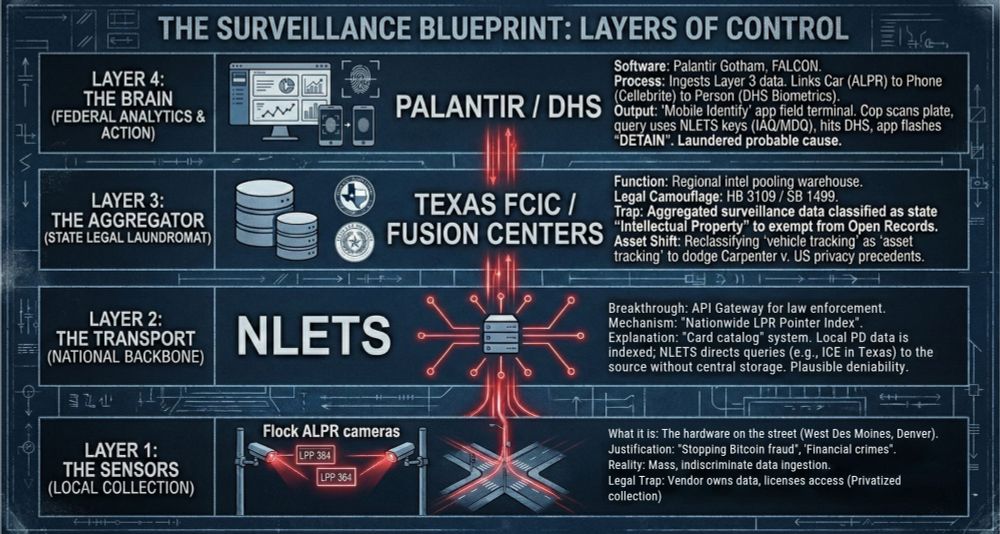
Here’s the stack.
Layer 1: street sensors.
Layer 2: national backbone.
Layer 3: state aggregation.
Layer 4: federal analytics/action.
When people argue about “one tool,” they miss the architecture.
Read more in Part 2 of the series->
exposed1.substack.com/p/the-alpr-t...
Layer 1: street sensors.
Layer 2: national backbone.
Layer 3: state aggregation.
Layer 4: federal analytics/action.
When people argue about “one tool,” they miss the architecture.
Read more in Part 2 of the series->
exposed1.substack.com/p/the-alpr-t...
December 14, 2025 at 3:05 AM
Here’s the stack.
Layer 1: street sensors.
Layer 2: national backbone.
Layer 3: state aggregation.
Layer 4: federal analytics/action.
When people argue about “one tool,” they miss the architecture.
Read more in Part 2 of the series->
exposed1.substack.com/p/the-alpr-t...
Layer 1: street sensors.
Layer 2: national backbone.
Layer 3: state aggregation.
Layer 4: federal analytics/action.
When people argue about “one tool,” they miss the architecture.
Read more in Part 2 of the series->
exposed1.substack.com/p/the-alpr-t...
This is the part that matters: data doesn’t stay local.
A state "clearinghouse" can turn normal transactions (licenses, benefits, rolls) into a routing layer—and suddenly “administrative” becomes enforcement-adjacent.
Part 3 of the series ->
exposed1.substack.com/p/save-the-b...
A state "clearinghouse" can turn normal transactions (licenses, benefits, rolls) into a routing layer—and suddenly “administrative” becomes enforcement-adjacent.
Part 3 of the series ->
exposed1.substack.com/p/save-the-b...
December 14, 2025 at 3:03 AM
This is the part that matters: data doesn’t stay local.
A state "clearinghouse" can turn normal transactions (licenses, benefits, rolls) into a routing layer—and suddenly “administrative” becomes enforcement-adjacent.
Part 3 of the series ->
exposed1.substack.com/p/save-the-b...
A state "clearinghouse" can turn normal transactions (licenses, benefits, rolls) into a routing layer—and suddenly “administrative” becomes enforcement-adjacent.
Part 3 of the series ->
exposed1.substack.com/p/save-the-b...
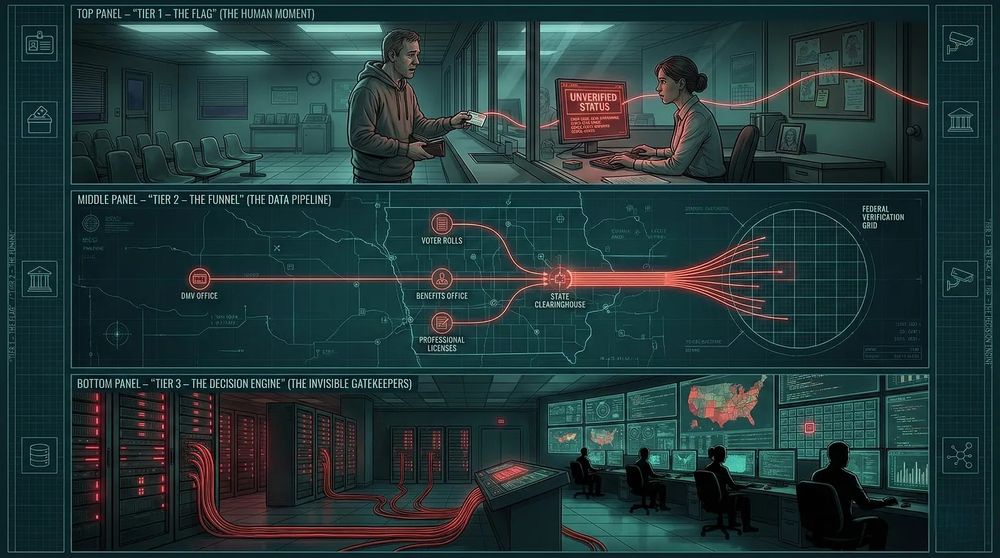
The human moment is always simple: a person at a counter.
The machinery behind it isn’t.
Top: “unverified status.”
Middle: the pipeline.
Bottom: the decision engine—where accountability goes to hide.
The machinery behind it isn’t.
Top: “unverified status.”
Middle: the pipeline.
Bottom: the decision engine—where accountability goes to hide.
December 14, 2025 at 3:01 AM
The human moment is always simple: a person at a counter.
The machinery behind it isn’t.
Top: “unverified status.”
Middle: the pipeline.
Bottom: the decision engine—where accountability goes to hide.
The machinery behind it isn’t.
Top: “unverified status.”
Middle: the pipeline.
Bottom: the decision engine—where accountability goes to hide.
Iowa is a test case, not the headline.
This is what “modern governance” looks like when databases get linked: different agencies, one pipeline. If it can be built quietly in one state, it can be replicated anywhere.
This is what “modern governance” looks like when databases get linked: different agencies, one pipeline. If it can be built quietly in one state, it can be replicated anywhere.

December 14, 2025 at 3:00 AM
Iowa is a test case, not the headline.
This is what “modern governance” looks like when databases get linked: different agencies, one pipeline. If it can be built quietly in one state, it can be replicated anywhere.
This is what “modern governance” looks like when databases get linked: different agencies, one pipeline. If it can be built quietly in one state, it can be replicated anywhere.
Watch the pattern:
Distraction (public narrative shifts) → Build (backend integration) → Activation (data exchange goes live).
Big systems don’t arrive with sirens. They arrive with paperwork.
Distraction (public narrative shifts) → Build (backend integration) → Activation (data exchange goes live).
Big systems don’t arrive with sirens. They arrive with paperwork.

December 14, 2025 at 2:59 AM
Watch the pattern:
Distraction (public narrative shifts) → Build (backend integration) → Activation (data exchange goes live).
Big systems don’t arrive with sirens. They arrive with paperwork.
Distraction (public narrative shifts) → Build (backend integration) → Activation (data exchange goes live).
Big systems don’t arrive with sirens. They arrive with paperwork.
This is why I treat it like an evidence case, not a vibe: contracts, MOUs, FOIA docs, executive actions—paper trails that map the pipeline.
Sunlight isn’t decoration. It’s containment.
Sunlight isn’t decoration. It’s containment.

December 14, 2025 at 2:58 AM
This is why I treat it like an evidence case, not a vibe: contracts, MOUs, FOIA docs, executive actions—paper trails that map the pipeline.
Sunlight isn’t decoration. It’s containment.
Sunlight isn’t decoration. It’s containment.