



@enricogl.bsky.social
On the 13th of February, we are pleased to host Prof. Martin Kircher, who will give the talk "Genome-wide variant effect prediction" at 4pm CET in Belval, Luxembourg. To join us, find all details here:

February 4, 2026 at 10:58 AM
On the 13th of February, we are pleased to host Prof. Martin Kircher, who will give the talk "Genome-wide variant effect prediction" at 4pm CET in Belval, Luxembourg. To join us, find all details here:
On Tuesday the 3rd of February, Prof. Cátia Pesquita will give the talk "Knowledge Graphs for Explainable AI in Biomedical Research" at 11am CET in Belval, Luxembourg. To join us, find all details here

February 2, 2026 at 5:42 PM
On Tuesday the 3rd of February, Prof. Cátia Pesquita will give the talk "Knowledge Graphs for Explainable AI in Biomedical Research" at 11am CET in Belval, Luxembourg. To join us, find all details here
On the 16th of January, Hannes Stärk (MIT) will give the talk "Generative models for designing binding proteins and peptides" at 4pm CET as part of our lecture series on Artificial Intelligence for Bioscientific Research. To join us, find all details here:

January 8, 2026 at 4:20 PM
On the 16th of January, Hannes Stärk (MIT) will give the talk "Generative models for designing binding proteins and peptides" at 4pm CET as part of our lecture series on Artificial Intelligence for Bioscientific Research. To join us, find all details here:
How can we identify causal mechanisms behind disease from cross-sectional molecular data? Our new publication in Briefings in Bioinformatics systematically compares causal network analysis methods academic.oup.com/bib/article/...
#SystemsBiology #Bioinformatics #CausalReasoning
#SystemsBiology #Bioinformatics #CausalReasoning
Validate User
academic.oup.com
December 5, 2025 at 6:34 PM
How can we identify causal mechanisms behind disease from cross-sectional molecular data? Our new publication in Briefings in Bioinformatics systematically compares causal network analysis methods academic.oup.com/bib/article/...
#SystemsBiology #Bioinformatics #CausalReasoning
#SystemsBiology #Bioinformatics #CausalReasoning
This Friday, 14th of November, Dr. Jannis Born will give the talk "Language Models for Molecular Discovery" in the BT2 RIKEN room at the LCSB in Luxembourg as part of our lecture series on Artificial Intelligence for Bioscientific Research. To join us, find all details here.

November 10, 2025 at 8:36 PM
This Friday, 14th of November, Dr. Jannis Born will give the talk "Language Models for Molecular Discovery" in the BT2 RIKEN room at the LCSB in Luxembourg as part of our lecture series on Artificial Intelligence for Bioscientific Research. To join us, find all details here.
On the 31st of October, Prof. Anne-Laure Boulesteix will give the talk "Neutral Benchmarking in bioinformatics" at 4pm CET in Belval, Luxembourg, as part of our Lecture Series on Artificial Intelligence for Bioscientific Research. To join us, please find all details here:

October 24, 2025 at 10:08 AM
On the 31st of October, Prof. Anne-Laure Boulesteix will give the talk "Neutral Benchmarking in bioinformatics" at 4pm CET in Belval, Luxembourg, as part of our Lecture Series on Artificial Intelligence for Bioscientific Research. To join us, please find all details here:
We are pleased to announce that Prof. Juho Rousu will give a talk titled "Predicting Drug Combination Response Surfaces" on September 1st at 4:00 p.m. CET in Belval, Luxembourg. Find all details on how to join us here. #AI #bioinformatics #lecture

August 22, 2025 at 12:44 PM
We are pleased to announce that Prof. Juho Rousu will give a talk titled "Predicting Drug Combination Response Surfaces" on September 1st at 4:00 p.m. CET in Belval, Luxembourg. Find all details on how to join us here. #AI #bioinformatics #lecture
How can we better analyze omics data with small sample sizes by learning from related biological problems? Check our new study on adaptive penalization for multi-task learning and transfer learning for high-dimensional omics data: doi.org/10.1093/bioi... #Omics #Bioinformatics #MachineLearning

Estimating sparse regression models in multi-task learning and transfer learning through adaptive penalisation
AbstractMethod. Here we propose a simple two-stage procedure for sharing information between related high-dimensional prediction or classification problems
doi.org
August 1, 2025 at 10:30 AM
How can we better analyze omics data with small sample sizes by learning from related biological problems? Check our new study on adaptive penalization for multi-task learning and transfer learning for high-dimensional omics data: doi.org/10.1093/bioi... #Omics #Bioinformatics #MachineLearning
Can machine learning predict which Parkinson's patients will develop complications before symptoms appear? Our new study uses multi-cohort machine learning to predict future outcomes in Parkinson's with improved robustness. doi.org/10.1038/s417...

Multi-cohort machine learning identifies predictors of cognitive impairment in Parkinson’s disease - npj Digital Medicine
npj Digital Medicine - Multi-cohort machine learning identifies predictors of cognitive impairment in Parkinson’s disease
doi.org
July 27, 2025 at 11:40 AM
Can machine learning predict which Parkinson's patients will develop complications before symptoms appear? Our new study uses multi-cohort machine learning to predict future outcomes in Parkinson's with improved robustness. doi.org/10.1038/s417...
PostDoc position in Bioinformatics and Computational Biology available in Luxembourg, with a focus on neurodegenerative disease analysis: euraxess.ec.europa.eu/jobs/345528 #jobs #PostDoc #research #bioinformatics

PostDoc in Bioinformatics, Biostatistics and Computational Biology
We seek a highly motivated bioinformatician or computational biologist who is well versed in the statistical and machine learning analysis of biomedical data and bioscientific programming for a projec...
euraxess.ec.europa.eu
May 20, 2025 at 10:32 AM
PostDoc position in Bioinformatics and Computational Biology available in Luxembourg, with a focus on neurodegenerative disease analysis: euraxess.ec.europa.eu/jobs/345528 #jobs #PostDoc #research #bioinformatics
On the 23rd of May (this Friday), Prof. Susana Vinga will give a talk on 'Causal Analysis of Biomedical Data: Identifying prognostic biomarkers in oncology and rheumatology using sparse regularised models' at 14:00 in BT2 Riken room, Belval, Luxembourg. To join us, find all details at edu.lu/6bupk
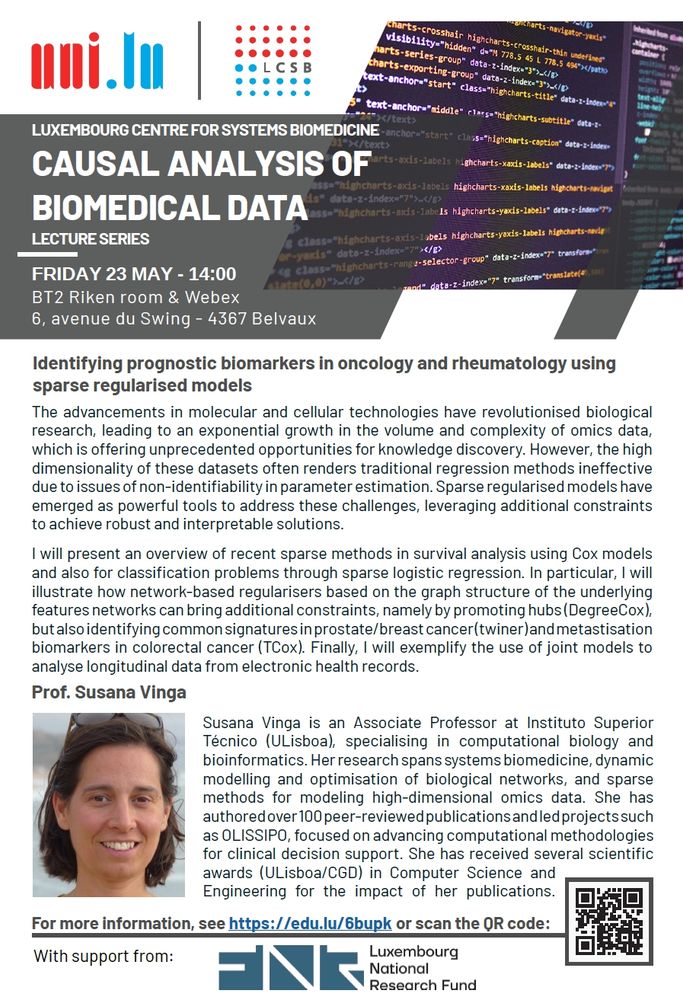
May 20, 2025 at 8:51 AM
On the 23rd of May (this Friday), Prof. Susana Vinga will give a talk on 'Causal Analysis of Biomedical Data: Identifying prognostic biomarkers in oncology and rheumatology using sparse regularised models' at 14:00 in BT2 Riken room, Belval, Luxembourg. To join us, find all details at edu.lu/6bupk
Can we predict motor fluctuations in Parkinson's disease using baseline clinical data? Our new study applies interpretable machine learning across three cohorts to identify robust predictors of this common complication. Read more: doi.org/10.1002/mds.... #ParkinsonsResearch #MachineLearning

Interpretable Machine Learning for Cross‐Cohort Prediction of Motor Fluctuations in Parkinson's Disease
Background
Motor fluctuations are a common complication in later stages of Parkinson's disease (PD) and significantly affect patients' quality of life. Robustly identifying risk and protective facto.....
doi.org
May 14, 2025 at 12:20 PM
Can we predict motor fluctuations in Parkinson's disease using baseline clinical data? Our new study applies interpretable machine learning across three cohorts to identify robust predictors of this common complication. Read more: doi.org/10.1002/mds.... #ParkinsonsResearch #MachineLearning
How do age, sex, and cell type affect molecular profiles in tauopathies? Our new study reveals sex- and cell type-specific temporal transcriptomic changes in the THY-Tau22 mouse model. Read more: doi.org/10.1186/s404... #AlzheimersResearch #Neurodegeneration

Temporal transcriptomic changes in the THY-Tau22 mouse model of tauopathy display cell type- and sex-specific differences - Acta Neuropathologica Communications
Background Tauopathies, including Alzheimer’s disease (AD) and frontotemporal dementia (FTD), display sex-specific differences in prevalence and progression, but the underlying molecular mechanisms re...
doi.org
May 9, 2025 at 5:43 PM
How do age, sex, and cell type affect molecular profiles in tauopathies? Our new study reveals sex- and cell type-specific temporal transcriptomic changes in the THY-Tau22 mouse model. Read more: doi.org/10.1186/s404... #AlzheimersResearch #Neurodegeneration
On the 21st of February, Prof. Livia Perfetto will give the talk "PatientProfiler, a network-based approach to support personalised medicine" at 4:00pm in Belval, Luxembourg. To join us, find all details at edu.lu/vee4x
#datascience #lecture #AI #biomedicine
#datascience #lecture #AI #biomedicine

January 30, 2025 at 3:24 PM
On the 21st of February, Prof. Livia Perfetto will give the talk "PatientProfiler, a network-based approach to support personalised medicine" at 4:00pm in Belval, Luxembourg. To join us, find all details at edu.lu/vee4x
#datascience #lecture #AI #biomedicine
#datascience #lecture #AI #biomedicine

Prof. Ina Koch will give a talk on the modeling of biological systems using Petri nets on the 22nd of Nov., at 2pm CET in Belval, Luxembourg, as part of our lecture series on Causal Analysis of Biomedical Data. To join us, please find all details here:

November 21, 2024 at 10:23 PM
Prof. Ina Koch will give a talk on the modeling of biological systems using Petri nets on the 22nd of Nov., at 2pm CET in Belval, Luxembourg, as part of our lecture series on Causal Analysis of Biomedical Data. To join us, please find all details here: