



Ecoclimber
@eco777.bsky.social
Cybersecurity, Healthcare Reseacher, Patient Advocate, Mountaineer
Dr. Angela Rasmussen
@angie_rasmussen
Two years ago, we demonstrated that the SARS-CoV-2 pandemic likely began at the Huanan Market via zoonosis resulting from the wildlife trade.
Many unanswered questions remained about the animals themselves.
www.cell.com/cell/fulltex...
x.com/angie_rasmus...
@angie_rasmussen
Two years ago, we demonstrated that the SARS-CoV-2 pandemic likely began at the Huanan Market via zoonosis resulting from the wildlife trade.
Many unanswered questions remained about the animals themselves.
www.cell.com/cell/fulltex...
x.com/angie_rasmus...

Genetic tracing of market wildlife and viruses at the epicenter of the COVID-19 pandemic
DNA of mammalian wildlife species susceptible to SARS-CoV-2 was detected along with
SARS-CoV-2 and other viruses in environmental samples from animal stalls located at
the market epicenter of the emer...
www.cell.com
January 30, 2025 at 1:47 AM
Dr. Angela Rasmussen
@angie_rasmussen
Two years ago, we demonstrated that the SARS-CoV-2 pandemic likely began at the Huanan Market via zoonosis resulting from the wildlife trade.
Many unanswered questions remained about the animals themselves.
www.cell.com/cell/fulltex...
x.com/angie_rasmus...
@angie_rasmussen
Two years ago, we demonstrated that the SARS-CoV-2 pandemic likely began at the Huanan Market via zoonosis resulting from the wildlife trade.
Many unanswered questions remained about the animals themselves.
www.cell.com/cell/fulltex...
x.com/angie_rasmus...
ORIGINS OF COVID-1
This is already been discussed years ago with various conspiracies, misinformation, speculation, theories etc. But what you don't see is hard scientific data from these groups.
Show me where there is an artificial insertion in the DNA sequence of SARS-CoV-2 Spike Protein clades
This is already been discussed years ago with various conspiracies, misinformation, speculation, theories etc. But what you don't see is hard scientific data from these groups.
Show me where there is an artificial insertion in the DNA sequence of SARS-CoV-2 Spike Protein clades
January 30, 2025 at 1:44 AM
ORIGINS OF COVID-1
This is already been discussed years ago with various conspiracies, misinformation, speculation, theories etc. But what you don't see is hard scientific data from these groups.
Show me where there is an artificial insertion in the DNA sequence of SARS-CoV-2 Spike Protein clades
This is already been discussed years ago with various conspiracies, misinformation, speculation, theories etc. But what you don't see is hard scientific data from these groups.
Show me where there is an artificial insertion in the DNA sequence of SARS-CoV-2 Spike Protein clades
Reposted by Ecoclimber

An exciting day for @pathoplexus.org - mpox is our first added pathogen since launching 3 months ago.
We are hopeful this will help in tracking, tackling, & reducing the burden of this devastating virus. While I'm glad we can add it to help, the need to add it is a reminder of this ongoing crisis.
We are hopeful this will help in tracking, tackling, & reducing the burden of this devastating virus. While I'm glad we can add it to help, the need to add it is a reminder of this ongoing crisis.

Today Pathoplexus announces the inclusion of a new viral pathogen: mpox (previously known as monkeypox).
Within the context of the current mpox outbreaks and ongoing health concerns, Pathoplexus aims to support sequence sharing to improve both understanding and response.
1/7
Within the context of the current mpox outbreaks and ongoing health concerns, Pathoplexus aims to support sequence sharing to improve both understanding and response.
1/7

December 10, 2024 at 9:30 AM
An exciting day for @pathoplexus.org - mpox is our first added pathogen since launching 3 months ago.
We are hopeful this will help in tracking, tackling, & reducing the burden of this devastating virus. While I'm glad we can add it to help, the need to add it is a reminder of this ongoing crisis.
We are hopeful this will help in tracking, tackling, & reducing the burden of this devastating virus. While I'm glad we can add it to help, the need to add it is a reminder of this ongoing crisis.
Reposted by Ecoclimber

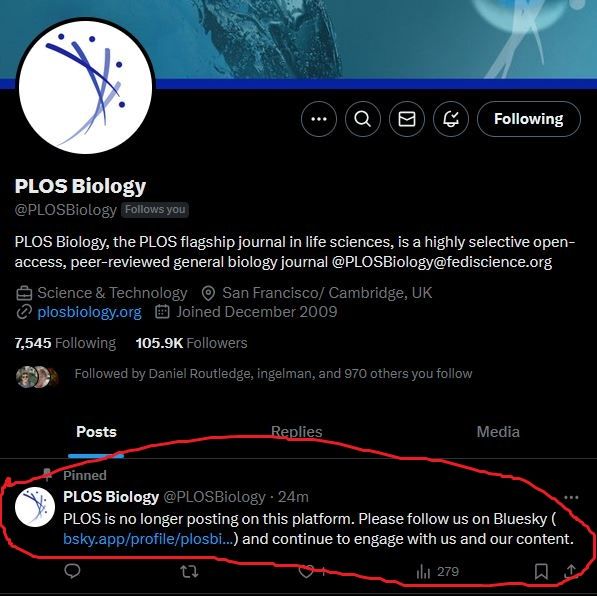
IT'S OFFICIAL! From today, @plos.org and its journals are no longer posting on Twitter/X. If you want to carry on hearing about great science in our journal, follow @plosbiology.org on Bluesky here: bsky.app/profile/plos...
December 16, 2024 at 6:59 PM
IT'S OFFICIAL! From today, @plos.org and its journals are no longer posting on Twitter/X. If you want to carry on hearing about great science in our journal, follow @plosbiology.org on Bluesky here: bsky.app/profile/plos...
Reposted by Ecoclimber


Reposted by Ecoclimber

"At 4 and 8 months after infection, 19% and 61% of patients, respectively, who had mild infections and developed antibodies were found to have seroreverted, compared with 2% and 29% of patients, respectively who had severe infections."
#COVID
www.nature.com/articles/s41...
#COVID
www.nature.com/articles/s41...

Long COVID: major findings, mechanisms and recommendations - Nature Reviews Microbiology
Long COVID is an often debilitating illness of severe symptoms that can develop during or following COVID-19. In this Review, Davis, McCorkell, Vogel and Topol explore our knowledge of long COVID and ...
www.nature.com
December 17, 2024 at 11:55 PM
"At 4 and 8 months after infection, 19% and 61% of patients, respectively, who had mild infections and developed antibodies were found to have seroreverted, compared with 2% and 29% of patients, respectively who had severe infections."
#COVID
www.nature.com/articles/s41...
#COVID
www.nature.com/articles/s41...