



david holtz
@dholtz.bsky.social
professor at columbia.
things i’m likely to skeet about (in no particular order): research, the #NBA, music, and #Survivor
things i’m likely to skeet about (in no particular order): research, the #NBA, music, and #Survivor
The DRO division at CBS is hiring this year! We welcome applicants from a wide range of fields, including OM, econ, stats, CS, engineering, and IS.
If you're on the market, apply! If you have any questions about the position, please reach out.
apply.interfolio.com/173616
If you're on the market, apply! If you have any questions about the position, please reach out.
apply.interfolio.com/173616

September 25, 2025 at 3:35 PM
The DRO division at CBS is hiring this year! We welcome applicants from a wide range of fields, including OM, econ, stats, CS, engineering, and IS.
If you're on the market, apply! If you have any questions about the position, please reach out.
apply.interfolio.com/173616
If you're on the market, apply! If you have any questions about the position, please reach out.
apply.interfolio.com/173616
one recent learning from wearing an oura ring is that I burn a decent number of calories when giving an academic talk. just one more incentive to get out there and promote your research, i guess

January 5, 2025 at 5:06 PM
one recent learning from wearing an oura ring is that I burn a decent number of calories when giving an academic talk. just one more incentive to get out there and promote your research, i guess

figured out my halloween costume for 2025: jeff proust


December 22, 2024 at 5:33 PM
figured out my halloween costume for 2025: jeff proust
the way the norcal earthquake caused a tsunami warning that then got canceled made me realize how cruel it was to shake your world, cause a wave of emotions, and then call things off. if you give me another shot, we can build a relationship with a strong foundation on solid ground. hope you’re well.

December 5, 2024 at 9:26 PM
the way the norcal earthquake caused a tsunami warning that then got canceled made me realize how cruel it was to shake your world, cause a wave of emotions, and then call things off. if you give me another shot, we can build a relationship with a strong foundation on solid ground. hope you’re well.
Many more interesting nuggets and examples in the paper, which again was led by the fantastic Nick Otis. He is going to be on the job market soon and is fantastic, so consider hiring him into your department! Here's a link to his website: nicholasotis.com 9/

December 21, 2023 at 4:11 PM
Many more interesting nuggets and examples in the paper, which again was led by the fantastic Nick Otis. He is going to be on the job market soon and is fantastic, so consider hiring him into your department! Here's a link to his website: nicholasotis.com 9/
Our results are not inconsistent with other studies; in fact, if low performers select into asking for assistance with more difficult tasks, you could get results that look like ours, even if low performers benefit more from AI on any given task. 7/


December 21, 2023 at 4:10 PM
Our results are not inconsistent with other studies; in fact, if low performers select into asking for assistance with more difficult tasks, you could get results that look like ours, even if low performers benefit more from AI on any given task. 7/
Exploratory analysis of the interaction logs with the AI mentor suggest this heterogeneity stems from the *types* of things low performers ask about: more challenging tasks that may not be well-suited to AI (or human) assistance. 6/


December 21, 2023 at 4:10 PM
Exploratory analysis of the interaction logs with the AI mentor suggest this heterogeneity stems from the *types* of things low performers ask about: more challenging tasks that may not be well-suited to AI (or human) assistance. 6/
The direction of our treatment effect heterogeneity is another difference between our work and existing research, which has found that generative AI *reduces* differences in productivity 5/

December 21, 2023 at 4:09 PM
The direction of our treatment effect heterogeneity is another difference between our work and existing research, which has found that generative AI *reduces* differences in productivity 5/
This null effect masks considerable and important heterogeneity: initially low-performing entrepreneurs saw a 10% performance decline, whereas high performers experienced a 20% performance boost from AI use! 4/

December 21, 2023 at 4:09 PM
This null effect masks considerable and important heterogeneity: initially low-performing entrepreneurs saw a 10% performance decline, whereas high performers experienced a 20% performance boost from AI use! 4/
In contrast to excellent recent work by folks like Noy and Zhang, Brynjolfsson Li and Raymond, and Dell'Acqua et al., which all find positive impacts of generative AI on well-defined tasks, we find no effect of generative AI, despite considerable usage. BUT... 3/

December 21, 2023 at 4:09 PM
In contrast to excellent recent work by folks like Noy and Zhang, Brynjolfsson Li and Raymond, and Dell'Acqua et al., which all find positive impacts of generative AI on well-defined tasks, we find no effect of generative AI, despite considerable usage. BUT... 3/
We ran a 5-month long RCT in Kenya with 640 Kenyan entrepreneurs, over 4,000 measures of firm performance, and thousands of interactions w/ a generative AI mentor that we built using GPT-4. Participants interacted w/ the mentor through WhatsApp. Example interaction shown here. 2/


December 21, 2023 at 4:08 PM
We ran a 5-month long RCT in Kenya with 640 Kenyan entrepreneurs, over 4,000 measures of firm performance, and thousands of interactions w/ a generative AI mentor that we built using GPT-4. Participants interacted w/ the mentor through WhatsApp. Example interaction shown here. 2/
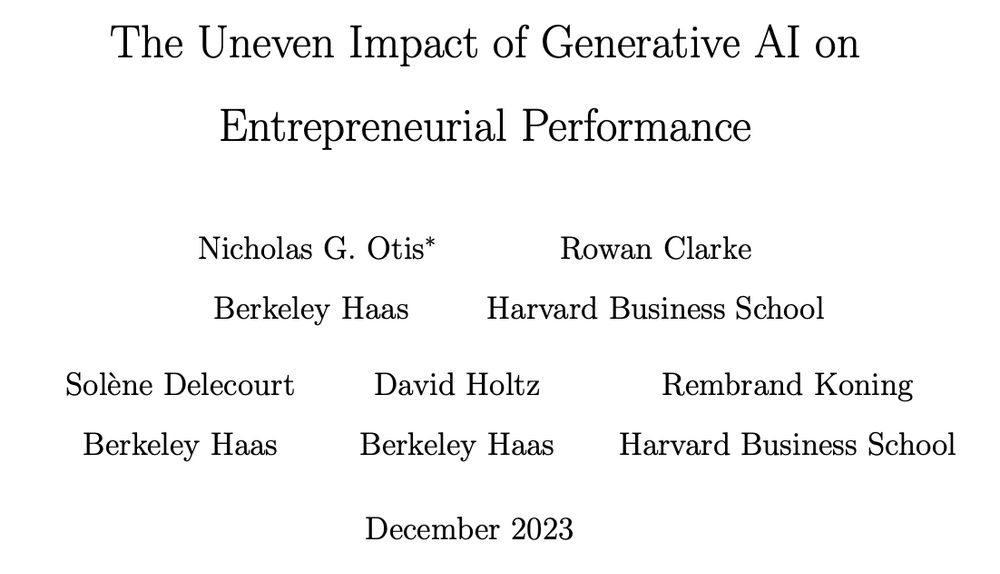
Announcing a new working paper measuring the causal impact of generative AI on business performance in emerging markets!
osf.io/preprints/os...
This is joint work w/ Nick Otis (who led the project), Rowan Clarke, Solene Delecourt, and Rem Koning.
More on our results below down👇 1/
osf.io/preprints/os...
This is joint work w/ Nick Otis (who led the project), Rowan Clarke, Solene Delecourt, and Rem Koning.
More on our results below down👇 1/

December 21, 2023 at 4:08 PM
Announcing a new working paper measuring the causal impact of generative AI on business performance in emerging markets!
osf.io/preprints/os...
This is joint work w/ Nick Otis (who led the project), Rowan Clarke, Solene Delecourt, and Rem Koning.
More on our results below down👇 1/
osf.io/preprints/os...
This is joint work w/ Nick Otis (who led the project), Rowan Clarke, Solene Delecourt, and Rem Koning.
More on our results below down👇 1/
Very excited by this recent paper by Naoki Egami and coauthors, which looks at how social scientists can conduct unbiased statistical inference when using LLM-generated annotations in their analyses: arxiv.org/pdf/2306.04746…

June 28, 2023 at 6:18 PM
Very excited by this recent paper by Naoki Egami and coauthors, which looks at how social scientists can conduct unbiased statistical inference when using LLM-generated annotations in their analyses: arxiv.org/pdf/2306.04746…