



Dawid Jędrzkiewicz
@dawidjedrzkiewicz.bsky.social
Reposted by Dawid Jędrzkiewicz
CAPTURING CHALCOGENIDES: A soluble Mg(0) metal crown complex reduces and captures chalcogenes. Large anions Se(2-) and Te(2-) need ring enlargement. Highlight: a first molecular s-block metal telluride complex with nearly planar pentacoordinated Te(2-). shorturl.at/n4TUm

September 5, 2025 at 11:08 AM
CAPTURING CHALCOGENIDES: A soluble Mg(0) metal crown complex reduces and captures chalcogenes. Large anions Se(2-) and Te(2-) need ring enlargement. Highlight: a first molecular s-block metal telluride complex with nearly planar pentacoordinated Te(2-). shorturl.at/n4TUm
Reposted by Dawid Jędrzkiewicz
Hey #ChemSky, need a read to start of the week? How about our latest #OpenAccess research article on ”Silicon-Based Azo Compound-Mediated CO Activation and N2 Release“ out now in @angewandtechemie.bsky.social: doi.org/10.1002/anie...

Silicon‐Based Azo Compound‐Mediated CO Activation and N2 Release
A rare silicon(IV)-based azo compound featuring a Si─N═N─Si linkage was synthesized via the direct reaction of an organoazide with a silaiminyl–silylene precursor. This compound undergoes an unusual ...
doi.org
September 29, 2025 at 9:21 AM
Hey #ChemSky, need a read to start of the week? How about our latest #OpenAccess research article on ”Silicon-Based Azo Compound-Mediated CO Activation and N2 Release“ out now in @angewandtechemie.bsky.social: doi.org/10.1002/anie...
Reposted by Dawid Jędrzkiewicz
REDOX-REACTIVITY of Yb and Sm inverse sandwich benzene complexes. An interesting observation is that, depending on substrate, benzene(4-) can reduce Sm(III) to Sm(II). doi.org/10.1002/chem...

October 8, 2025 at 11:36 AM
REDOX-REACTIVITY of Yb and Sm inverse sandwich benzene complexes. An interesting observation is that, depending on substrate, benzene(4-) can reduce Sm(III) to Sm(II). doi.org/10.1002/chem...
Reposted by Dawid Jędrzkiewicz
TIRE CHANGE: First Mg(I) complex with a Cp* ligand enables facile ligand exchange. Reaction with RONa gives (BDI)Mg-MgOR and Cp*Na. This paves the way for syntheses of many new asymmetric Mg(I) complexes. @angew_chem onlinelibrary.wiley.com/doi/epdf/10....

October 17, 2025 at 1:11 PM
TIRE CHANGE: First Mg(I) complex with a Cp* ligand enables facile ligand exchange. Reaction with RONa gives (BDI)Mg-MgOR and Cp*Na. This paves the way for syntheses of many new asymmetric Mg(I) complexes. @angew_chem onlinelibrary.wiley.com/doi/epdf/10....
Reposted by Dawid Jędrzkiewicz
THIS CHALLENGING SYNTHESIS completes the (BDI)Ae-(benzene)-Ae(BDI) series (Ae = Mg, Ca, Sr, Ba) with Ba. We show trends in stability, structure, bonding and reactivity. Reacting like (BDI)Ba-Ba(BDI) this is the first Ba(I) synthon. shorturl.at/ZdToA @chemicalscience.rsc.org

September 4, 2025 at 11:00 AM
THIS CHALLENGING SYNTHESIS completes the (BDI)Ae-(benzene)-Ae(BDI) series (Ae = Mg, Ca, Sr, Ba) with Ba. We show trends in stability, structure, bonding and reactivity. Reacting like (BDI)Ba-Ba(BDI) this is the first Ba(I) synthon. shorturl.at/ZdToA @chemicalscience.rsc.org
Reposted by Dawid Jędrzkiewicz
P4 REDUCTION generally results in multi-nuclear Zintl anions: P8(2-), P4(2-) or P7(3-). Reaction with a soluble Mg(0) complex gave full reduction to P(3-). Latter anion serves as a triple base, a three-fold nucleophile or 3e-reducing agent. onlinelibrary.wiley.com/doi/epdf/10.10

September 2, 2025 at 10:31 AM
P4 REDUCTION generally results in multi-nuclear Zintl anions: P8(2-), P4(2-) or P7(3-). Reaction with a soluble Mg(0) complex gave full reduction to P(3-). Latter anion serves as a triple base, a three-fold nucleophile or 3e-reducing agent. onlinelibrary.wiley.com/doi/epdf/10.10
Reposted by Dawid Jędrzkiewicz

Reversible C–H Bond Activation of Unactivated Arenes by a Nickel-Silylene Complex - pubs.acs.org/doi/10.1021/...
So proud to congratulate first author Leon Gomm for his first paper in JACS. Thanks to Hui Zhu and Stefan Grimme for the ever helpful DFT calculations. @unibonn.bsky.social
So proud to congratulate first author Leon Gomm for his first paper in JACS. Thanks to Hui Zhu and Stefan Grimme for the ever helpful DFT calculations. @unibonn.bsky.social
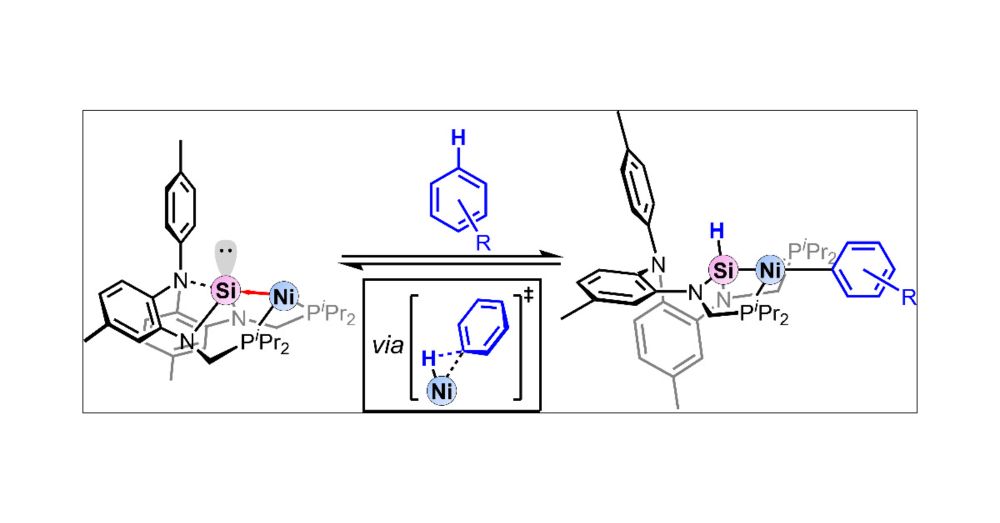
Reversible C–H Bond Activation of Unactivated Arenes by a Nickel-Silylene Complex
A nickel-silylene complex is shown to reversibly activate benzene via C–H bond activation at ambient temperature. The benzene C–H bond formally adds across the Ni–Si core to form a nickel-silyl comple...
pubs.acs.org
August 8, 2025 at 4:14 PM
Reversible C–H Bond Activation of Unactivated Arenes by a Nickel-Silylene Complex - pubs.acs.org/doi/10.1021/...
So proud to congratulate first author Leon Gomm for his first paper in JACS. Thanks to Hui Zhu and Stefan Grimme for the ever helpful DFT calculations. @unibonn.bsky.social
So proud to congratulate first author Leon Gomm for his first paper in JACS. Thanks to Hui Zhu and Stefan Grimme for the ever helpful DFT calculations. @unibonn.bsky.social
Reposted by Dawid Jędrzkiewicz
Liam Griffin and I have reviewed recent advances in the heterometallic bonding chemistry of the alkaline earth metals @daltontrans.rsc.org. It was fun to put this together, and we hope it's useful!
pubs.rsc.org/en/content/a...
pubs.rsc.org/en/content/a...

Alkaline earth metals: heterometallic bonding
The alkaline earth metals are notorious for their tendency to form ionic compounds of their dications. In recent years, however, chemists have found ways to kinetically skirt around the edges of these...
pubs.rsc.org
August 11, 2025 at 9:18 AM
Liam Griffin and I have reviewed recent advances in the heterometallic bonding chemistry of the alkaline earth metals @daltontrans.rsc.org. It was fun to put this together, and we hope it's useful!
pubs.rsc.org/en/content/a...
pubs.rsc.org/en/content/a...
Reposted by Dawid Jędrzkiewicz
Excited to see this work published today in @jacs.acspublications.org , fun chemistry and a real group effort here by @clairemcmullin.bsky.social , @moraleschem.bsky.social , Mary and big Mike! (@bathchem.bsky.social)
pubs.acs.org/doi/10.1021/...
pubs.acs.org/doi/10.1021/...
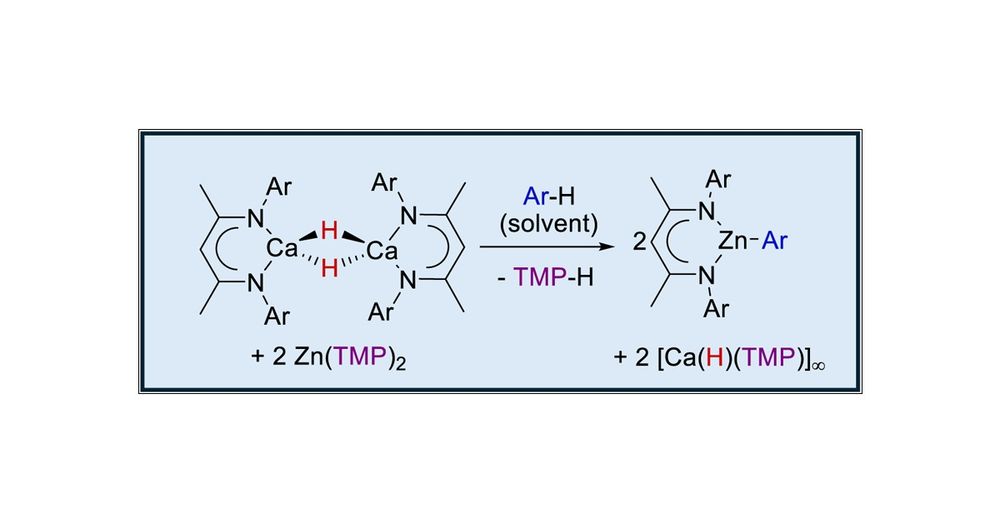
Arene Activation by Calcium Hydride/Zinc Amide Equilibration
The β-diketiminato calcium hydride, [(BDI)CaH]2 (BDI = HC{(Me)CNDipp}2, where Dipp = 2,6-i-Pr2C6H3), reacts with [Zn{N(SiMe3)2}2] and [Zn(TMP)2] (TMP = 2,2,6,6-tetramethylpiperidide) to provide labile...
pubs.acs.org
August 2, 2025 at 10:16 PM
Excited to see this work published today in @jacs.acspublications.org , fun chemistry and a real group effort here by @clairemcmullin.bsky.social , @moraleschem.bsky.social , Mary and big Mike! (@bathchem.bsky.social)
pubs.acs.org/doi/10.1021/...
pubs.acs.org/doi/10.1021/...
Reposted by Dawid Jędrzkiewicz
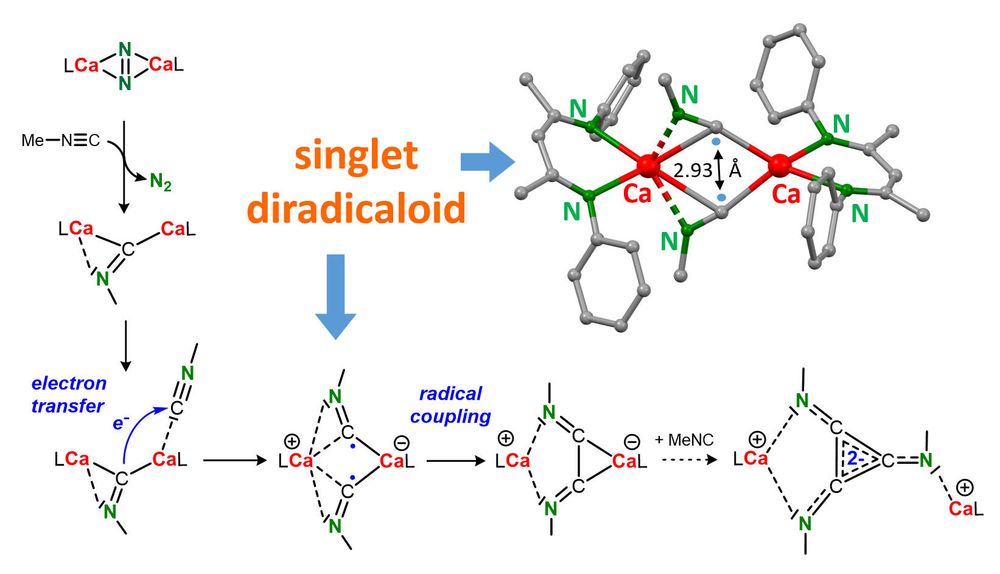
OPEN SINGLET DIRADICALOID as intermediate in the Ca-mediated reductive coupling of isocyanide finally resulting in a deltate complex. A unique mechanism in group 2 metal mediated reductive C-C coupling @ChemicalScience pubs.rsc.org/en/content/a...
June 5, 2025 at 8:01 AM
OPEN SINGLET DIRADICALOID as intermediate in the Ca-mediated reductive coupling of isocyanide finally resulting in a deltate complex. A unique mechanism in group 2 metal mediated reductive C-C coupling @ChemicalScience pubs.rsc.org/en/content/a...
Reposted by Dawid Jędrzkiewicz
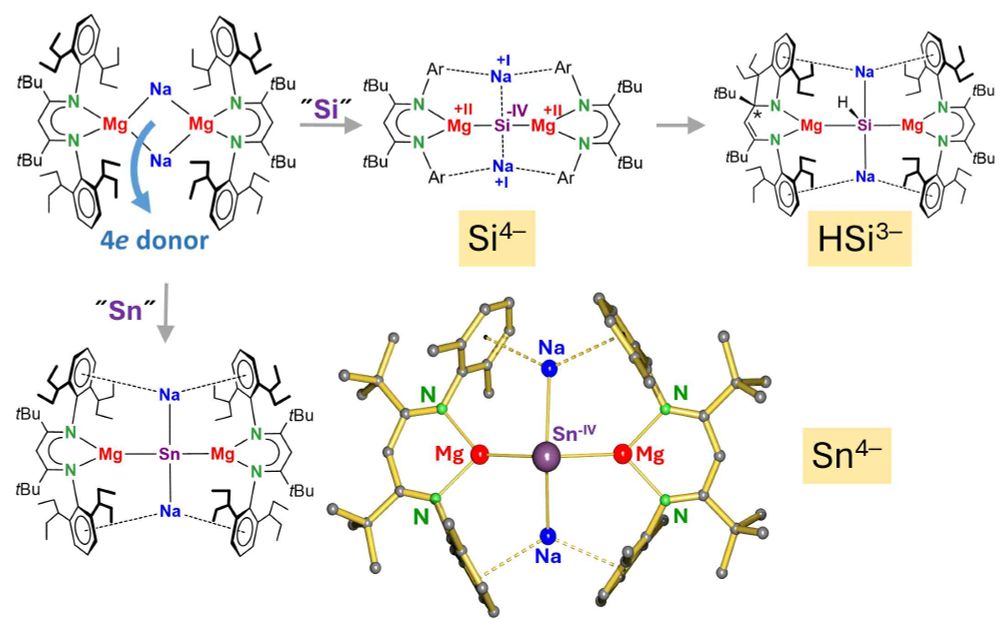
LOW-VALENT Si, Ge, Sn, Pb: HOW LOW CAN WE GO???
Hydrocarbon-soluble Mg(0) reduces Si all the way to Si(4-). Unfortunately not stable and decomposing to the HSi(3-) anion. However, Sn(4-) is stable and functions as 4-fold Nu or 8e reducing agent. Preprint: shorturl.at/4mH0O
Hydrocarbon-soluble Mg(0) reduces Si all the way to Si(4-). Unfortunately not stable and decomposing to the HSi(3-) anion. However, Sn(4-) is stable and functions as 4-fold Nu or 8e reducing agent. Preprint: shorturl.at/4mH0O
May 28, 2025 at 9:21 AM
LOW-VALENT Si, Ge, Sn, Pb: HOW LOW CAN WE GO???
Hydrocarbon-soluble Mg(0) reduces Si all the way to Si(4-). Unfortunately not stable and decomposing to the HSi(3-) anion. However, Sn(4-) is stable and functions as 4-fold Nu or 8e reducing agent. Preprint: shorturl.at/4mH0O
Hydrocarbon-soluble Mg(0) reduces Si all the way to Si(4-). Unfortunately not stable and decomposing to the HSi(3-) anion. However, Sn(4-) is stable and functions as 4-fold Nu or 8e reducing agent. Preprint: shorturl.at/4mH0O
Reposted by Dawid Jędrzkiewicz
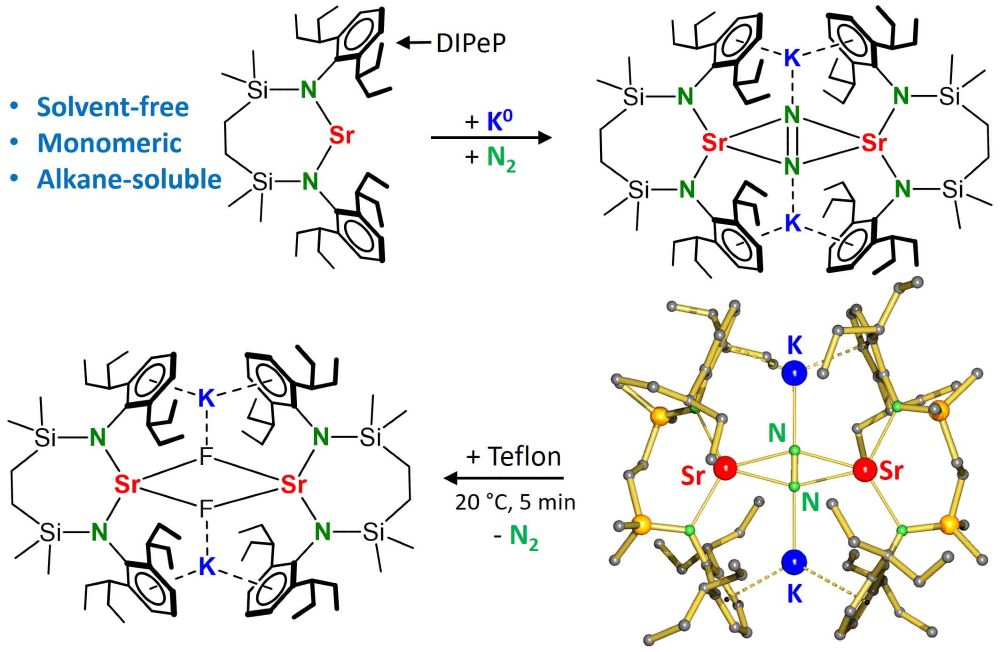
K and Sr join forces in N2 reduction: We describe the loooong road to Sr-N2 complexes. So reactive!!! Converts Teflon within minutes in a soluble form of K+F- @AngewChem doi.org/10.1002/anie...
May 2, 2025 at 10:00 PM
K and Sr join forces in N2 reduction: We describe the loooong road to Sr-N2 complexes. So reactive!!! Converts Teflon within minutes in a soluble form of K+F- @AngewChem doi.org/10.1002/anie...
Reposted by Dawid Jędrzkiewicz
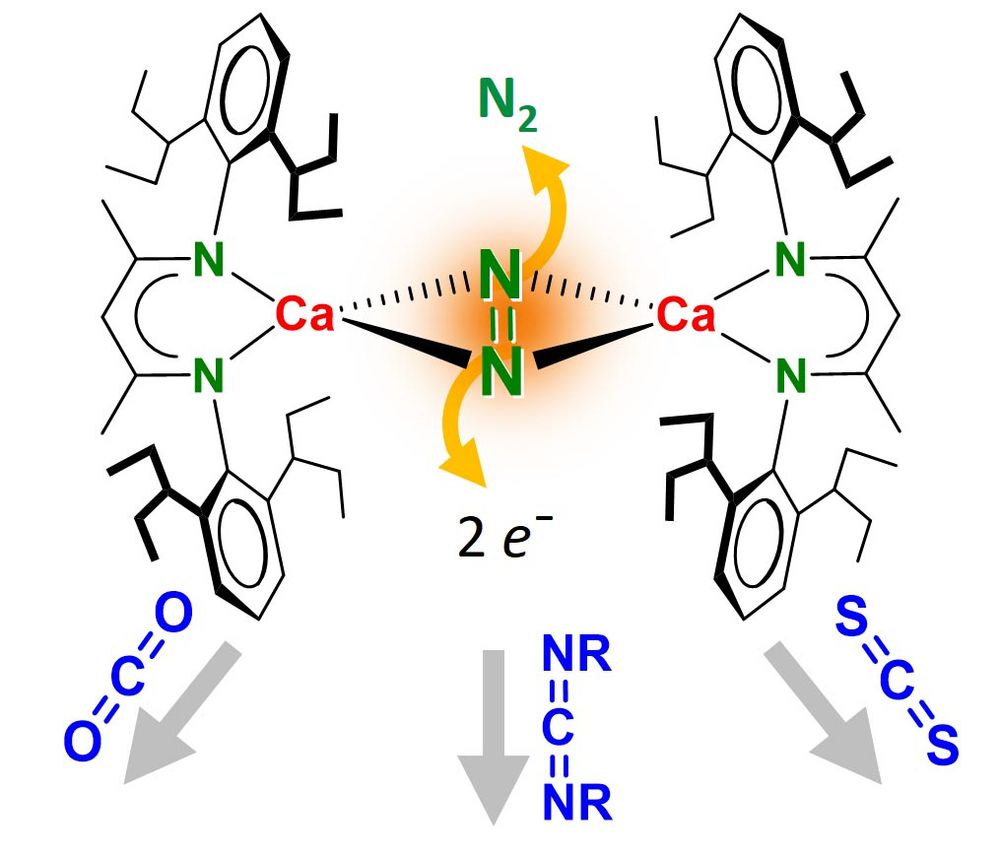
CO2 REDUCTION WITH LOW-VALENT CALCIUM: Ca-N2 complexes react like synthons for low-valent Ca(I). We discuss first intermediates and final products in CO2, CS2 and RN=C=NR reduction. @ChemistryEur tinyurl.com/4xy6t6kc
April 28, 2025 at 7:11 AM
CO2 REDUCTION WITH LOW-VALENT CALCIUM: Ca-N2 complexes react like synthons for low-valent Ca(I). We discuss first intermediates and final products in CO2, CS2 and RN=C=NR reduction. @ChemistryEur tinyurl.com/4xy6t6kc
Reposted by Dawid Jędrzkiewicz
Catalytic methane functionalization and all it takes is... beryllium! We also compare the mechanisms of methane beryllation and borylation to reveal why Be finds it so easy @pubs.acs.org pubs.acs.org/doi/10.1021/...
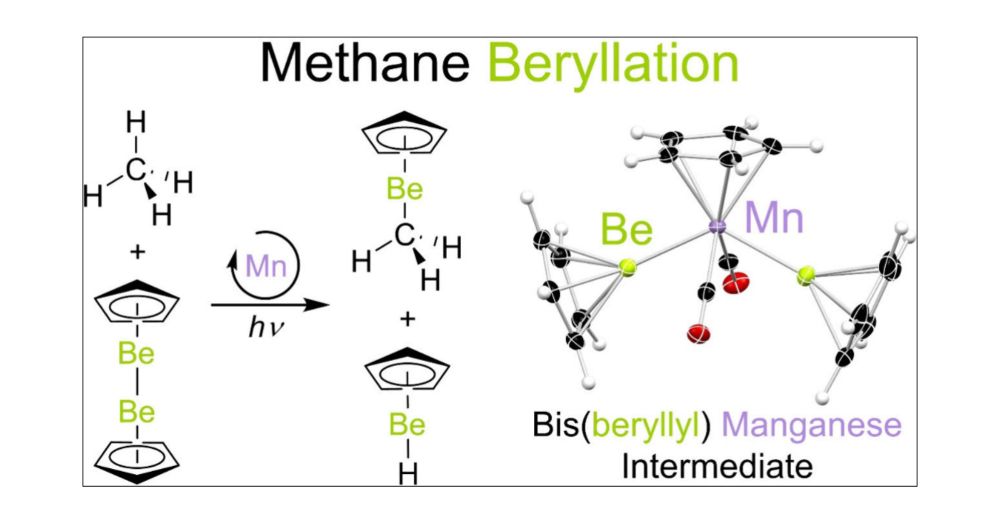
Methane Beryllation Catalyzed by a Base Metal Complex
The homogeneous catalytic functionalization of methane is extremely challenging due to the relative nonpolarity and high C–H bond strength of this hydrocarbon. Here, using catalytic quantities (10 mol...
pubs.acs.org
March 11, 2025 at 7:45 PM
Catalytic methane functionalization and all it takes is... beryllium! We also compare the mechanisms of methane beryllation and borylation to reveal why Be finds it so easy @pubs.acs.org pubs.acs.org/doi/10.1021/...
Reposted by Dawid Jędrzkiewicz
Save the date: Come and join the first Global Inorganic Virtual Seminar with Suzanna Bart and @harder-research.bsky.social!
riceuniversity.zoom.us/webinar/regi...
riceuniversity.zoom.us/webinar/regi...

April 17, 2025 at 2:42 PM
Save the date: Come and join the first Global Inorganic Virtual Seminar with Suzanna Bart and @harder-research.bsky.social!
riceuniversity.zoom.us/webinar/regi...
riceuniversity.zoom.us/webinar/regi...
Reposted by Dawid Jędrzkiewicz
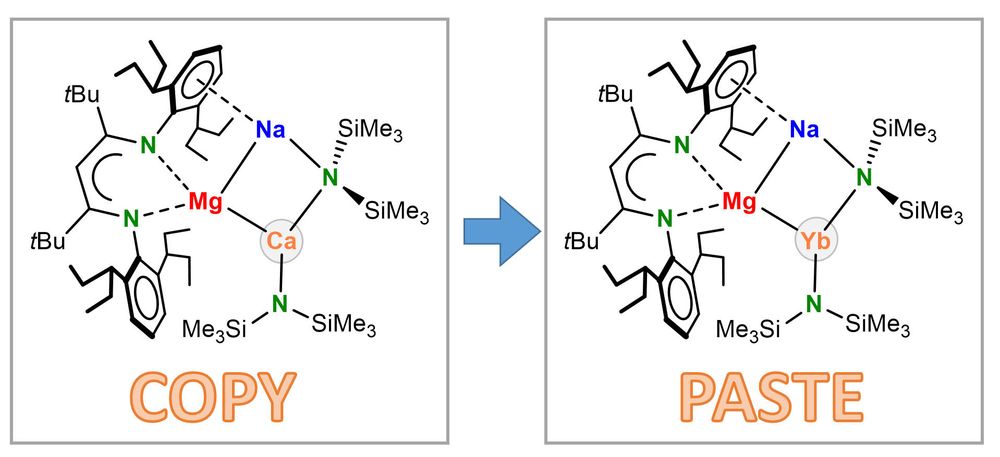
Exploiting the similarity between Ca(II) and Yb(II), first Mg-lanthanide bonding has been realised. The peculiarities of this unique Mg-Yb bond are discussed. Mg(0)-Yb(II)? Mg(I)-Yb(I)? @JACS pubs.acs.org/doi/10.1021/...
April 4, 2025 at 6:15 PM
Exploiting the similarity between Ca(II) and Yb(II), first Mg-lanthanide bonding has been realised. The peculiarities of this unique Mg-Yb bond are discussed. Mg(0)-Yb(II)? Mg(I)-Yb(I)? @JACS pubs.acs.org/doi/10.1021/...
Reposted by Dawid Jędrzkiewicz
Pushing the boundaries of #organosodium reagents, we are incredibly excited to report their applications in #iron #catalysed #crosscouplings with Sobi Asako and Laurean Ilies at RIKEN 🇯🇵 @naturesynthesis.bsky.social
@unibe.ch #openaccess #TeamWorkMakestheDreamWork
www.nature.com/articles/s44...
@unibe.ch #openaccess #TeamWorkMakestheDreamWork
www.nature.com/articles/s44...


March 25, 2025 at 12:38 PM
Pushing the boundaries of #organosodium reagents, we are incredibly excited to report their applications in #iron #catalysed #crosscouplings with Sobi Asako and Laurean Ilies at RIKEN 🇯🇵 @naturesynthesis.bsky.social
@unibe.ch #openaccess #TeamWorkMakestheDreamWork
www.nature.com/articles/s44...
@unibe.ch #openaccess #TeamWorkMakestheDreamWork
www.nature.com/articles/s44...
Reposted by Dawid Jędrzkiewicz

Redox-active inverse crowns for small molecule activation, from Sjoerd Harder @harder-research.bsky.social and co-workers
www.nature.com/articles/s41...
#chemsky
www.nature.com/articles/s41...
#chemsky
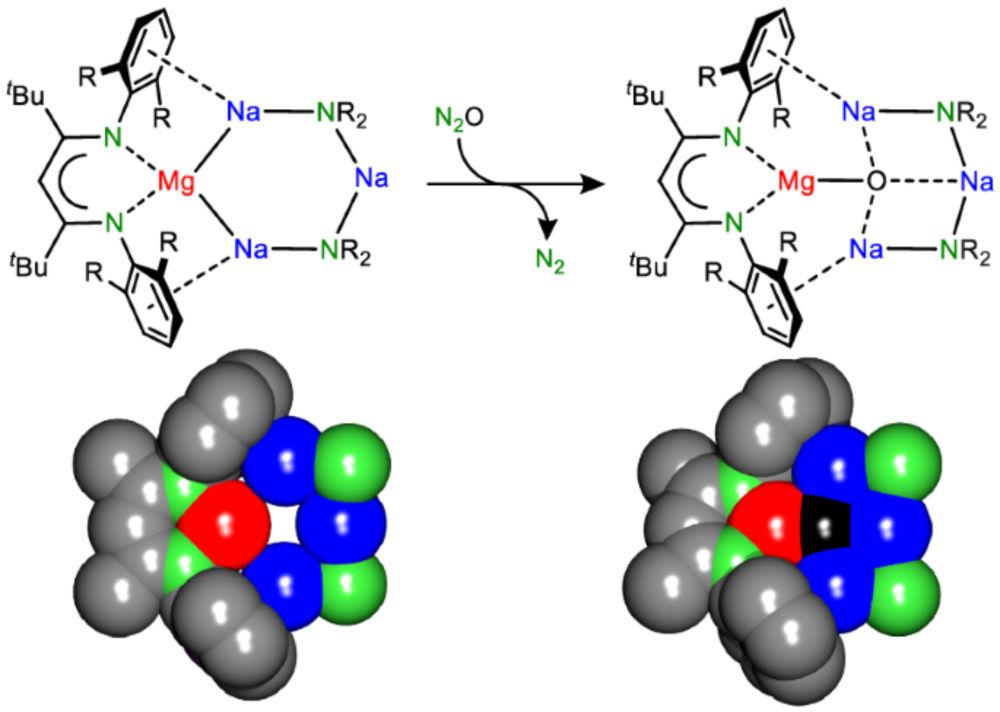
Redox-active inverse crowns for small molecule activation - Nature Chemistry
Following the building principles of crown ethers for cation encapsulation, inverse crowns are rings of metals that bind anions. Now a redox-active inverse crown ether featuring Na+ cations and Mg0 ha...
www.nature.com
February 21, 2025 at 7:21 AM
Redox-active inverse crowns for small molecule activation, from Sjoerd Harder @harder-research.bsky.social and co-workers
www.nature.com/articles/s41...
#chemsky
www.nature.com/articles/s41...
#chemsky
Reposted by Dawid Jędrzkiewicz
OXIDATION STATE CONFUSION: Al(I)-Sn(II)? Al(II)-Sn(I)? Al(III)-Sn(0)? The crooked structure of this complex can be explained by a Al-donor Sn-acceptor bond. Details can be found here: chemistry-europe.onlinelibrary.wiley.com/doi/10.1002/...

March 25, 2025 at 2:37 PM
OXIDATION STATE CONFUSION: Al(I)-Sn(II)? Al(II)-Sn(I)? Al(III)-Sn(0)? The crooked structure of this complex can be explained by a Al-donor Sn-acceptor bond. Details can be found here: chemistry-europe.onlinelibrary.wiley.com/doi/10.1002/...
Reposted by Dawid Jędrzkiewicz
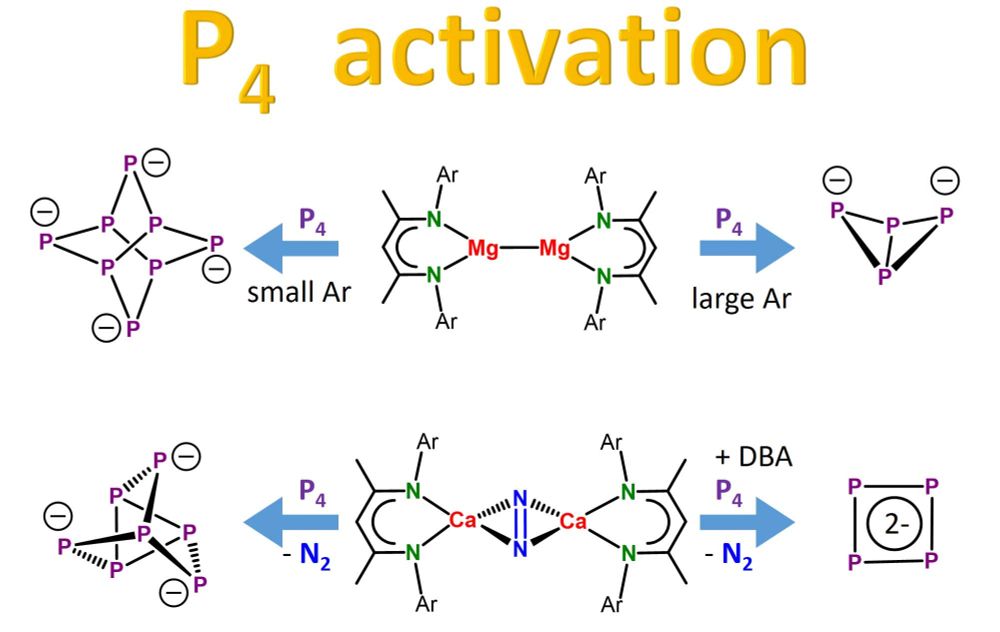
P4 reduction by low valent Mg(I) complexes and a Ca(I) synthon. The selectivity can be tuned with ligand bulk, metal choice and addition of dibora-anthracene (DBA). Details can be found in Chemical Science: pubs.rsc.org/en/content/a...
February 5, 2025 at 12:37 PM
P4 reduction by low valent Mg(I) complexes and a Ca(I) synthon. The selectivity can be tuned with ligand bulk, metal choice and addition of dibora-anthracene (DBA). Details can be found in Chemical Science: pubs.rsc.org/en/content/a...
Reposted by Dawid Jędrzkiewicz
PREFORMED REDOX-ACTIVE INVERSE CROWNS: Finally out in @naturechemistry.bsky.social Highly selective reduction of N2O, epoxide, sulfur or O2. The ring can also be extended to a larger metalla-crown for stabilization of larger anions like N2O2(2-). Open access: shorturl.at/LZE6Y

February 17, 2025 at 4:21 PM
PREFORMED REDOX-ACTIVE INVERSE CROWNS: Finally out in @naturechemistry.bsky.social Highly selective reduction of N2O, epoxide, sulfur or O2. The ring can also be extended to a larger metalla-crown for stabilization of larger anions like N2O2(2-). Open access: shorturl.at/LZE6Y
Reposted by Dawid Jędrzkiewicz

Was great to be a part of this! Now out in @chemsci.bsky.social
P4 reduction by low valent Mg(I) complexes and a Ca(I) synthon. The selectivity can be tuned with ligand bulk, metal choice and addition of dibora-anthracene (DBA). Details can be found in Chemical Science: pubs.rsc.org/en/content/a...
February 6, 2025 at 6:15 AM
Was great to be a part of this! Now out in @chemsci.bsky.social