



@davidlandry1.bsky.social
Reposted

Congratulations to @puginiercamille.bsky.social on her @academiesciences.bsky.social prize for her PhD work at @lrsv-toulouse.bsky.social!
@talbotlabtsl.bsky.social says "I am really proud to see Camille receive this honour and excited about the expertise she's brought to my group"
buff.ly/SCb17kf
@talbotlabtsl.bsky.social says "I am really proud to see Camille receive this honour and excited about the expertise she's brought to my group"
buff.ly/SCb17kf

December 3, 2025 at 12:15 PM
Congratulations to @puginiercamille.bsky.social on her @academiesciences.bsky.social prize for her PhD work at @lrsv-toulouse.bsky.social!
@talbotlabtsl.bsky.social says "I am really proud to see Camille receive this honour and excited about the expertise she's brought to my group"
buff.ly/SCb17kf
@talbotlabtsl.bsky.social says "I am really proud to see Camille receive this honour and excited about the expertise she's brought to my group"
buff.ly/SCb17kf
Reposted

~12 years after we coined it EPP1 with @oswaldovaldesl.bsky.social one afternoon when we were postdoc with @jeanmichelane.bsky.social!
Congrats @melaniekrich.bsky.social @tatiana-vernie.bsky.social et al. for the hard work!
EPP1 is the fourth member of the Common Symbiosis Pathway 🍄🌱!
Congrats @melaniekrich.bsky.social @tatiana-vernie.bsky.social et al. for the hard work!
EPP1 is the fourth member of the Common Symbiosis Pathway 🍄🌱!
So happy to see the latest preprint of the team out! www.biorxiv.org/content/10.1...
The continuation of a long standing project started by @oswaldovaldesl.bsky.social in @jeanmichelane.bsky.social‘s lab. 1/7 🧵
The continuation of a long standing project started by @oswaldovaldesl.bsky.social in @jeanmichelane.bsky.social‘s lab. 1/7 🧵

EPP1 is an ancestral component of the plant Common Symbiosis Pathway
The success of plants on land has been enabled by mutualistic intracellular associations with microbes for 450 million years ([Delaux and Schornack 2021][1]). Because of their intracellular nature, th...
www.biorxiv.org
October 6, 2025 at 3:44 PM
~12 years after we coined it EPP1 with @oswaldovaldesl.bsky.social one afternoon when we were postdoc with @jeanmichelane.bsky.social!
Congrats @melaniekrich.bsky.social @tatiana-vernie.bsky.social et al. for the hard work!
EPP1 is the fourth member of the Common Symbiosis Pathway 🍄🌱!
Congrats @melaniekrich.bsky.social @tatiana-vernie.bsky.social et al. for the hard work!
EPP1 is the fourth member of the Common Symbiosis Pathway 🍄🌱!
Reposted
So happy to see the latest preprint of the team out! www.biorxiv.org/content/10.1...
The continuation of a long standing project started by @oswaldovaldesl.bsky.social in @jeanmichelane.bsky.social‘s lab. 1/7 🧵
The continuation of a long standing project started by @oswaldovaldesl.bsky.social in @jeanmichelane.bsky.social‘s lab. 1/7 🧵
EPP1 is an ancestral component of the plant Common Symbiosis Pathway
The success of plants on land has been enabled by mutualistic intracellular associations with microbes for 450 million years ([Delaux and Schornack 2021][1]). Because of their intracellular nature, th...
www.biorxiv.org
October 6, 2025 at 1:36 PM
So happy to see the latest preprint of the team out! www.biorxiv.org/content/10.1...
The continuation of a long standing project started by @oswaldovaldesl.bsky.social in @jeanmichelane.bsky.social‘s lab. 1/7 🧵
The continuation of a long standing project started by @oswaldovaldesl.bsky.social in @jeanmichelane.bsky.social‘s lab. 1/7 🧵
Reposted
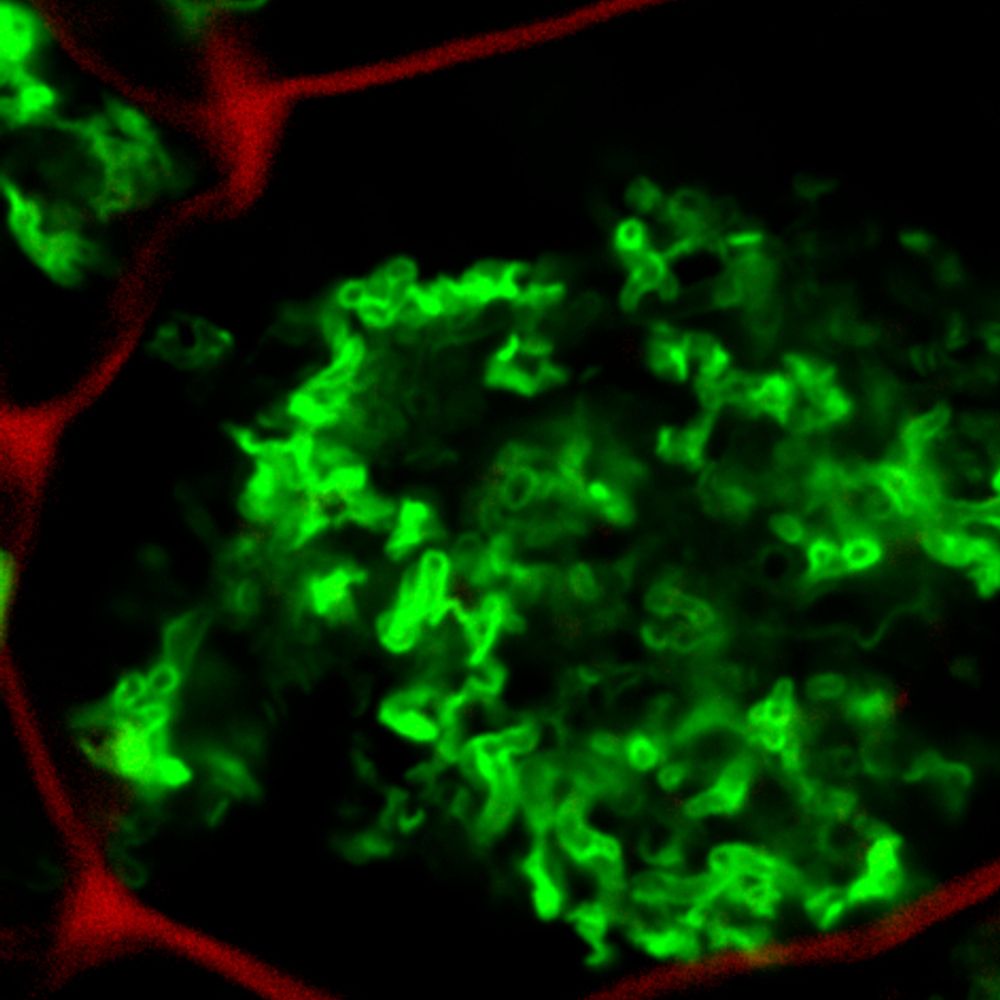
I repeat, the Common Signalling pathway for symbiosis is on fire! Kudos to our colleagues from Toulouse 🍄🌿

EPP1 is an ancestral component of the plant Common SymbiosisPathway https://www.biorxiv.org/content/10.1101/2025.09.30.679610v1
October 2, 2025 at 6:04 PM
I repeat, the Common Signalling pathway for symbiosis is on fire! Kudos to our colleagues from Toulouse 🍄🌿
Reposted


Reposted

So excited to see our review on how to detect horizontal gene transfers and their impact on plant functional evolution finally published in @theplantcell.bsky.social!
Great teamwork between @lrsv-toulouse.bsky.social and LGDP-Perpignan 😎🥳🌱
academic.oup.com/plcell/advan...
Great teamwork between @lrsv-toulouse.bsky.social and LGDP-Perpignan 😎🥳🌱
academic.oup.com/plcell/advan...

Mechanisms, Detection, and Impact of Horizontal Gene Transfer in Plant Functional Evolution
Abstract. Horizontal gene transfers (HGT) have been observed across the tree of life. While their adaptive importance in bacteria is conspicuous, the occur
academic.oup.com
August 28, 2025 at 8:08 AM
So excited to see our review on how to detect horizontal gene transfers and their impact on plant functional evolution finally published in @theplantcell.bsky.social!
Great teamwork between @lrsv-toulouse.bsky.social and LGDP-Perpignan 😎🥳🌱
academic.oup.com/plcell/advan...
Great teamwork between @lrsv-toulouse.bsky.social and LGDP-Perpignan 😎🥳🌱
academic.oup.com/plcell/advan...
Reposted
Outstanding paper ! -> receptor-like cytoplasmic kinase AeRLCK2 mediates Nod-independent rhizobial symbiosis in Aeschynomene legumes | The Plant Cell | Oxford Academic

receptor-like cytoplasmic kinase AeRLCK2 mediates Nod-independent rhizobial symbiosis in Aeschynomene legumes
Many plants interact symbiotically with arbuscular mycorrhizal fungi to enhance inorganic phosphorus uptake, and legumes also develop a nodule symbiosis with rhizobia for nitrogen acquisition. The establishment and functioning of both symbioses rely on a common plant signaling pathway activated by structurally related Myc and Nod factors. Recently, a SPARK receptor-like kinase (RLK)/receptor-like cytoplasmic kinase (RLCK) complex was shown to be essential for arbuscular mycorrhiza formation in both monocot and dicot plants. Here, we show that in Aeschynomene legumes, the RLCK component of this receptor complex has undergone a gene duplication event and mediates a unique nodule symbiosis that is independent of rhizobial Nod factors. In Aeschynomene evenia, AeRLCK2 is crucial for nodule initiation but not for arbuscular mycorrhiza symbiosis. Additionally, AeRLCK2 physically interacts with and is phosphorylated by the cysteine-rich RLK, AeCRK, which is also required for nodulation. This finding uncovers an important molecular mechanism that controls the establishment of nodulation and is associated with Nod-independent symbiosis.
sco.lt
August 26, 2025 at 4:52 PM
Outstanding paper ! -> receptor-like cytoplasmic kinase AeRLCK2 mediates Nod-independent rhizobial symbiosis in Aeschynomene legumes | The Plant Cell | Oxford Academic