


Daniel Pereira
@danielcunhapereira.bsky.social
PhD student @ CICECO University of Aveiro 🇵🇹
Mostly involved with solid-state NMR, computational calculations and adsorption to study materials for CO2 capture 👨🔬🥼
Mostly involved with solid-state NMR, computational calculations and adsorption to study materials for CO2 capture 👨🔬🥼
Reposted by Daniel Pereira
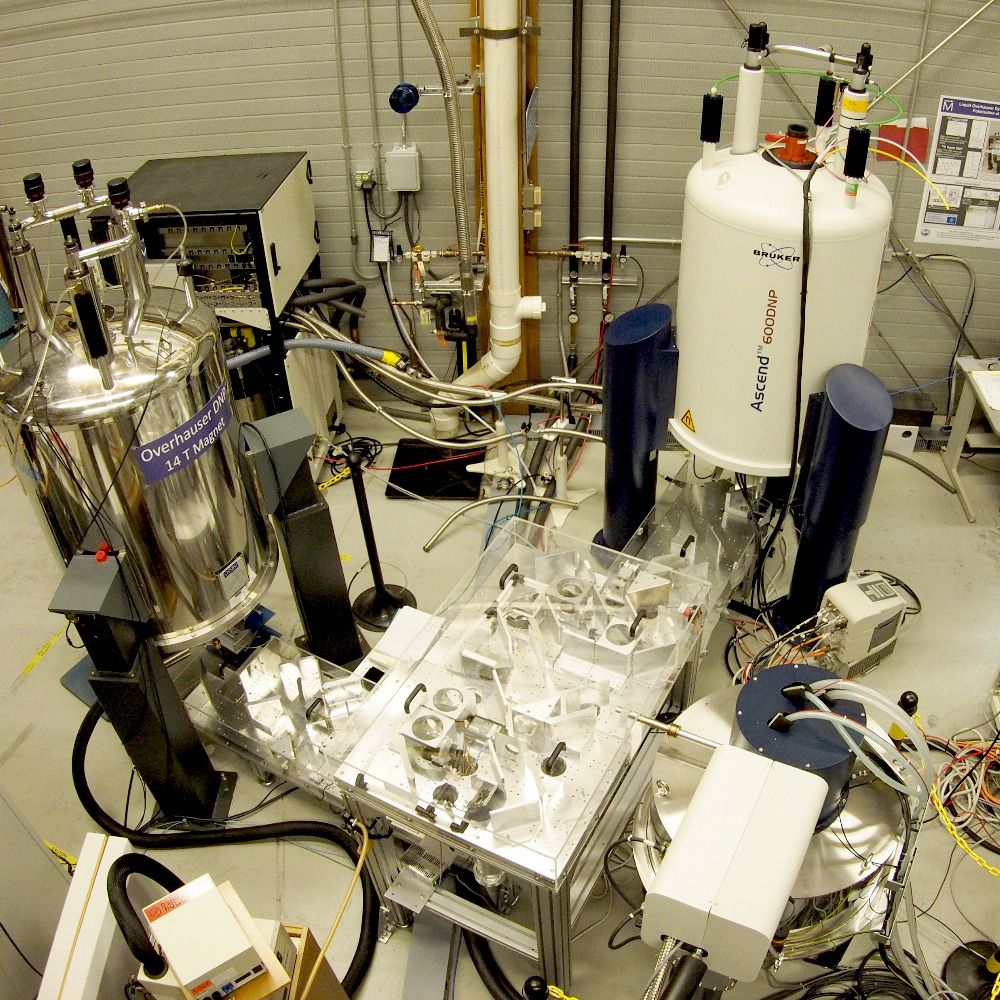
nationalmaglab.org/news-events/...
@brukercorporation.bsky.social @nationalmaglab.bsky.social #NMRchat #chemsky
@brukercorporation.bsky.social @nationalmaglab.bsky.social #NMRchat #chemsky

MagLab Scientist Earns Prestigious Research Prize - MagLab
MagLab researcher Zhehong Gan has been named 2025 recipient of the Gunther Laukien prize for groundbreaking research in nuclear magnetic resonance.
nationalmaglab.org
April 10, 2025 at 2:34 PM
Reposted by Daniel Pereira

MRSimulator is an open-source Python package for fast computation/analysis of nuclear magnetic resonance (NMR) spectra in fluid and solid phases
mrsimulator.readthedocs.io/en/stable/
github.com/deepanshs/mr...
#NMRchat #NMR 🧲
mrsimulator.readthedocs.io/en/stable/
github.com/deepanshs/mr...
#NMRchat #NMR 🧲

April 6, 2025 at 2:04 PM
MRSimulator is an open-source Python package for fast computation/analysis of nuclear magnetic resonance (NMR) spectra in fluid and solid phases
mrsimulator.readthedocs.io/en/stable/
github.com/deepanshs/mr...
#NMRchat #NMR 🧲
mrsimulator.readthedocs.io/en/stable/
github.com/deepanshs/mr...
#NMRchat #NMR 🧲
GPT-based article reviews that lack intellectual depth, unethical self-citation practices by reviewers, data fabrication … sad days for science 🫠🫠🫠
#Science #ScienceChat
#Science #ScienceChat

🤨 another hand-drawn 1H-NMR spectrum in #chemsky with unphysical nonsense (e.g. black line, 3.3 ppm) 🙁
...all junk, and no one at this "scientific journal" cares about #researchintegrity
doi.org/10.1016/j.ij...
...all junk, and no one at this "scientific journal" cares about #researchintegrity
doi.org/10.1016/j.ij...

February 19, 2025 at 10:13 AM
GPT-based article reviews that lack intellectual depth, unethical self-citation practices by reviewers, data fabrication … sad days for science 🫠🫠🫠
#Science #ScienceChat
#Science #ScienceChat
Happy to share this new publication!
In this work I was able to improve the synthesis of CALF-20, making the production faster and with higher yield. 👨🔬🧪⚗️
The improved CO2 capture performance was a bonus I was not expecting 😁
#science @uaveiro.bsky.social
dx.doi.org/10.1021/acs....
In this work I was able to improve the synthesis of CALF-20, making the production faster and with higher yield. 👨🔬🧪⚗️
The improved CO2 capture performance was a bonus I was not expecting 😁
#science @uaveiro.bsky.social
dx.doi.org/10.1021/acs....
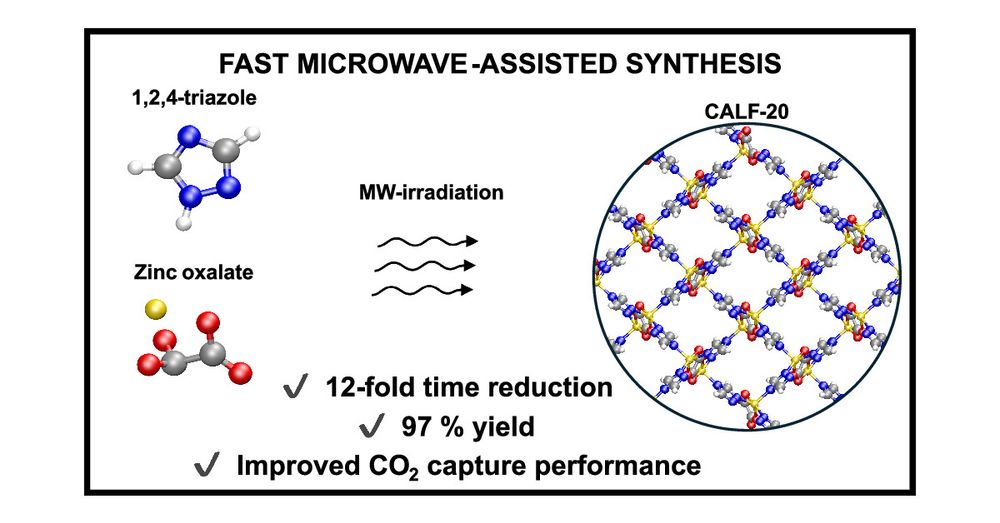
Enhancing CO2 Capture Via Fast Microwave-Assisted Synthesis of the CALF-20 Metal–Organic Framework
Metal–organic frameworks (MOFs) are promising porous materials for CO2 adsorption due to their high surface area, tunable properties, and selective adsorption capabilities. The recently reported Calgary Framework 20 (CALF-20) MOF has very appealing CO2 capture properties: high uptake capacity; low regeneration energy; durability (>450 000 cycles) under steam and wet acid gases; simple and scalable synthesis. This study investigates the microwave (MW)-assisted synthesis of CALF-20, which reduces reaction time 12-fold while enhancing the synthesis yield to 97%. Structural analysis confirmed that MW-synthesized CALF-20 retains its crystallographic structure and shows improved CO2 capture performance, exhibiting higher adsorption capacity (∼20% higher), selectivity, and lower regeneration energy. This method provides a rapid and efficient alternative for producing the CALF-20 adsorbent for CO2 capture and separation applications.
dx.doi.org
February 12, 2025 at 2:18 PM
Happy to share this new publication!
In this work I was able to improve the synthesis of CALF-20, making the production faster and with higher yield. 👨🔬🧪⚗️
The improved CO2 capture performance was a bonus I was not expecting 😁
#science @uaveiro.bsky.social
dx.doi.org/10.1021/acs....
In this work I was able to improve the synthesis of CALF-20, making the production faster and with higher yield. 👨🔬🧪⚗️
The improved CO2 capture performance was a bonus I was not expecting 😁
#science @uaveiro.bsky.social
dx.doi.org/10.1021/acs....