


Cosmic Observer
@cosmicobserver.bsky.social
Just another fool. Also a physicist. I like holograms.
However you can absolutely treat an electron classically as a point particle of negative charge.
It’s just that you don’t see its fermionic properties.
It’s just that you don’t see its fermionic properties.
January 18, 2025 at 9:01 AM
However you can absolutely treat an electron classically as a point particle of negative charge.
It’s just that you don’t see its fermionic properties.
It’s just that you don’t see its fermionic properties.
Usually we say that because the fermionic field over which we integrate in the path integral is Grassmann valued, which does not really make sense for a classical observable quantity. They are usually set to zero in classical backgrounds.
January 18, 2025 at 9:00 AM
Usually we say that because the fermionic field over which we integrate in the path integral is Grassmann valued, which does not really make sense for a classical observable quantity. They are usually set to zero in classical backgrounds.
Where did you hide Weinberg 1 ? This is the true masterpiece...
December 11, 2024 at 9:33 AM
Where did you hide Weinberg 1 ? This is the true masterpiece...
the formula above holds for the Schwartzschild solution with r_S the Schwartzschild radius.
Other solutions have similar expressions.
Other solutions have similar expressions.
December 10, 2024 at 7:53 AM
the formula above holds for the Schwartzschild solution with r_S the Schwartzschild radius.
Other solutions have similar expressions.
Other solutions have similar expressions.
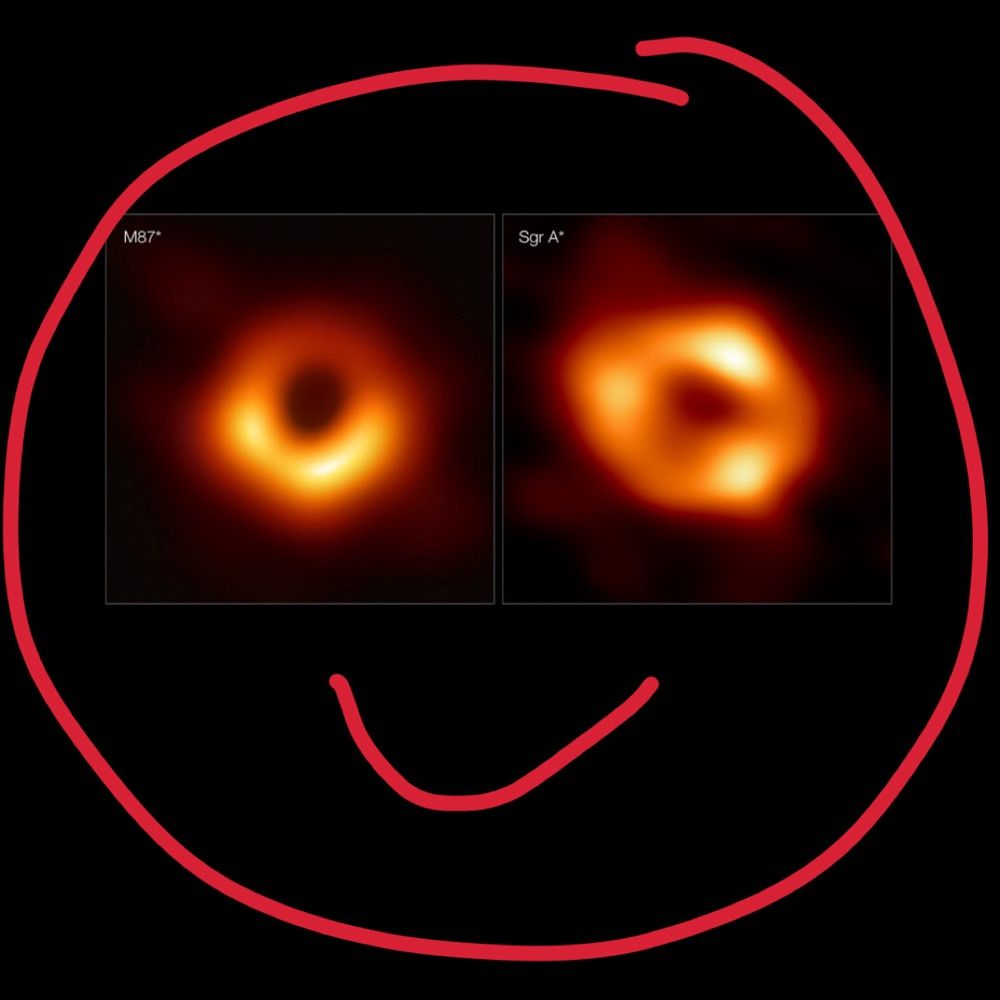
The dark region in BH pictures is not the event horizon (EH) but its « shadow »
This is because photons getting too close to the Eah will always fall in.
More precisely, there is a critical impact parameter b_c = 3 sqrt(3) r_S/2 below which photons fall in the BH.
That’s the size of the shadow.
This is because photons getting too close to the Eah will always fall in.
More precisely, there is a critical impact parameter b_c = 3 sqrt(3) r_S/2 below which photons fall in the BH.
That’s the size of the shadow.
December 10, 2024 at 7:52 AM
The dark region in BH pictures is not the event horizon (EH) but its « shadow »
This is because photons getting too close to the Eah will always fall in.
More precisely, there is a critical impact parameter b_c = 3 sqrt(3) r_S/2 below which photons fall in the BH.
That’s the size of the shadow.
This is because photons getting too close to the Eah will always fall in.
More precisely, there is a critical impact parameter b_c = 3 sqrt(3) r_S/2 below which photons fall in the BH.
That’s the size of the shadow.
She’s basically the trump of science
December 8, 2024 at 8:20 PM
She’s basically the trump of science

That’s because the 10D theory is maximally supersymmetric but we would like the 4D one to be minimally supersymmetric, since we don’t have SUSY in the real world.
Compactifications preserving the minimal amount of SUSY are Calabi Yau compactifications.
We don’t know much about the 0 susy case.
Compactifications preserving the minimal amount of SUSY are Calabi Yau compactifications.
We don’t know much about the 0 susy case.
December 7, 2024 at 7:21 AM
That’s because the 10D theory is maximally supersymmetric but we would like the 4D one to be minimally supersymmetric, since we don’t have SUSY in the real world.
Compactifications preserving the minimal amount of SUSY are Calabi Yau compactifications.
We don’t know much about the 0 susy case.
Compactifications preserving the minimal amount of SUSY are Calabi Yau compactifications.
We don’t know much about the 0 susy case.
From the worldsheet perspective string theory is just a 2D conformal sigma model, so if you can define QFT you can define it.
From the spacetime perspective you can also formulate it as a field theory, an approach which is known as « string field theory ». So again, not so different.
From the spacetime perspective you can also formulate it as a field theory, an approach which is known as « string field theory ». So again, not so different.
December 7, 2024 at 5:19 AM
From the worldsheet perspective string theory is just a 2D conformal sigma model, so if you can define QFT you can define it.
From the spacetime perspective you can also formulate it as a field theory, an approach which is known as « string field theory ». So again, not so different.
From the spacetime perspective you can also formulate it as a field theory, an approach which is known as « string field theory ». So again, not so different.
In that sense, the string theory is only defined perturbatively.
However, via holography, we think that some gauge theories (usual QFTs without gravity) can be the full non perturbative definition of string theories.
So at the end QFT and ST might be 2 faces of the same thing.
However, via holography, we think that some gauge theories (usual QFTs without gravity) can be the full non perturbative definition of string theories.
So at the end QFT and ST might be 2 faces of the same thing.
December 6, 2024 at 8:31 PM
In that sense, the string theory is only defined perturbatively.
However, via holography, we think that some gauge theories (usual QFTs without gravity) can be the full non perturbative definition of string theories.
So at the end QFT and ST might be 2 faces of the same thing.
However, via holography, we think that some gauge theories (usual QFTs without gravity) can be the full non perturbative definition of string theories.
So at the end QFT and ST might be 2 faces of the same thing.
Here it’s all on a « time slice » picture, so we are not fixing the topology of the worldsheet.
When you introduce interactions, you consider a path integral over all topologies.
Higher genus topologies are suppressed by the string coupling that turns out to be the dilaton in the low energy GR.
When you introduce interactions, you consider a path integral over all topologies.
Higher genus topologies are suppressed by the string coupling that turns out to be the dilaton in the low energy GR.
December 6, 2024 at 8:28 PM
Here it’s all on a « time slice » picture, so we are not fixing the topology of the worldsheet.
When you introduce interactions, you consider a path integral over all topologies.
Higher genus topologies are suppressed by the string coupling that turns out to be the dilaton in the low energy GR.
When you introduce interactions, you consider a path integral over all topologies.
Higher genus topologies are suppressed by the string coupling that turns out to be the dilaton in the low energy GR.
You have to be a bit careful because there are gauge symmetries and you need to properly identify physical states.
This is no different than quantizing the electromagnetic field in QFT.
But then you get the physical spectrum and there are massless spin 2 states, aka gravitons !
This is no different than quantizing the electromagnetic field in QFT.
But then you get the physical spectrum and there are massless spin 2 states, aka gravitons !
December 6, 2024 at 8:25 PM
You have to be a bit careful because there are gauge symmetries and you need to properly identify physical states.
This is no different than quantizing the electromagnetic field in QFT.
But then you get the physical spectrum and there are massless spin 2 states, aka gravitons !
This is no different than quantizing the electromagnetic field in QFT.
But then you get the physical spectrum and there are massless spin 2 states, aka gravitons !
The story is that you solve the equations of motion for a 1D string so that the worksheet has extremal area (equivalent to particles having extremal proper time)
Then you introduce creation/annihilation operators for the independent solutions, with the usual algebra, and study the Hamiltonian.
Then you introduce creation/annihilation operators for the independent solutions, with the usual algebra, and study the Hamiltonian.
December 6, 2024 at 8:22 PM
The story is that you solve the equations of motion for a 1D string so that the worksheet has extremal area (equivalent to particles having extremal proper time)
Then you introduce creation/annihilation operators for the independent solutions, with the usual algebra, and study the Hamiltonian.
Then you introduce creation/annihilation operators for the independent solutions, with the usual algebra, and study the Hamiltonian.
Other nice references are David Tong’s lecture notes, or the textbooks by Polchinksi or Becker-Becker-Schwartz. This last one is particularly nice because it contains many modern applications.
December 6, 2024 at 8:17 PM
Other nice references are David Tong’s lecture notes, or the textbooks by Polchinksi or Becker-Becker-Schwartz. This last one is particularly nice because it contains many modern applications.
The precise matter action depends on what you have on the worldsheet theory.
In the simplest consistant (= anomaly free) examples you usually get 10d supergravity.
You can start from there and look for compactifications down to 4d.
Or you can look for other ways to cancel the anomaly.
In the simplest consistant (= anomaly free) examples you usually get 10d supergravity.
You can start from there and look for compactifications down to 4d.
Or you can look for other ways to cancel the anomaly.
December 6, 2024 at 8:15 PM
The precise matter action depends on what you have on the worldsheet theory.
In the simplest consistant (= anomaly free) examples you usually get 10d supergravity.
You can start from there and look for compactifications down to 4d.
Or you can look for other ways to cancel the anomaly.
In the simplest consistant (= anomaly free) examples you usually get 10d supergravity.
You can start from there and look for compactifications down to 4d.
Or you can look for other ways to cancel the anomaly.
A self contained reference that I like are Weigand’s lecture notes :
www.thphys.uni-heidelberg.de/courses/weig...
See in particular sec. 5.6 that addresses what you are asking for.
In general you get the Einstein’s equations for pure GR + particular matter content.
www.thphys.uni-heidelberg.de/courses/weig...
See in particular sec. 5.6 that addresses what you are asking for.
In general you get the Einstein’s equations for pure GR + particular matter content.
www.thphys.uni-heidelberg.de
December 6, 2024 at 8:13 PM
A self contained reference that I like are Weigand’s lecture notes :
www.thphys.uni-heidelberg.de/courses/weig...
See in particular sec. 5.6 that addresses what you are asking for.
In general you get the Einstein’s equations for pure GR + particular matter content.
www.thphys.uni-heidelberg.de/courses/weig...
See in particular sec. 5.6 that addresses what you are asking for.
In general you get the Einstein’s equations for pure GR + particular matter content.