




Ciara Weets
@ciaramweets.bsky.social
junior scientist @ georgetown | M.Sc. in Global Infectious Disease | interested in disease ecology, vaccination, modeling health implications of policy | (she/her)
I will forever be grateful to my team of mentors and coauthors for their counsel, advice and opportunity to present this work in multiple fora as it progressed. @rebeccakatz.bsky.social @heatherswadley.bsky.social @gucghss.bsky.social @colincarlson.bsky.social + entire AMP EID team
April 15, 2025 at 2:31 PM
I will forever be grateful to my team of mentors and coauthors for their counsel, advice and opportunity to present this work in multiple fora as it progressed. @rebeccakatz.bsky.social @heatherswadley.bsky.social @gucghss.bsky.social @colincarlson.bsky.social + entire AMP EID team
What does this tell us?
-diversity in policy characteristics may reflect cultural perceptions of disease + role of the state
-smallpox vaxx mandate & penalties in obsolete currency suggest lack of enforcement in some places
-layered enforcement mechanisms = more opportunities to ensure compliance
-diversity in policy characteristics may reflect cultural perceptions of disease + role of the state
-smallpox vaxx mandate & penalties in obsolete currency suggest lack of enforcement in some places
-layered enforcement mechanisms = more opportunities to ensure compliance
April 15, 2025 at 2:31 PM
What does this tell us?
-diversity in policy characteristics may reflect cultural perceptions of disease + role of the state
-smallpox vaxx mandate & penalties in obsolete currency suggest lack of enforcement in some places
-layered enforcement mechanisms = more opportunities to ensure compliance
-diversity in policy characteristics may reflect cultural perceptions of disease + role of the state
-smallpox vaxx mandate & penalties in obsolete currency suggest lack of enforcement in some places
-layered enforcement mechanisms = more opportunities to ensure compliance
87.7% (93/106) of countries with legally-enforceable routine vaccination policies include specific enforcement mechanisms to ensure compliance with immunization requirements, though there was significant diversity in enforcement mechanisms.

April 15, 2025 at 2:31 PM
87.7% (93/106) of countries with legally-enforceable routine vaccination policies include specific enforcement mechanisms to ensure compliance with immunization requirements, though there was significant diversity in enforcement mechanisms.
Diseases w/ historically high morbidity & mortality, for which vaccines have long been available (e.g., diphtheria, measles, polio), were most universally included in policy. Recently emergent (e.g., COVID-19) and regionally endemic diseases (e.g., Japanese Encephalitis) were less commonly included.

April 15, 2025 at 2:31 PM
Diseases w/ historically high morbidity & mortality, for which vaccines have long been available (e.g., diphtheria, measles, polio), were most universally included in policy. Recently emergent (e.g., COVID-19) and regionally endemic diseases (e.g., Japanese Encephalitis) were less commonly included.
We find that:
54.6% (106) of countries studied currently have legally-enforceable policies at the national level requiring childhood vaccination against at least one disease, yet there was significant variation in the number of diseases for which vaccines are required.
54.6% (106) of countries studied currently have legally-enforceable policies at the national level requiring childhood vaccination against at least one disease, yet there was significant variation in the number of diseases for which vaccines are required.

April 15, 2025 at 2:31 PM
We find that:
54.6% (106) of countries studied currently have legally-enforceable policies at the national level requiring childhood vaccination against at least one disease, yet there was significant variation in the number of diseases for which vaccines are required.
54.6% (106) of countries studied currently have legally-enforceable policies at the national level requiring childhood vaccination against at least one disease, yet there was significant variation in the number of diseases for which vaccines are required.
To date, relatively few studies have evaluated the efficacy of childhood vaccine policies, primarily in high-income countries. Broader evaluations of policy characteristics & impacts have been limited by the lack of a comprehensive global policy database-so we spent the last two years building one.
April 15, 2025 at 2:31 PM
To date, relatively few studies have evaluated the efficacy of childhood vaccine policies, primarily in high-income countries. Broader evaluations of policy characteristics & impacts have been limited by the lack of a comprehensive global policy database-so we spent the last two years building one.
As always, a huge thank you to my coauthors for the guidance, mentorship, and collaboration on this piece. @colincarlson.bsky.social @haileyrobertson.bsky.social @rebeccakatz.bsky.social (& other coauthors who have not yet migrated over here 🦋)
January 27, 2025 at 10:20 PM
As always, a huge thank you to my coauthors for the guidance, mentorship, and collaboration on this piece. @colincarlson.bsky.social @haileyrobertson.bsky.social @rebeccakatz.bsky.social (& other coauthors who have not yet migrated over here 🦋)
The WHO has improved transparency around decision-making for DON report publication recently, underscoring the value of the DON as a tool for highlighting potential health emergencies and understanding the challenges faced when reporting high-consequence information under time constraints
January 27, 2025 at 10:20 PM
The WHO has improved transparency around decision-making for DON report publication recently, underscoring the value of the DON as a tool for highlighting potential health emergencies and understanding the challenges faced when reporting high-consequence information under time constraints
Surprisingly, neither Covid-19 nor mpox featured heavily in the DON, and most reports occurred before the declaration of a PHEIC. Info was then disseminated through periodic situation reports - except when novel variants emerged. Notably, no DON report was released regarding the Omicron variant 🦠

January 27, 2025 at 10:20 PM
Surprisingly, neither Covid-19 nor mpox featured heavily in the DON, and most reports occurred before the declaration of a PHEIC. Info was then disseminated through periodic situation reports - except when novel variants emerged. Notably, no DON report was released regarding the Omicron variant 🦠
Studying reports from the WHO Disease Outbreak News (DON) between 2020-2023, we find that outbreaks of viral hemorrhagic fevers and the avian influenza panzootic dominate the DON. We also find an increase in reports of climate-sensitive diseases, especially those that are vector- or water-borne 🦟💧

January 27, 2025 at 10:20 PM
Studying reports from the WHO Disease Outbreak News (DON) between 2020-2023, we find that outbreaks of viral hemorrhagic fevers and the avian influenza panzootic dominate the DON. We also find an increase in reports of climate-sensitive diseases, especially those that are vector- or water-borne 🦟💧
I’m so proud of this work and eternally grateful to @colincarlson.bsky.social @danjbecker.bsky.social @ctrlalttim.bsky.social and to my fellow trainees for the mentorship, opportunity to contribute, and chance to learn during this process.
January 15, 2025 at 4:00 PM
I’m so proud of this work and eternally grateful to @colincarlson.bsky.social @danjbecker.bsky.social @ctrlalttim.bsky.social and to my fellow trainees for the mentorship, opportunity to contribute, and chance to learn during this process.
Read our paper, Pathogens and Planetary Change, out today in the first issue of @natrevbiodiv.bsky.social. www.nature.com/articles/s44...

Pathogens and planetary change - Nature Reviews Biodiversity
This Review explores the relationship between emerging infectious diseases and biodiversity loss, and how both are connected to global environmental changes in the Anthropocene.
www.nature.com
January 15, 2025 at 4:00 PM
Read our paper, Pathogens and Planetary Change, out today in the first issue of @natrevbiodiv.bsky.social. www.nature.com/articles/s44...
Reposted by Ciara Weets

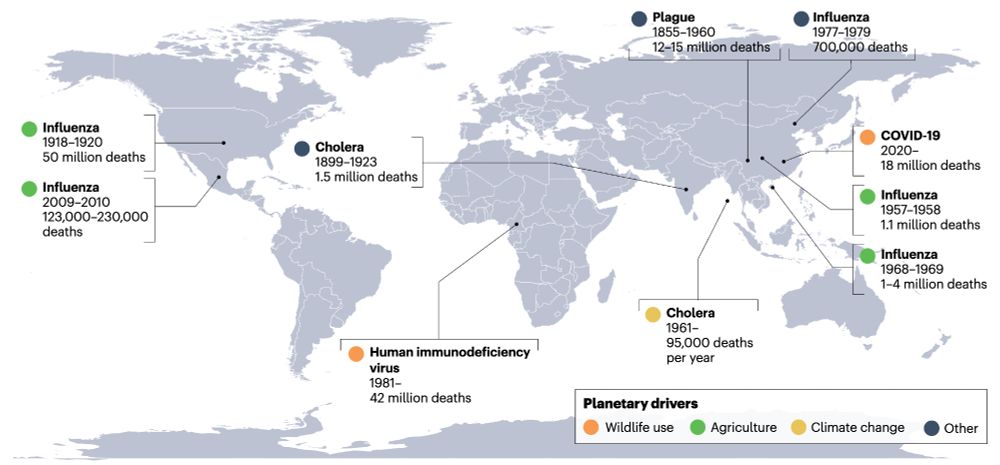
Popular science narratives about pandemics - specifically, that they happen because of disordered relationships with nature - just aren't true. Half of modern pandemics have been one virus (influenza), and only a modest fraction of pandemic pathogens (3 of 10) have jumped from wildlife to humans.
January 15, 2025 at 2:30 PM
Popular science narratives about pandemics - specifically, that they happen because of disordered relationships with nature - just aren't true. Half of modern pandemics have been one virus (influenza), and only a modest fraction of pandemic pathogens (3 of 10) have jumped from wildlife to humans.