




Carolin Schlarb
@carolin-schlarb.bsky.social
Carnivore specialist
Current affiliation at Leibniz Institute for Zoo and Wildlife Research, Berlin
Cheetah Research Project, Dept. Evolutionary Ecology
M.Sc. Organismic, Evolutionary and Paleobiology - University of Bonn
Current affiliation at Leibniz Institute for Zoo and Wildlife Research, Berlin
Cheetah Research Project, Dept. Evolutionary Ecology
M.Sc. Organismic, Evolutionary and Paleobiology - University of Bonn
Reposted by Carolin Schlarb

2️⃣weeks to go!
Join us online on 13–14 November for two days of talks and discussions on animal behavior 🐝🐙🐘
💻 It’s free & open to everyone worldwide, don’t miss out!
The full program is out now, have a look 👇
ablaoc25.sciencesconf.org/resource/pag...
Join us online on 13–14 November for two days of talks and discussions on animal behavior 🐝🐙🐘
💻 It’s free & open to everyone worldwide, don’t miss out!
The full program is out now, have a look 👇
ablaoc25.sciencesconf.org/resource/pag...
Animal Behaviour Live: Annual Online Conference 2025 - Sciencesconf.org
ablaoc25.sciencesconf.org
October 29, 2025 at 8:14 AM
2️⃣weeks to go!
Join us online on 13–14 November for two days of talks and discussions on animal behavior 🐝🐙🐘
💻 It’s free & open to everyone worldwide, don’t miss out!
The full program is out now, have a look 👇
ablaoc25.sciencesconf.org/resource/pag...
Join us online on 13–14 November for two days of talks and discussions on animal behavior 🐝🐙🐘
💻 It’s free & open to everyone worldwide, don’t miss out!
The full program is out now, have a look 👇
ablaoc25.sciencesconf.org/resource/pag...
Reposted by Carolin Schlarb
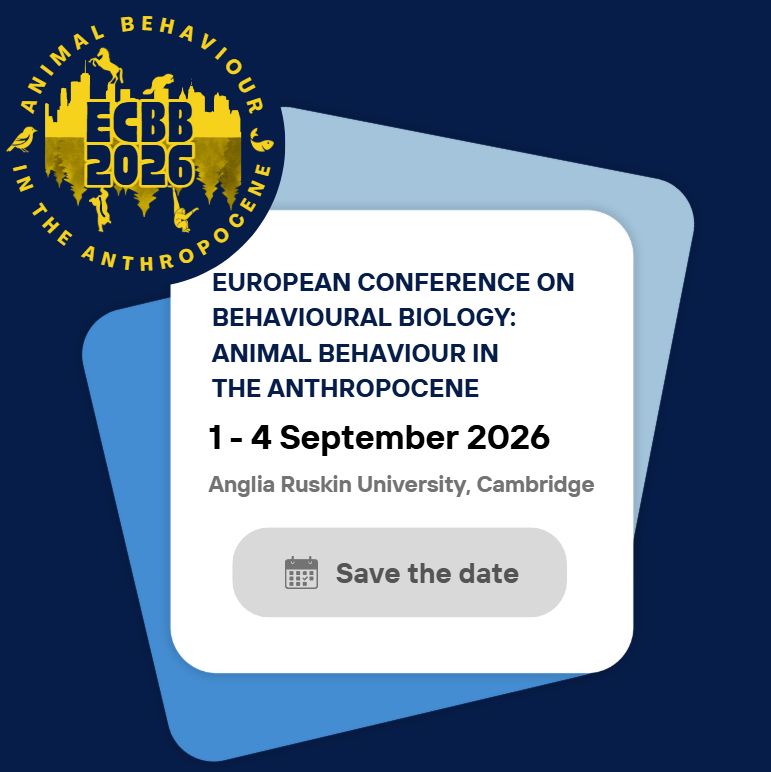
Save the date for the next European Conference on Behavioural Biology!
Animal Behaviour in the Anthropocene, 1-4 September 2026 at Anglia Ruskin University.
Watch this space for updates on speakers, plenaries, and calls for abstracts!
#AcademicSky #UpcomingConferences
Animal Behaviour in the Anthropocene, 1-4 September 2026 at Anglia Ruskin University.
Watch this space for updates on speakers, plenaries, and calls for abstracts!
#AcademicSky #UpcomingConferences
July 18, 2025 at 10:38 AM
Save the date for the next European Conference on Behavioural Biology!
Animal Behaviour in the Anthropocene, 1-4 September 2026 at Anglia Ruskin University.
Watch this space for updates on speakers, plenaries, and calls for abstracts!
#AcademicSky #UpcomingConferences
Animal Behaviour in the Anthropocene, 1-4 September 2026 at Anglia Ruskin University.
Watch this space for updates on speakers, plenaries, and calls for abstracts!
#AcademicSky #UpcomingConferences
Reposted by Carolin Schlarb

The guiña, a small wildcat, has been moved to least concern on the IUCN Red List of Threatened Species. Found only in Chile and Argentina, this small cat was previously listed as vulnerable.
But the threat downgrade isn’t a sign of conservation success, researchers say.
But the threat downgrade isn’t a sign of conservation success, researchers say.

IUCN downgrades guiña threat status, prompting conservation warning
The guiña, a small cat species found only in Chile and northern Argentina, has just been reclassified as of least concern by the IUCN. Until recently it was listed as vulnerable to extinction.…
news.mongabay.com
October 12, 2025 at 11:17 AM
The guiña, a small wildcat, has been moved to least concern on the IUCN Red List of Threatened Species. Found only in Chile and Argentina, this small cat was previously listed as vulnerable.
But the threat downgrade isn’t a sign of conservation success, researchers say.
But the threat downgrade isn’t a sign of conservation success, researchers say.
Reposted by Carolin Schlarb
Our paper just published on the relationships between pastoralists and cheetah in the Horn of Africa. More than 60% of respondents reported a cheetah attack in the last year and reported that killing cheetahs was widespread. www.frontiersin.org/journals/con...

Frontiers | Attitudes, norms, and beliefs of pastoralists toward cheetahs in the Horn of Africa
Free-ranging African cheetahs (Acinonyx jubatus) inhabit only 13% of their former range. A subspecies of particular conservation concern is the Northeastern ...
www.frontiersin.org
October 11, 2025 at 11:20 AM
Our paper just published on the relationships between pastoralists and cheetah in the Horn of Africa. More than 60% of respondents reported a cheetah attack in the last year and reported that killing cheetahs was widespread. www.frontiersin.org/journals/con...
Reposted by Carolin Schlarb

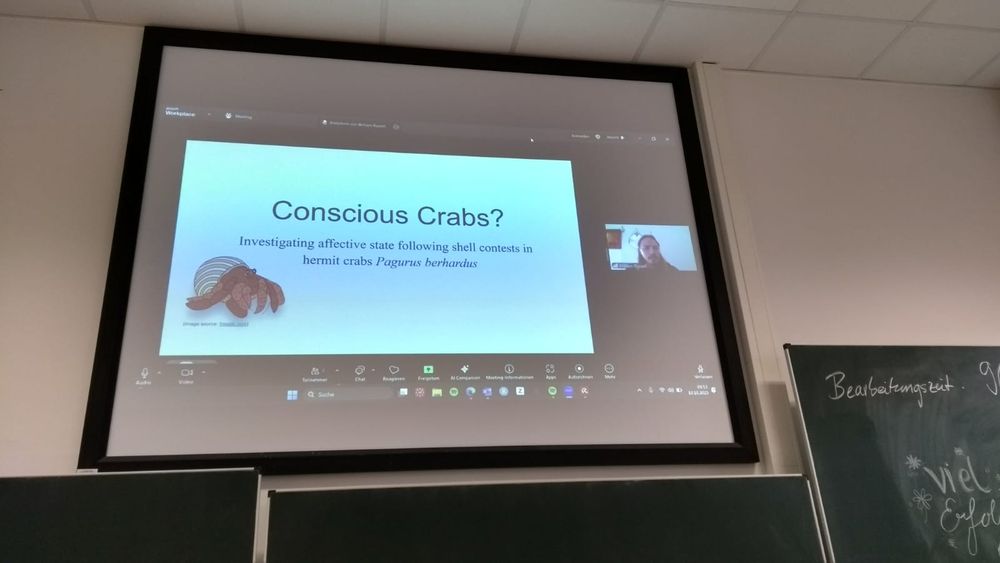
Kicking off day 3 of #GradMeet25 with more talks on sociality — linking it to dispersal, cognition, and endocrinology! From social dispersal in burying beetles to hormonal changes in cheetahs 🐘🐅🦀🪲
@paulhuber.bsky.social @carolin-schlarb.bsky.social @robotowilliam.bsky.social
@paulhuber.bsky.social @carolin-schlarb.bsky.social @robotowilliam.bsky.social



October 10, 2025 at 8:17 AM
Kicking off day 3 of #GradMeet25 with more talks on sociality — linking it to dispersal, cognition, and endocrinology! From social dispersal in burying beetles to hormonal changes in cheetahs 🐘🐅🦀🪲
@paulhuber.bsky.social @carolin-schlarb.bsky.social @robotowilliam.bsky.social
@paulhuber.bsky.social @carolin-schlarb.bsky.social @robotowilliam.bsky.social
Reposted by Carolin Schlarb
A buzzing 🐝 poster session at #GradMeet25 — great science, great conversations, great energy! ✨

October 9, 2025 at 9:31 AM
A buzzing 🐝 poster session at #GradMeet25 — great science, great conversations, great energy! ✨
Last month I attended the conference of the German Society for Mammalogy in Siena, Italy and presented my study on hormonal and morphological changes in male cheetahs that become territorial 🐆 Thanks for having me!


October 8, 2025 at 2:57 PM
Last month I attended the conference of the German Society for Mammalogy in Siena, Italy and presented my study on hormonal and morphological changes in male cheetahs that become territorial 🐆 Thanks for having me!
Reposted by Carolin Schlarb

Flowers can be wolf-pollinated, apparently. BRB doing some extreme gardening for rewilding purposes
www.cbc.ca/radio/asitha...
www.cbc.ca/radio/asitha...

Ethiopian wolves have a sweet tooth. These flowers are their lollipops | CBC Radio
Ethiopian wolves are carnivores but new research suggests they supplement their diet with the sweet, sticky nectar from native flowers. And scientists say they may even be acting as pollinators in the...
www.cbc.ca
March 21, 2025 at 10:26 AM
Flowers can be wolf-pollinated, apparently. BRB doing some extreme gardening for rewilding purposes
www.cbc.ca/radio/asitha...
www.cbc.ca/radio/asitha...
Reposted by Carolin Schlarb

By studying the vocalizations of primates, birds and whales, researchers have spotted features of animal communication once thought unique to human language. To probe deeper, some researchers are turning to AI to explore whether we can infer meaning from such communications.

AI is helping to decode animals’ speech. Will it also let us talk with them?
The complexity of vocal communication in some primates, whales and birds might approach that of human language.
spklr.io
September 29, 2025 at 4:21 PM
By studying the vocalizations of primates, birds and whales, researchers have spotted features of animal communication once thought unique to human language. To probe deeper, some researchers are turning to AI to explore whether we can infer meaning from such communications.
Reposted by Carolin Schlarb

What a great experience the 2025 meeting in Siena was!
We had inspiring talks, shared knowledge, sparked discussions, and strengthend the amazing community of mammalogists.
A big thanks goes out to the coordination team and the Italian Mammal Society- Associazione Teriologica Italiana!
We had inspiring talks, shared knowledge, sparked discussions, and strengthend the amazing community of mammalogists.
A big thanks goes out to the coordination team and the Italian Mammal Society- Associazione Teriologica Italiana!

September 8, 2025 at 4:20 PM
What a great experience the 2025 meeting in Siena was!
We had inspiring talks, shared knowledge, sparked discussions, and strengthend the amazing community of mammalogists.
A big thanks goes out to the coordination team and the Italian Mammal Society- Associazione Teriologica Italiana!
We had inspiring talks, shared knowledge, sparked discussions, and strengthend the amazing community of mammalogists.
A big thanks goes out to the coordination team and the Italian Mammal Society- Associazione Teriologica Italiana!