



The Backseat Policy Critic
@backseatpolicy.bsky.social
Various policy musings from someone with far too little experience to justify their confidence, with an emphasis on systems and culture. All views represent opinions rather than advice.
Seems more logical to focus UK troops in the North in the Baltics, where there is already a presence and which is more vulnerable, and instead leave the peacekeeping to countries like Turkey and India which *can* credibly claim to be neutral
August 16, 2025 at 5:09 PM
Seems more logical to focus UK troops in the North in the Baltics, where there is already a presence and which is more vulnerable, and instead leave the peacekeeping to countries like Turkey and India which *can* credibly claim to be neutral
I am literally in the first few pages and we already have a fully fleshed out account symbolic filtering and mental models. I am increasingly wondering if the secret behind functional and nonfunctional systems lies somewhere in the involvement and interaction of autistic people vs neurotypicals

June 1, 2025 at 3:15 PM
I am literally in the first few pages and we already have a fully fleshed out account symbolic filtering and mental models. I am increasingly wondering if the secret behind functional and nonfunctional systems lies somewhere in the involvement and interaction of autistic people vs neurotypicals
Likewise, most of the structural notions behind government would be replicated (albeit in a more sophisticated form) by Heath, and later by Blair.
May 16, 2025 at 10:34 AM
Likewise, most of the structural notions behind government would be replicated (albeit in a more sophisticated form) by Heath, and later by Blair.
If you look at a lot of the intent behind their actual policies, a lot of it was pretty reasonable and frankly resembles a lot of what the UK should be doing now, ie adopting and optimising around a knowledge based services export model on a global level.
May 16, 2025 at 10:34 AM
If you look at a lot of the intent behind their actual policies, a lot of it was pretty reasonable and frankly resembles a lot of what the UK should be doing now, ie adopting and optimising around a knowledge based services export model on a global level.
Was the Wilson government really that much of a failure though? The elephant in the room at the time was the BoP crisis, which effectively sucked away all capacity for anything else and essentially guaranteed losing the election regardless (arguably much like 2024).
May 16, 2025 at 10:34 AM
Was the Wilson government really that much of a failure though? The elephant in the room at the time was the BoP crisis, which effectively sucked away all capacity for anything else and essentially guaranteed losing the election regardless (arguably much like 2024).
Also, being told that I am considered a trade nerd by Sam Lowe has made my day
April 28, 2025 at 12:35 PM
Also, being told that I am considered a trade nerd by Sam Lowe has made my day
The US right now:
![US: [to EU] When you make aggressive lopsided smash and grab trade demands to the UK it’s “reasonable national interest”. But when I make aggressive lopsided smash and grab trade demands to you, it’s bullying and disrespecting allies”. That hardly seems fair.](https://cdn.bsky.app/img/feed_thumbnail/plain/did:plc:wlnwhmznw3747npd2323s3ga/bafkreifigzl2mi4gaaa5n6dgxiitbda6x73z4gpuww2nbyatxtgkonapai@jpeg)
April 28, 2025 at 12:34 PM
The US right now:
Certainly that’s always been my read on what POSIWID is meant to communicate at least.
February 9, 2025 at 12:22 PM
Certainly that’s always been my read on what POSIWID is meant to communicate at least.
I’d argue it also plays into a wider attitude of “focus on what it is you are actually trying to do, rather than fixating on too much on specifics of form (or on the flip side, excessively vague principles that you then debate the ‘true meaning of)”.
February 9, 2025 at 12:22 PM
I’d argue it also plays into a wider attitude of “focus on what it is you are actually trying to do, rather than fixating on too much on specifics of form (or on the flip side, excessively vague principles that you then debate the ‘true meaning of)”.
TLDR: The reason why the UK has historically been so successful is that it is the ultimate viable system - able to immediately identify when systems are failing to adapt to their environment and modify/bypass them as needed.
February 9, 2025 at 10:44 AM
TLDR: The reason why the UK has historically been so successful is that it is the ultimate viable system - able to immediately identify when systems are failing to adapt to their environment and modify/bypass them as needed.
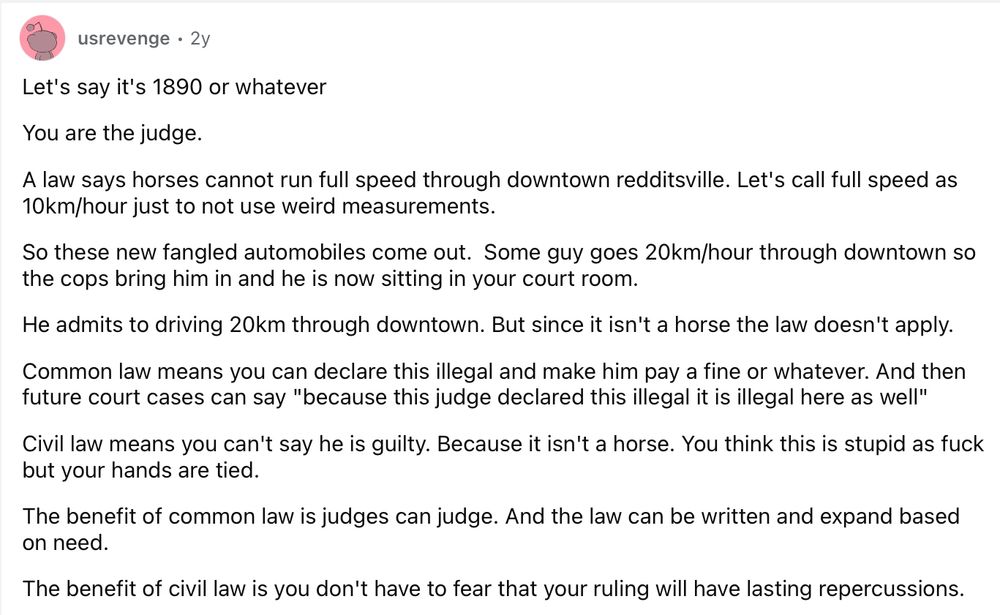
It also explains an awful lot about a lot of things, such as the frustrations the UK and other UK-inspired countries (like Norway and Sweden) has with the EU, the relative efficiency of Common Law countries over Civil Law, and the UK’s historic success at systems building compared to everyone else.
February 9, 2025 at 10:41 AM
It also explains an awful lot about a lot of things, such as the frustrations the UK and other UK-inspired countries (like Norway and Sweden) has with the EU, the relative efficiency of Common Law countries over Civil Law, and the UK’s historic success at systems building compared to everyone else.
However more widely, once you notice this, you begin to see it everywhere in the UK - be it in the constitution, the obsession with conventions, in the constitutional monarchy system and in common law.
February 9, 2025 at 10:41 AM
However more widely, once you notice this, you begin to see it everywhere in the UK - be it in the constitution, the obsession with conventions, in the constitutional monarchy system and in common law.
Despite having used money laundering as an example, I have no idea if this is how regulation is actually done (by the sounds of your piece, it seems like it’s a bit closer to European traditions than UK ones).
February 9, 2025 at 10:41 AM
Despite having used money laundering as an example, I have no idea if this is how regulation is actually done (by the sounds of your piece, it seems like it’s a bit closer to European traditions than UK ones).
The downside of this is that it relies on both parties acting in reasonably good faith (the ‘good chaps theory of government’), and while for the most part I’d say it does happen in the UK, it’s a bit more difficult in places with worse political culture.
February 9, 2025 at 10:41 AM
The downside of this is that it relies on both parties acting in reasonably good faith (the ‘good chaps theory of government’), and while for the most part I’d say it does happen in the UK, it’s a bit more difficult in places with worse political culture.
In this way, the UK reliance on convention is essentially the ultimate variety amplifier - it enables it to respond to any situation exactly how it is, rather than having to construct some magic all purpose model that somehow pre-empts every situation.
February 9, 2025 at 10:41 AM
In this way, the UK reliance on convention is essentially the ultimate variety amplifier - it enables it to respond to any situation exactly how it is, rather than having to construct some magic all purpose model that somehow pre-empts every situation.
Thus, you get a middle ground between the demands of the regulator (ability to crack down on bad behaviour freely), and the regulated (a decent set of guidelines on how to behave and the knowledge that you will be treated fairly when the rigid system is inevitably flawed).
February 9, 2025 at 10:41 AM
Thus, you get a middle ground between the demands of the regulator (ability to crack down on bad behaviour freely), and the regulated (a decent set of guidelines on how to behave and the knowledge that you will be treated fairly when the rigid system is inevitably flawed).
It can then use the results of this to feed back into strongly advisory, but non-absolute forms of guidance (eg precedents in common law). That way you organically build up your systems in response to the environment and feedback loops, rather than rigid rulebooks.
February 9, 2025 at 10:41 AM
It can then use the results of this to feed back into strongly advisory, but non-absolute forms of guidance (eg precedents in common law). That way you organically build up your systems in response to the environment and feedback loops, rather than rigid rulebooks.
Thus, rather than trying to create some explicit regulatory bridge between the two, it instead relies on the fact that (as you say) most of the time both of them have the same purpose, and uses that as the engine for resolving the differences between compliance and enforcement.
February 9, 2025 at 10:41 AM
Thus, rather than trying to create some explicit regulatory bridge between the two, it instead relies on the fact that (as you say) most of the time both of them have the same purpose, and uses that as the engine for resolving the differences between compliance and enforcement.
Rather than sitting and going through a checklist and b*llocking people for doing x, it instead settles on a broad principle (eg money laundering is bad), and then sits down, has an honest conversation between parties, and decides from there what was actually reasonable.
February 9, 2025 at 10:41 AM
Rather than sitting and going through a checklist and b*llocking people for doing x, it instead settles on a broad principle (eg money laundering is bad), and then sits down, has an honest conversation between parties, and decides from there what was actually reasonable.
The key problem you seem to be orbiting around is that it is almost impossible to precisely articulate what is or isn’t okay without either creating holes in the regulation or inflicting undue burdens on the regulated. However, the joy of the traditional UK system is that it doesn’t need to do this.
February 9, 2025 at 10:41 AM
The key problem you seem to be orbiting around is that it is almost impossible to precisely articulate what is or isn’t okay without either creating holes in the regulation or inflicting undue burdens on the regulated. However, the joy of the traditional UK system is that it doesn’t need to do this.
One thing that often stands out about the UK is the extent to which it relies on conventions, be it the unwritten constitution or the system of common law. Many commentators present this as a flaw that needs to be rectified, but I’d argue that it instead acts as the ultimate variety amplifier.
February 9, 2025 at 10:41 AM
One thing that often stands out about the UK is the extent to which it relies on conventions, be it the unwritten constitution or the system of common law. Many commentators present this as a flaw that needs to be rectified, but I’d argue that it instead acts as the ultimate variety amplifier.