




Amy Ross Arguedas
@amyrossarguedas.bsky.social
Postdoctoral Researcher @reutersinstitute.bsky.social | Northwestern University and Universidad de Costa Rica alum | Usual disclaimers
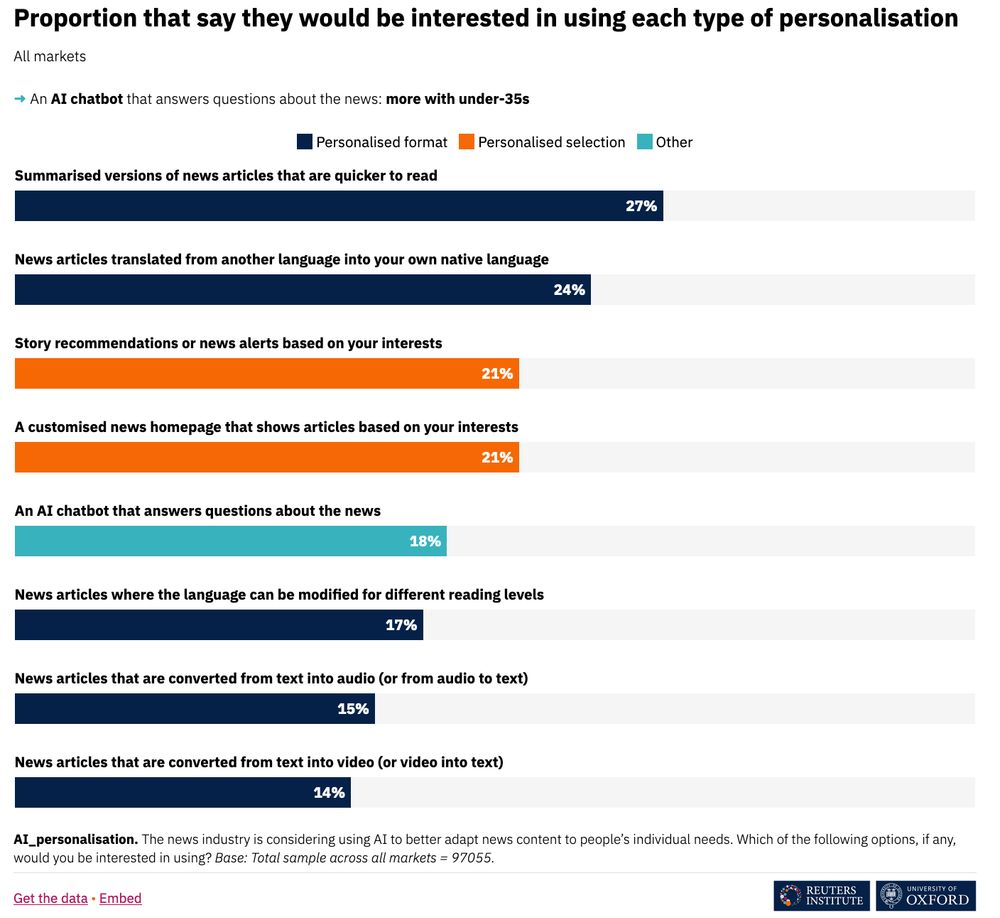
Younger people, who tend to be more comfortable with AI in general, also showed greater interest in the use of AI for personalising *formats* (e.g. adapting articles to different reading levels), as well as chatbots.

June 24, 2025 at 11:51 AM
Younger people, who tend to be more comfortable with AI in general, also showed greater interest in the use of AI for personalising *formats* (e.g. adapting articles to different reading levels), as well as chatbots.
We found some differences by markets: e.g. translation ranks higher in linguistically unique European countries (e.g. Finland, Hungary); interest in adapting language for dif reading levels ranks higher in countries with lower literacy rates or reading proficiency (most popular option in India).

June 24, 2025 at 11:51 AM
We found some differences by markets: e.g. translation ranks higher in linguistically unique European countries (e.g. Finland, Hungary); interest in adapting language for dif reading levels ranks higher in countries with lower literacy rates or reading proficiency (most popular option in India).
We found relatively low interest – below 30% – for any single option (which may be shaped by low familiarity with these kinds of tools). Interest was highest in options for making news use more efficient (summaries and translations) and relevant (customised homepages and recommendations or alerts).
June 24, 2025 at 11:51 AM
We found relatively low interest – below 30% – for any single option (which may be shaped by low familiarity with these kinds of tools). Interest was highest in options for making news use more efficient (summaries and translations) and relevant (customised homepages and recommendations or alerts).
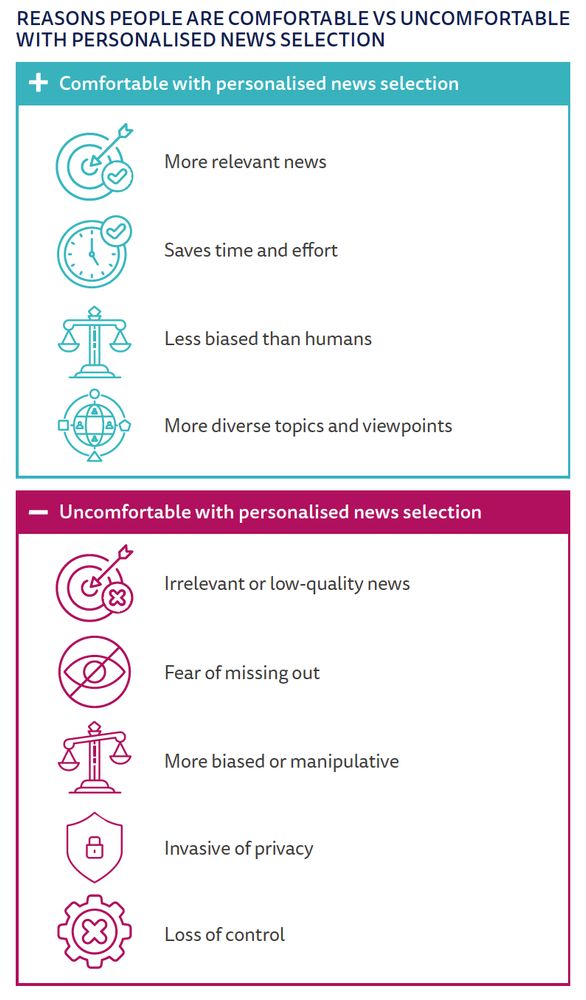
In open comments, those who said they were comfortable with personalised news selection explained they appreciated things like greater relevance, efficiency, and diversity; those who were uncomfortable questioned the quality of recommendations or worried about biases, missing out, surveillance, etc.
June 24, 2025 at 11:51 AM
In open comments, those who said they were comfortable with personalised news selection explained they appreciated things like greater relevance, efficiency, and diversity; those who were uncomfortable questioned the quality of recommendations or worried about biases, missing out, surveillance, etc.
We found that close to half of respondents are comfortable with personalised news selection, but comfort was lower than personalisation for weather, music, or online TV (and higher than for social media/video feeds).

June 24, 2025 at 11:51 AM
We found that close to half of respondents are comfortable with personalised news selection, but comfort was lower than personalisation for weather, music, or online TV (and higher than for social media/video feeds).
The share of internet news users who say that they read news from at least one major outlet with a top editor of colour also slightly decreased from 27% to 23% and ranges from 0% in Brazil, Germany, and the UK, where no editors in the sample are people of colour, to 85% in South Africa.

March 21, 2025 at 12:08 PM
The share of internet news users who say that they read news from at least one major outlet with a top editor of colour also slightly decreased from 27% to 23% and ranges from 0% in Brazil, Germany, and the UK, where no editors in the sample are people of colour, to 85% in South Africa.
As in previous years, in every single country covered, the percentage of top editors of colour remains below – often far below – the percentage of people of colour in the general population.
March 21, 2025 at 12:08 PM
As in previous years, in every single country covered, the percentage of top editors of colour remains below – often far below – the percentage of people of colour in the general population.
In Brazil, and to a lesser degree the UK, there are fewer top editors of colour than there are journalists of colour. Despite the decreases in South Africa and the US, there are still more top editors of colour than journalists of colour in both countries.

March 21, 2025 at 12:08 PM
In Brazil, and to a lesser degree the UK, there are fewer top editors of colour than there are journalists of colour. Despite the decreases in South Africa and the US, there are still more top editors of colour than journalists of colour in both countries.
In Brazil, Germany, and the UK, none of the outlets in our sample have a person of colour as top editor. In South Africa, the percentage of top editors of colour dropped from 71% in 2024 to 63% in 2025. In the US, the percentage also decreased from 29% last year to 15% in 2025.

March 21, 2025 at 12:08 PM
In Brazil, Germany, and the UK, none of the outlets in our sample have a person of colour as top editor. In South Africa, the percentage of top editors of colour dropped from 71% in 2024 to 63% in 2025. In the US, the percentage also decreased from 29% last year to 15% in 2025.
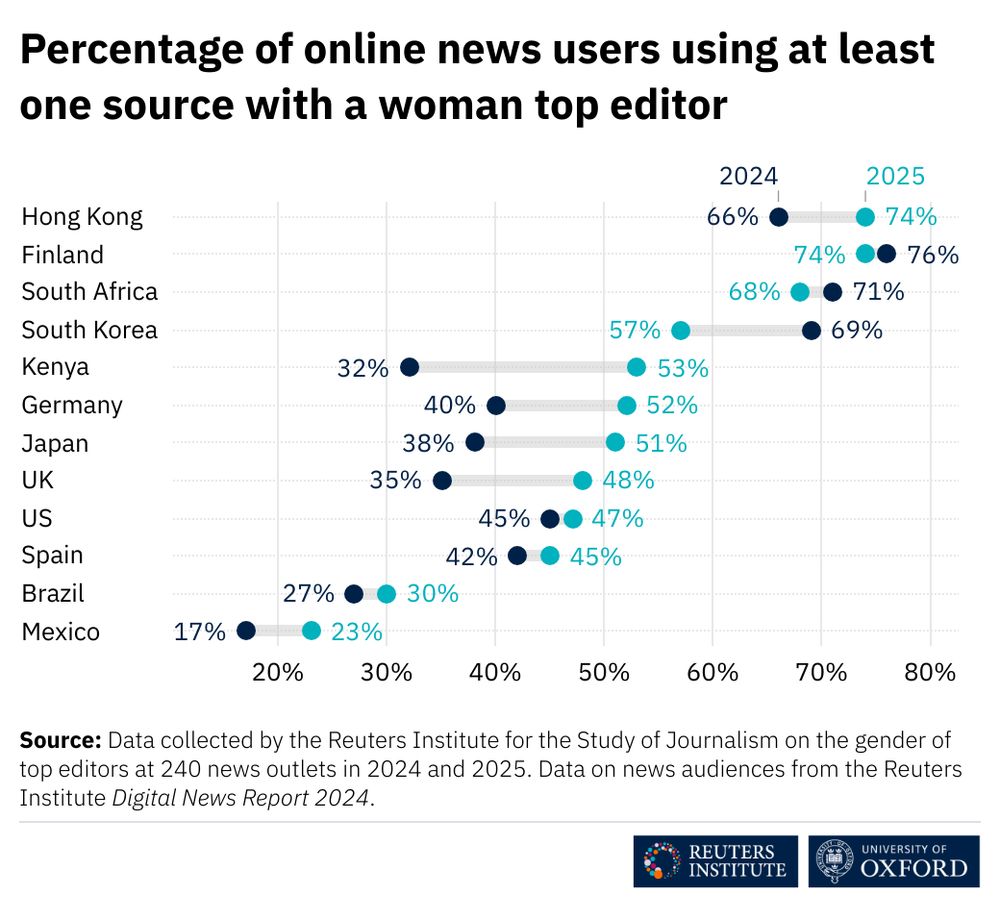
There is notable variation in the percentage of online news users in each market who say they get news from one or more major outlets with a woman as the top editor. This ranges from, at the high end, 74% in Finland and Hong Kong to, at the low end, 23% in Mexico.
March 6, 2025 at 12:18 PM
There is notable variation in the percentage of online news users in each market who say they get news from one or more major outlets with a woman as the top editor. This ranges from, at the high end, 74% in Finland and Hong Kong to, at the low end, 23% in Mexico.
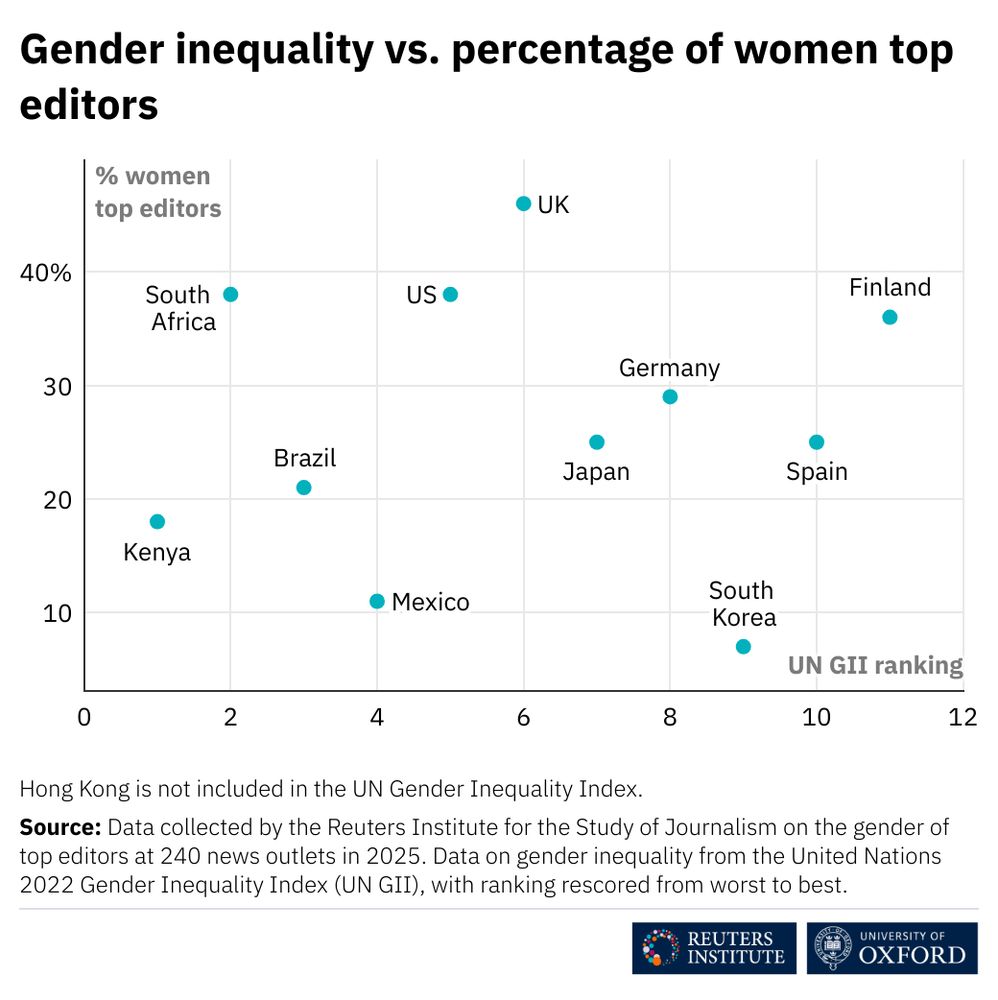
Looking at gender equality in society and the % of women in top editorial positions, we find no correlation. It is still the case that many countries that score well on the United Nations Gender Inequality Index (UN GII) have relatively few women among the top editors.
March 6, 2025 at 12:18 PM
Looking at gender equality in society and the % of women in top editorial positions, we find no correlation. It is still the case that many countries that score well on the United Nations Gender Inequality Index (UN GII) have relatively few women among the top editors.
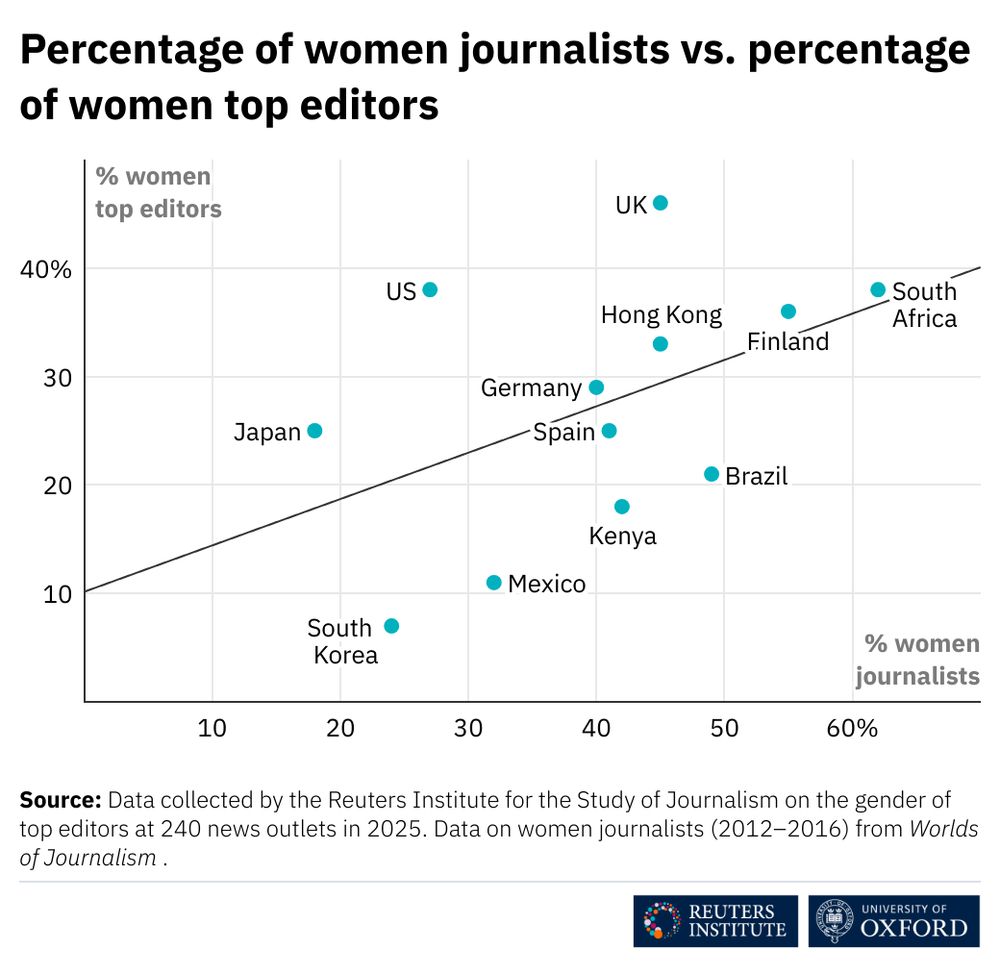
When we compare the percentage of women working in journalism with the percentage of women in top editorial positions, we find a weak positive correlation. Still, in 9/12 markets there are lower percentages of women in top editorial roles than women working as journalists.
March 6, 2025 at 12:18 PM
When we compare the percentage of women working in journalism with the percentage of women in top editorial positions, we find a weak positive correlation. Still, in 9/12 markets there are lower percentages of women in top editorial roles than women working as journalists.
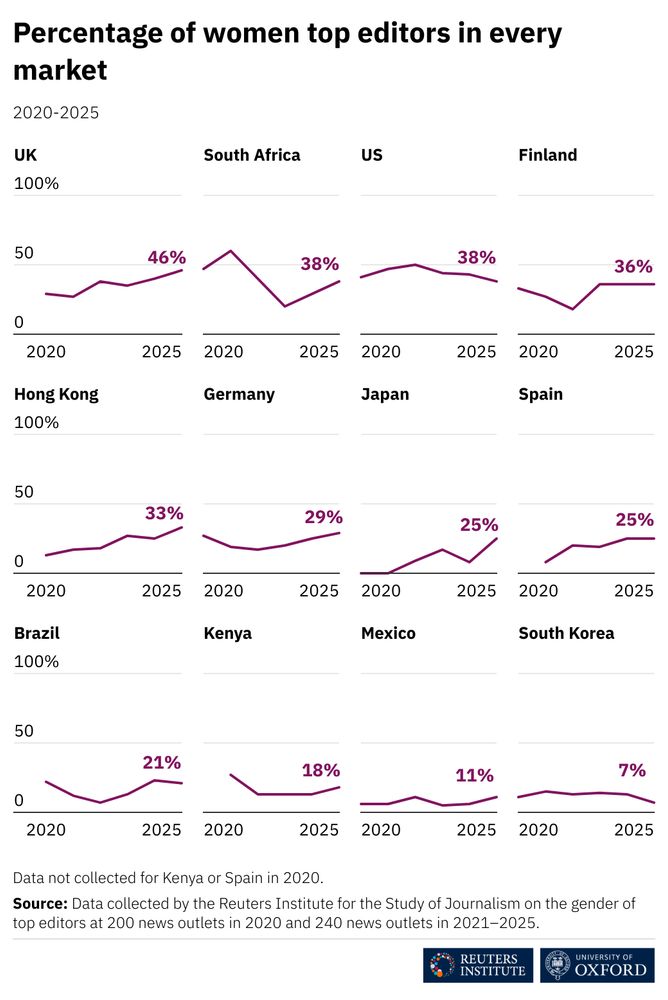
The percentage of women in top editors varies significantly from market to market, from 7% in South Korea to 46% in the UK. We also find country differences in the trends over time.
March 6, 2025 at 12:18 PM
The percentage of women in top editors varies significantly from market to market, from 7% in South Korea to 46% in the UK. We also find country differences in the trends over time.