




Alison Preston
@aliprestonphd.bsky.social
Professor of Neuroscience @utaustin.bsky.social investigating how kids, teens & adults learn, remember & make sense of the world.
preston.clm.utexas.edu
preston.clm.utexas.edu
(4/4)
Overall, we found that independence predicts memory abilities in ways that age alone doesn't capture.
Do you study memory development? We created a survey tool to help capture how independently kids manage their time!
Details here: osf.io/preprints/ps...
Overall, we found that independence predicts memory abilities in ways that age alone doesn't capture.
Do you study memory development? We created a survey tool to help capture how independently kids manage their time!
Details here: osf.io/preprints/ps...
OSF
osf.io
November 21, 2025 at 8:34 PM
(4/4)
Overall, we found that independence predicts memory abilities in ways that age alone doesn't capture.
Do you study memory development? We created a survey tool to help capture how independently kids manage their time!
Details here: osf.io/preprints/ps...
Overall, we found that independence predicts memory abilities in ways that age alone doesn't capture.
Do you study memory development? We created a survey tool to help capture how independently kids manage their time!
Details here: osf.io/preprints/ps...
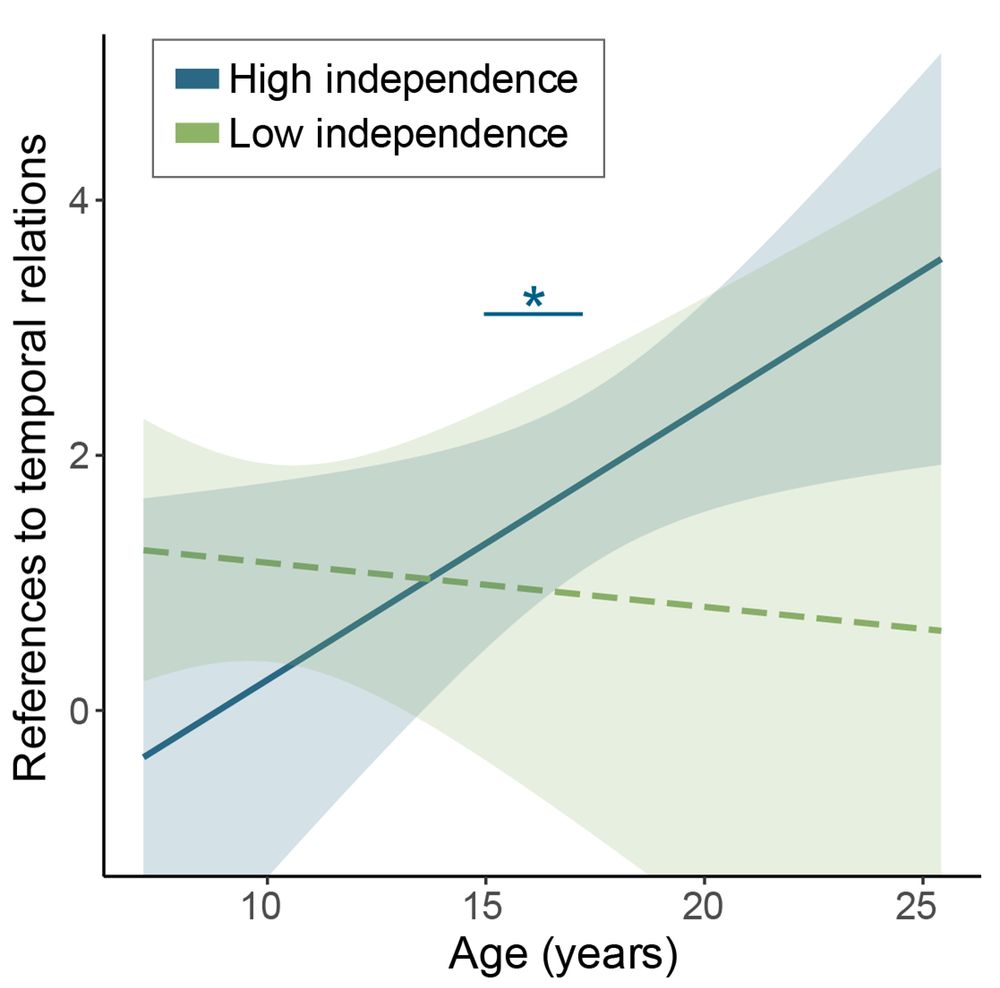
(3/4)
Beyond age, independence predicts how individuals talk about their lived experience.
Children & teens who manage time more independently (getting themselves up, having their own get-ready routine) use more sophisticated time language when recalling their daily experiences.
Beyond age, independence predicts how individuals talk about their lived experience.
Children & teens who manage time more independently (getting themselves up, having their own get-ready routine) use more sophisticated time language when recalling their daily experiences.
November 21, 2025 at 8:34 PM
(3/4)
Beyond age, independence predicts how individuals talk about their lived experience.
Children & teens who manage time more independently (getting themselves up, having their own get-ready routine) use more sophisticated time language when recalling their daily experiences.
Beyond age, independence predicts how individuals talk about their lived experience.
Children & teens who manage time more independently (getting themselves up, having their own get-ready routine) use more sophisticated time language when recalling their daily experiences.
(2/4)
When asked to describe a typical day in their lives, younger children mostly describe the order of events, using words like “then” & “before.”
Older children & teens talk less about order & instead describe their experiences in terms of schedules & routines.
When asked to describe a typical day in their lives, younger children mostly describe the order of events, using words like “then” & “before.”
Older children & teens talk less about order & instead describe their experiences in terms of schedules & routines.

November 21, 2025 at 8:34 PM
(2/4)
When asked to describe a typical day in their lives, younger children mostly describe the order of events, using words like “then” & “before.”
Older children & teens talk less about order & instead describe their experiences in terms of schedules & routines.
When asked to describe a typical day in their lives, younger children mostly describe the order of events, using words like “then” & “before.”
Older children & teens talk less about order & instead describe their experiences in terms of schedules & routines.
(4/4)
Our review proposes a neurocognitive framework for understanding these differences.
Overall, we need developmentally appropriate approaches when asking children about WHEN something happened.
Learn more in our full review: osf.io/preprints/ps...
Our review proposes a neurocognitive framework for understanding these differences.
Overall, we need developmentally appropriate approaches when asking children about WHEN something happened.
Learn more in our full review: osf.io/preprints/ps...
OSF
osf.io
November 12, 2025 at 5:26 PM
(4/4)
Our review proposes a neurocognitive framework for understanding these differences.
Overall, we need developmentally appropriate approaches when asking children about WHEN something happened.
Learn more in our full review: osf.io/preprints/ps...
Our review proposes a neurocognitive framework for understanding these differences.
Overall, we need developmentally appropriate approaches when asking children about WHEN something happened.
Learn more in our full review: osf.io/preprints/ps...
(3/4)
Young children (ages 4-9) remember events like separate snapshots in isolation 🖼️🖼️
Teenagers begin to recognize patterns but struggle to apply them flexibly 🖼️🤔🖼️
It's not until early adulthood that the brain can access both specific details AND general patterns as needed.
Young children (ages 4-9) remember events like separate snapshots in isolation 🖼️🖼️
Teenagers begin to recognize patterns but struggle to apply them flexibly 🖼️🤔🖼️
It's not until early adulthood that the brain can access both specific details AND general patterns as needed.

November 12, 2025 at 5:26 PM
(3/4)
Young children (ages 4-9) remember events like separate snapshots in isolation 🖼️🖼️
Teenagers begin to recognize patterns but struggle to apply them flexibly 🖼️🤔🖼️
It's not until early adulthood that the brain can access both specific details AND general patterns as needed.
Young children (ages 4-9) remember events like separate snapshots in isolation 🖼️🖼️
Teenagers begin to recognize patterns but struggle to apply them flexibly 🖼️🤔🖼️
It's not until early adulthood that the brain can access both specific details AND general patterns as needed.
(2/4)
When children are witnesses, we ask detailed questions about when events occurred. But if we don't understand HOW kids remember time at different ages, we might misjudge their credibility when they're actually doing the best their developing brains allow.
So how is WHEN different for kids?
When children are witnesses, we ask detailed questions about when events occurred. But if we don't understand HOW kids remember time at different ages, we might misjudge their credibility when they're actually doing the best their developing brains allow.
So how is WHEN different for kids?

November 12, 2025 at 5:26 PM
(2/4)
When children are witnesses, we ask detailed questions about when events occurred. But if we don't understand HOW kids remember time at different ages, we might misjudge their credibility when they're actually doing the best their developing brains allow.
So how is WHEN different for kids?
When children are witnesses, we ask detailed questions about when events occurred. But if we don't understand HOW kids remember time at different ages, we might misjudge their credibility when they're actually doing the best their developing brains allow.
So how is WHEN different for kids?