



Alan Watson
@alan-watson.bsky.social
Your claim was that there was no published evidence of the effects - there is a great deal.
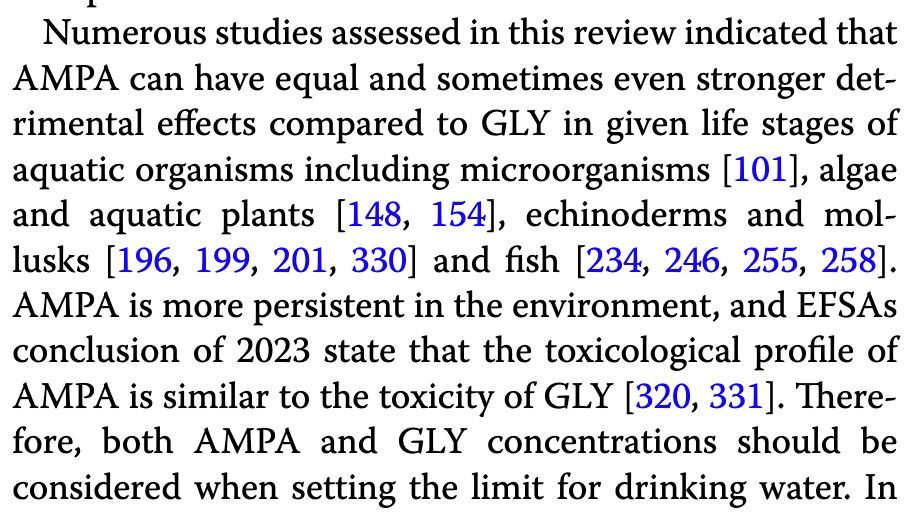
Further, some organisms die, some degrade Glyphosate into metabolites, particularly AMPA, which are also hazardous and are very relevant to human exposure risks!
DOi: 10.1186/s12302-024-00849-1
Further, some organisms die, some degrade Glyphosate into metabolites, particularly AMPA, which are also hazardous and are very relevant to human exposure risks!
DOi: 10.1186/s12302-024-00849-1
January 10, 2025 at 12:32 AM
Your claim was that there was no published evidence of the effects - there is a great deal.
Further, some organisms die, some degrade Glyphosate into metabolites, particularly AMPA, which are also hazardous and are very relevant to human exposure risks!
DOi: 10.1186/s12302-024-00849-1
Further, some organisms die, some degrade Glyphosate into metabolites, particularly AMPA, which are also hazardous and are very relevant to human exposure risks!
DOi: 10.1186/s12302-024-00849-1
Furthermore, bacterial pathways for degradation of Glyphosate are well established (eg DOI:10.14712/23361964.2023.1) -thus increasing the concentration of metabolites, particularly AMPA, in the soil.
These metabolites must be considered in any assessment of effects (DOi:10.1186/s12302-024-00849-1)
These metabolites must be considered in any assessment of effects (DOi:10.1186/s12302-024-00849-1)

January 10, 2025 at 12:28 AM
Furthermore, bacterial pathways for degradation of Glyphosate are well established (eg DOI:10.14712/23361964.2023.1) -thus increasing the concentration of metabolites, particularly AMPA, in the soil.
These metabolites must be considered in any assessment of effects (DOi:10.1186/s12302-024-00849-1)
These metabolites must be considered in any assessment of effects (DOi:10.1186/s12302-024-00849-1)
Yet large effects are reported - not at 'mega doses' but simply simulating applications through a growing season eg:
"Microbial biomass carbon was reduced by 45%, & the numbers of the cultivable bacteria & fungi were decreased by 84 & 63%, respectively, under the higher glyphosate application rate"
"Microbial biomass carbon was reduced by 45%, & the numbers of the cultivable bacteria & fungi were decreased by 84 & 63%, respectively, under the higher glyphosate application rate"

January 10, 2025 at 12:09 AM
Yet large effects are reported - not at 'mega doses' but simply simulating applications through a growing season eg:
"Microbial biomass carbon was reduced by 45%, & the numbers of the cultivable bacteria & fungi were decreased by 84 & 63%, respectively, under the higher glyphosate application rate"
"Microbial biomass carbon was reduced by 45%, & the numbers of the cultivable bacteria & fungi were decreased by 84 & 63%, respectively, under the higher glyphosate application rate"

Because IARC rely on " evidence-based research"!(publications.iarc.fr/549).
Is that so hard to understand?
Since the IARC conclusion on Glyphosate the evidence has become significantly stronger, eg, DOI:10.3390/agrochemicals2010005
Is that so hard to understand?
Since the IARC conclusion on Glyphosate the evidence has become significantly stronger, eg, DOI:10.3390/agrochemicals2010005

January 9, 2025 at 1:53 PM
Because IARC rely on " evidence-based research"!(publications.iarc.fr/549).
Is that so hard to understand?
Since the IARC conclusion on Glyphosate the evidence has become significantly stronger, eg, DOI:10.3390/agrochemicals2010005
Is that so hard to understand?
Since the IARC conclusion on Glyphosate the evidence has become significantly stronger, eg, DOI:10.3390/agrochemicals2010005
"...present experiment Roundup application affected hyphal ...and spore (i.e. amount of 16:1v5 NLFA) biomass in the soil. Spore biomass generally declined with herbicide application, which is in accordance with others who showed reduced spore viability even under the lowest glyphosate rate"

January 9, 2025 at 1:25 PM
"...present experiment Roundup application affected hyphal ...and spore (i.e. amount of 16:1v5 NLFA) biomass in the soil. Spore biomass generally declined with herbicide application, which is in accordance with others who showed reduced spore viability even under the lowest glyphosate rate"
Really?
"it has already been documented that glyphosate has caused toxic effects in non-target organisms found in soil and water, including various plants, animals, and bacteria"
Doi:10.3390/ microorganisms9112322
There are plenty of others but this was to hand...
"it has already been documented that glyphosate has caused toxic effects in non-target organisms found in soil and water, including various plants, animals, and bacteria"
Doi:10.3390/ microorganisms9112322
There are plenty of others but this was to hand...

January 9, 2025 at 12:48 PM
Really?
"it has already been documented that glyphosate has caused toxic effects in non-target organisms found in soil and water, including various plants, animals, and bacteria"
Doi:10.3390/ microorganisms9112322
There are plenty of others but this was to hand...
"it has already been documented that glyphosate has caused toxic effects in non-target organisms found in soil and water, including various plants, animals, and bacteria"
Doi:10.3390/ microorganisms9112322
There are plenty of others but this was to hand...
Microplastics in Animals:
"Evidence of microplastics crossing biological barriers and accumulating in critical organ systems suggests potential long-term health risks for animals that may also have implications for humans through environmental and food-chain exposure"
DOI:10.3390/pollutants4040033
"Evidence of microplastics crossing biological barriers and accumulating in critical organ systems suggests potential long-term health risks for animals that may also have implications for humans through environmental and food-chain exposure"
DOI:10.3390/pollutants4040033

January 9, 2025 at 12:27 PM
Microplastics in Animals:
"Evidence of microplastics crossing biological barriers and accumulating in critical organ systems suggests potential long-term health risks for animals that may also have implications for humans through environmental and food-chain exposure"
DOI:10.3390/pollutants4040033
"Evidence of microplastics crossing biological barriers and accumulating in critical organ systems suggests potential long-term health risks for animals that may also have implications for humans through environmental and food-chain exposure"
DOI:10.3390/pollutants4040033
"reducing your meat intake to three times per week saves as much CO2 as one short-haul flight each month”
Eliminating meat from your diet saves the equivalent CO2 emissions of over 24 short-haul flights/year...
Doi:10.2139/ssrn.4092911
Eliminating meat from your diet saves the equivalent CO2 emissions of over 24 short-haul flights/year...
Doi:10.2139/ssrn.4092911

November 29, 2024 at 9:17 PM
"reducing your meat intake to three times per week saves as much CO2 as one short-haul flight each month”
Eliminating meat from your diet saves the equivalent CO2 emissions of over 24 short-haul flights/year...
Doi:10.2139/ssrn.4092911
Eliminating meat from your diet saves the equivalent CO2 emissions of over 24 short-haul flights/year...
Doi:10.2139/ssrn.4092911