


aidev.bsky.social
@aidev.bsky.social
Reposted by aidev.bsky.social

This week I had the chance to speak to John Roese, CTO at Dell Technologies (and now chief AI officer, too) about why businesses need to prioritise return on investment with AI.
Really interesting perspective on just getting started – and not just taking the safe route.
Really interesting perspective on just getting started – and not just taking the safe route.

Dell Technologies CTO: ROI on AI should be the number one focus for execs
Chasing workforce consensus or playing it safe may cost firms far more in the long run than making decisive moves on AI now and learning from their results
www.itpro.com
November 28, 2024 at 2:54 PM
This week I had the chance to speak to John Roese, CTO at Dell Technologies (and now chief AI officer, too) about why businesses need to prioritise return on investment with AI.
Really interesting perspective on just getting started – and not just taking the safe route.
Really interesting perspective on just getting started – and not just taking the safe route.
Reposted by aidev.bsky.social

"Human-AI Coevolution" is mentioned in the United Nation's Human Development Report: "A Matter of Choice: People and Possibilities in the Age of AI". Honored to see our work be a part of int'l discussions on the future of human-AI interactions & ethical development of intelligent systems.
May 7, 2025 at 6:23 PM
"Human-AI Coevolution" is mentioned in the United Nation's Human Development Report: "A Matter of Choice: People and Possibilities in the Age of AI". Honored to see our work be a part of int'l discussions on the future of human-AI interactions & ethical development of intelligent systems.
AI writes code but if you want to learn Python you still need to understand it.
November 25, 2025 at 3:30 PM
AI writes code but if you want to learn Python you still need to understand it.
Reposted by aidev.bsky.social

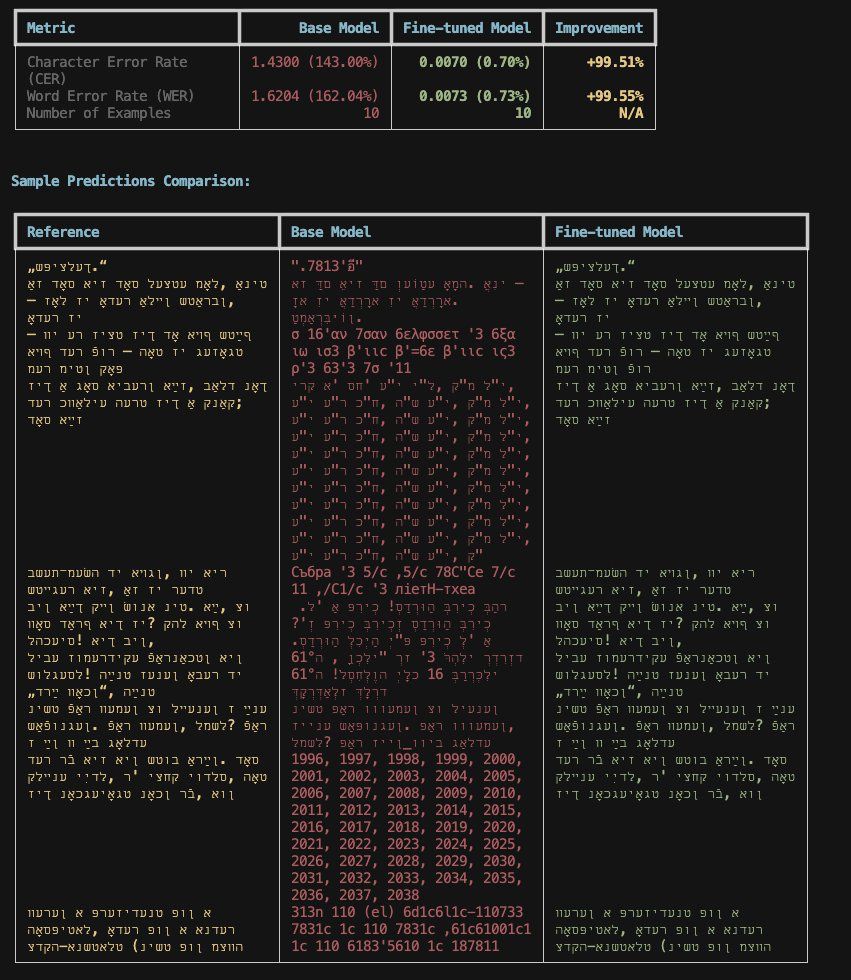
More coming soon but finetuned Qwen 3 VL-8B on 150k lines of synthetic Yiddish typed and handwritten data. Results are pretty amazing. Even on the harder heldout set it gets a CER of 1% and a WER of 2%. Preparing page-level dataset and finetunes now, thanks to the John Locke Jr.
October 24, 2025 at 8:14 PM
More coming soon but finetuned Qwen 3 VL-8B on 150k lines of synthetic Yiddish typed and handwritten data. Results are pretty amazing. Even on the harder heldout set it gets a CER of 1% and a WER of 2%. Preparing page-level dataset and finetunes now, thanks to the John Locke Jr.
Reposted by aidev.bsky.social

AI coding tools are shifting to a surprising place: the terminal For years, code-editing tools like Cursor, Windsurf, and GitHub’s Copilot have been the standard for AI-powered software development. But as agentic AI grows more... @cosmicmeta.io #AIDev
https://u2m.io/bycPdIPL
https://u2m.io/bycPdIPL

AI coding tools are shifting to a surprising place: the terminal | TechCrunch
For years, code-editing tools like Cursor, Windsurf, and GitHub’s Copilot have been the standard for AI-powered software development. But as agentic AI grows more powerful and vibe-coding takes off, a subtle shift has changed how AI systems are interacting with software. Instead of working on code, they’re increasingly interacting directly with the shell of whatever system they’re installed in. It’s a significant change in how AI-powered software development happens – and despite the low profile, it could have significant implications for where the field goes from here.
techcrunch.com
July 15, 2025 at 4:42 PM
AI coding tools are shifting to a surprising place: the terminal For years, code-editing tools like Cursor, Windsurf, and GitHub’s Copilot have been the standard for AI-powered software development. But as agentic AI grows more... @cosmicmeta.io #AIDev
https://u2m.io/bycPdIPL
https://u2m.io/bycPdIPL

July 15, 2025 at 4:24 PM
Reposted by aidev.bsky.social
For more on the dataset, see the official paper from its creators: arxiv.org/abs/2211.01226

DEArt: Dataset of European Art
Large datasets that were made publicly available to the research community over the last 20 years have been a key enabling factor for the advances in deep learning algorithms for NLP or computer vision. These datasets are generally pairs of aligned image / manually annotated metadata, where images are photographs of everyday life. Scholarly and historical content, on the other hand, treat subjects that are not necessarily popular to a general audience, they may not always contain a large number of data points, and new data may be difficult or impossible to collect. Some exceptions do exist, for instance, scientific or health data, but this is not the case for cultural heritage (CH). The poor performance of the best models in computer vision - when tested over artworks - coupled with the lack of extensively annotated datasets for CH, and the fact that artwork images depict objects and actions not captured by photographs, indicate that a CH-specific dataset would be highly valuable for this community. We propose DEArt, at this point primarily an object detection and pose classification dataset meant to be a reference for paintings between the XIIth and the XVIIIth centuries. It contains more than 15000 images, about 80% non-iconic, aligned with manual annotations for the bounding boxes identifying all instances of 69 classes as well as 12 possible poses for boxes identifying human-like objects. Of these, more than 50 classes are CH-specific and thus do not appear in other datasets; these reflect imaginary beings, symbolic entities and other categories related to art. Additionally, existing datasets do not include pose annotations. Our results show that object detectors for the cultural heritage domain can achieve a level of precision comparable to state-of-art models for generic images via transfer learning.
arxiv.org
March 31, 2025 at 8:32 PM
For more on the dataset, see the official paper from its creators: arxiv.org/abs/2211.01226