



@abrahamlabhms.bsky.social
We also show that helicase residue K356 plays a key role in stabilizing HPI binding to the HSV-1 H/P complex. UL52 residues used in drug binding are poorly conserved across β- and γ-herpesviruses, a possible explanation for α-herpesvirus drug specificity.

December 29, 2025 at 8:34 PM
We also show that helicase residue K356 plays a key role in stabilizing HPI binding to the HSV-1 H/P complex. UL52 residues used in drug binding are poorly conserved across β- and γ-herpesviruses, a possible explanation for α-herpesvirus drug specificity.
We discovered an extensive interface between polymerase (UL30) and helicase (UL5), mediated in part by a conserved motif within the polymerase.

December 29, 2025 at 8:34 PM
We discovered an extensive interface between polymerase (UL30) and helicase (UL5), mediated in part by a conserved motif within the polymerase.
Cryo-EM maps of H/P subunits UL5, UL52, and UL8 reveal a bilobed architecture centered on primase UL52. Further addition of the polymerase holoenzyme UL30 and UL42 allowed us to understand how the HSV-1 replication fork assembles onto DNA and its inhibition by HPI drugs.

December 29, 2025 at 8:34 PM
Cryo-EM maps of H/P subunits UL5, UL52, and UL8 reveal a bilobed architecture centered on primase UL52. Further addition of the polymerase holoenzyme UL30 and UL42 allowed us to understand how the HSV-1 replication fork assembles onto DNA and its inhibition by HPI drugs.
We are excited to share our new @CellCellPress paper revealing mechanisms of action of promising drugs against the helicase-primase of herpes simplex virus 1 (HSV-1) 🤩 harvardvirology.bsky.social www.cell.com/cell/fulltex...

December 29, 2025 at 8:34 PM
We are excited to share our new @CellCellPress paper revealing mechanisms of action of promising drugs against the helicase-primase of herpes simplex virus 1 (HSV-1) 🤩 harvardvirology.bsky.social www.cell.com/cell/fulltex...
A K33A substitution in the stable signal peptide (SSP) allowed for stabilization of the pre-fusion GPC, with molecular dynamics suggesting K33A stabilizes GPC by better accommodating membrane lipids in the SSP33 pocket, supported by our cryo-EM density

August 9, 2025 at 9:51 AM
A K33A substitution in the stable signal peptide (SSP) allowed for stabilization of the pre-fusion GPC, with molecular dynamics suggesting K33A stabilizes GPC by better accommodating membrane lipids in the SSP33 pocket, supported by our cryo-EM density
Further structural and functional analyses also reveal the effect of specific residues in transmembrane and membrane proximal region on pH-mediated fusion, elucidating the attenuation mechanism of the JUNV Candid#1 vaccine

August 9, 2025 at 9:51 AM
Further structural and functional analyses also reveal the effect of specific residues in transmembrane and membrane proximal region on pH-mediated fusion, elucidating the attenuation mechanism of the JUNV Candid#1 vaccine
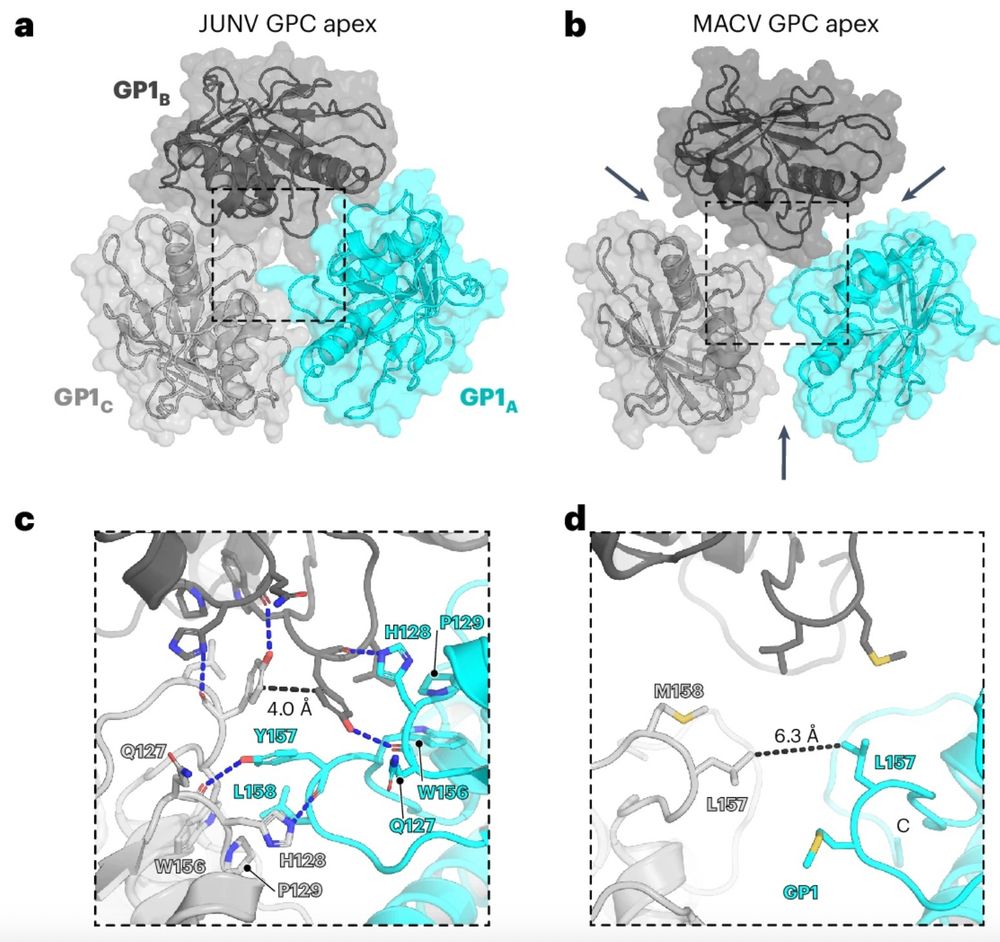
These cryo-EM structures reveal notable differences between JUNV and MACV in GP1 organization at the apex and C terminus. The MACV GPC apex has a more open appearance due to its GP1 subunits slightly rotating outwards and clockwise 🔃compared to JUNV GP1 subunits
August 9, 2025 at 9:51 AM
These cryo-EM structures reveal notable differences between JUNV and MACV in GP1 organization at the apex and C terminus. The MACV GPC apex has a more open appearance due to its GP1 subunits slightly rotating outwards and clockwise 🔃compared to JUNV GP1 subunits
Our @natmicrobiol.nature.com paper provides the most complete insight into the molecular organization of the JUNV and MACV GPCs yet 😲revealing new features not seen in previous structures, such as the TM helices and cytosolic portions, including ZBD

August 9, 2025 at 9:51 AM
Our @natmicrobiol.nature.com paper provides the most complete insight into the molecular organization of the JUNV and MACV GPCs yet 😲revealing new features not seen in previous structures, such as the TM helices and cytosolic portions, including ZBD
Interesting tidbit in the story: a WEEV-related alphavirus that circulates on the east coast (EEEV territory) called highlands J virus (HJV) also uses PCDH10 as a receptor. It diverged from WEEV not that long ago and retained most PCDH10 contact residues.

April 4, 2025 at 7:59 PM
Interesting tidbit in the story: a WEEV-related alphavirus that circulates on the east coast (EEEV territory) called highlands J virus (HJV) also uses PCDH10 as a receptor. It diverged from WEEV not that long ago and retained most PCDH10 contact residues.
Some WEEV strains and EEEV both bind VLDLR at the LA1 and LA2 domains, suggesting that VLDLR LA1-LA2 decoy receptor may have broad activity against them. This molecule protected mice against lethal challenge by a WEEV strain that binds VLDLR.

April 4, 2025 at 7:59 PM
Some WEEV strains and EEEV both bind VLDLR at the LA1 and LA2 domains, suggesting that VLDLR LA1-LA2 decoy receptor may have broad activity against them. This molecule protected mice against lethal challenge by a WEEV strain that binds VLDLR.
Strains isolated during epidemics of the early 20th century bind VLDLR and ApoER2 as additional receptors. Our structure of a 1941 strain bound by VLDLR revealed a distinct binding mode than other alphaviruses that bind LDLR-related proteins, such as EEEV, SFV or VEEV.

April 4, 2025 at 7:59 PM
Strains isolated during epidemics of the early 20th century bind VLDLR and ApoER2 as additional receptors. Our structure of a 1941 strain bound by VLDLR revealed a distinct binding mode than other alphaviruses that bind LDLR-related proteins, such as EEEV, SFV or VEEV.
We found a substitution in the E2 glycoprotein, L149Q, that would disrupt hydrophobic contact with PCDH10, and confirmed this mutation alone abolishes human PCDH10 binding. L149Q is found in all strains isolated in California and Texas in 2005, suggesting a wide geographic range.

April 4, 2025 at 7:59 PM
We found a substitution in the E2 glycoprotein, L149Q, that would disrupt hydrophobic contact with PCDH10, and confirmed this mutation alone abolishes human PCDH10 binding. L149Q is found in all strains isolated in California and Texas in 2005, suggesting a wide geographic range.
Protocadherin 10 (PCDH10) is a major receptor for WEEV. Multiple strains isolated in 2005 lost the ability to bind human and horse PCDH10, yet still bind avian PCDH10. Cryo-EM structures show identical binding mode of sparrow and human PCDH10.

April 4, 2025 at 7:59 PM
Protocadherin 10 (PCDH10) is a major receptor for WEEV. Multiple strains isolated in 2005 lost the ability to bind human and horse PCDH10, yet still bind avian PCDH10. Cryo-EM structures show identical binding mode of sparrow and human PCDH10.
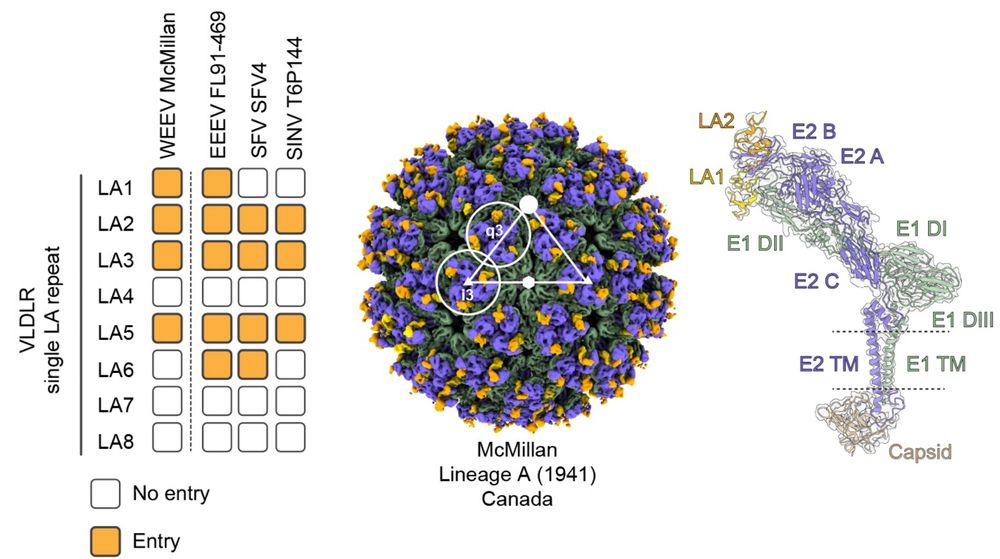
We also determined structures of an ancestral WEEV strain bound to VLDLR, revealing a distinct binding mode compared to other alphaviruses that bind LDLR-related receptors such as EEEV, SFV, or VEEV, indicating independent evolution of WEEV to bind VLDLR/ApoER2!
January 2, 2025 at 10:25 PM
We also determined structures of an ancestral WEEV strain bound to VLDLR, revealing a distinct binding mode compared to other alphaviruses that bind LDLR-related receptors such as EEEV, SFV, or VEEV, indicating independent evolution of WEEV to bind VLDLR/ApoER2!
Excited to share our @biorxivpreprint.bsky.social exploring how binding of western equine encephalitis virus (WEEV) to its cellular receptors evolved over the past century 🤩 www.biorxiv.org/content/10.1... @harvardmicro.bsky.social

January 2, 2025 at 10:25 PM
Excited to share our @biorxivpreprint.bsky.social exploring how binding of western equine encephalitis virus (WEEV) to its cellular receptors evolved over the past century 🤩 www.biorxiv.org/content/10.1... @harvardmicro.bsky.social