



Yoïn van Spijk
@yvanspijk.bsky.social
/'dʑowɪn/
• taalkundige | linguist
• schrijver van 'Die goeie ouwe taal' en 'Woord voor woord' | author
• all graphics and videos: http://tumblr.com/yvanspijk
• Patreon: patreon.com/yvanspijk
• photo by Dirk-Jan van Dijk
• taalkundige | linguist
• schrijver van 'Die goeie ouwe taal' en 'Woord voor woord' | author
• all graphics and videos: http://tumblr.com/yvanspijk
• Patreon: patreon.com/yvanspijk
• photo by Dirk-Jan van Dijk
Pinned
Yoïn van Spijk
@yvanspijk.bsky.social
· Jul 20
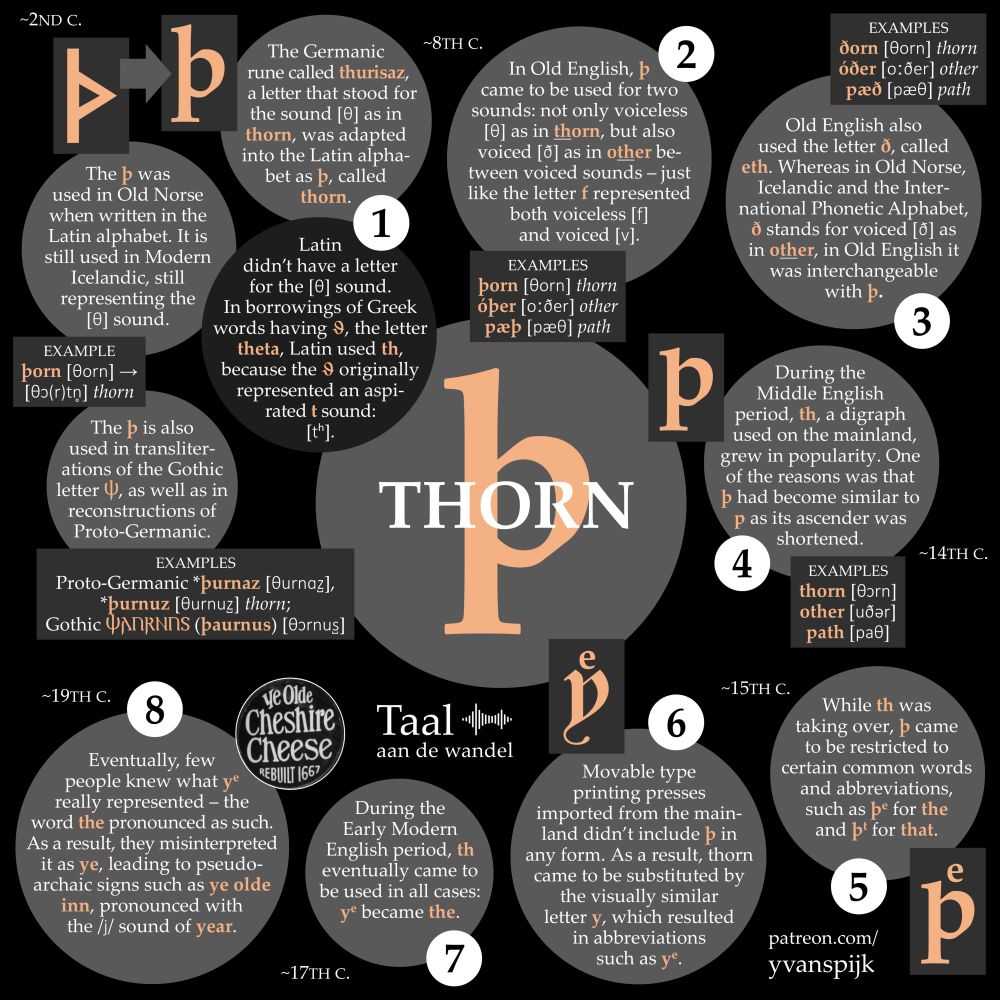
'Ye' in names such as 'Ye Olde Inn' was originally pronounced 'the'.
The pronunciation with y is due to a misinterpretation.
'Ye' originated as a second-best way of writing 'þe', þ being thorn, the original English letter for the th sound.
Click my new infographic to read the story of thorn:
The pronunciation with y is due to a misinterpretation.
'Ye' originated as a second-best way of writing 'þe', þ being thorn, the original English letter for the th sound.
Click my new infographic to read the story of thorn:
The French word ‘huit’ (8) stems from Latin ‘octō’, so why does it have an h?
Its h was added at a time when u and v were still variants of the same letter: ‘uit’ (8) could be read as ‘vit’ (lives).
The h of Spanish ‘huevo’ (egg), from ‘ovum’, has the same origin.
Zoom in to learn all about it:
Its h was added at a time when u and v were still variants of the same letter: ‘uit’ (8) could be read as ‘vit’ (lives).
The h of Spanish ‘huevo’ (egg), from ‘ovum’, has the same origin.
Zoom in to learn all about it:

January 4, 2026 at 6:11 PM
The French word ‘huit’ (8) stems from Latin ‘octō’, so why does it have an h?
Its h was added at a time when u and v were still variants of the same letter: ‘uit’ (8) could be read as ‘vit’ (lives).
The h of Spanish ‘huevo’ (egg), from ‘ovum’, has the same origin.
Zoom in to learn all about it:
Its h was added at a time when u and v were still variants of the same letter: ‘uit’ (8) could be read as ‘vit’ (lives).
The h of Spanish ‘huevo’ (egg), from ‘ovum’, has the same origin.
Zoom in to learn all about it:
Reposted by Yoïn van Spijk
Latin had six noun cases, but in all Romance languages except Romanian, nouns and adjectives only have one singular form and one plural form left. What happened?
This extra large infographic tells you how the Latin case system collapsed – and why it's the accusative case that lives on in Romance.
This extra large infographic tells you how the Latin case system collapsed – and why it's the accusative case that lives on in Romance.

January 1, 2026 at 6:49 PM
Latin had six noun cases, but in all Romance languages except Romanian, nouns and adjectives only have one singular form and one plural form left. What happened?
This extra large infographic tells you how the Latin case system collapsed – and why it's the accusative case that lives on in Romance.
This extra large infographic tells you how the Latin case system collapsed – and why it's the accusative case that lives on in Romance.
Latin had six noun cases, but in all Romance languages except Romanian, nouns and adjectives only have one singular form and one plural form left. What happened?
This extra large infographic tells you how the Latin case system collapsed – and why it's the accusative case that lives on in Romance.
This extra large infographic tells you how the Latin case system collapsed – and why it's the accusative case that lives on in Romance.
January 1, 2026 at 6:49 PM
Latin had six noun cases, but in all Romance languages except Romanian, nouns and adjectives only have one singular form and one plural form left. What happened?
This extra large infographic tells you how the Latin case system collapsed – and why it's the accusative case that lives on in Romance.
This extra large infographic tells you how the Latin case system collapsed – and why it's the accusative case that lives on in Romance.
Reposted by Yoïn van Spijk
Today, my etymological doublet series is coming to an end with an episode on German, on request of several people.
The orange German words on the right have the same origin as the blue ones on the right, but they took a very different path.
Many of the examples are courtesy of Matthieu Pierens.
The orange German words on the right have the same origin as the blue ones on the right, but they took a very different path.
Many of the examples are courtesy of Matthieu Pierens.

December 29, 2025 at 7:37 PM
Today, my etymological doublet series is coming to an end with an episode on German, on request of several people.
The orange German words on the right have the same origin as the blue ones on the right, but they took a very different path.
Many of the examples are courtesy of Matthieu Pierens.
The orange German words on the right have the same origin as the blue ones on the right, but they took a very different path.
Many of the examples are courtesy of Matthieu Pierens.
Today, my etymological doublet series is coming to an end with an episode on German, on request of several people.
The orange German words on the right have the same origin as the blue ones on the right, but they took a very different path.
Many of the examples are courtesy of Matthieu Pierens.
The orange German words on the right have the same origin as the blue ones on the right, but they took a very different path.
Many of the examples are courtesy of Matthieu Pierens.
December 29, 2025 at 7:37 PM
Today, my etymological doublet series is coming to an end with an episode on German, on request of several people.
The orange German words on the right have the same origin as the blue ones on the right, but they took a very different path.
Many of the examples are courtesy of Matthieu Pierens.
The orange German words on the right have the same origin as the blue ones on the right, but they took a very different path.
Many of the examples are courtesy of Matthieu Pierens.
Reposted by Yoïn van Spijk
The English word ‘shirt’ has the same origin as ‘skirt’.
While ‘shirt’ directly stems from Proto-Germanic *skurtijōn, ‘skirt’ was borrowed from its Old Norse descendant.
Here’s number 10 in my doublet series: English doublets with a Germanic origin.
Tomorrow: German.
I started this series ... 1/
While ‘shirt’ directly stems from Proto-Germanic *skurtijōn, ‘skirt’ was borrowed from its Old Norse descendant.
Here’s number 10 in my doublet series: English doublets with a Germanic origin.
Tomorrow: German.
I started this series ... 1/

December 28, 2025 at 6:58 PM
The English word ‘shirt’ has the same origin as ‘skirt’.
While ‘shirt’ directly stems from Proto-Germanic *skurtijōn, ‘skirt’ was borrowed from its Old Norse descendant.
Here’s number 10 in my doublet series: English doublets with a Germanic origin.
Tomorrow: German.
I started this series ... 1/
While ‘shirt’ directly stems from Proto-Germanic *skurtijōn, ‘skirt’ was borrowed from its Old Norse descendant.
Here’s number 10 in my doublet series: English doublets with a Germanic origin.
Tomorrow: German.
I started this series ... 1/
The English word ‘shirt’ has the same origin as ‘skirt’.
While ‘shirt’ directly stems from Proto-Germanic *skurtijōn, ‘skirt’ was borrowed from its Old Norse descendant.
Here’s number 10 in my doublet series: English doublets with a Germanic origin.
Tomorrow: German.
I started this series ... 1/
While ‘shirt’ directly stems from Proto-Germanic *skurtijōn, ‘skirt’ was borrowed from its Old Norse descendant.
Here’s number 10 in my doublet series: English doublets with a Germanic origin.
Tomorrow: German.
I started this series ... 1/
December 28, 2025 at 6:58 PM
The English word ‘shirt’ has the same origin as ‘skirt’.
While ‘shirt’ directly stems from Proto-Germanic *skurtijōn, ‘skirt’ was borrowed from its Old Norse descendant.
Here’s number 10 in my doublet series: English doublets with a Germanic origin.
Tomorrow: German.
I started this series ... 1/
While ‘shirt’ directly stems from Proto-Germanic *skurtijōn, ‘skirt’ was borrowed from its Old Norse descendant.
Here’s number 10 in my doublet series: English doublets with a Germanic origin.
Tomorrow: German.
I started this series ... 1/
Reposted by Yoïn van Spijk
The Dutch words ‘zolder’ (“attic”) and ‘solarium’ (“tanning salon”) are doublets: they both stem from Latin ‘sōlārium’ (“roof terrace”).
Dutch ‘solarium’ is a late borrowing, while ‘zolder’ was borrowed into the Germanic ancestor of Dutch.
Here’s number 9 in my series: Dutch doublets from Latin.
Dutch ‘solarium’ is a late borrowing, while ‘zolder’ was borrowed into the Germanic ancestor of Dutch.
Here’s number 9 in my series: Dutch doublets from Latin.

December 27, 2025 at 7:06 PM
The Dutch words ‘zolder’ (“attic”) and ‘solarium’ (“tanning salon”) are doublets: they both stem from Latin ‘sōlārium’ (“roof terrace”).
Dutch ‘solarium’ is a late borrowing, while ‘zolder’ was borrowed into the Germanic ancestor of Dutch.
Here’s number 9 in my series: Dutch doublets from Latin.
Dutch ‘solarium’ is a late borrowing, while ‘zolder’ was borrowed into the Germanic ancestor of Dutch.
Here’s number 9 in my series: Dutch doublets from Latin.
The Dutch words ‘zolder’ (“attic”) and ‘solarium’ (“tanning salon”) are doublets: they both stem from Latin ‘sōlārium’ (“roof terrace”).
Dutch ‘solarium’ is a late borrowing, while ‘zolder’ was borrowed into the Germanic ancestor of Dutch.
Here’s number 9 in my series: Dutch doublets from Latin.
Dutch ‘solarium’ is a late borrowing, while ‘zolder’ was borrowed into the Germanic ancestor of Dutch.
Here’s number 9 in my series: Dutch doublets from Latin.
December 27, 2025 at 7:06 PM
The Dutch words ‘zolder’ (“attic”) and ‘solarium’ (“tanning salon”) are doublets: they both stem from Latin ‘sōlārium’ (“roof terrace”).
Dutch ‘solarium’ is a late borrowing, while ‘zolder’ was borrowed into the Germanic ancestor of Dutch.
Here’s number 9 in my series: Dutch doublets from Latin.
Dutch ‘solarium’ is a late borrowing, while ‘zolder’ was borrowed into the Germanic ancestor of Dutch.
Here’s number 9 in my series: Dutch doublets from Latin.
Reposted by Yoïn van Spijk
The Galician words ‘palabra’ (“word”) and ‘parábola’ (“parable; parabola”) are so-called doublets: they stem from the same word, Latin ‘parabolam’.
‘Palabra’ was inherited from spoken Latin, while ‘parábola’ is a late borrowing from written Latin.
Here’s episode 8 of my doublet series: Galician.
‘Palabra’ was inherited from spoken Latin, while ‘parábola’ is a late borrowing from written Latin.
Here’s episode 8 of my doublet series: Galician.

December 26, 2025 at 6:23 PM
The Galician words ‘palabra’ (“word”) and ‘parábola’ (“parable; parabola”) are so-called doublets: they stem from the same word, Latin ‘parabolam’.
‘Palabra’ was inherited from spoken Latin, while ‘parábola’ is a late borrowing from written Latin.
Here’s episode 8 of my doublet series: Galician.
‘Palabra’ was inherited from spoken Latin, while ‘parábola’ is a late borrowing from written Latin.
Here’s episode 8 of my doublet series: Galician.
The Galician words ‘palabra’ (“word”) and ‘parábola’ (“parable; parabola”) are so-called doublets: they stem from the same word, Latin ‘parabolam’.
‘Palabra’ was inherited from spoken Latin, while ‘parábola’ is a late borrowing from written Latin.
Here’s episode 8 of my doublet series: Galician.
‘Palabra’ was inherited from spoken Latin, while ‘parábola’ is a late borrowing from written Latin.
Here’s episode 8 of my doublet series: Galician.
December 26, 2025 at 6:23 PM
The Galician words ‘palabra’ (“word”) and ‘parábola’ (“parable; parabola”) are so-called doublets: they stem from the same word, Latin ‘parabolam’.
‘Palabra’ was inherited from spoken Latin, while ‘parábola’ is a late borrowing from written Latin.
Here’s episode 8 of my doublet series: Galician.
‘Palabra’ was inherited from spoken Latin, while ‘parábola’ is a late borrowing from written Latin.
Here’s episode 8 of my doublet series: Galician.
Reposted by Yoïn van Spijk
The Catalan word ‘metzina’ means “poison”. It stems from the same Latin word as ‘medicina’, meaning “medicine”.
‘Metzina’ was inherited from spoken Latin, while ‘medicina’ is a late borrowing from written Latin.
Pairs like this are called doublets.
Episode 7 of my series: Catalan.
Next: Galician.
‘Metzina’ was inherited from spoken Latin, while ‘medicina’ is a late borrowing from written Latin.
Pairs like this are called doublets.
Episode 7 of my series: Catalan.
Next: Galician.

December 25, 2025 at 6:45 PM
The Catalan word ‘metzina’ means “poison”. It stems from the same Latin word as ‘medicina’, meaning “medicine”.
‘Metzina’ was inherited from spoken Latin, while ‘medicina’ is a late borrowing from written Latin.
Pairs like this are called doublets.
Episode 7 of my series: Catalan.
Next: Galician.
‘Metzina’ was inherited from spoken Latin, while ‘medicina’ is a late borrowing from written Latin.
Pairs like this are called doublets.
Episode 7 of my series: Catalan.
Next: Galician.
The Catalan word ‘metzina’ means “poison”. It stems from the same Latin word as ‘medicina’, meaning “medicine”.
‘Metzina’ was inherited from spoken Latin, while ‘medicina’ is a late borrowing from written Latin.
Pairs like this are called doublets.
Episode 7 of my series: Catalan.
Next: Galician.
‘Metzina’ was inherited from spoken Latin, while ‘medicina’ is a late borrowing from written Latin.
Pairs like this are called doublets.
Episode 7 of my series: Catalan.
Next: Galician.
December 25, 2025 at 6:45 PM
The Catalan word ‘metzina’ means “poison”. It stems from the same Latin word as ‘medicina’, meaning “medicine”.
‘Metzina’ was inherited from spoken Latin, while ‘medicina’ is a late borrowing from written Latin.
Pairs like this are called doublets.
Episode 7 of my series: Catalan.
Next: Galician.
‘Metzina’ was inherited from spoken Latin, while ‘medicina’ is a late borrowing from written Latin.
Pairs like this are called doublets.
Episode 7 of my series: Catalan.
Next: Galician.
Reposted by Yoïn van Spijk
38/40 Die goeie ouwe taal by @yvanspijk.bsky.social . Excellent book about the often surprising paths of etymology of every day words and expressions in Dutch. Highly recommended if you can read Dutch!
December 25, 2025 at 12:08 PM
38/40 Die goeie ouwe taal by @yvanspijk.bsky.social . Excellent book about the often surprising paths of etymology of every day words and expressions in Dutch. Highly recommended if you can read Dutch!
Reposted by Yoïn van Spijk
Romanian ‘femeie’ (woman) and ‘familie’ (family) are doublets: they both stem from Latin ‘familiam’.
‘Femeie’ was inherited from spoken Latin, undergoing the typically Romanian sound changes – and a pecular meaning shift!
‘Familie’ was borrowed from written Latin.
Number 6 in my series: Romanian!
‘Femeie’ was inherited from spoken Latin, undergoing the typically Romanian sound changes – and a pecular meaning shift!
‘Familie’ was borrowed from written Latin.
Number 6 in my series: Romanian!

December 24, 2025 at 6:48 PM
Romanian ‘femeie’ (woman) and ‘familie’ (family) are doublets: they both stem from Latin ‘familiam’.
‘Femeie’ was inherited from spoken Latin, undergoing the typically Romanian sound changes – and a pecular meaning shift!
‘Familie’ was borrowed from written Latin.
Number 6 in my series: Romanian!
‘Femeie’ was inherited from spoken Latin, undergoing the typically Romanian sound changes – and a pecular meaning shift!
‘Familie’ was borrowed from written Latin.
Number 6 in my series: Romanian!
Romanian ‘femeie’ (woman) and ‘familie’ (family) are doublets: they both stem from Latin ‘familiam’.
‘Femeie’ was inherited from spoken Latin, undergoing the typically Romanian sound changes – and a pecular meaning shift!
‘Familie’ was borrowed from written Latin.
Number 6 in my series: Romanian!
‘Femeie’ was inherited from spoken Latin, undergoing the typically Romanian sound changes – and a pecular meaning shift!
‘Familie’ was borrowed from written Latin.
Number 6 in my series: Romanian!
December 24, 2025 at 6:48 PM
Romanian ‘femeie’ (woman) and ‘familie’ (family) are doublets: they both stem from Latin ‘familiam’.
‘Femeie’ was inherited from spoken Latin, undergoing the typically Romanian sound changes – and a pecular meaning shift!
‘Familie’ was borrowed from written Latin.
Number 6 in my series: Romanian!
‘Femeie’ was inherited from spoken Latin, undergoing the typically Romanian sound changes – and a pecular meaning shift!
‘Familie’ was borrowed from written Latin.
Number 6 in my series: Romanian!
Reposted by Yoïn van Spijk
Portuguese put the words it inherited from Latin through a lot of fascinating sound changes.
This becomes extra clear when you compare them to later borrowings of the same Latin word:
‘chão’ and ‘plano’ both come from Latin ‘plānum’!
Here’s episode 5 of my 10-part series.
Tomorrow: Romanian.
This becomes extra clear when you compare them to later borrowings of the same Latin word:
‘chão’ and ‘plano’ both come from Latin ‘plānum’!
Here’s episode 5 of my 10-part series.
Tomorrow: Romanian.

December 23, 2025 at 7:07 PM
Portuguese put the words it inherited from Latin through a lot of fascinating sound changes.
This becomes extra clear when you compare them to later borrowings of the same Latin word:
‘chão’ and ‘plano’ both come from Latin ‘plānum’!
Here’s episode 5 of my 10-part series.
Tomorrow: Romanian.
This becomes extra clear when you compare them to later borrowings of the same Latin word:
‘chão’ and ‘plano’ both come from Latin ‘plānum’!
Here’s episode 5 of my 10-part series.
Tomorrow: Romanian.
Portuguese put the words it inherited from Latin through a lot of fascinating sound changes.
This becomes extra clear when you compare them to later borrowings of the same Latin word:
‘chão’ and ‘plano’ both come from Latin ‘plānum’!
Here’s episode 5 of my 10-part series.
Tomorrow: Romanian.
This becomes extra clear when you compare them to later borrowings of the same Latin word:
‘chão’ and ‘plano’ both come from Latin ‘plānum’!
Here’s episode 5 of my 10-part series.
Tomorrow: Romanian.
December 23, 2025 at 7:07 PM
Portuguese put the words it inherited from Latin through a lot of fascinating sound changes.
This becomes extra clear when you compare them to later borrowings of the same Latin word:
‘chão’ and ‘plano’ both come from Latin ‘plānum’!
Here’s episode 5 of my 10-part series.
Tomorrow: Romanian.
This becomes extra clear when you compare them to later borrowings of the same Latin word:
‘chão’ and ‘plano’ both come from Latin ‘plānum’!
Here’s episode 5 of my 10-part series.
Tomorrow: Romanian.
Reposted by Yoïn van Spijk

'Toegepaste magie': anders dan de theoretische magie gaat dit om ervaringsleren voor praktisch geschoolden. Middelmatige hbo-magie met maatschappelijk nut.
Maar: iedereen magisch opgeleid!
Maar: iedereen magisch opgeleid!

December 23, 2025 at 11:07 AM
'Toegepaste magie': anders dan de theoretische magie gaat dit om ervaringsleren voor praktisch geschoolden. Middelmatige hbo-magie met maatschappelijk nut.
Maar: iedereen magisch opgeleid!
Maar: iedereen magisch opgeleid!
Tsja, rekenen ze voor mij ramen?
Dat is de vraag.
Ik denk dat ik niet voldoende interessen heb om whatsapp te sturen.
Dat is de vraag.
Ik denk dat ik niet voldoende interessen heb om whatsapp te sturen.

December 23, 2025 at 12:08 PM
Tsja, rekenen ze voor mij ramen?
Dat is de vraag.
Ik denk dat ik niet voldoende interessen heb om whatsapp te sturen.
Dat is de vraag.
Ik denk dat ik niet voldoende interessen heb om whatsapp te sturen.
Reposted by Yoïn van Spijk
Poverty can be a headache. ‘Micragna’, the Italian descendant of Latin ‘hēmicrānia’ (migraine), evolved to to mean “poverty”.
Later, ‘hēmicrānia’ was borrowed from Latin, becoming ‘emicrania’ - a doublet of ‘micragna’.
Here’s episode 4 of my 10-part doublet series:
Italian.
Tomorrow: Portuguese.
Later, ‘hēmicrānia’ was borrowed from Latin, becoming ‘emicrania’ - a doublet of ‘micragna’.
Here’s episode 4 of my 10-part doublet series:
Italian.
Tomorrow: Portuguese.

December 22, 2025 at 6:51 PM
Poverty can be a headache. ‘Micragna’, the Italian descendant of Latin ‘hēmicrānia’ (migraine), evolved to to mean “poverty”.
Later, ‘hēmicrānia’ was borrowed from Latin, becoming ‘emicrania’ - a doublet of ‘micragna’.
Here’s episode 4 of my 10-part doublet series:
Italian.
Tomorrow: Portuguese.
Later, ‘hēmicrānia’ was borrowed from Latin, becoming ‘emicrania’ - a doublet of ‘micragna’.
Here’s episode 4 of my 10-part doublet series:
Italian.
Tomorrow: Portuguese.
Reposted by Yoïn van Spijk

Someone said that France was nestled in Europe. So I said "I believe it's Switzerland that's Nestléd in Europe".
December 21, 2025 at 5:33 PM
Someone said that France was nestled in Europe. So I said "I believe it's Switzerland that's Nestléd in Europe".
Poverty can be a headache. ‘Micragna’, the Italian descendant of Latin ‘hēmicrānia’ (migraine), evolved to to mean “poverty”.
Later, ‘hēmicrānia’ was borrowed from Latin, becoming ‘emicrania’ - a doublet of ‘micragna’.
Here’s episode 4 of my 10-part doublet series:
Italian.
Tomorrow: Portuguese.
Later, ‘hēmicrānia’ was borrowed from Latin, becoming ‘emicrania’ - a doublet of ‘micragna’.
Here’s episode 4 of my 10-part doublet series:
Italian.
Tomorrow: Portuguese.
December 22, 2025 at 6:51 PM
Poverty can be a headache. ‘Micragna’, the Italian descendant of Latin ‘hēmicrānia’ (migraine), evolved to to mean “poverty”.
Later, ‘hēmicrānia’ was borrowed from Latin, becoming ‘emicrania’ - a doublet of ‘micragna’.
Here’s episode 4 of my 10-part doublet series:
Italian.
Tomorrow: Portuguese.
Later, ‘hēmicrānia’ was borrowed from Latin, becoming ‘emicrania’ - a doublet of ‘micragna’.
Here’s episode 4 of my 10-part doublet series:
Italian.
Tomorrow: Portuguese.
Most Spanish words come from Latin, but did you know there are 2 different types?
Words inherited from spoken Latin vs. words borrowed from written Latin during the Middle Ages and after.
Some words took both routes, creating doublets.
Here’s episode 3 of my 10-part doublet series.
Next: Italian.
Words inherited from spoken Latin vs. words borrowed from written Latin during the Middle Ages and after.
Some words took both routes, creating doublets.
Here’s episode 3 of my 10-part doublet series.
Next: Italian.

December 21, 2025 at 6:35 PM
Most Spanish words come from Latin, but did you know there are 2 different types?
Words inherited from spoken Latin vs. words borrowed from written Latin during the Middle Ages and after.
Some words took both routes, creating doublets.
Here’s episode 3 of my 10-part doublet series.
Next: Italian.
Words inherited from spoken Latin vs. words borrowed from written Latin during the Middle Ages and after.
Some words took both routes, creating doublets.
Here’s episode 3 of my 10-part doublet series.
Next: Italian.
Reposted by Yoïn van Spijk
The French word ‘employer’ (to emploi) has the same origin as ‘impliquer’ (to imply).
The former was inherited from Latin, while the latter was borrowed from it later.
They’re called doublets.
Stay tuned for doublets in Spanish, Italian, Portuguese, Romanian, Catalan, Galician, Dutch and English.
The former was inherited from Latin, while the latter was borrowed from it later.
They’re called doublets.
Stay tuned for doublets in Spanish, Italian, Portuguese, Romanian, Catalan, Galician, Dutch and English.

December 20, 2025 at 5:34 PM
The French word ‘employer’ (to emploi) has the same origin as ‘impliquer’ (to imply).
The former was inherited from Latin, while the latter was borrowed from it later.
They’re called doublets.
Stay tuned for doublets in Spanish, Italian, Portuguese, Romanian, Catalan, Galician, Dutch and English.
The former was inherited from Latin, while the latter was borrowed from it later.
They’re called doublets.
Stay tuned for doublets in Spanish, Italian, Portuguese, Romanian, Catalan, Galician, Dutch and English.