




World Economics
@worldeconomics.bsky.social
Sharing insights on global trends, economics, and data-driven analysis.
Email: enquiries@worldeconomics.com
Email: enquiries@worldeconomics.com
Initial gains from post-Socialist reforms boosted Russian living standards by 135% from 2000 to 2008, but growth has slowed dramatically since. #Russia #Growth https://www.worldeconomics.com/Thoughts/Russian-Living-Standards-Growth-Held-Back-by-Irredentist-Putin.aspx?ThoughtID=35

Russian Living Standards - Held Back by Irredentist Putin: | World Economics
Real GDP per capita growth per year has neared stagnation levels since 2008.
www.worldeconomics.com
December 4, 2025 at 2:33 PM
Initial gains from post-Socialist reforms boosted Russian living standards by 135% from 2000 to 2008, but growth has slowed dramatically since. #Russia #Growth https://www.worldeconomics.com/Thoughts/Russian-Living-Standards-Growth-Held-Back-by-Irredentist-Putin.aspx?ThoughtID=35
By 2050 Italy will have only one working-age person per retiree - when medical and pension costs are factored in, the real support ratio looks closer to 1:2 or worse. #Italy #Economy https://www.worldeconomics.com/Thoughts/The-Alarming-Cost-of-Aging-Demographics.aspx?ThoughtID=259

The Alarming Cost of Aging Demographics: | World Economics
Much of the developed world is experiencing rapidly falling fertility rates. Attempts to reverse this fall – which in most developed countries has dropped far below the replacement threshold - have been unsuccessful so far.
www.worldeconomics.com
December 4, 2025 at 1:36 PM
By 2050 Italy will have only one working-age person per retiree - when medical and pension costs are factored in, the real support ratio looks closer to 1:2 or worse. #Italy #Economy https://www.worldeconomics.com/Thoughts/The-Alarming-Cost-of-Aging-Demographics.aspx?ThoughtID=259
GDP data is often outdated, incomplete, or politically influenced, meaning official figures may misrepresent real economic conditions. #GDP #DataQuality https://www.worldeconomics.com/Thoughts/WARNING-Dont-Trust-Official-GDP-Data.aspx?ThoughtID=32
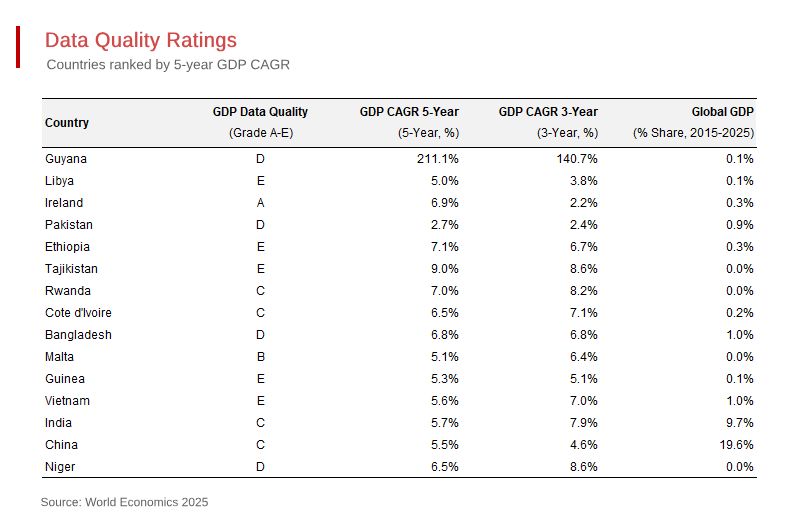
WARNING: Dont Trust Official GDP Data: Depending of data selection, over 87% of GDP data may - be unusable for investment purposes| World Economics
Organisations of many kinds use GDP data. Governments, Non Governmental Organisations, Civil Societies, Businesses and a thousand others trust "official" economic data and use it as if it were holy writ. Highly regarded companies like global consultants McKinsey produce lists of the fastest growing countries to admire and perhaps invest in. Government aid is distributed, product plans put together, and factories built using such data as authoritative ammunition. - - Yet few bother to inquire whether the GDP data used is of reasonable quality. In reality a great deal of GDP data is of such poor quality it should never be used to site an ice cream stall let alone be part of an elaborate business plan.
www.worldeconomics.com
December 4, 2025 at 12:39 PM
GDP data is often outdated, incomplete, or politically influenced, meaning official figures may misrepresent real economic conditions. #GDP #DataQuality https://www.worldeconomics.com/Thoughts/WARNING-Dont-Trust-Official-GDP-Data.aspx?ThoughtID=32
Central banks rely on flawed data for interest rate decisions, yet few recognise the decline in survey reliability in recent years. #MonetaryPolicy #Economics https://www.worldeconomics.com/Thoughts/Key-Interest-Rate-Decisions-Rely-Partly-on-Garbage-Data.aspx?ThoughtID=192

Key Interest Rate Decisions Rely Partly on Garbage Data: | World Economics
Central banks the world over rely on deeply flawed data to make crucial decisions on interest rates. Few politicians, economists or bankers realise just how unreliable economic data has become in recent years. - - In the US the percentage of companies responding to two vital job surveys: the Bureau of Labour Statistics Non-Farm Payrolls (NFS) and Job Openings (JOLTS) has fallen dramatically since Covid. The release of the US Jobs data on the first Friday of each month still generates feverish anticipation in the financial markets, but how many realise that the response rate to the JOLTS survey has fallen from 65%+ to a little over 30% in just a few years. Anything close to a 30% response rate is unlikely to produce data good enough as the basis for vital decisions on monetary policy. - - The UK holds lead position for self-harm in respect of economic data quality, having decided to relocate the Office of National Statistics from central London to an obscure industrial park a 3 hour drive away. Some 90% of the previously London based ONS staff left their jobs, causing serious problems that persist to this day. - - The UK equivalent to the US Jobs surveys is the ONSs Labour Force Survey. It was designed to operate with a 55% response rate, but the length of the survey has been unwisely expanded, inevitably reducing response rates far below the desired level. In addition, as in many other countries, Covid led switches from in person to phone surveys brought survey response rates down further to (in the UK case) wholly unacceptable levels around 15% in 2023.
www.worldeconomics.com
December 4, 2025 at 11:42 AM
Central banks rely on flawed data for interest rate decisions, yet few recognise the decline in survey reliability in recent years. #MonetaryPolicy #Economics https://www.worldeconomics.com/Thoughts/Key-Interest-Rate-Decisions-Rely-Partly-on-Garbage-Data.aspx?ThoughtID=192
Contrary to some claims, China’s aging population is unlikely to slow growth significantly, with demographic shifts not driving GDP per capita gains. #China #Demographics https://www.worldeconomics.com/Thoughts/Some-Reasons-why-China-GDP-is-Likely-to-Continue-Growing-Faste.aspx?ThoughtID=159

Some Reasons why Chinas GDP is Likely to Continue Growing Faster than that of the USA: | World Economics
Chinas GDP growth record is extraordinary; its education system is extraordinary (it graduates 1.4m engineers a year and over 20% of the worlds bachelor degrees); it is far ahead of all countries in patent applications; it has a vast and highly skilled workforce focussed on the most tech intensive industries; and suggestions that China will get old before it gets rich due to the ending of its "demographic dividend" have been debunked by a recent paper pointing out that demographic changes have not been a critical driver of increases in GDP per Capita. Last but far from least, Asia as a whole is by far the biggest and fastest growing part of the world economy.
www.worldeconomics.com
December 4, 2025 at 10:45 AM
Contrary to some claims, China’s aging population is unlikely to slow growth significantly, with demographic shifts not driving GDP per capita gains. #China #Demographics https://www.worldeconomics.com/Thoughts/Some-Reasons-why-China-GDP-is-Likely-to-Continue-Growing-Faste.aspx?ThoughtID=159
Only 9% of African countries produce reliable GDP data, and just 4% have trustworthy population statistics, highlighting major data quality issues. #Africa #DataQuality https://www.worldeconomics.com/Thoughts/Africas-Data-Quality-Problem.aspx?ThoughtID=167

Africa’s Data Quality Problem: | World Economics
African GDP and Population data are both of very poor quality. Governance is also rated as being very poor, with many autocratic rulers interfering with economic data quality. Only 9% of African countries are rated as having A or B grade GDP data. Only 4% applies for Population data. 15% are rated as having A or B grade Governance. And five of the top ten largest (by GDP) sub-Saharan countries are rated as having D or E grade data. In these circumstances World Economics believes pan-African GDP or Population size, or measures such as GDP per Capita or Debt per Capita that dependent on either GDP or Population data, should be treated with circumspection.
www.worldeconomics.com
December 4, 2025 at 9:48 AM
Only 9% of African countries produce reliable GDP data, and just 4% have trustworthy population statistics, highlighting major data quality issues. #Africa #DataQuality https://www.worldeconomics.com/Thoughts/Africas-Data-Quality-Problem.aspx?ThoughtID=167
Despite strong recent growth, climate change could slash Pakistan’s GDP by a fifth by 2050 as extreme weather linked to warming becomes the new normal. #Pakistan #Economy https://www.worldeconomics.com/Thoughts/Pakistans-Possible-Climate-Calamity.aspx?ThoughtID=249

Pakistan’s Possible Climate Calamity: | World Economics
In its share of global growth over the last decade, Pakistan ranks 3rd. Yet, due to Pakistan’s already high average temperature, climate change – as for much of South Asia – will be a key challenge for this developing country. Moreover, its average temperature has been rising over recent decades.
www.worldeconomics.com
December 4, 2025 at 8:51 AM
Despite strong recent growth, climate change could slash Pakistan’s GDP by a fifth by 2050 as extreme weather linked to warming becomes the new normal. #Pakistan #Economy https://www.worldeconomics.com/Thoughts/Pakistans-Possible-Climate-Calamity.aspx?ThoughtID=249
Thailand’s worker-to-retiree ratio is set to fall from 17 in 1950 to just 2 by 2050, creating a major fiscal challenge. #Thailand #AgingPopulation https://www.worldeconomics.com/Thoughts/Thailands-Unsustainable-Retiree-Burden-on-its-Shrinking-Workforce.aspx?ThoughtID=326

Thailands Unsustainable Retiree Burden on its Shrinking Workforce: | World Economics
Thailand’s fertility rate has dropped to 1.2%, and decades of low fertility is now causing the working-age population to fall. Simultaneously, retirees are living longer and forming an ever-larger part of the population. These factors are causing an extraordinary decline in the number of working-age people available to support the expanding number of retirees.
www.worldeconomics.com
December 4, 2025 at 7:54 AM
Thailand’s worker-to-retiree ratio is set to fall from 17 in 1950 to just 2 by 2050, creating a major fiscal challenge. #Thailand #AgingPopulation https://www.worldeconomics.com/Thoughts/Thailands-Unsustainable-Retiree-Burden-on-its-Shrinking-Workforce.aspx?ThoughtID=326
US national debt may be $36 trillion, but hidden obligations to retirees and health programs make true indebtedness far higher. #USA #Debt https://www.worldeconomics.com/Thoughts/Dangerously-Misleading-Debt-Data.aspx?ThoughtID=117

Dangerously Misleading Debt Data: The most powerful form of lie is the omission – George Orwell| World Economics
Debt poses a serious problem in most developed countries, and in many developing ones. But statistical omission and obfuscation hide the true problem. Rapidly rising numbers of old age dependants plus unfunded pay-as-you-go social security schemes are already causing unrest. More is likely to follow as state backed promises of medical and old age support become impossible to fulfil.
www.worldeconomics.com
December 4, 2025 at 6:57 AM
US national debt may be $36 trillion, but hidden obligations to retirees and health programs make true indebtedness far higher. #USA #Debt https://www.worldeconomics.com/Thoughts/Dangerously-Misleading-Debt-Data.aspx?ThoughtID=117
Investment in education, health care, and human capital has been key to South Korea’s impressive rise in living standards. #SouthKorea #HumanCapital https://www.worldeconomics.com/Thoughts/Living-Standards-in-South-Korea-Soar-Above-Asia-Pacific-Region-and-Emerging-Markets.aspx?ThoughtID=14

Living Standards in South Korea Soar Above - Asia-Pacific Region and Emerging Markets: | World Economics
Economic Growth boosted by strong institutions and investment in human capital.
www.worldeconomics.com
December 4, 2025 at 6:00 AM
Investment in education, health care, and human capital has been key to South Korea’s impressive rise in living standards. #SouthKorea #HumanCapital https://www.worldeconomics.com/Thoughts/Living-Standards-in-South-Korea-Soar-Above-Asia-Pacific-Region-and-Emerging-Markets.aspx?ThoughtID=14
China's tech revolution builds a vast skilled workforce adaptable to high-tech industries, countering slowdown fears and positioning it to outpace US growth through 2030 and beyond. #China #Innovation https://www.worldeconomics.com/Thoughts/The-Worlds-Biggest-Economy.aspx?ThoughtID=122

The World’s Biggest Economy: - America or China? - | World Economics
There is some dispute over which of the two undisputed superpowers is the biggest. - - The Economist (for example) clearly thinks America remains king of the jungle. Its issue dated May 13th 2023 subheads a paper called Peak China with the unequivocal "The meteoric rise of Chinas economy is ending". And notes later that "Even if Chinas economy does become the biggest in the world, its lead is likely to remain small". - - It must be emphasised that nothing is certain in the murky world of economic data. World Economics has spent many years studying - GDP measures - and knows a significant proportion of GDP data is little better than random numbers, as one notable economist referred to some African data. The Economist may be right. However there are good reasons for believing that Chinas GDP is already significantly bigger, and is continuing to grow significantly faster than that of America. Here they are: - - First, the view that the American economy is still bigger than Chinas rests mainly on using the unrefined dollar as the measure. But as all travellers know, a dollar in downtown Hanoi buys more than a dollar in NYC. In the same article we cite, The Economist itself points out that a basket of goods and services that costs $100 in America, costs only about $60 in China, yet measures US supremacy without considering the big price differentials. - - An alternative measure of country wealth is based on - Purchasing Power Parity (PPP) - , and is widely believed to be more reliable as a measure of relative GDP between countries than simple dollar values.
In 2022, the IMF judged the Chinese economy in PPP terms to be 23% larger than America. At the same time, using PPP data the World Bank estimated the Chinese economy to be 18.8% larger than America. And even the CIA considered the differential in favour of China at 16%.
www.worldeconomics.com
December 4, 2025 at 5:03 AM
China's tech revolution builds a vast skilled workforce adaptable to high-tech industries, countering slowdown fears and positioning it to outpace US growth through 2030 and beyond. #China #Innovation https://www.worldeconomics.com/Thoughts/The-Worlds-Biggest-Economy.aspx?ThoughtID=122
With only 74% of working-age Austrians employed, the real support ratio for retirees is even lower than projected. #Austria #Workforce https://www.worldeconomics.com/Thoughts/Austrias-Old-Age-Burden.aspx?ThoughtID=283
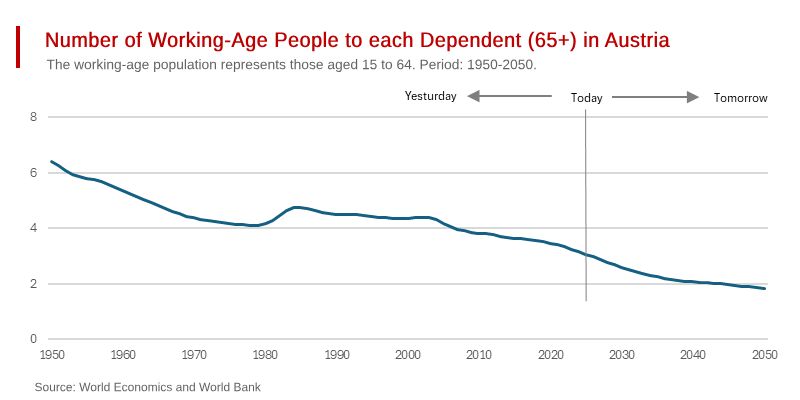
Austria’s Alarming Retiree Burden on its Shrinking Workforce: | World Economics
Decades of falling fertility are causing the working-age population of Austria to fall. Simultaneously, retirees are living longer and forming an ever-larger portion of the population. These factors are causing an extraordinary decline in the number of working-age people available to support the expanding number of retirees.
www.worldeconomics.com
December 4, 2025 at 4:06 AM
With only 74% of working-age Austrians employed, the real support ratio for retirees is even lower than projected. #Austria #Workforce https://www.worldeconomics.com/Thoughts/Austrias-Old-Age-Burden.aspx?ThoughtID=283
Fertility rates across the Americas have fallen sharply since 1970, with many countries now below replacement levels, creating aging populations. #Americas #Demographics https://www.worldeconomics.com/Thoughts/Dire-Demographics-across-the-Americas.aspx?ThoughtID=245

Dire Demographics across the Americas: | World Economics
The Americas have seen some of the sharpest downturns in fertility rates globally from 1970 to the present. The rate in Mexico, Chile and Jamaica, for example, has fallen threefold across that period and is now below the replacement threshold. Most countries across the Americas are now also below the replacement threshold. This means population growth will stagnate creating, in turn, more elderly demographics. It is probable that in the specific areas of Latin America and the Caribbean, women’s access to contraception – and, subsequently, their ability to plan their families – has been - central - to this plummet in fertility rates since 1970.
www.worldeconomics.com
December 4, 2025 at 3:09 AM
Fertility rates across the Americas have fallen sharply since 1970, with many countries now below replacement levels, creating aging populations. #Americas #Demographics https://www.worldeconomics.com/Thoughts/Dire-Demographics-across-the-Americas.aspx?ThoughtID=245
Fertility, more than disease or conflict, is the key factor behind East Asia’s demographic decline and shrinking future labour force. #Population #Demographics https://www.worldeconomics.com/Thoughts/Dramatic-Demographic-Decline-in-East-Asia.aspx?ThoughtID=238

Dramatic Demographic Decline in East Asia: | World Economics
East Asia has been the primary driving force in global growth over the recent decades, but rapidly falling fertility rates suggest the region may cede its lead over the coming years. Childbearing levels across the region have been, on average, below the replacement rate since 2010. Other factors, such as disease and war, can affect population numbers, but fertility is by far the greatest indicator over time.
www.worldeconomics.com
December 4, 2025 at 2:12 AM
Fertility, more than disease or conflict, is the key factor behind East Asia’s demographic decline and shrinking future labour force. #Population #Demographics https://www.worldeconomics.com/Thoughts/Dramatic-Demographic-Decline-in-East-Asia.aspx?ThoughtID=238
Across the EU’s largest countries fertility has fallen far below replacement - the result is a shrinking workforce facing the impossible task of funding ever-growing retiree costs. #EU #Ageing https://www.worldeconomics.com/Thoughts/The-Alarming-Cost-of-Aging-Demographics.aspx?ThoughtID=259
The Alarming Cost of Aging Demographics: | World Economics
Much of the developed world is experiencing rapidly falling fertility rates. Attempts to reverse this fall – which in most developed countries has dropped far below the replacement threshold - have been unsuccessful so far.
www.worldeconomics.com
December 4, 2025 at 12:18 AM
Across the EU’s largest countries fertility has fallen far below replacement - the result is a shrinking workforce facing the impossible task of funding ever-growing retiree costs. #EU #Ageing https://www.worldeconomics.com/Thoughts/The-Alarming-Cost-of-Aging-Demographics.aspx?ThoughtID=259
Decades of failed fertility policies mean Russia faces a silent crisis: fewer workers, longer-living retirees, and an unsustainable tax burden long after Ukraine is forgotten. #Russia #Economy https://www.worldeconomics.com/Thoughts/War-is-Not-Russias-Only-Problem.aspx?ThoughtID=276

War is Not Russia’s Only Problem...: | World Economics
Decades of low fertility are causing the Russian working-age population to fall. Simultaneously, retirees are living longer and forming an ever-larger part of the population. These factors are causing an extraordinary decline in the number of working-age people available to support the expanding number of retirees. Attempts by the state to - increase the rate - appear to have been ineffective.
www.worldeconomics.com
December 3, 2025 at 6:36 PM
Decades of failed fertility policies mean Russia faces a silent crisis: fewer workers, longer-living retirees, and an unsustainable tax burden long after Ukraine is forgotten. #Russia #Economy https://www.worldeconomics.com/Thoughts/War-is-Not-Russias-Only-Problem.aspx?ThoughtID=276
Each new generation will be roughly half the size of the previous one, foreshadowing long-term population collapse. #PopulationDecline #China https://www.worldeconomics.com/Thoughts/Chinas-Coming-Population-Collapse.aspx?ThoughtID=237

China’s Coming Population Collapse: | World Economics
China has experienced a dramatic fall in fertility rates. With levels already far below replacement, depopulation is imminent. Other factors, such as disease and war, can affect population numbers, but fertility is by far the greatest indicator over time.
www.worldeconomics.com
December 3, 2025 at 5:39 PM
Each new generation will be roughly half the size of the previous one, foreshadowing long-term population collapse. #PopulationDecline #China https://www.worldeconomics.com/Thoughts/Chinas-Coming-Population-Collapse.aspx?ThoughtID=237
By mid-century, Croatia risks “growing old before it grows rich” as its shrinking workforce struggles to support rising retiree costs. #Croatia #Finance https://www.worldeconomics.com/Thoughts/Croatias-Unsustainable-Retiree-Burden-on-its-Shrinking-Workforce.aspx?ThoughtID=338

Croatias Unsustainable Retiree Burden on its Shrinking Workforce: | World Economics
Decades of low fertility are causing Croatia’s working-age population to fall. Simultaneously, retirees are living longer and forming an ever-larger part of the population. These factors are causing an extraordinary decline in the number of working-age people available to support the expanding number of retirees.
www.worldeconomics.com
December 3, 2025 at 4:42 PM
By mid-century, Croatia risks “growing old before it grows rich” as its shrinking workforce struggles to support rising retiree costs. #Croatia #Finance https://www.worldeconomics.com/Thoughts/Croatias-Unsustainable-Retiree-Burden-on-its-Shrinking-Workforce.aspx?ThoughtID=338
By 2050, Italy may struggle to sustain social services as retirees vastly outnumber available workers. #Italy #Population https://www.worldeconomics.com/Thoughts/Italys-Demographic-Time-Bomb.aspx?ThoughtID=270

Italy’s Unsustainable Retiree Burden on its Shrinking Workforce: | World Economics
Decades of low fertility are causing the Italian working-age population to fall. Simultaneously, retirees are living longer and forming an ever-larger part of the population. These factors are causing an extraordinary decline in the number of working-age people available to support the expanding number of retirees.
www.worldeconomics.com
December 3, 2025 at 3:45 PM
By 2050, Italy may struggle to sustain social services as retirees vastly outnumber available workers. #Italy #Population https://www.worldeconomics.com/Thoughts/Italys-Demographic-Time-Bomb.aspx?ThoughtID=270
While The Economist claims America's economy remains supreme, PPP data from IMF, World Bank and CIA show China already 16-23% larger, a lead widened by outdated base years and informal sectors. #China #USA https://www.worldeconomics.com/Thoughts/The-Worlds-Biggest-Economy.aspx?ThoughtID=122
The World’s Biggest Economy: - America or China? - | World Economics
There is some dispute over which of the two undisputed superpowers is the biggest. - - The Economist (for example) clearly thinks America remains king of the jungle. Its issue dated May 13th 2023 subheads a paper called Peak China with the unequivocal "The meteoric rise of Chinas economy is ending". And notes later that "Even if Chinas economy does become the biggest in the world, its lead is likely to remain small". - - It must be emphasised that nothing is certain in the murky world of economic data. World Economics has spent many years studying - GDP measures - and knows a significant proportion of GDP data is little better than random numbers, as one notable economist referred to some African data. The Economist may be right. However there are good reasons for believing that Chinas GDP is already significantly bigger, and is continuing to grow significantly faster than that of America. Here they are: - - First, the view that the American economy is still bigger than Chinas rests mainly on using the unrefined dollar as the measure. But as all travellers know, a dollar in downtown Hanoi buys more than a dollar in NYC. In the same article we cite, The Economist itself points out that a basket of goods and services that costs $100 in America, costs only about $60 in China, yet measures US supremacy without considering the big price differentials. - - An alternative measure of country wealth is based on - Purchasing Power Parity (PPP) - , and is widely believed to be more reliable as a measure of relative GDP between countries than simple dollar values.
In 2022, the IMF judged the Chinese economy in PPP terms to be 23% larger than America. At the same time, using PPP data the World Bank estimated the Chinese economy to be 18.8% larger than America. And even the CIA considered the differential in favour of China at 16%.
www.worldeconomics.com
December 3, 2025 at 1:51 PM
While The Economist claims America's economy remains supreme, PPP data from IMF, World Bank and CIA show China already 16-23% larger, a lead widened by outdated base years and informal sectors. #China #USA https://www.worldeconomics.com/Thoughts/The-Worlds-Biggest-Economy.aspx?ThoughtID=122
India’s rapid growth may see it surpass the US in the next decade, underscoring the shift in global economic power towards Asia. #India #GlobalEconomy https://www.worldeconomics.com/Thoughts/Worries-About-the-EU-Falling-Behind-the-US-are-Misplaced.aspx?ThoughtID=204

Worries About the EU Falling - Behind the US are Misplaced: But global geopolitics really are being transformed by the rise of Asia| World Economics
There has been much discussion of late by senior EU politicians (President Macron most recently in his much discussed "Europe - It can die " speech) and journalists (notably FT journalist Gideon Rachman, who suggested that American GDP was smaller than that of the EU in 2008, but is now 50% bigger), that the EU is falling far behind America in GDP terms. - - Such alarmist views stem from the use of the US dollar in inter country comparisons. - - One hundred US dollars would buy only around 63 euros in mid-2008. In mid-2025 they will buy far more - over 85 euros. Any comparison in dollars using such periods will inevitably produce comparisons that strain credibility. The same analysis in Purchasing Power Parity terms suggests relatively little change in real living standards over this period, and is a far better guide to the on-the-ground reality. - - Politicians and journalists would be better employed looking at comparisons of the growing size of Asia compared with the EU and the USA. The chart below illustrates the growth of China and India compared with the US and EU, in Purchasing Power Parity terms, with adjustments made by World Economics for outdated Base years in both China and India, and Informal economies (significantly bigger in Asia than in the West).
www.worldeconomics.com
December 3, 2025 at 12:54 PM
India’s rapid growth may see it surpass the US in the next decade, underscoring the shift in global economic power towards Asia. #India #GlobalEconomy https://www.worldeconomics.com/Thoughts/Worries-About-the-EU-Falling-Behind-the-US-are-Misplaced.aspx?ThoughtID=204
With unfunded pension liabilities at 378% of GDP, Romania faces an unprecedented retiree burden. #Romania #Economy https://www.worldeconomics.com/Thoughts/Romanias-Unsustainable-Retiree-Burden-on-its-Shrinking-Workforce.aspx?ThoughtID=335
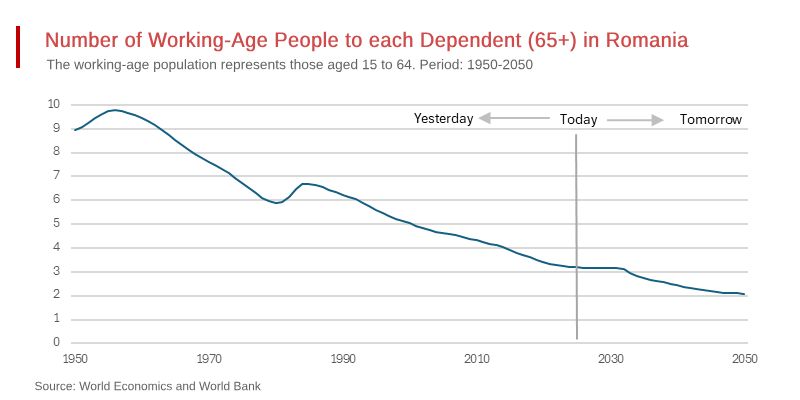
Romanias Unsustainable Retiree Burden on its Shrinking Workforce: | World Economics
Decades of low fertility are causing Romania’s working-age population to fall. Simultaneously, retirees are living longer and forming an ever-larger part of the population. These factors are causing an extraordinary decline in the number of working-age people available to support the expanding number of retirees.
www.worldeconomics.com
December 3, 2025 at 11:57 AM
With unfunded pension liabilities at 378% of GDP, Romania faces an unprecedented retiree burden. #Romania #Economy https://www.worldeconomics.com/Thoughts/Romanias-Unsustainable-Retiree-Burden-on-its-Shrinking-Workforce.aspx?ThoughtID=335
The country has been downgraded to D-grade, indicating poor governance despite rising global economic influence. #Türkiye #Economics https://www.worldeconomics.com/Thoughts/Turkeys-Downgraded-on-the-World-Economics-Governance-Index.aspx?ThoughtID=364

Türkiye Downgraded on the World Economics Governance Index: | World Economics
Türkiye’s rating has declined on the - World Economics Governance Index - over the last decade. This reflects falling standards across data reflecting corruption, the rule of law, press freedom and political rights.
www.worldeconomics.com
December 3, 2025 at 10:03 AM
The country has been downgraded to D-grade, indicating poor governance despite rising global economic influence. #Türkiye #Economics https://www.worldeconomics.com/Thoughts/Turkeys-Downgraded-on-the-World-Economics-Governance-Index.aspx?ThoughtID=364
Over half of Estonia’s social protection spending goes to retirees, straining the state as the workforce contracts. #Estonia #Pensions https://www.worldeconomics.com/Thoughts/Estonias-Unsustainable-Retiree-Burden-on-its-Shrinking-Workforce.aspx?ThoughtID=340

Estonias Unsustainable Retiree Burden on its Shrinking Workforce: | World Economics
Decades of low fertility are causing Estonia’s working-age population to fall. Simultaneously, retirees are living longer and forming an ever-larger part of the population. These factors are causing an extraordinary decline in the number of working-age people available to support the expanding number of retirees.
www.worldeconomics.com
December 3, 2025 at 9:06 AM
Over half of Estonia’s social protection spending goes to retirees, straining the state as the workforce contracts. #Estonia #Pensions https://www.worldeconomics.com/Thoughts/Estonias-Unsustainable-Retiree-Burden-on-its-Shrinking-Workforce.aspx?ThoughtID=340
Norway’s unfunded pension obligations stand at 264% of GDP, highlighting an unsustainable future tax burden. #Norway #Economy https://www.worldeconomics.com/Thoughts/Norways-Unsustainable-Retiree-Burden-on-its-Shrinking-Workforce.aspx?ThoughtID=324

Norways Retiree Burden on its Shrinking Workforce: | World Economics
Norway’s fertility rate has been in decline in recent years. This is projected to cause the working-age population to fall by the end of this decade. Simultaneously, retirees are living longer and forming an ever-larger part of the population. These factors are causing a large decline in the number of working-age people available to support the expanding number of retirees.
www.worldeconomics.com
December 3, 2025 at 8:10 AM
Norway’s unfunded pension obligations stand at 264% of GDP, highlighting an unsustainable future tax burden. #Norway #Economy https://www.worldeconomics.com/Thoughts/Norways-Unsustainable-Retiree-Burden-on-its-Shrinking-Workforce.aspx?ThoughtID=324