



Valentin Beyer
@udddikit.bsky.social
Polymer Chemistry Enthusiast with an emphasis on Polyesters, Aston University
Pinned
Valentin Beyer
@udddikit.bsky.social
· Jul 7
🧪 PhD Opportunity – Sustainable Polymer Membranes 🌱
Join a fully funded PhD at Aston University (UK) to develop biobased polyester membranes for advanced separations.
📍 Start: Jan 2026 | Deadline: 25 Aug 2025
🔗 www.findaphd.com/phds/project...
#PhD #Sustainability #Polymers #Membranes
Join a fully funded PhD at Aston University (UK) to develop biobased polyester membranes for advanced separations.
📍 Start: Jan 2026 | Deadline: 25 Aug 2025
🔗 www.findaphd.com/phds/project...
#PhD #Sustainability #Polymers #Membranes
🧪 PhD Opportunity – Sustainable Polymer Membranes 🌱
Join a fully funded PhD at Aston University (UK) to develop biobased polyester membranes for advanced separations.
📍 Start: Jan 2026 | Deadline: 25 Aug 2025
🔗 www.findaphd.com/phds/project...
#PhD #Sustainability #Polymers #Membranes
Join a fully funded PhD at Aston University (UK) to develop biobased polyester membranes for advanced separations.
📍 Start: Jan 2026 | Deadline: 25 Aug 2025
🔗 www.findaphd.com/phds/project...
#PhD #Sustainability #Polymers #Membranes
July 7, 2025 at 5:47 PM
🧪 PhD Opportunity – Sustainable Polymer Membranes 🌱
Join a fully funded PhD at Aston University (UK) to develop biobased polyester membranes for advanced separations.
📍 Start: Jan 2026 | Deadline: 25 Aug 2025
🔗 www.findaphd.com/phds/project...
#PhD #Sustainability #Polymers #Membranes
Join a fully funded PhD at Aston University (UK) to develop biobased polyester membranes for advanced separations.
📍 Start: Jan 2026 | Deadline: 25 Aug 2025
🔗 www.findaphd.com/phds/project...
#PhD #Sustainability #Polymers #Membranes
Reposted by Valentin Beyer

Thrilled to share this work on precise COOH-functionalized polyesters in reprocessable vitrimers, now online in JACS! This research highlights the role of catalysts in vitrimer chemistry and how tailored catalyst mixtures can control vitrimer properties and bond exchange pubs.acs.org/doi/10.1021/...
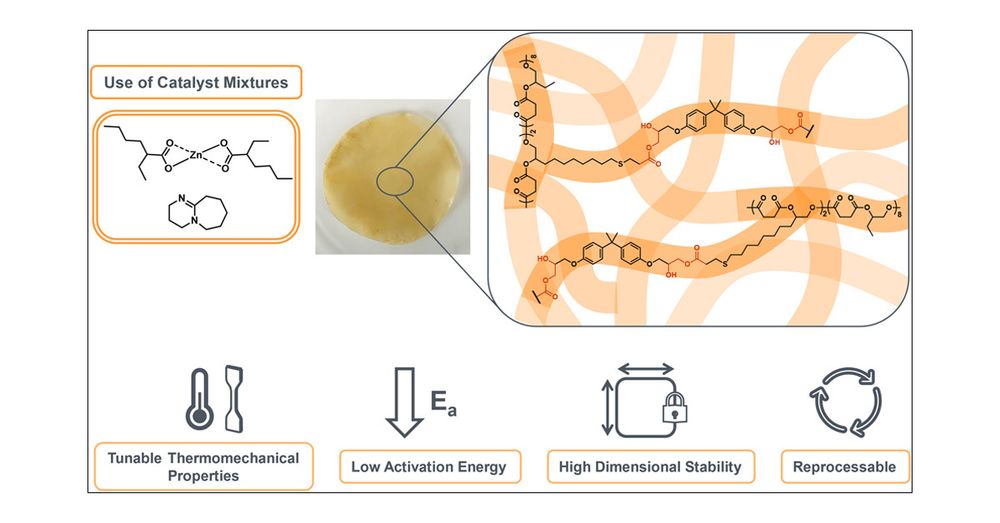
Precise Carboxylic Acid-Functionalized Polyesters in Reprocessable Vitrimers
Thermosets are valued for their exceptional dimensional stability, mechanical properties, and resistance to creep and chemicals. Their permanent molecular structures limit reshaping, reprocessing, and recycling. Incorporating exchangeable chemical bonds into cross-linked polymer networks provides materials with thermoset-like properties that are also reprocessable. Here, ring-opening copolymerization (ROCOP) of unpurified, commercially available epoxides and succinic anhydride is employed to synthesize well-defined, low molecular weight polyesters with controlled functionalization. Polymer networks are then formed through the catalyzed reaction of these copolymers with the epoxy-containing cross-linker diglycidyl ether of bisphenol A. Catalyst mixtures of zinc bis(2-ethylhexanoate) and 1,8-diazabicyclo(5.4.0)undec-7-ene are used to assess the role of the catalysts in the curing and dynamic bond exchange reactions. Varying the catalyst ratios results in polymer networks with tunable mechanical properties (90% < εb < 450%, 0.30 MPa < UTS < 24 MPa), high creep recovery (%recovery > 90% after five creep cycles), and good reprocessability.
pubs.acs.org
February 14, 2025 at 11:43 AM
Thrilled to share this work on precise COOH-functionalized polyesters in reprocessable vitrimers, now online in JACS! This research highlights the role of catalysts in vitrimer chemistry and how tailored catalyst mixtures can control vitrimer properties and bond exchange pubs.acs.org/doi/10.1021/...