Taylor Boas
tboas.bsky.social
Taylor Boas
@tboas.bsky.social

Professor & Chair, BU Political Science. Latin American politics, religion, public opinion & behavior. Author, Evangelicals and Electoral Politics in Latin America.

Political science 40%
Sociology 21%

One of the best things about my job is working with graduate students and learning so much about their diverse and fascinating research topics!

@zcalbright.bsky.social‬, “Beyond the Great Powers: How South American States are Navigating US–China Competition in the 21st Century.” Postdoctoral Research Associate, Latin American Studies, Princeton University.

Leo Moradi, “Alfarabi’s Political Thought in his Parallel Works: Enumeration of the Sciences, Book of Religion, Political Regime, and Virtuous City.” Lecturer, University of North Texas.

@kaftan.bsky.social‬, “Understanding the European Union’s Behavior during the Crises: Evidence from the Rule of Law and Equality Crises.” Associate, Takeda Pharmaceuticals.

@bofeng.bsky.social‬, “Discretion in Policymaking and Bureaucratic Oversight under Weak Institutions: Evidence from Contemporary China.” Assistant Professor, Shanghai University of Finance and Economics.

As we wrap up summer dissertation defenses, I’d like to celebrate my four awesome @bupolisci.bsky.social PhD students who graduated this year, their dissertation topics, and their job market outcomes:
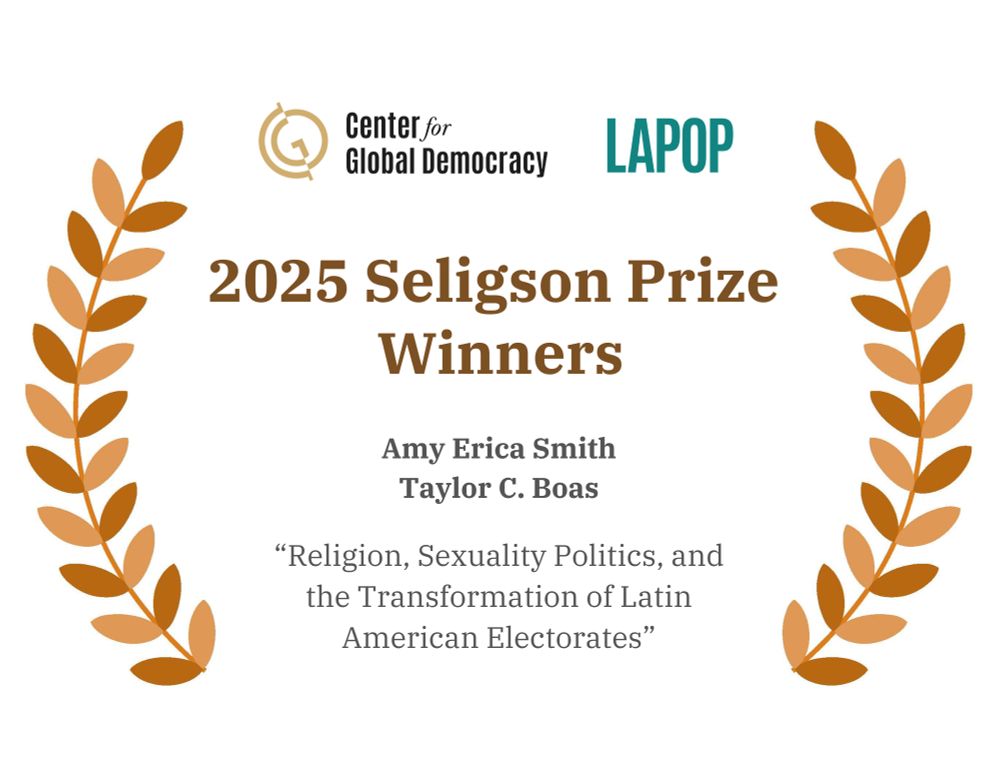
We are excited to announce the winners of the 2025 Seligson Prize! 🎉Congratulations🎉 to Amy Erica Smith and @tboas.bsky.social for their article: “Religion, Sexuality Politics, and the Transformation of Latin American Electorates.” [1/4]

Read it in ‪@bjpols.bsky.social:
🔗cup.org/4f3Ly4F

Really looking forward to Thanksgiving so I can rest…I mean, write five recommendation letters and a tenure letter.

When do attitudes on abortion or same-sex marriage influence voting behavior in Latin America? Now on Open Access FirstView with @bjpols.bsky.social: my article with Amy Erica Smith, "Religion, Sexuality Politics, and the Transformation of Latin American Electorates." doi.org/10.1017/S000....

Reposted by Taylor C. Boas

New research: Growing up in a county where one's peers are 10 percentage points more likely to become Republicans makes a young person 4.7 percentage points more likely to become Republican upon entering the electorate (same for Democrats). www.nber.org/system/files...

Still learning how all this works in my first hour on here...but please add me to polisky.

Please add me