




Tatia Buidze
@tatiabu.bsky.social
🧠 | University College London (UCL), Research Fellow in Cognitive Neuroscience
Computational modelling of brain dynamics in attention, value learning, and social cognition
Street and analog photography 📷 |Urban exploring 🏢 | Movies 🎥
They/them 🌈
Computational modelling of brain dynamics in attention, value learning, and social cognition
Street and analog photography 📷 |Urban exploring 🏢 | Movies 🎥
They/them 🌈
Pinned
Tatia Buidze
@tatiabu.bsky.social
· Jun 18
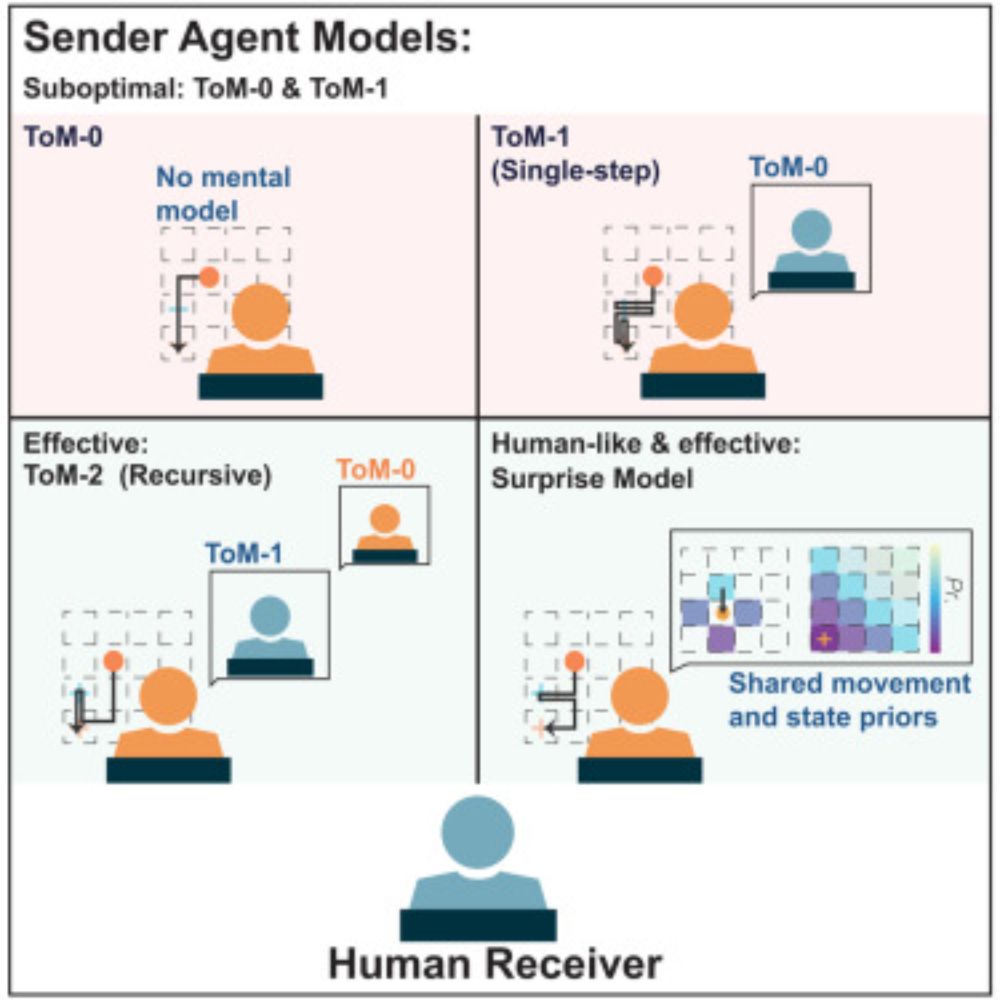
Expectation violations as an effective alternative to complex mentalizing in novel communication
Neuroscience; Systems neuroscience; Social sciences
www.cell.com
✨Excited to share that our new paper is now out in iScience!✨
🧠 We show that people can coordinate surprisingly well in novel interactions by violating others' expectations - without requiring deep, recursive reasoning about others’ beliefs.
📄 Read the full paper here: www.cell.com/iscience/ful...
🧠 We show that people can coordinate surprisingly well in novel interactions by violating others' expectations - without requiring deep, recursive reasoning about others’ beliefs.
📄 Read the full paper here: www.cell.com/iscience/ful...
Reposted by Tatia Buidze

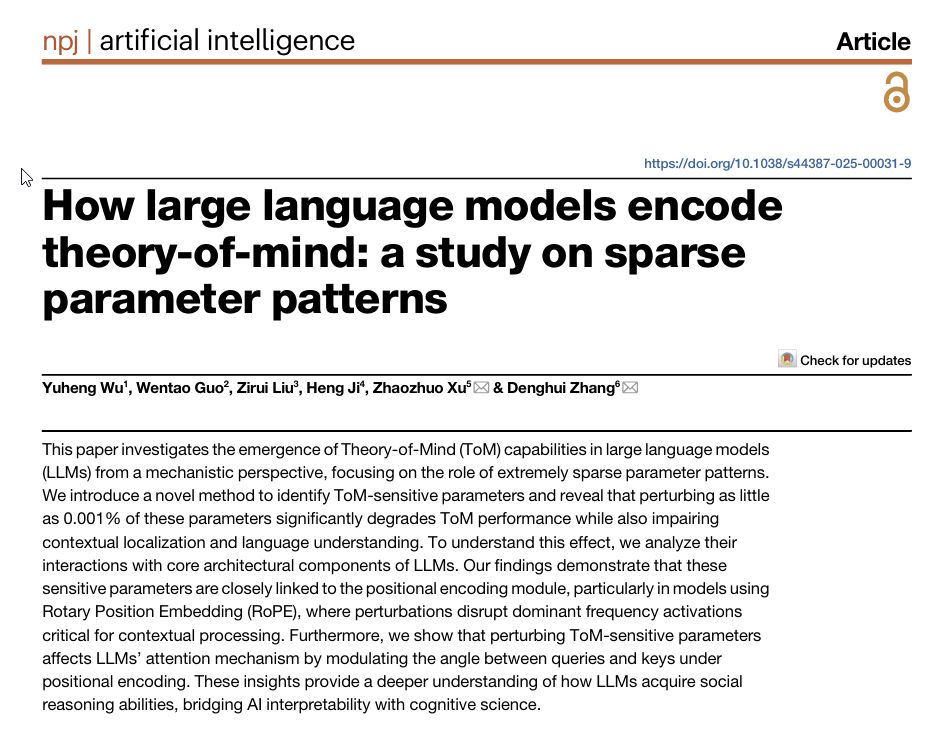
This paper finds LLMs' ability to understand that others have different beliefs (Theory of Mind) comes from 0.001% of their parameters. Break those specific weights & the model loses both its ability to track what others know AND language comprehension
Interesting implications for models (& minds?)
Interesting implications for models (& minds?)
September 4, 2025 at 6:43 PM
This paper finds LLMs' ability to understand that others have different beliefs (Theory of Mind) comes from 0.001% of their parameters. Break those specific weights & the model loses both its ability to track what others know AND language comprehension
Interesting implications for models (& minds?)
Interesting implications for models (& minds?)
Reposted by Tatia Buidze

I'm so excited to help bring this Computational Neuroscience workshop to life! Join a fantastic group of researchers in Denmark this August (11-14).
We've designed it for PhDs & postdocs to connect with experts and build new skills. Hope to see you there! Please do share with your colleagues!
We've designed it for PhDs & postdocs to connect with experts and build new skills. Hope to see you there! Please do share with your colleagues!
Register for Computational Neuroscience - NAD Workshop 🖥️
📅 WHEN: August 11-14
🧑🦰 WHO: Neuroscientists affiliated with a Danish research institution
🌍 WHERE: Gl. Avernæs Sinatur Hotel & Konference
⏰ DEADLINE: June 26
Read more and register 👉 bit.ly/3G7hIQ8
📅 WHEN: August 11-14
🧑🦰 WHO: Neuroscientists affiliated with a Danish research institution
🌍 WHERE: Gl. Avernæs Sinatur Hotel & Konference
⏰ DEADLINE: June 26
Read more and register 👉 bit.ly/3G7hIQ8

June 20, 2025 at 8:34 AM
I'm so excited to help bring this Computational Neuroscience workshop to life! Join a fantastic group of researchers in Denmark this August (11-14).
We've designed it for PhDs & postdocs to connect with experts and build new skills. Hope to see you there! Please do share with your colleagues!
We've designed it for PhDs & postdocs to connect with experts and build new skills. Hope to see you there! Please do share with your colleagues!
Reposted by Tatia Buidze
Ready to shape the future of #ComputationalScience?
We’re inviting researchers like you to mentor student-led projects this July. Just 2-3 hours of commitment and no prep needed!
This is your chance to give back and grow!
➡️ Learn more and sign up to #volunteer neuromatch.io/mentoring/
We’re inviting researchers like you to mentor student-led projects this July. Just 2-3 hours of commitment and no prep needed!
This is your chance to give back and grow!
➡️ Learn more and sign up to #volunteer neuromatch.io/mentoring/


June 20, 2025 at 7:49 AM
Ready to shape the future of #ComputationalScience?
We’re inviting researchers like you to mentor student-led projects this July. Just 2-3 hours of commitment and no prep needed!
This is your chance to give back and grow!
➡️ Learn more and sign up to #volunteer neuromatch.io/mentoring/
We’re inviting researchers like you to mentor student-led projects this July. Just 2-3 hours of commitment and no prep needed!
This is your chance to give back and grow!
➡️ Learn more and sign up to #volunteer neuromatch.io/mentoring/
✨Excited to share that our new paper is now out in iScience!✨
🧠 We show that people can coordinate surprisingly well in novel interactions by violating others' expectations - without requiring deep, recursive reasoning about others’ beliefs.
📄 Read the full paper here: www.cell.com/iscience/ful...
🧠 We show that people can coordinate surprisingly well in novel interactions by violating others' expectations - without requiring deep, recursive reasoning about others’ beliefs.
📄 Read the full paper here: www.cell.com/iscience/ful...
Expectation violations as an effective alternative to complex mentalizing in novel communication
Neuroscience; Systems neuroscience; Social sciences
www.cell.com
June 18, 2025 at 12:28 PM
✨Excited to share that our new paper is now out in iScience!✨
🧠 We show that people can coordinate surprisingly well in novel interactions by violating others' expectations - without requiring deep, recursive reasoning about others’ beliefs.
📄 Read the full paper here: www.cell.com/iscience/ful...
🧠 We show that people can coordinate surprisingly well in novel interactions by violating others' expectations - without requiring deep, recursive reasoning about others’ beliefs.
📄 Read the full paper here: www.cell.com/iscience/ful...
Reposted by Tatia Buidze
What about the social cerebellum during development we wondered? Here you find some cool insights on this awesome part of the brain! BIG thanks for the great work Katerina Manoli, and support from Charlotte Grosse Wiesmann and Frank van Overwalle 🧠🦋 rdcu.be/epKmZ

Functional recruitment and connectivity of the cerebellum is associated with the emergence of Theory of Mind in early childhood
Nature Communications - The cerebellum is heavily implicated in adult social cognition, but its role in Theory of Mind development remains unclear. Here, the authors show that children’s...
rdcu.be
June 6, 2025 at 2:09 PM
What about the social cerebellum during development we wondered? Here you find some cool insights on this awesome part of the brain! BIG thanks for the great work Katerina Manoli, and support from Charlotte Grosse Wiesmann and Frank van Overwalle 🧠🦋 rdcu.be/epKmZ
Reposted by Tatia Buidze
Ten simple rules for queer data collection and analysis dx.plos.org/10.1371/jour...

Ten simple rules for queer data collection and analysis by STEM researchers
Queer people are still underrepresented both as STEM researchers and participants, partially due to a dearth of accurate data on this demographic. The lack of consideration for queer identities in dat...
dx.plos.org
May 29, 2025 at 8:16 AM
Ten simple rules for queer data collection and analysis dx.plos.org/10.1371/jour...
Reposted by Tatia Buidze
Funded PhD opportunity with @sjblakemore.bsky.social and I, at Cambridge. We are looking for someone interested in developmental science, to start in the coming academic year. Please share it with anyone you think might be interested (see details attached 😁).
drive.google.com/file/d/1RIvg...
drive.google.com/file/d/1RIvg...
Funded PhD opportunity.pdf
drive.google.com
May 27, 2025 at 1:49 PM
Funded PhD opportunity with @sjblakemore.bsky.social and I, at Cambridge. We are looking for someone interested in developmental science, to start in the coming academic year. Please share it with anyone you think might be interested (see details attached 😁).
drive.google.com/file/d/1RIvg...
drive.google.com/file/d/1RIvg...
Reposted by Tatia Buidze

Dorsomedial and ventromedial prefrontal cortex lesions differentially impact social influence and temporal discounting journals.plos.org/plosbiology/... new lab paper from the fantastic @zhilinsu.bsky.social with wonderful collaborators 🌟
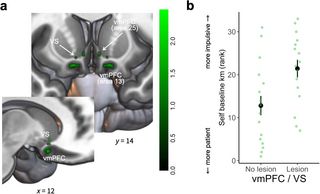
Dorsomedial and ventromedial prefrontal cortex lesions differentially impact social influence and temporal discounting
The medial prefrontal cortex (mPFC) is involved in economic and social decision-making in humans but the specific functions of its subregions are not clear. This study shows that the dorsal mPFC is ca...
journals.plos.org
April 29, 2025 at 11:51 AM
Dorsomedial and ventromedial prefrontal cortex lesions differentially impact social influence and temporal discounting journals.plos.org/plosbiology/... new lab paper from the fantastic @zhilinsu.bsky.social with wonderful collaborators 🌟
Reposted by Tatia Buidze
Deadline extended to 28th April!! Summer School in Computational Social Cognition with fantastic keynotes by Matthew Rushworth, @dianatamir.bsky.social and @davidamodio.bsky.social. Come & learn more about computational modelling, make new friends, & explore the UK's 2nd largest city 🙂👇. Please RT!
🌟 Join us for the 2nd Birmingham-Leiden Summer School in Computational Social Cognition! Amazing line-up of keynote speakers and instructors, new topics, and only £480 with 4 nights accommodation, social events and meals included! 🌟
www.compsoccog.com
www.compsoccog.com

🚨 SUMMER SCHOOL!
Announcing the 2nd Birmingham-Leiden Summer School in Computational Social Cognition, Sep 2-5, 2025.
Fantastic line-up of keynote: Matthew Rushworth, Diana Tamir @dianatamir.bsky.social, and David Amodio @davidamodio.bsky.social .
👇
Apply by 18 April (compsoccog.com) and RT!
Announcing the 2nd Birmingham-Leiden Summer School in Computational Social Cognition, Sep 2-5, 2025.
Fantastic line-up of keynote: Matthew Rushworth, Diana Tamir @dianatamir.bsky.social, and David Amodio @davidamodio.bsky.social .
👇
Apply by 18 April (compsoccog.com) and RT!
April 17, 2025 at 10:18 AM
Deadline extended to 28th April!! Summer School in Computational Social Cognition with fantastic keynotes by Matthew Rushworth, @dianatamir.bsky.social and @davidamodio.bsky.social. Come & learn more about computational modelling, make new friends, & explore the UK's 2nd largest city 🙂👇. Please RT!
Reposted by Tatia Buidze
Reposted by Tatia Buidze
There is again a model-based neuroscience summer school from Aug 4-8th in Amsterdam! modelbasedneurosci.com
Model-Based Neuroscience and Cognition Summer School
Visit the post for more.
modelbasedneurosci.com
March 24, 2025 at 12:08 PM
There is again a model-based neuroscience summer school from Aug 4-8th in Amsterdam! modelbasedneurosci.com
Reposted by Tatia Buidze
getting this paper published was a bit painful but I am proud of it: www.nature.com/articles/s41.... We use deep RL to find mechanisms that help (real) people sustain the commons. Well done to Raphael Koster and Miruna Pislar (not on BlueSky). non-paywalled version on arxiv.
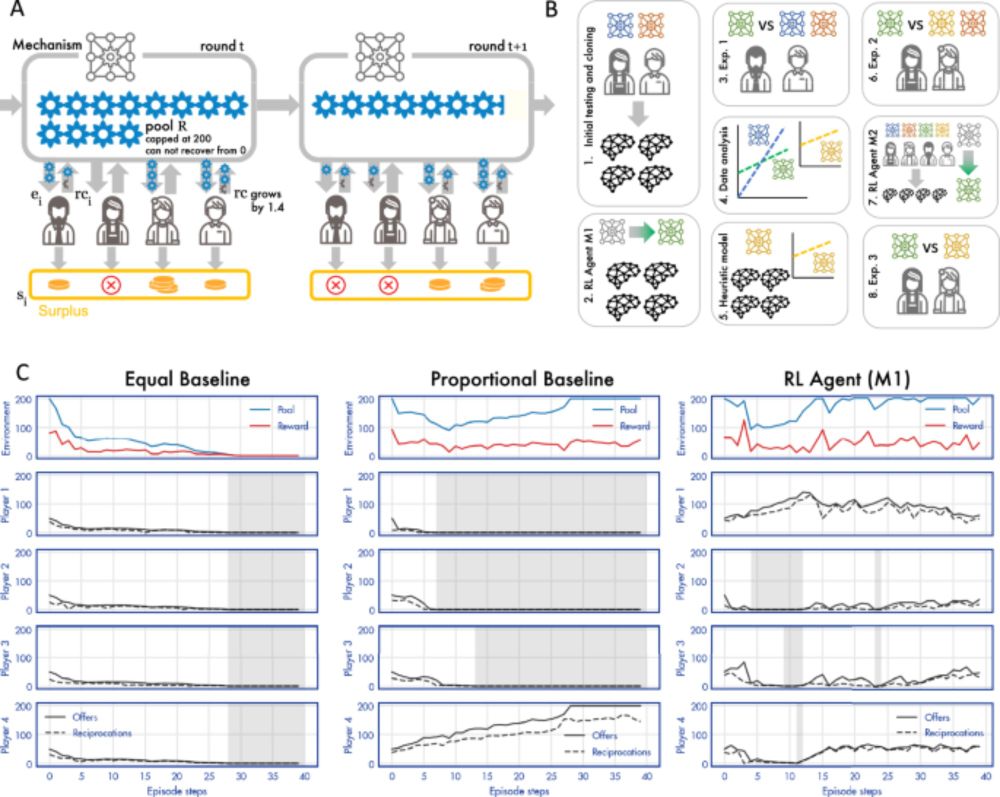
Deep reinforcement learning can promote sustainable human behaviour in a common-pool resource problem - Nature Communications
Koster et al introduce a deep reinforcement learning (RL) mechanism designed to manage common-pool resources successfully encourages sustainable cooperation among human participants by dynamically adj...
www.nature.com
March 24, 2025 at 8:22 AM
getting this paper published was a bit painful but I am proud of it: www.nature.com/articles/s41.... We use deep RL to find mechanisms that help (real) people sustain the commons. Well done to Raphael Koster and Miruna Pislar (not on BlueSky). non-paywalled version on arxiv.
Reposted by Tatia Buidze
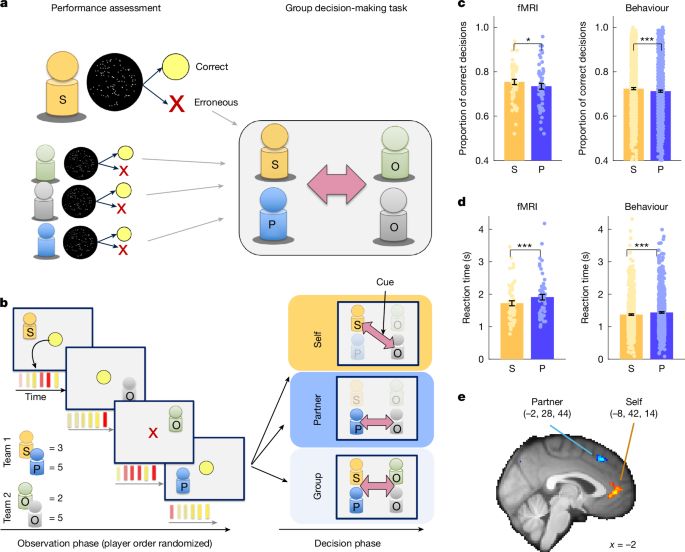
New paper “Basis functions for complex social decisions in dorsomedial prefrontal cortex” in @nature.com led by @mkwittmann.bsky.social with many others. We show basis functions code relations between people, similar to their role in other perceptual and motor domains www.nature.com/articles/s41...
Basis functions for complex social decisions in dorsomedial frontal cortex - Nature
A study combining group decision-making tasks with fMRI shows that the brain’s dorsomedial prefrontal cortex uses basis functions, similar to those in the visual, motor and spatial domains, to re...
www.nature.com
March 13, 2025 at 8:29 AM
New paper “Basis functions for complex social decisions in dorsomedial prefrontal cortex” in @nature.com led by @mkwittmann.bsky.social with many others. We show basis functions code relations between people, similar to their role in other perceptual and motor domains www.nature.com/articles/s41...
Reposted by Tatia Buidze
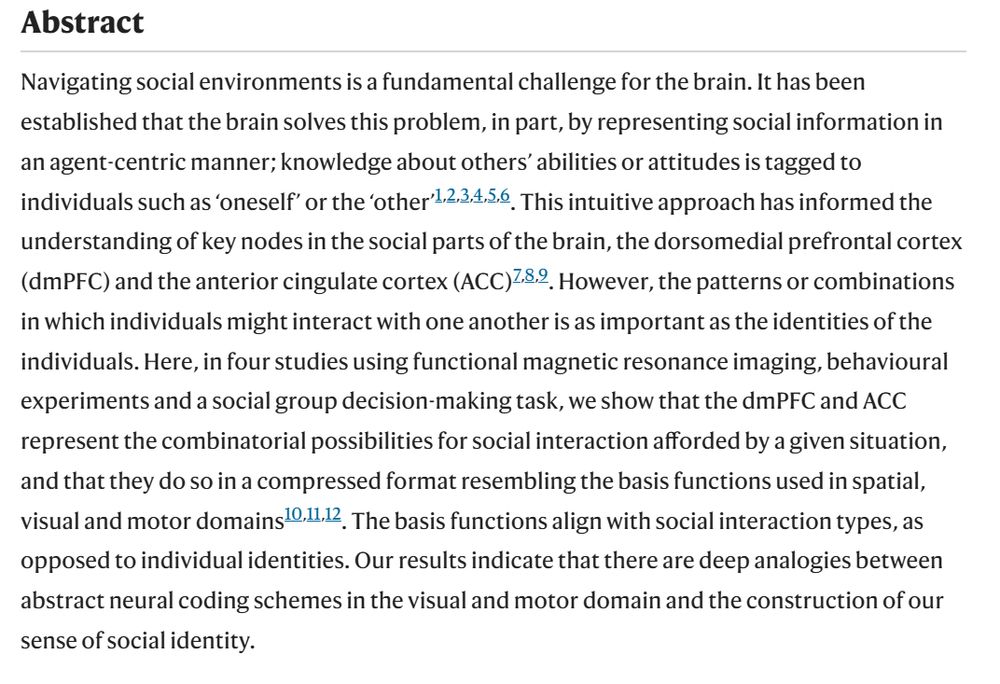
Our paper in Nature (@mkwittmann.bsky.social et al.): the brain does not only process the *identity* of a person but primarily our *relationship* to them. Even on a neural level, who someone is *in relation to others* is key. www.nature.com/articles/s41...
#PsychSciSky #socialpsyc #neuroskyence
#PsychSciSky #socialpsyc #neuroskyence
March 12, 2025 at 5:37 PM
Our paper in Nature (@mkwittmann.bsky.social et al.): the brain does not only process the *identity* of a person but primarily our *relationship* to them. Even on a neural level, who someone is *in relation to others* is key. www.nature.com/articles/s41...
#PsychSciSky #socialpsyc #neuroskyence
#PsychSciSky #socialpsyc #neuroskyence
Reposted by Tatia Buidze
Think about conference location to avoid visa discrimination www.nature.com/articles/d41...

We moved a conference halfway around the globe to avoid visa discrimination
Event organizers often overlook the visa-related difficulties that researchers in low- and middle-income countries face. This must change.
www.nature.com
March 5, 2025 at 7:35 AM
Think about conference location to avoid visa discrimination www.nature.com/articles/d41...
Reposted by Tatia Buidze
creative ways that students use chatGPT www.nature.com/articles/d41...

ChatGPT for students: learners find creative new uses for chatbots
The utility of generative AI tools is expanding far beyond simple summarisation and grammar support towards more sophisticated, pedagogical applications.
www.nature.com
March 4, 2025 at 7:54 AM
creative ways that students use chatGPT www.nature.com/articles/d41...
6️⃣Our results show that surprise is used to communicate in novel interaction, reflected in behavior, physiology, and neural activity. This suggests a cognitive mechanism shaping how we develop new communication systems and has implications for human communication, AI, and human-machine interaction.
February 27, 2025 at 2:30 PM
6️⃣Our results show that surprise is used to communicate in novel interaction, reflected in behavior, physiology, and neural activity. This suggests a cognitive mechanism shaping how we develop new communication systems and has implications for human communication, AI, and human-machine interaction.
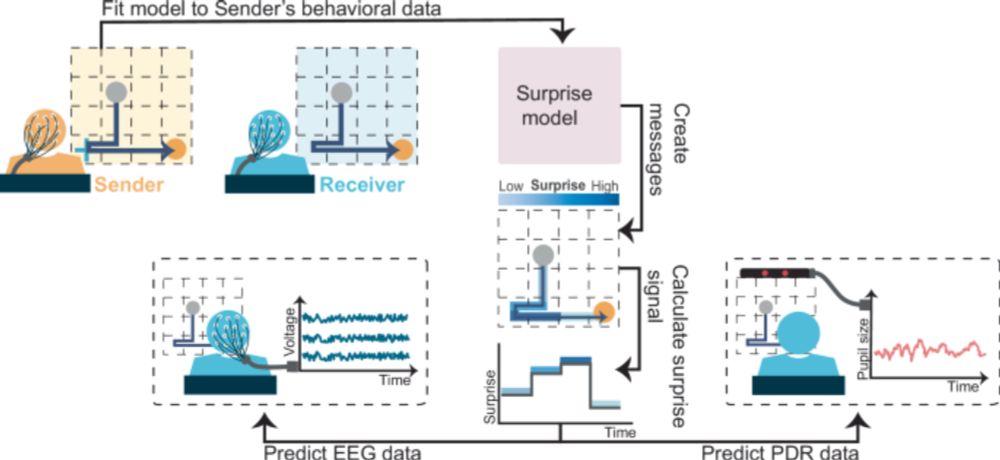
5️⃣We thought that If Receivers recognize goals through surprise, we should see neural markers of expectation violations. Indeed, EEG data shows surprise is encoded in fronto-central brain regions, linking it to cognitive processes of detecting unexpected events.

February 27, 2025 at 2:30 PM
5️⃣We thought that If Receivers recognize goals through surprise, we should see neural markers of expectation violations. Indeed, EEG data shows surprise is encoded in fronto-central brain regions, linking it to cognitive processes of detecting unexpected events.
4. To provide the physiological evidence of the model, we conducted model-based analysis of receive’s PDR data. Receivers’ PDR strongly correlates with model-derived surprise—suggesting that unexpected movements grab attention and influence cognitive processing.

February 27, 2025 at 2:29 PM
4. To provide the physiological evidence of the model, we conducted model-based analysis of receive’s PDR data. Receivers’ PDR strongly correlates with model-derived surprise—suggesting that unexpected movements grab attention and influence cognitive processing.
3️⃣The Surprise Model accurately predicts Sender’s message design and participant behavior across different samples. It outperforms models using only movement or state priors, showing that all components are essential to capture human communication!

February 27, 2025 at 2:28 PM
3️⃣The Surprise Model accurately predicts Sender’s message design and participant behavior across different samples. It outperforms models using only movement or state priors, showing that all components are essential to capture human communication!
2️⃣TCG is a two-player game where the Sender moves on a grid-creating a message, while the Receiver must infer their hidden goal based on the observed message. After analyzing hundreds of messages, we identified three distinct message types senders used to communicate.

February 27, 2025 at 2:28 PM
2️⃣TCG is a two-player game where the Sender moves on a grid-creating a message, while the Receiver must infer their hidden goal based on the observed message. After analyzing hundreds of messages, we identified three distinct message types senders used to communicate.
1️⃣To test this, we built a Surprise Model with two key components. The movement component assumes motion continues in a straight line, so deviations create surprise. The state prior encodes Sender’s goal information. We tested this model in the Tacit Communication Game (TCG).

February 27, 2025 at 2:27 PM
1️⃣To test this, we built a Surprise Model with two key components. The movement component assumes motion continues in a straight line, so deviations create surprise. The state prior encodes Sender’s goal information. We tested this model in the Tacit Communication Game (TCG).
Here we proposed that without a common language, people rely on universal physical principles to build shared understanding. Once a system is established, Senders strategically defy expectations to create meaning—making surprise a powerful communicative tool.
February 27, 2025 at 2:25 PM
Here we proposed that without a common language, people rely on universal physical principles to build shared understanding. Once a system is established, Senders strategically defy expectations to create meaning—making surprise a powerful communicative tool.
✨Excited to share that our paper on how expectation violations shape novel human communication has just been published in Nature Communications! ✨
📖 read the full paper: www.nature.com/articles/s41....
🧵 Detailed breakdown bellow! 👇
📖 read the full paper: www.nature.com/articles/s41....
🧵 Detailed breakdown bellow! 👇
Expectation violations signal goals in novel human communication - Nature Communications
In the absence of language, there is a lack of common knowledge necessary for efficient communication. Here, the authors show that people solve this problem by reverting to commonly accepted physical ...
www.nature.com
February 27, 2025 at 2:25 PM
✨Excited to share that our paper on how expectation violations shape novel human communication has just been published in Nature Communications! ✨
📖 read the full paper: www.nature.com/articles/s41....
🧵 Detailed breakdown bellow! 👇
📖 read the full paper: www.nature.com/articles/s41....
🧵 Detailed breakdown bellow! 👇