



Self Research Institute
@selfresearch.org
We’re a nonprofit organization dedicated to empowering individuals with tools for self-discovery, data sovereignty, and ethical innovation to improve quality of life for all.
People experience agency when systems provide autonomy, clarity, and stability—not because of discipline or willpower.
Research shows environments shape how much control people can actually exercise day to day.
Agency functions as a health-relevant outcome of system design.
Research shows environments shape how much control people can actually exercise day to day.
Agency functions as a health-relevant outcome of system design.

January 26, 2026 at 5:41 PM
People experience agency when systems provide autonomy, clarity, and stability—not because of discipline or willpower.
Research shows environments shape how much control people can actually exercise day to day.
Agency functions as a health-relevant outcome of system design.
Research shows environments shape how much control people can actually exercise day to day.
Agency functions as a health-relevant outcome of system design.
Reflection integrates emotion, context, and cognition.
Evidence shows adaptive reflection improves regulation, sensemaking, and decision quality.
Reflection isn’t introspection. It’s system updating.
What did you notice this week?
Evidence shows adaptive reflection improves regulation, sensemaking, and decision quality.
Reflection isn’t introspection. It’s system updating.
What did you notice this week?

January 23, 2026 at 5:10 PM
Reflection integrates emotion, context, and cognition.
Evidence shows adaptive reflection improves regulation, sensemaking, and decision quality.
Reflection isn’t introspection. It’s system updating.
What did you notice this week?
Evidence shows adaptive reflection improves regulation, sensemaking, and decision quality.
Reflection isn’t introspection. It’s system updating.
What did you notice this week?
Data ownership shapes how safe people feel.
When it’s unclear who controls health data or how it’s used, cognitive load rises and trust erodes over time.
Governance isn’t abstract.
It’s something people experience.
What kind of clarity would help you feel safer using digital health tools?
When it’s unclear who controls health data or how it’s used, cognitive load rises and trust erodes over time.
Governance isn’t abstract.
It’s something people experience.
What kind of clarity would help you feel safer using digital health tools?

January 21, 2026 at 5:14 PM
Data ownership shapes how safe people feel.
When it’s unclear who controls health data or how it’s used, cognitive load rises and trust erodes over time.
Governance isn’t abstract.
It’s something people experience.
What kind of clarity would help you feel safer using digital health tools?
When it’s unclear who controls health data or how it’s used, cognitive load rises and trust erodes over time.
Governance isn’t abstract.
It’s something people experience.
What kind of clarity would help you feel safer using digital health tools?
Insight is a health skill most of us were never taught.
Many tools track behavior. Few help people understand patterns across mood, identity, context, and meaning.
Research suggests reflection can be supported by design.
If there were a course in reading your own patterns, what would lesson one be?
Many tools track behavior. Few help people understand patterns across mood, identity, context, and meaning.
Research suggests reflection can be supported by design.
If there were a course in reading your own patterns, what would lesson one be?

January 20, 2026 at 4:37 PM
Insight is a health skill most of us were never taught.
Many tools track behavior. Few help people understand patterns across mood, identity, context, and meaning.
Research suggests reflection can be supported by design.
If there were a course in reading your own patterns, what would lesson one be?
Many tools track behavior. Few help people understand patterns across mood, identity, context, and meaning.
Research suggests reflection can be supported by design.
If there were a course in reading your own patterns, what would lesson one be?
Social pain isn’t “just in your head.”
Persistent disconnection increases stress load and shows up in the body over time.
Social, emotional, and physical health are biologically linked.
What’s one small way you protected connection recently?
Persistent disconnection increases stress load and shows up in the body over time.
Social, emotional, and physical health are biologically linked.
What’s one small way you protected connection recently?

January 16, 2026 at 5:25 PM
Social pain isn’t “just in your head.”
Persistent disconnection increases stress load and shows up in the body over time.
Social, emotional, and physical health are biologically linked.
What’s one small way you protected connection recently?
Persistent disconnection increases stress load and shows up in the body over time.
Social, emotional, and physical health are biologically linked.
What’s one small way you protected connection recently?
Self-efficacy turns intention into action.
Belief in your ability to act predicts whether health behaviors actually happen — and it’s shaped by context, support, and feedback.
Where does your “I can do this” belief hold… and where does it drop?
Belief in your ability to act predicts whether health behaviors actually happen — and it’s shaped by context, support, and feedback.
Where does your “I can do this” belief hold… and where does it drop?

January 14, 2026 at 6:19 PM
Self-efficacy turns intention into action.
Belief in your ability to act predicts whether health behaviors actually happen — and it’s shaped by context, support, and feedback.
Where does your “I can do this” belief hold… and where does it drop?
Belief in your ability to act predicts whether health behaviors actually happen — and it’s shaped by context, support, and feedback.
Where does your “I can do this” belief hold… and where does it drop?
Shared data can build insight — but only when it’s voluntary and contextual.
Research shows people benefit most when data is interpreted together with trust, consent, and meaning.
What pattern would you share with someone you trust — and why?
Research shows people benefit most when data is interpreted together with trust, consent, and meaning.
What pattern would you share with someone you trust — and why?

January 12, 2026 at 7:22 PM
Shared data can build insight — but only when it’s voluntary and contextual.
Research shows people benefit most when data is interpreted together with trust, consent, and meaning.
What pattern would you share with someone you trust — and why?
Research shows people benefit most when data is interpreted together with trust, consent, and meaning.
What pattern would you share with someone you trust — and why?
Data ownership is a health equity issue.
Who controls health data shapes who benefits from it.
Digital health needs real consent, transparency, and user control — not just access.
What health data would you want to truly own?
Who controls health data shapes who benefits from it.
Digital health needs real consent, transparency, and user control — not just access.
What health data would you want to truly own?

January 9, 2026 at 5:36 PM
Data ownership is a health equity issue.
Who controls health data shapes who benefits from it.
Digital health needs real consent, transparency, and user control — not just access.
What health data would you want to truly own?
Who controls health data shapes who benefits from it.
Digital health needs real consent, transparency, and user control — not just access.
What health data would you want to truly own?
Your health carries more than your body.
Mental health isn’t shaped only by habits. Housing, income, work, discrimination, and neighborhood conditions all play a role.
If you feel depleted, it might not be your mindset.
It might be the system you’re standing in.
Mental health isn’t shaped only by habits. Housing, income, work, discrimination, and neighborhood conditions all play a role.
If you feel depleted, it might not be your mindset.
It might be the system you’re standing in.

January 7, 2026 at 8:04 PM
Your health carries more than your body.
Mental health isn’t shaped only by habits. Housing, income, work, discrimination, and neighborhood conditions all play a role.
If you feel depleted, it might not be your mindset.
It might be the system you’re standing in.
Mental health isn’t shaped only by habits. Housing, income, work, discrimination, and neighborhood conditions all play a role.
If you feel depleted, it might not be your mindset.
It might be the system you’re standing in.
Agency isn’t a productivity metric. It’s a health domain.
Research shows that feeling capable and self-directed predicts lower stress, better coping, higher well-being, and stronger follow-through on health behaviors.
Accomplishment isn’t achievement.
It’s evidence of capacity.
Research shows that feeling capable and self-directed predicts lower stress, better coping, higher well-being, and stronger follow-through on health behaviors.
Accomplishment isn’t achievement.
It’s evidence of capacity.

January 5, 2026 at 6:11 PM
Agency isn’t a productivity metric. It’s a health domain.
Research shows that feeling capable and self-directed predicts lower stress, better coping, higher well-being, and stronger follow-through on health behaviors.
Accomplishment isn’t achievement.
It’s evidence of capacity.
Research shows that feeling capable and self-directed predicts lower stress, better coping, higher well-being, and stronger follow-through on health behaviors.
Accomplishment isn’t achievement.
It’s evidence of capacity.
Most health frameworks treat life domains as separate, yet
systems science shows well-being emerges from how domains interact: finances shape physical health, identity affects emotional health, and digital context influences mental health.
Health is the function of a system.
systems science shows well-being emerges from how domains interact: finances shape physical health, identity affects emotional health, and digital context influences mental health.
Health is the function of a system.

January 2, 2026 at 5:21 PM
Most health frameworks treat life domains as separate, yet
systems science shows well-being emerges from how domains interact: finances shape physical health, identity affects emotional health, and digital context influences mental health.
Health is the function of a system.
systems science shows well-being emerges from how domains interact: finances shape physical health, identity affects emotional health, and digital context influences mental health.
Health is the function of a system.
Open source thrives on community. So does self-research.
As we move into 2026, we’re focused on agency, privacy, and clarity in personal health data.
If you believe health data should be self-owned, interpretable, and used for understanding, we’d love to connect.
Let’s build this together.
As we move into 2026, we’re focused on agency, privacy, and clarity in personal health data.
If you believe health data should be self-owned, interpretable, and used for understanding, we’d love to connect.
Let’s build this together.

December 30, 2025 at 6:03 PM
Open source thrives on community. So does self-research.
As we move into 2026, we’re focused on agency, privacy, and clarity in personal health data.
If you believe health data should be self-owned, interpretable, and used for understanding, we’d love to connect.
Let’s build this together.
As we move into 2026, we’re focused on agency, privacy, and clarity in personal health data.
If you believe health data should be self-owned, interpretable, and used for understanding, we’d love to connect.
Let’s build this together.
The future of health isn’t tracking. It’s modeling.
Your body runs on internal models predicting safety, effort, meaning, identity, and context.
Health tools should help you understand those models, not just log data.
What would you model about yourself?
#WholeHealth
Your body runs on internal models predicting safety, effort, meaning, identity, and context.
Health tools should help you understand those models, not just log data.
What would you model about yourself?
#WholeHealth

December 26, 2025 at 6:11 PM
The future of health isn’t tracking. It’s modeling.
Your body runs on internal models predicting safety, effort, meaning, identity, and context.
Health tools should help you understand those models, not just log data.
What would you model about yourself?
#WholeHealth
Your body runs on internal models predicting safety, effort, meaning, identity, and context.
Health tools should help you understand those models, not just log data.
What would you model about yourself?
#WholeHealth
You can’t optimize a human life.
Optimization works for machines.
Humans are nonlinear, contextual, and meaning-driven.
Whole Health isn’t about optimization.
It’s about orientation.
What part of your life shouldn’t be optimized?
Optimization works for machines.
Humans are nonlinear, contextual, and meaning-driven.
Whole Health isn’t about optimization.
It’s about orientation.
What part of your life shouldn’t be optimized?

December 24, 2025 at 6:34 PM
You can’t optimize a human life.
Optimization works for machines.
Humans are nonlinear, contextual, and meaning-driven.
Whole Health isn’t about optimization.
It’s about orientation.
What part of your life shouldn’t be optimized?
Optimization works for machines.
Humans are nonlinear, contextual, and meaning-driven.
Whole Health isn’t about optimization.
It’s about orientation.
What part of your life shouldn’t be optimized?
Your brain prefers what’s predictable, not what’s comfortable.
That’s why familiar stress can feel safer than unknown ease — even when it hurts.
Change means updating old predictions, not forcing willpower.
What pattern are you holding onto out of habit?
That’s why familiar stress can feel safer than unknown ease — even when it hurts.
Change means updating old predictions, not forcing willpower.
What pattern are you holding onto out of habit?

December 22, 2025 at 6:27 PM
Your brain prefers what’s predictable, not what’s comfortable.
That’s why familiar stress can feel safer than unknown ease — even when it hurts.
Change means updating old predictions, not forcing willpower.
What pattern are you holding onto out of habit?
That’s why familiar stress can feel safer than unknown ease — even when it hurts.
Change means updating old predictions, not forcing willpower.
What pattern are you holding onto out of habit?
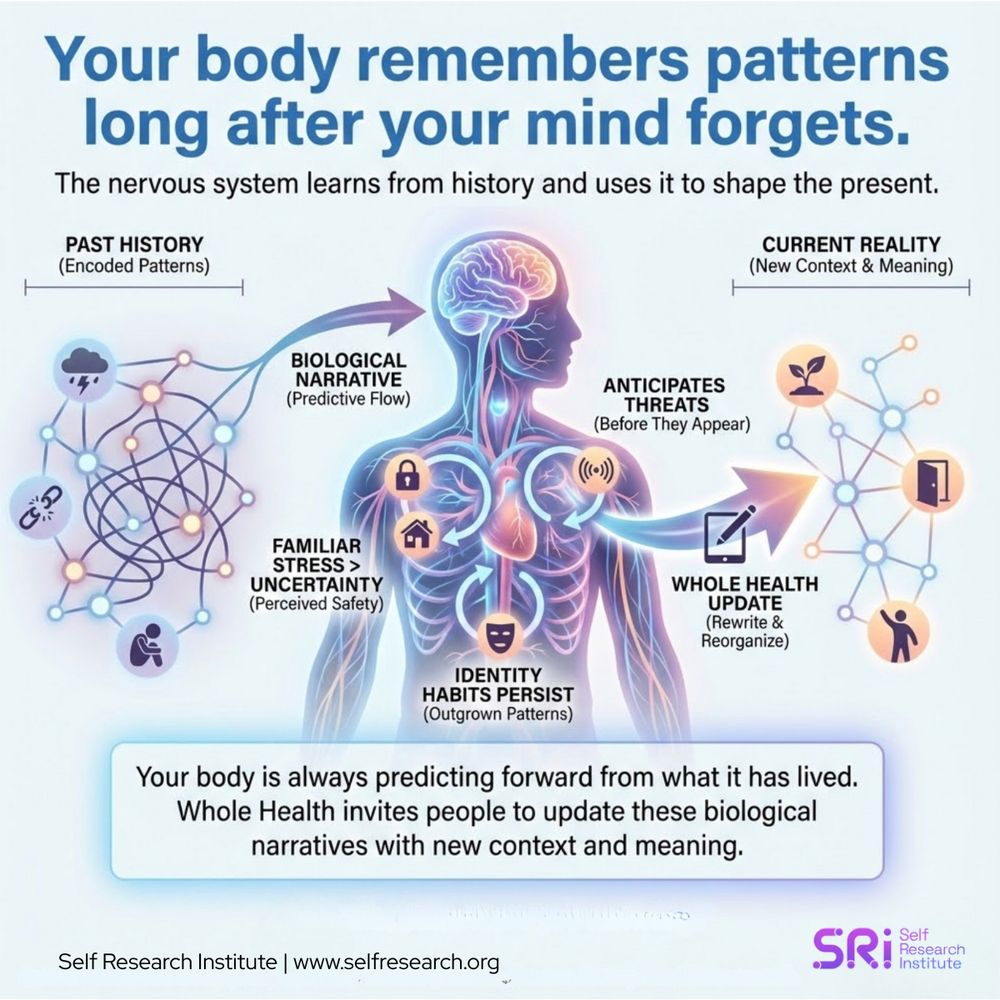
Your nervous system is a historian.
Your body remembers patterns long after your mind forgets.
That’s why familiar stress can feel safer than uncertainty, and why old habits persist even when life changes.
Updating these patterns takes more than insight. It takes new signals of safety and meaning.
Your body remembers patterns long after your mind forgets.
That’s why familiar stress can feel safer than uncertainty, and why old habits persist even when life changes.
Updating these patterns takes more than insight. It takes new signals of safety and meaning.
December 19, 2025 at 5:59 PM
Your nervous system is a historian.
Your body remembers patterns long after your mind forgets.
That’s why familiar stress can feel safer than uncertainty, and why old habits persist even when life changes.
Updating these patterns takes more than insight. It takes new signals of safety and meaning.
Your body remembers patterns long after your mind forgets.
That’s why familiar stress can feel safer than uncertainty, and why old habits persist even when life changes.
Updating these patterns takes more than insight. It takes new signals of safety and meaning.
Gut feelings aren’t magic.
They’re signals from the body predicting safety and meaning.
Do you listen to yours?
They’re signals from the body predicting safety and meaning.
Do you listen to yours?

December 17, 2025 at 5:32 PM
Gut feelings aren’t magic.
They’re signals from the body predicting safety and meaning.
Do you listen to yours?
They’re signals from the body predicting safety and meaning.
Do you listen to yours?
New paper in Digital Health from the Self Research Institute.
We review why many digital health tools for cardiometabolic disease fall short in practice and propose a framework for improving long-term outcomes.
Open-access: doi.org/10.1177/2055...
We review why many digital health tools for cardiometabolic disease fall short in practice and propose a framework for improving long-term outcomes.
Open-access: doi.org/10.1177/2055...

December 16, 2025 at 5:29 PM
New paper in Digital Health from the Self Research Institute.
We review why many digital health tools for cardiometabolic disease fall short in practice and propose a framework for improving long-term outcomes.
Open-access: doi.org/10.1177/2055...
We review why many digital health tools for cardiometabolic disease fall short in practice and propose a framework for improving long-term outcomes.
Open-access: doi.org/10.1177/2055...
Quality of Life isn’t a vibe. It’s a system.
Research defines QoL across psychological, social, physical, and contextual domains.
Whole Health is applying those dimensions to real life.
Which domain feels strongest for you right now?
Research defines QoL across psychological, social, physical, and contextual domains.
Whole Health is applying those dimensions to real life.
Which domain feels strongest for you right now?

December 15, 2025 at 6:40 PM
Quality of Life isn’t a vibe. It’s a system.
Research defines QoL across psychological, social, physical, and contextual domains.
Whole Health is applying those dimensions to real life.
Which domain feels strongest for you right now?
Research defines QoL across psychological, social, physical, and contextual domains.
Whole Health is applying those dimensions to real life.
Which domain feels strongest for you right now?
You don’t change behavior.
Behavior changes when meaning does.
That’s why willpower fades and understanding lasts.
What habit changed when your meaning changed?
#MeaningMaking #BehaviorScience
Behavior changes when meaning does.
That’s why willpower fades and understanding lasts.
What habit changed when your meaning changed?
#MeaningMaking #BehaviorScience

December 12, 2025 at 5:19 PM
You don’t change behavior.
Behavior changes when meaning does.
That’s why willpower fades and understanding lasts.
What habit changed when your meaning changed?
#MeaningMaking #BehaviorScience
Behavior changes when meaning does.
That’s why willpower fades and understanding lasts.
What habit changed when your meaning changed?
#MeaningMaking #BehaviorScience
Most health apps store data as timestamp + number.
That structure can’t represent meaning, identity, or context.
To generate real insight, systems need relationships, not rows.
Personal #KnowledgeGraphs fix this.
What connection do you wish tech understood about you?
#Ontology #HumanCenteredAI
That structure can’t represent meaning, identity, or context.
To generate real insight, systems need relationships, not rows.
Personal #KnowledgeGraphs fix this.
What connection do you wish tech understood about you?
#Ontology #HumanCenteredAI

December 10, 2025 at 6:02 PM
Most health apps store data as timestamp + number.
That structure can’t represent meaning, identity, or context.
To generate real insight, systems need relationships, not rows.
Personal #KnowledgeGraphs fix this.
What connection do you wish tech understood about you?
#Ontology #HumanCenteredAI
That structure can’t represent meaning, identity, or context.
To generate real insight, systems need relationships, not rows.
Personal #KnowledgeGraphs fix this.
What connection do you wish tech understood about you?
#Ontology #HumanCenteredAI
Your body runs a faster data pipeline than your mind.
Neuroscience shows interoception (body signals) updates in milliseconds, while conscious awareness lags by seconds.
That "gut feeling" isn't magic—it's latency. We build tools to give you the syntax for what your nervous system already knows.
Neuroscience shows interoception (body signals) updates in milliseconds, while conscious awareness lags by seconds.
That "gut feeling" isn't magic—it's latency. We build tools to give you the syntax for what your nervous system already knows.

December 8, 2025 at 6:42 PM
Your body runs a faster data pipeline than your mind.
Neuroscience shows interoception (body signals) updates in milliseconds, while conscious awareness lags by seconds.
That "gut feeling" isn't magic—it's latency. We build tools to give you the syntax for what your nervous system already knows.
Neuroscience shows interoception (body signals) updates in milliseconds, while conscious awareness lags by seconds.
That "gut feeling" isn't magic—it's latency. We build tools to give you the syntax for what your nervous system already knows.
The future of health isn’t wellness tech. It’s agency tech.
Apps push compliance. But long-term well-being comes from agency — understanding your own mind, your context, your patterns.
Where do you want more agency in your life?
#AgencyTech #HumanCenteredTech #DigitalAutonomy
#PersonalSovereignty
Apps push compliance. But long-term well-being comes from agency — understanding your own mind, your context, your patterns.
Where do you want more agency in your life?
#AgencyTech #HumanCenteredTech #DigitalAutonomy
#PersonalSovereignty

December 5, 2025 at 5:32 PM
The future of health isn’t wellness tech. It’s agency tech.
Apps push compliance. But long-term well-being comes from agency — understanding your own mind, your context, your patterns.
Where do you want more agency in your life?
#AgencyTech #HumanCenteredTech #DigitalAutonomy
#PersonalSovereignty
Apps push compliance. But long-term well-being comes from agency — understanding your own mind, your context, your patterns.
Where do you want more agency in your life?
#AgencyTech #HumanCenteredTech #DigitalAutonomy
#PersonalSovereignty
If data doesn't change your mind, it's just noise.
For health data to become knowledge, it must:
🔹 Reduce uncertainty
🔹 Shift your assumptions
🔹 Connect to identity
🔹 Update your internal models
Your stats don't matter until they produce meaning.
#QuantifiedSelf #DataEpistemology
For health data to become knowledge, it must:
🔹 Reduce uncertainty
🔹 Shift your assumptions
🔹 Connect to identity
🔹 Update your internal models
Your stats don't matter until they produce meaning.
#QuantifiedSelf #DataEpistemology

December 3, 2025 at 5:21 PM
If data doesn't change your mind, it's just noise.
For health data to become knowledge, it must:
🔹 Reduce uncertainty
🔹 Shift your assumptions
🔹 Connect to identity
🔹 Update your internal models
Your stats don't matter until they produce meaning.
#QuantifiedSelf #DataEpistemology
For health data to become knowledge, it must:
🔹 Reduce uncertainty
🔹 Shift your assumptions
🔹 Connect to identity
🔹 Update your internal models
Your stats don't matter until they produce meaning.
#QuantifiedSelf #DataEpistemology
This #GivingTuesday, support the science of being human.
We’re building a future where:
- People can investigate their own health
- Data is treated with dignity
- Science becomes participatory
- Whole Health replaces fragmented care
And today, you can help shape that future.
www.selfresearch.org
We’re building a future where:
- People can investigate their own health
- Data is treated with dignity
- Science becomes participatory
- Whole Health replaces fragmented care
And today, you can help shape that future.
www.selfresearch.org

December 2, 2025 at 5:23 PM
This #GivingTuesday, support the science of being human.
We’re building a future where:
- People can investigate their own health
- Data is treated with dignity
- Science becomes participatory
- Whole Health replaces fragmented care
And today, you can help shape that future.
www.selfresearch.org
We’re building a future where:
- People can investigate their own health
- Data is treated with dignity
- Science becomes participatory
- Whole Health replaces fragmented care
And today, you can help shape that future.
www.selfresearch.org