


Schubotz Lab
@schubotzlab.bsky.social
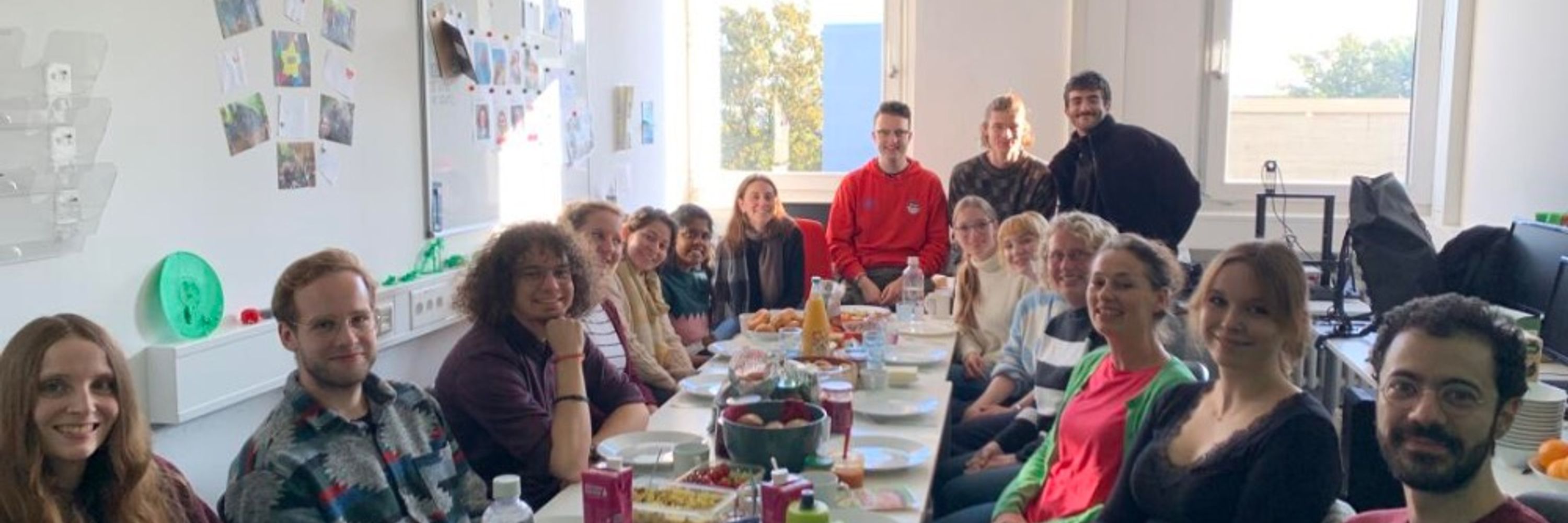
We are the Schubotz Lab at the University of Münster - we study event processing, learning and decision making, and the role of predictions in human cognition.
https://www.uni-muenster.de/PsyIFP/AESchubotz/en/index.html
https://www.uni-muenster.de/PsyIFP/AESchubotz/en/index.html
Reposted by Schubotz Lab

Happy to belatedly share some good pre-Christmas news: My colleague Karine Malysheva from Taras Shevchenko National University of Kyiv and I secured a Collaborative Diversity and Inclusion grant from @officialsarmac.bsky.social.
January 6, 2026 at 4:00 PM
Happy to belatedly share some good pre-Christmas news: My colleague Karine Malysheva from Taras Shevchenko National University of Kyiv and I secured a Collaborative Diversity and Inclusion grant from @officialsarmac.bsky.social.
We are proud to share the first publication of our cooperation project with the German Sport University Cologne! doi.org/10.1016/j.ne...
Redirecting
doi.org
January 8, 2026 at 11:34 AM
We are proud to share the first publication of our cooperation project with the German Sport University Cologne! doi.org/10.1016/j.ne...
Reposted by Schubotz Lab

I'm excited to share our new paper about initial prediction errors, which arise spontaneously at first exposure to coherent novel stimuli.
In this study we investigated the neural and mnemonic consequences of initial PEs compared to those of experimentally induced PEs.
doi.org/10.1016/j.ne...
In this study we investigated the neural and mnemonic consequences of initial PEs compared to those of experimentally induced PEs.
doi.org/10.1016/j.ne...
December 19, 2025 at 2:08 PM
I'm excited to share our new paper about initial prediction errors, which arise spontaneously at first exposure to coherent novel stimuli.
In this study we investigated the neural and mnemonic consequences of initial PEs compared to those of experimentally induced PEs.
doi.org/10.1016/j.ne...
In this study we investigated the neural and mnemonic consequences of initial PEs compared to those of experimentally induced PEs.
doi.org/10.1016/j.ne...
How do gaze patterns and hand movements differ between actors in naturalistic manipulation tasks when one person's action respond to the other's? New research from our lab, led by post-doc Anoush, using eye tracking and motion capture elucidates these processes. www.frontiersin.org/journals/psy...

Frontiers | Analyzing Gaze and Hand Movement Patterns in Leader-Follower Interactions During a Time-Continuous Cooperative Manipulation Task
In daily life, people often interact by taking on leader and follower roles. Unlike laboratory experiments, these interactions unfold naturally and continuou...
www.frontiersin.org
December 5, 2025 at 7:48 AM
How do gaze patterns and hand movements differ between actors in naturalistic manipulation tasks when one person's action respond to the other's? New research from our lab, led by post-doc Anoush, using eye tracking and motion capture elucidates these processes. www.frontiersin.org/journals/psy...
NEW PUBLICATION
Our PI Ricarda Schubotz wrote an open peer commentary responding to Druzhinin and Ramírez, drawing attention to uncertainty being an intrinsic property of the brain. Read it here: constructivist.info/21/1/096
Our PI Ricarda Schubotz wrote an open peer commentary responding to Druzhinin and Ramírez, drawing attention to uncertainty being an intrinsic property of the brain. Read it here: constructivist.info/21/1/096
Not Only in or of the Observer: A Neuroscientific View on Uncertainty - Schubotz R. I., 2025
While Druzhinin and Ramírez locate uncertainty in the reflective consciousness of the observer, from a neuroscientific perspective, it is understood as an intrinsic property of the inferential â¦
constructivist.info
December 5, 2025 at 7:43 AM
NEW PUBLICATION
Our PI Ricarda Schubotz wrote an open peer commentary responding to Druzhinin and Ramírez, drawing attention to uncertainty being an intrinsic property of the brain. Read it here: constructivist.info/21/1/096
Our PI Ricarda Schubotz wrote an open peer commentary responding to Druzhinin and Ramírez, drawing attention to uncertainty being an intrinsic property of the brain. Read it here: constructivist.info/21/1/096
Reposted by Schubotz Lab

🔥 Open PhD position at the Institute of Medical Psychology and Systems Neuroscience @uni-muenster.de!
Join our team to investigate neural mechanisms of conscious and non-conscious processing of neutral and emotional stimuli using EEG, fMRI, or both simultaneously. tinyurl.com/phdmuenster
Join our team to investigate neural mechanisms of conscious and non-conscious processing of neutral and emotional stimuli using EEG, fMRI, or both simultaneously. tinyurl.com/phdmuenster

November 27, 2025 at 2:17 PM
🔥 Open PhD position at the Institute of Medical Psychology and Systems Neuroscience @uni-muenster.de!
Join our team to investigate neural mechanisms of conscious and non-conscious processing of neutral and emotional stimuli using EEG, fMRI, or both simultaneously. tinyurl.com/phdmuenster
Join our team to investigate neural mechanisms of conscious and non-conscious processing of neutral and emotional stimuli using EEG, fMRI, or both simultaneously. tinyurl.com/phdmuenster
Reposted by Schubotz Lab
New Paper Out!
Why do some prediction errors (PEs) lead to changes in episodic memories and others do not?
Our new research supports the idea that the size of the episodic PE plays a crucial role in shaping mnemonic and neural outcomes.
These are the 4 most important results:
Why do some prediction errors (PEs) lead to changes in episodic memories and others do not?
Our new research supports the idea that the size of the episodic PE plays a crucial role in shaping mnemonic and neural outcomes.
These are the 4 most important results:
July 21, 2025 at 7:04 AM
New Paper Out!
Why do some prediction errors (PEs) lead to changes in episodic memories and others do not?
Our new research supports the idea that the size of the episodic PE plays a crucial role in shaping mnemonic and neural outcomes.
These are the 4 most important results:
Why do some prediction errors (PEs) lead to changes in episodic memories and others do not?
Our new research supports the idea that the size of the episodic PE plays a crucial role in shaping mnemonic and neural outcomes.
These are the 4 most important results:
The Generative Episodic Memory conference organised by our @for2812.bsky.social is coming to an end and three of our lab members presented their current work. Thanks so much to the GEM organisers for putting together this great conference!
June 4, 2025 at 8:31 AM
The Generative Episodic Memory conference organised by our @for2812.bsky.social is coming to an end and three of our lab members presented their current work. Thanks so much to the GEM organisers for putting together this great conference!
New paper about processing of episodic prediction errors out from our lab. Nina will also present this research at next week's GEM, organised by @for2812.bsky.social

May 30, 2025 at 8:14 AM
New paper about processing of episodic prediction errors out from our lab. Nina will also present this research at next week's GEM, organised by @for2812.bsky.social
The first group of students from the new cohort of the interdisciplinary master’s in cognitive neuroscience visited us for their lab rotation this week. Each group learns about the analysis of MRI data, techniques in brain imaging, and the research interests and activities of our group.

November 27, 2024 at 8:06 AM
The first group of students from the new cohort of the interdisciplinary master’s in cognitive neuroscience visited us for their lab rotation this week. Each group learns about the analysis of MRI data, techniques in brain imaging, and the research interests and activities of our group.
New paper from our lab in NeuroImage on cortical chronotopy, led by Falko Mecklenbrauck!
www.sciencedirect.com/science/arti...
www.sciencedirect.com/science/arti...

Decoding Cortical Chronotopy - Comparing the Influence of Different Cortical Organizational Schemes
The brain's diverse intrinsic timescales enable us to perceive stimuli with varying temporal persistency. This study aimed to uncover the cortical org…
www.sciencedirect.com
November 4, 2024 at 12:55 PM
New paper from our lab in NeuroImage on cortical chronotopy, led by Falko Mecklenbrauck!
www.sciencedirect.com/science/arti...
www.sciencedirect.com/science/arti...
New paper from our lab on prediction errors in episodic memory. This is the first paper with our new stimulus material in the PEGI project - a lot more is to come.
My new paper on the effect of prediction errors on episodic memory is out now in Memory
www.tandfonline.com/doi/full/10....
www.tandfonline.com/doi/full/10....

Prediction errors lead to updating of memories for conversations
Previous research has established that the brain uses episodic memories to make continuous predictions about the world and that prediction errors, so the mismatch between generated predictions and ...
www.tandfonline.com
October 15, 2024 at 8:52 AM
New paper from our lab on prediction errors in episodic memory. This is the first paper with our new stimulus material in the PEGI project - a lot more is to come.
Our lab member Benjamin Jainta successfully defended his PhD! In a great presentation, he summarised his work about prediction errors in episodic memory and highlighted effects of repetition, repeated learning, agency, and perspective.

September 9, 2024 at 8:00 AM
Our lab member Benjamin Jainta successfully defended his PhD! In a great presentation, he summarised his work about prediction errors in episodic memory and highlighted effects of repetition, repeated learning, agency, and perspective.
New research from our lab led by Benjamin Jainta concerning mnemonic consequences of prediction errors just came out in the Journal of Cognitive Neuroscience. Find out how the brain responds to repetitive vs varying prediction errors here: doi.org/10.1162/jocn...

Same Same, But Different: Brain Areas Underlying the Learning from Repetitive Episodic Prediction Errors
Abstract. Prediction errors (PEs) function as learning signals. It is yet unclear how varying compared to repetitive PEs affect episodic memory in brain and behavior. The current study investigated ce...
doi.org
August 1, 2024 at 9:33 AM
New research from our lab led by Benjamin Jainta concerning mnemonic consequences of prediction errors just came out in the Journal of Cognitive Neuroscience. Find out how the brain responds to repetitive vs varying prediction errors here: doi.org/10.1162/jocn...
Our post doc Sophie won one of the poster prizes at PUG with her work on episodic memory after prediction errors. Congratulations!
Read the paper here: direct.mit.edu/jocn/article...
Read the paper here: direct.mit.edu/jocn/article...

June 3, 2024 at 5:26 PM
Our post doc Sophie won one of the poster prizes at PUG with her work on episodic memory after prediction errors. Congratulations!
Read the paper here: direct.mit.edu/jocn/article...
Read the paper here: direct.mit.edu/jocn/article...
Reposted by Schubotz Lab
Went to my first PUG conference in Hamburg last week - presented some very fresh analyses on memory representations after prediction errors, and got lots of interesting new input on all things cognitive neuroscience.

June 3, 2024 at 5:01 PM
Went to my first PUG conference in Hamburg last week - presented some very fresh analyses on memory representations after prediction errors, and got lots of interesting new input on all things cognitive neuroscience.