




Quantitative Economics
@qe-editors.bsky.social
News from the editors of Quantitative Economics
Quantitative Economics Volume 17, Issue 1 (January 2026) is now online
www.econometricsociety.org/publications...
www.econometricsociety.org/publications...

January 30, 2026 at 5:40 PM
Quantitative Economics Volume 17, Issue 1 (January 2026) is now online
www.econometricsociety.org/publications...
www.econometricsociety.org/publications...
With quasilinear utility, satisficing (imperfect optimization) looks less severe after aggregation: individual errors can cancel out. @JRehbeck buff.ly/kB2E1zU

January 30, 2026 at 2:03 PM
With quasilinear utility, satisficing (imperfect optimization) looks less severe after aggregation: individual errors can cancel out. @JRehbeck buff.ly/kB2E1zU
Using micro data from 120,000 shale wells, this paper finds strong short-run price responsiveness of U.S. oil supply. Producers are forward-looking and respond to price signals by timing completion and refracturing decisions. @hcbjornland @tsgundersen buff.ly/0wB3xhi

January 21, 2026 at 2:01 PM
Using micro data from 120,000 shale wells, this paper finds strong short-run price responsiveness of U.S. oil supply. Producers are forward-looking and respond to price signals by timing completion and refracturing decisions. @hcbjornland @tsgundersen buff.ly/0wB3xhi
Parents’ traits can bias reports of children’s non-cognitive skills. Using parent and teacher measures of child skills in a dynamic model, we show that this bias tends to mask maternal influence and can distort evaluations of childhood interventions. buff.ly/H8Oi42O

January 12, 2026 at 2:02 PM
Parents’ traits can bias reports of children’s non-cognitive skills. Using parent and teacher measures of child skills in a dynamic model, we show that this bias tends to mask maternal influence and can distort evaluations of childhood interventions. buff.ly/H8Oi42O
We show how to solve dynamic programming problems on a quantum annealer. Our new algorithms recover value and policy functions, avoid scaling bottlenecks, and already run on current hardware. We even solve the real business cycle model on a quantum chip.
buff.ly/xRWTYlE
buff.ly/xRWTYlE

December 19, 2025 at 2:02 PM
We show how to solve dynamic programming problems on a quantum annealer. Our new algorithms recover value and policy functions, avoid scaling bottlenecks, and already run on current hardware. We even solve the real business cycle model on a quantum chip.
buff.ly/xRWTYlE
buff.ly/xRWTYlE
Our talent-to-task model shows how tech + capital concentrate in complex tasks, driving wage & job polarization. Optimal policy: compress labor taxes, tax high-complexity sectors, subsidize low ones, and add a Pigouvian spillover term. buff.ly/cP3YgLN

December 12, 2025 at 2:02 PM
Our talent-to-task model shows how tech + capital concentrate in complex tasks, driving wage & job polarization. Optimal policy: compress labor taxes, tax high-complexity sectors, subsidize low ones, and add a Pigouvian spillover term. buff.ly/cP3YgLN
How much can a principal gain when the agent learns instead of best-responding? No-swap-regret learning gives outcomes close to classic principal–agent models, including Stackelberg games, contract design, and Bayesian persuasion. @tao_lin_cs @YilingChenC buff.ly/hQKbvmj

December 1, 2025 at 2:02 PM
How much can a principal gain when the agent learns instead of best-responding? No-swap-regret learning gives outcomes close to classic principal–agent models, including Stackelberg games, contract design, and Bayesian persuasion. @tao_lin_cs @YilingChenC buff.ly/hQKbvmj
Disruptive peers impact their closest social circle's learning. We study peer effects using network data to show how disruptive students affect their classmates’ outcomes. Crucial insights for education policy! buff.ly/dQ5r0gG

November 20, 2025 at 2:04 PM
Disruptive peers impact their closest social circle's learning. We study peer effects using network data to show how disruptive students affect their classmates’ outcomes. Crucial insights for education policy! buff.ly/dQ5r0gG
Quantitative Economics Volume 16, Issue 4 (November 2025) is now online
www.econometricsociety.org/publications...
www.econometricsociety.org/publications...

November 19, 2025 at 4:58 PM
Quantitative Economics Volume 16, Issue 4 (November 2025) is now online
www.econometricsociety.org/publications...
www.econometricsociety.org/publications...
We build a world economy HANK model for the Euro Area, Core & Periphery. Fiscal consolidation under current EA rules is costly, but aligning debt targets with historical values greatly reduces welfare losses. @xiaoshan__chen @lazarakis_s @p_varthalitis buff.ly/eZXPt91

November 10, 2025 at 2:03 PM
We build a world economy HANK model for the Euro Area, Core & Periphery. Fiscal consolidation under current EA rules is costly, but aligning debt targets with historical values greatly reduces welfare losses. @xiaoshan__chen @lazarakis_s @p_varthalitis buff.ly/eZXPt91
How do durables affect consumption smoothing? Asymmetric information lowers their value as a smoothing tool. We measure lemons penalty for cars using Danish data and show income shocks sustain used car market @richardblundell.bsky.social @ran-gu.bsky.social buff.ly/3j30eyQ

October 31, 2025 at 2:06 PM
How do durables affect consumption smoothing? Asymmetric information lowers their value as a smoothing tool. We measure lemons penalty for cars using Danish data and show income shocks sustain used car market @richardblundell.bsky.social @ran-gu.bsky.social buff.ly/3j30eyQ
Using a nonlinear Proxy-SVAR, we find that oil supply cuts have large real effects but small on prices and oil supply increases have small real effects but large on prices. We rationalize this asymmetry through the behavior of uncertainty. buff.ly/pcaDo6G

October 27, 2025 at 2:03 PM
Using a nonlinear Proxy-SVAR, we find that oil supply cuts have large real effects but small on prices and oil supply increases have small real effects but large on prices. We rationalize this asymmetry through the behavior of uncertainty. buff.ly/pcaDo6G
China’s 2014–16 LTV relaxation spurred mortgages and home prices. Loan-level evidence + a quantitative model uncover a new housing investment channel: capital gains fueled upsizing while crowding out consumption. buff.ly/TJ7j8yQ

October 22, 2025 at 1:06 PM
China’s 2014–16 LTV relaxation spurred mortgages and home prices. Loan-level evidence + a quantitative model uncover a new housing investment channel: capital gains fueled upsizing while crowding out consumption. buff.ly/TJ7j8yQ
We develop an empirical minimax-regret policy learning algorithm which can assign never-before-observed treatment values to a population, by combining data on a subset of possible treatment values with shape restrictions on treatment response. buff.ly/S0hflec

October 13, 2025 at 1:04 PM
We develop an empirical minimax-regret policy learning algorithm which can assign never-before-observed treatment values to a population, by combining data on a subset of possible treatment values with shape restrictions on treatment response. buff.ly/S0hflec
The homogeneity assumption in dynamic discrete games allows pooling data across markets and time. This paper proposes an approximate randomization test for this assumption via MCMC, with an application to the U.S. cement industry. buff.ly/avaeEOS

October 2, 2025 at 1:04 PM
The homogeneity assumption in dynamic discrete games allows pooling data across markets and time. This paper proposes an approximate randomization test for this assumption via MCMC, with an application to the U.S. cement industry. buff.ly/avaeEOS
Higher property taxes raise long-run welfare. By shifting capital from housing to businesses they lower house prices and interest rates and boost wages, thereby improving life-cycle consumption smoothing. However, current homeowners lose from such a reform.https://buff.ly/Py8ec3Q

September 22, 2025 at 1:03 PM
Higher property taxes raise long-run welfare. By shifting capital from housing to businesses they lower house prices and interest rates and boost wages, thereby improving life-cycle consumption smoothing. However, current homeowners lose from such a reform.https://buff.ly/Py8ec3Q
The Executive Committee of the Econometric Society has approved an increase in the publication fees for papers in its two Open Access journals, Quantitative Economics and Theoretical Economics. Read more www.econometricsociety.org/society/news...
Changes in Publication Fees for Quantitative Economics and Theoretical Economics - The Econometric Society
The Executive Committee of the Econometric Society has approved an increase in the publication fees for papers in its two Open Access...
www.econometricsociety.org
September 12, 2025 at 3:31 PM
The Executive Committee of the Econometric Society has approved an increase in the publication fees for papers in its two Open Access journals, Quantitative Economics and Theoretical Economics. Read more www.econometricsociety.org/society/news...
We develop a stochastic macro-climate model to analyze the influence of climate change on asset returns. Quasi-analytical formulas allow to price various types of long-dated assets, including fixed-income products, derivatives, and equities. buff.ly/bQ2SxBv

September 11, 2025 at 1:03 PM
We develop a stochastic macro-climate model to analyze the influence of climate change on asset returns. Quasi-analytical formulas allow to price various types of long-dated assets, including fixed-income products, derivatives, and equities. buff.ly/bQ2SxBv
"Many random coefficient choice models are nonparametrically identified, using exclusion restrictions. Logit shocks are not needed." @JRehbeck buff.ly/jkCr0xS

September 1, 2025 at 1:03 PM
"Many random coefficient choice models are nonparametrically identified, using exclusion restrictions. Logit shocks are not needed." @JRehbeck buff.ly/jkCr0xS
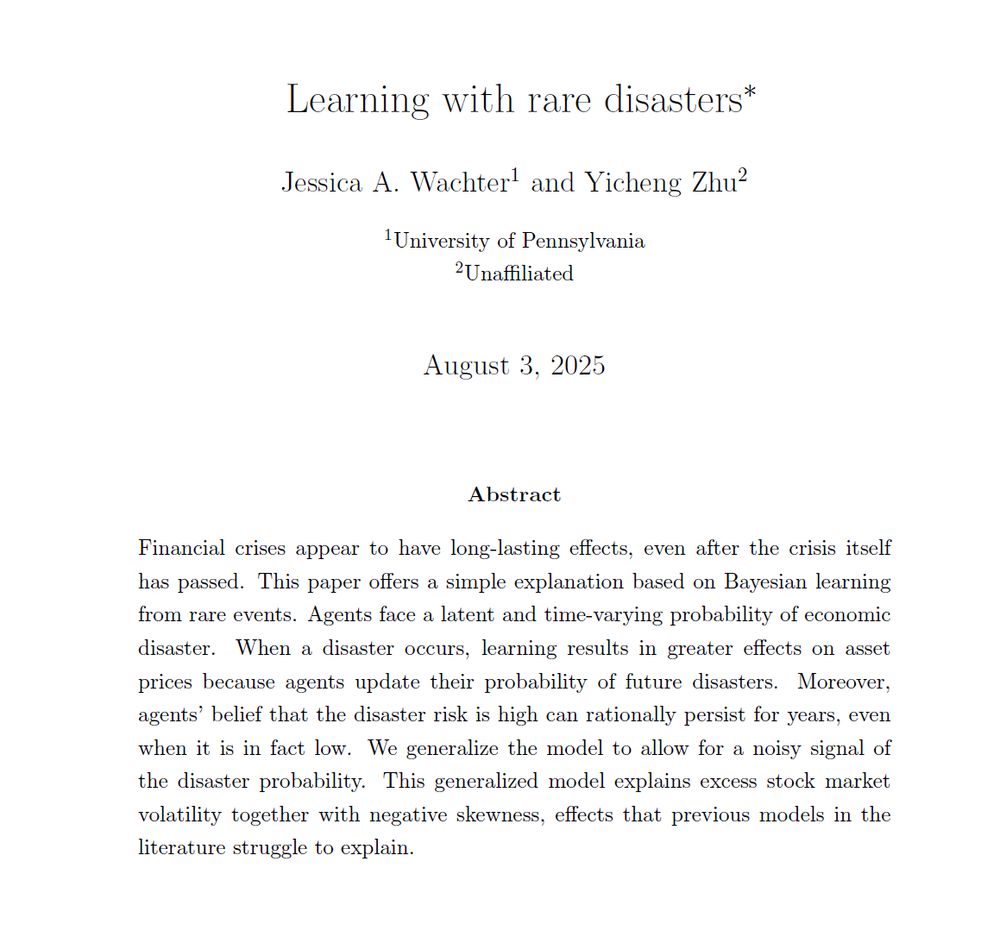
Why do crises leave lasting scars on markets? A model of Bayesian learning about rare disasters shows that beliefs adjust slowly: risk premia spike, asset values fall, volatility persists, and returns skew negative—even after the shock itself fades buff.ly/pWQVBOX
August 28, 2025 at 1:00 PM
Why do crises leave lasting scars on markets? A model of Bayesian learning about rare disasters shows that beliefs adjust slowly: risk premia spike, asset values fall, volatility persists, and returns skew negative—even after the shock itself fades buff.ly/pWQVBOX
We challenge standard predictive algorithm evaluation, proposing Comprehensive OOS Evaluation via Statistical Decision Theory. Achieving this requires ML researchers to collaborate with econometricians and statisticians to tackle SDT's computational hurdles buff.ly/2xDJTkl

July 28, 2025 at 1:02 PM
We challenge standard predictive algorithm evaluation, proposing Comprehensive OOS Evaluation via Statistical Decision Theory. Achieving this requires ML researchers to collaborate with econometricians and statisticians to tackle SDT's computational hurdles buff.ly/2xDJTkl
Quantitative Economics Volume 16, Issue 3 (July 2025) is now online
www.econometricsociety.org/publications...
www.econometricsociety.org/publications...

July 25, 2025 at 6:22 PM
Quantitative Economics Volume 16, Issue 3 (July 2025) is now online
www.econometricsociety.org/publications...
www.econometricsociety.org/publications...
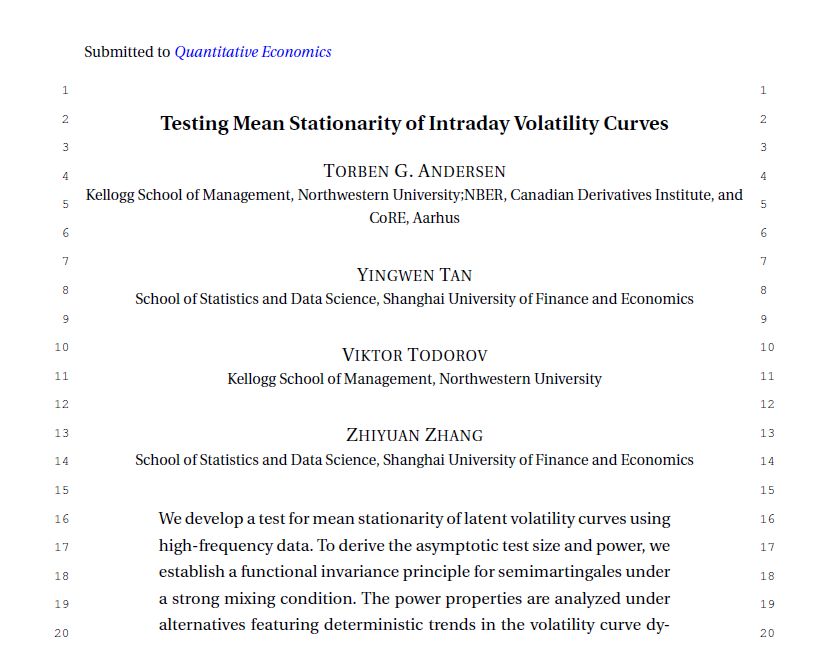
We propose a test for mean stationarity in latent volatility curves using high-frequency data. Applied to S&P 500 futures, results show strong evidence of nonstationary volatility—key for real-time risk, jump detection & market activity metrics. buff.ly/MFtu4Ou
July 15, 2025 at 1:02 PM
We propose a test for mean stationarity in latent volatility curves using high-frequency data. Applied to S&P 500 futures, results show strong evidence of nonstationary volatility—key for real-time risk, jump detection & market activity metrics. buff.ly/MFtu4Ou
We are excited to announce the following new AEs joined the board on July 1st: Esteban M. Aucejo (ASU), Job Boerma (University of Wisconsin-Madison), Liangjun Su (Tsinghua University) & Chamna Yoon (Seoul National University). We look forward to benefiting from their expertise.
July 1, 2025 at 4:04 PM
We are excited to announce the following new AEs joined the board on July 1st: Esteban M. Aucejo (ASU), Job Boerma (University of Wisconsin-Madison), Liangjun Su (Tsinghua University) & Chamna Yoon (Seoul National University). We look forward to benefiting from their expertise.
We are thrilled to have Anna Mikusheva (MIT) and Fabrizio Perri (Federal Reserve Bank of Minnesota) join the editorial board as Co-editors starting July 1st, 2025. While their focus will be respectively on econometrics and on macroeconomics, they will be handling papers in a wide range of topics.
July 1, 2025 at 12:57 PM
We are thrilled to have Anna Mikusheva (MIT) and Fabrizio Perri (Federal Reserve Bank of Minnesota) join the editorial board as Co-editors starting July 1st, 2025. While their focus will be respectively on econometrics and on macroeconomics, they will be handling papers in a wide range of topics.