




Phillip Greißel
@phillipgreissel.bsky.social
Photochemist | PhD Student @ Guldi Group, FAU
Exploring molecular & nanoscale systems for photon down-conversion
Exploring molecular & nanoscale systems for photon down-conversion
Reposted by Phillip Greißel

➡️ Increasing the length of molecular nanographenes leads to higher photoluminescence quantum yields!💡
In this @jacs.acspublications.org paper, we show how molecular length tunes the interplay between dark and bright excited states.
🔗 pubs.acs.org/doi/10.1021/...
Many thanks to all coauthors!!
In this @jacs.acspublications.org paper, we show how molecular length tunes the interplay between dark and bright excited states.
🔗 pubs.acs.org/doi/10.1021/...
Many thanks to all coauthors!!

Synthesis and Excited-State Dynamics in Molecular Nanographene: Herzberg–Teller Vibronic Coupling and Energy Transfer to Porphyrins
Nanographenes (NGs) and graphene nanoribbons (GNRs) are molecular-level bridges to bulk-carbon materials. When synthesized with atomic precision via, for example, bottom-up strategies, a direct connection between the structure and properties is demonstrable. This is of key interest, especially considering practical applications. In the current work, we report the synthesis and comprehensive photophysical characterization of a full-benzenoid nanographene (NG-Br) and its covalent conjugate featuring a porphyrin (NG-(Zn)Por). Our synthetic approach relies on a cascade of Suzuki coupling, reduction, and Sandmeyer bromination reactions, starting from halogenated nitrobenzene derivatives. Knowing at which concentration aggregation occurs is important to study either monomers of NG-Br or its aggregates. In organic solvents, the association constant of NG-Br exceeds 1 × 10⁶ M–1. Photophysical and theoretical analyses on the monomer revealed a subtle energy proximity between (S1)/(Lb) and (S2)/(La) that is the basis for strong vibronic coupling via the Herzberg–Teller mechanism, as well as (S1,1) and (S2,0) vibronic mixing. In NG-(Zn)Por, an ultrafast (S1–S1) energy transfer from NG to the porphyrin was observed. Our findings are essential for establishing an unambiguous structure–property relationship for NGs and 9-armchair GNRs, providing a blueprint for their use in optoelectronic devices ranging from single-electron transistors to OLEDs and organic solar cells.
pubs.acs.org
December 18, 2025 at 4:59 PM
➡️ Increasing the length of molecular nanographenes leads to higher photoluminescence quantum yields!💡
In this @jacs.acspublications.org paper, we show how molecular length tunes the interplay between dark and bright excited states.
🔗 pubs.acs.org/doi/10.1021/...
Many thanks to all coauthors!!
In this @jacs.acspublications.org paper, we show how molecular length tunes the interplay between dark and bright excited states.
🔗 pubs.acs.org/doi/10.1021/...
Many thanks to all coauthors!!
Reposted by Phillip Greißel
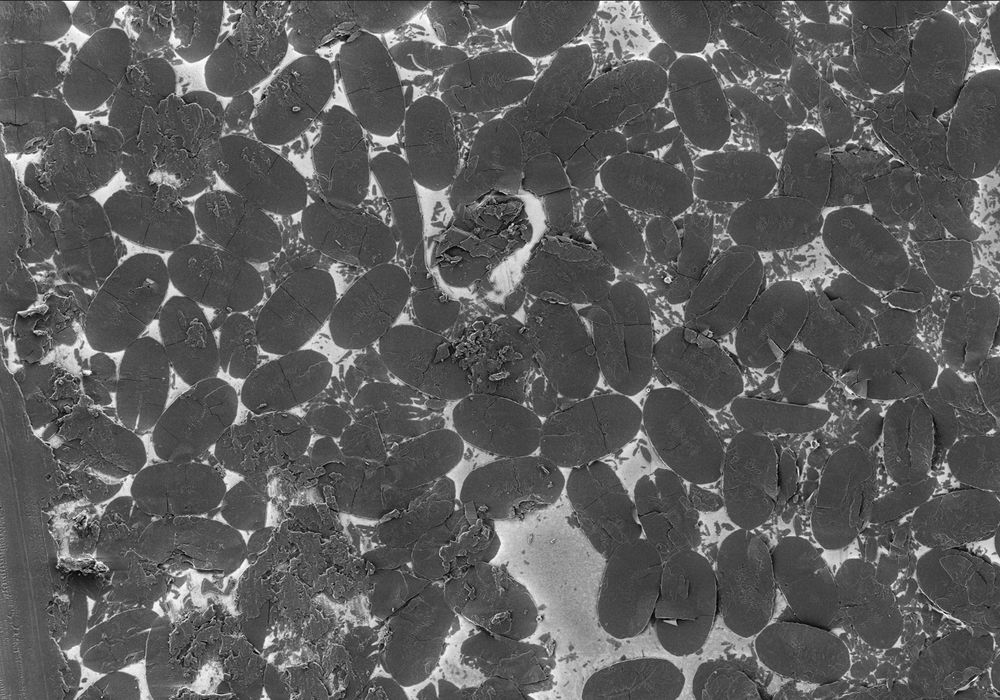
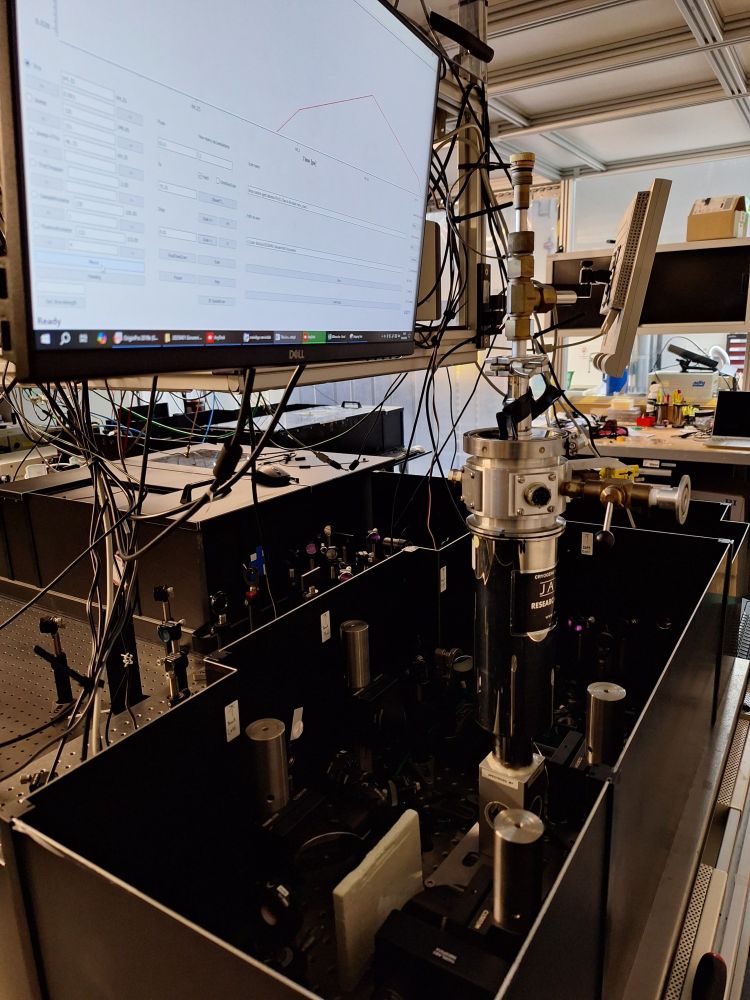
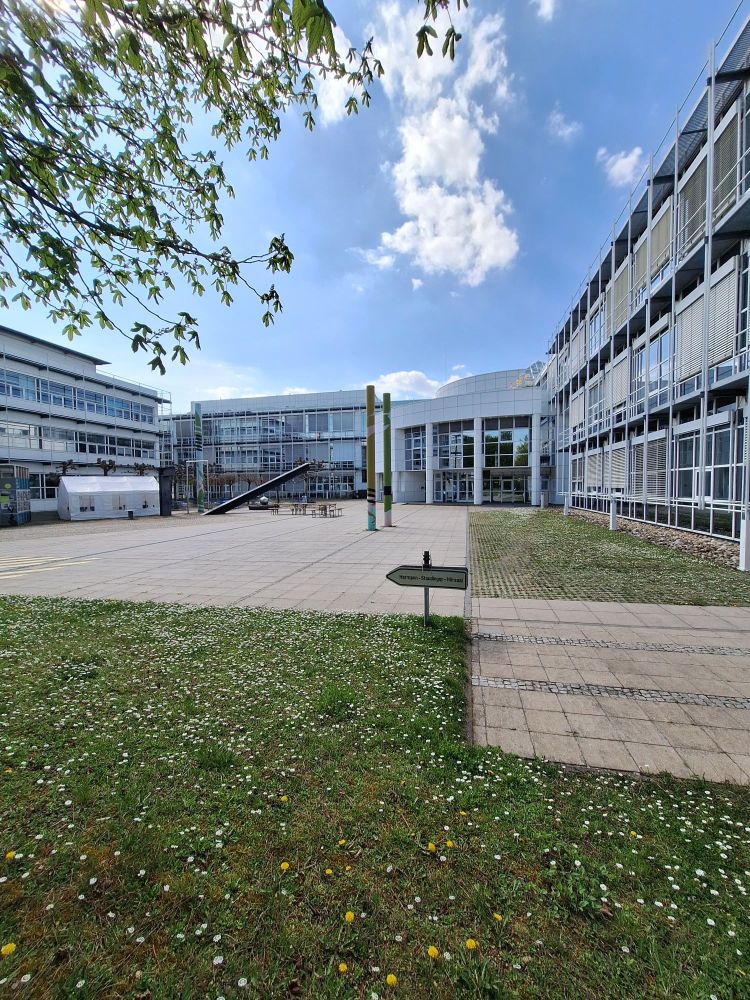
Had a fantastic week of measurements at @mpip-mainz.mpg.de — thanks a lot to @giulialavarda.bsky.social for hosting me. Honored to be the first guest of her group!
Really enjoyed learning about THz spectroscopy in the group of Prof. Bonn. And many thanks to Prof. Blom for the fruitful discussions!
Really enjoyed learning about THz spectroscopy in the group of Prof. Bonn. And many thanks to Prof. Blom for the fruitful discussions!
April 7, 2025 at 2:32 PM
Had a fantastic week of measurements at @mpip-mainz.mpg.de — thanks a lot to @giulialavarda.bsky.social for hosting me. Honored to be the first guest of her group!
Really enjoyed learning about THz spectroscopy in the group of Prof. Bonn. And many thanks to Prof. Blom for the fruitful discussions!
Really enjoyed learning about THz spectroscopy in the group of Prof. Bonn. And many thanks to Prof. Blom for the fruitful discussions!
Happy to share our latest JACS publication on twisted molecular nanoribbons! Our study reveals that both external factors and ribbon length greatly influence their deactivation—longer ribbons even enable intramolecular singlet fission. Many thanks to everyone involved! pubs.acs.org/doi/10.1021/...

Intramolecular Singlet Fission in Individual Graphene Nanoribbons─Competition with a Charge Transfer
Graphene nanoribbons (NRs) constitute a versatile platform for developing novel materials, where their structure governs their optical, electronic, and magnetic properties while also shaping their excited-state dynamics. Here, we investigate a set of three twisted N-doped molecular NRs of increasing length, obtained by linearly fusing perylene diimide to pyrene and pyrazino- or thiadiazolo-quinoxaline residues. By employing various temperature-dependent time-resolved spectroscopy techniques, we reveal how the flexible twisted NR geometry promotes the formation of a mixed electronic state with varying contributions from locally excited and charge-transfer (CT) states. The fate of this mixed state is highly sensitive to the molecular geometry, length, and solvent polarity. For the shortest NR, intersystem crossing dominates the deactivation pathway, efficiently generating triplets in low-polarity solvents. In contrast, for the extended NRs, intramolecular singlet fission (SF) takes place within a single nanoribbon. This is enabled by enhanced superexchange coupling due to a pronounced push–pull nature and the existence of multiple localized π-electron states caused by heteroatom doping, thereby circumventing the need for dimeric interactions typically associated with conventional SF systems. In higher-polarity environments, evidence of a (diabatic) CT state emerges. These findings underscore the intricate relationship between geometry, energy levels, and excited-state dynamics in twisted N-doped NRs.
pubs.acs.org
March 19, 2025 at 2:54 PM
Happy to share our latest JACS publication on twisted molecular nanoribbons! Our study reveals that both external factors and ribbon length greatly influence their deactivation—longer ribbons even enable intramolecular singlet fission. Many thanks to everyone involved! pubs.acs.org/doi/10.1021/...
Reposted by Phillip Greißel

🚨 PhD Position Available! 🚨
Join our group at FAU as part of RTG 2861! 🎓🔬 We are looking for a PhD candidate to study carbon planar lattices via transient spectroscopies.
📌 Details & application: rtg2861-pcl.chm.tu-dresden.de/joboffer/
🔄 Retweets appreciated!
#chemsky #pisky #PhD #Spectroscopy
Join our group at FAU as part of RTG 2861! 🎓🔬 We are looking for a PhD candidate to study carbon planar lattices via transient spectroscopies.
📌 Details & application: rtg2861-pcl.chm.tu-dresden.de/joboffer/
🔄 Retweets appreciated!
#chemsky #pisky #PhD #Spectroscopy
PCL — Open Positions
rtg2861-pcl.chm.tu-dresden.de
March 11, 2025 at 10:43 AM
🚨 PhD Position Available! 🚨
Join our group at FAU as part of RTG 2861! 🎓🔬 We are looking for a PhD candidate to study carbon planar lattices via transient spectroscopies.
📌 Details & application: rtg2861-pcl.chm.tu-dresden.de/joboffer/
🔄 Retweets appreciated!
#chemsky #pisky #PhD #Spectroscopy
Join our group at FAU as part of RTG 2861! 🎓🔬 We are looking for a PhD candidate to study carbon planar lattices via transient spectroscopies.
📌 Details & application: rtg2861-pcl.chm.tu-dresden.de/joboffer/
🔄 Retweets appreciated!
#chemsky #pisky #PhD #Spectroscopy
Reposted by Phillip Greißel

Solarzellen der Zukunft? ☀️🔋
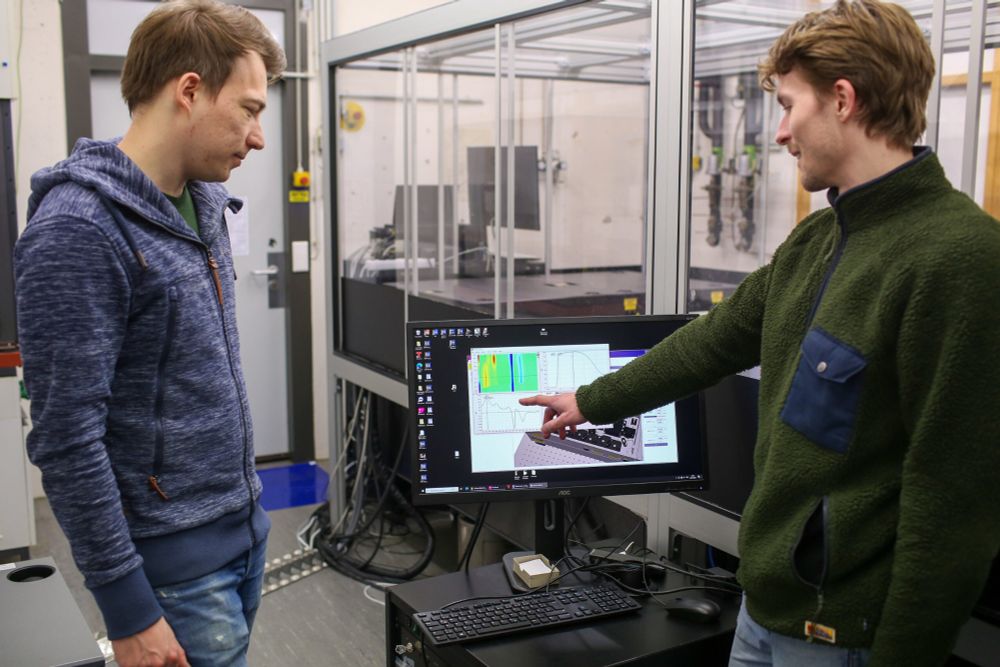
Die FAU-Chemiker Phillip Greißel & Dominik Thiel erforschen, wie Solarzellen noch effizienter werden können. Ihre Erkenntnisse tragen dazu bei, die nachhaltige Energiegewinnung weiter zu verbessern! 🔬⚡
Mehr dazu im Interview: www.nat.fau.de/2025/02/07/p...
Die FAU-Chemiker Phillip Greißel & Dominik Thiel erforschen, wie Solarzellen noch effizienter werden können. Ihre Erkenntnisse tragen dazu bei, die nachhaltige Energiegewinnung weiter zu verbessern! 🔬⚡
Mehr dazu im Interview: www.nat.fau.de/2025/02/07/p...
Photovoltaik: Grundlagenforschung mit hoher Relevanz
Momentan verbrennen wir noch große Mengen fossiler Energieträger wie Erdöl oder Kohle, um unseren Energiehunger zu stillen. Dabei entsteht das Treibhausgas Kohlendioxid, das in der Atmosphäre wie eine...
go.fau.de
February 10, 2025 at 8:17 AM
Solarzellen der Zukunft? ☀️🔋
Die FAU-Chemiker Phillip Greißel & Dominik Thiel erforschen, wie Solarzellen noch effizienter werden können. Ihre Erkenntnisse tragen dazu bei, die nachhaltige Energiegewinnung weiter zu verbessern! 🔬⚡
Mehr dazu im Interview: www.nat.fau.de/2025/02/07/p...
Die FAU-Chemiker Phillip Greißel & Dominik Thiel erforschen, wie Solarzellen noch effizienter werden können. Ihre Erkenntnisse tragen dazu bei, die nachhaltige Energiegewinnung weiter zu verbessern! 🔬⚡
Mehr dazu im Interview: www.nat.fau.de/2025/02/07/p...
Reposted by Phillip Greißel

Alright since a critical mass of photochemists officially joined it was about time to try and make a photochemistry/spectroscopy starter pack; hopefully this is a good start, feel free to reach out to be added! #chemsky
go.bsky.app/Cyibs8f
go.bsky.app/Cyibs8f
November 14, 2024 at 3:54 AM
Alright since a critical mass of photochemists officially joined it was about time to try and make a photochemistry/spectroscopy starter pack; hopefully this is a good start, feel free to reach out to be added! #chemsky
go.bsky.app/Cyibs8f
go.bsky.app/Cyibs8f